From 1880 to 1920 more than 4 million Italian immigrants came to the United States, mostly from rural southern Italy. Many were poor peasants escaping the chaotic political situation and widespread poverty of a recently united Italian peninsula.
Almost all the new immigrants came through Ellis Island; many settled in the crowded tenements of the New York region, where men found work in the subways, canals and buildings of the growing city. The women often worked in the sweatshops that multiplied in New York at the time. Almost half of the 146 workers killed as fire consumed the Triangle Shirtwaist Factory in 1911, were Italian women.
Over time, the immigrants moved elsewhere and became prominent in American society, but at first large numbers suffered from the over-crowding, harsh conditions, discrimination and cultural shock they met in cities like New York. Many returned to Italy with stories of the contradictions and injustices lurking in “the American dream.”
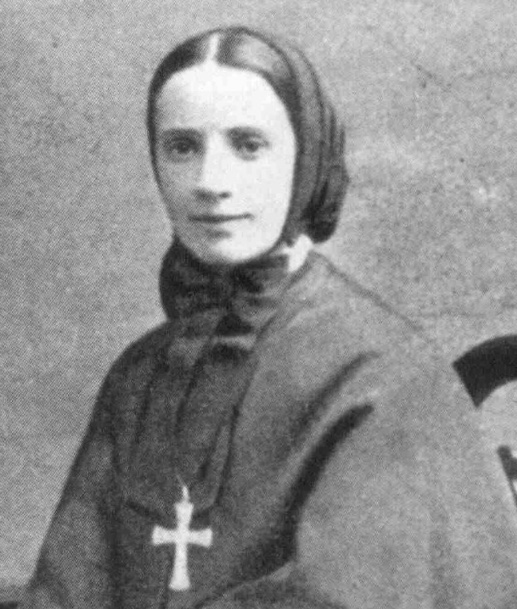
Mother Maria Francesca Cabrini
Mother Maria Francesca Cabrini (1850-19170), founder of the Missionaries of the Sacred Heart, an order of women missionaries , came to America in 1889 at the urging of Pope Leo XIII to serve the underserved poor. Her work is succinctly described on the website of the Cabrini Mission Foundation. and in the movie Cabrini.
She proceeded to found schools, orphanages, hospitals and social services institutions to serve the needs of immigrants in the United States and other parts of the world. Despite poor health and frailty, Mother Cabrini crossed the ocean 25 times during 29 years of missionary work, and with her sisters founded 67 institutions in nine countries on three continents – one for each year of her life.
Mother Cabrini was a collaborator from the start of her missionary activity. She was a woman of her time, yet beyond her time. Her message – “all things are possible with God” – is as alive today as it was 110 years ago. Mother Cabrini lived and worked among the people, poor and rich alike, using whatever means were provided to support her works. She was a progressive, strategic visionary, willing to take risks, adaptable to change, and responsive to every opportunity that arose to help others. In recognition of her extraordinary service to immigrants, Mother Cabrini was canonized in 1946 as the “first American saint,” and was officially declared the Universal Patroness of Immigrants by the Vatican in 1950.”
Be good to have leaders like her today in the church, as well as in society, wouldn’t it? “… a progressive, strategic visionary, willing to take risks, adaptable to change, and responsive to every opportunity that arose to help others.”
Her feastday is November 13th. “Mother Cabrini, pray for us.”
Three popes involved in the Second Vatican Council have been canonized: Pope John XXIII, Pope Paul VI and Pope John Paul II.. They were declared saints, not just because they were popes, but because of their holiness and their involvement and promotion of the council.
Three months after his election as pope in 1958, Pope John XXIII, whom we remember today, called for a general council. It was to an “aggiornomento” , an updating of the church for bringing its message to the people of our time and the world of today. His official biography, which can be found here ends, “Since his death on June 3, 1963, much has been written and spoken about the warmth and holiness of the beloved Pope John. Perhaps the testimony of the world was best expressed by a newspaper drawing of the earth shrouded in mourning with the simple caption, “A Death in the Family.”
I was fortunate to meet Pope John personally in 1962 when Father Theodore Foley and I accompanied Bishop Quentin Olwell, bishop of Cotabato, in the Philippines, on his “ad Limina” visit to Rome. The pope told me to “be like St. Gabriel.” That year Pope John was named Time Magazine’s Man of the Year.
The popes often describe the council as the path the church must take into the future. Some years ago at a synod of bishops, Pope Francis described that path as the road Jesus took from Jericho to Jerusalem to enter the mystery of his death and resurrection. It’s a winding road, not easy to travel. Here’s a picture of it from the air in the 1930s.
Today the Passionists celebrate the feast of St. Vincent Strambi, CP (1745-1824). In his early years as a Passionist priest Strambi was a well known preacher, writer and spiritual director. He was a close associate of St. Paul of the Cross and wrote his biography after his death.
He was chosen to be bishop of Marcerata during tumultuous years in Italian history when Napoleon moved to take over Italy, the papacy and the Catholic Church. Strambi was an heroic supporter of the pope and fought for the freedom of the church.
To understand most saints you have to understand the times in which they lived. They’re antidotes for the poison of their time. Unfortunately historians pay little notice to the challenging times Vincent Strambi lived in.
In 1789, following the French Revolution, a Reign of Terror struck the church in France, religious orders were suppressed, priests and religious were imprisoned, exiled, put to death. Word of the terror quickly reached Italy and Rome; the defenseless Italian peninsula would be the next target for France’s fierce revolution.
Pope Pius VI asked for prayers that Rome be spared, and he called on Vincent Strambi, then one of the church’s best preachers, to prepare the people for a blow sure to come. In packed churches and piazzas in Rome Strambi promised that God would not abandon his people. The Roman people gained strength from his words.
In 1796 Napoleon Bonaparte turned to Italy, demanding heavy tribute from the Pope and the Papal States. The murder of the French General Duhot in Rome gave him the pretext for invading the city, deposing and imprisoning the pope and declaring the Papal States a Republic.
Religious houses were suppressed, their goods systematically confiscated. Strambi, a well-known opposition figure, fled to Monte Argentario, a Passionist sanctuary on the Mediterranean Sea.
In 1799 Pius VI died in exile and was succeeded by Pius VII who, in 1801, appointed Strambi bishop of Macerata and Tolentino, two important cities in the Papal States along Italy’s Adriatic coast, poverty-stricken from years of political and military turmoil.
The bishops of the Papal States were largely responsible for temporal as well as spiritual affairs and Bishop Strambi became a champion of the poor in his diocese. He lived sparingly himself, without signs of wealth or position. The poor were constantly on his mind. “Don’t you hear the cries of the poor?” he said one day to the treasurer of his seminary, looking out his window.
The education of poor children interested him especially and he urged his priests to care for them. In sermons he constantly looked to the Passion of Jesus for wisdom in the struggles of the time. His devotion to the Precious Blood of Jesus was influenced, at least in part, from reflection on the bloodshed the Napoleonic Wars brought to millions in Europe. Almost 4 million died as warfare rose to a level never seen before. Their blood was precious to God.
On May 5, 1809, after occupying Rome and most of the Papal States. Napoleon declared the region under French control and the temporal power of the pope abrogated. On June 6, 1809 Pius VII placed notices on church doors throughout Rome excommunicating anyone cooperating with the French. July 6, the French general Radet arrested the pope and brought him north to Savona.
Napoleon then demanded bishops sign an oath of loyalty to his new government. Refusal meant exile and imprisonment, signing was an act of disloyalty to the pope.
“I am ready for prison and for death. I am with the pope,” Strambi declared. On September 28,1808 he left his diocese under guard for northern Italy where he remained for 5 years under house arrest.
After Napoleon’s defeat in 1814 the church’s exiled leaders returned. Bishop Strambi returned to his diocese in May, 1814; immediately the pope asked him to come to Rome to preach a nine day “retreat of reconciliation” in late July and early August. Not all met the French invasion heroically.
In 1816 a typhoid epidemic followed invading armies. Food shortages and inflation spread through the bishop’s diocese. He opened hospitals for the dying and sought supplies for his suffering flock.
Physically frail from birth, Bishop Strambi became increasingly ill and found it harder to manage his diocese. By 1814, the world too had changed. The Papal States had no bishops in the long chaotic period of the Napoleonic invasion and new forces demanding change came to power. Strambi recognized it was too much for him.
In 1823 he asked the new pope, Leo XII, to allow him to retire. The pope accepted his resignation on one condition, that he come and live with him as an advisor in the Quirinal Palace, then the pope’s residence in Rome. A local commentator said of the departing bishop: “ He was a man who lived a holy life, giving alms to all and content with only the necessary for himself. We are sorry to see him go, for we lose a good pastor. The cries of the poor are especially loud, for they lose one who cared for and sustained them.”
Vincent died in Rome on January 1, 1824, having offered his life to the Lord in place of that of the pope who was seriously ill.
Pope Leo ordered the process for his canonization 8 days after his death. He was declared a Saint in 1950 and his relics now rest in Macerata, the city where he was a zealous pastor for twenty-two years.
St. Vincent Strambi’s room, Saints John and Paul Monastery, Rome
With the help of the Holy Spiirt, I on my part will do all I can that the living image of Jesus crucified be imprinted in the hearts of each of you. I do this gladly, not counting the cost. I consider myself fortunate to give my lifeblood so that Christ might be formed in you. I can say, like the apostle, that because of my love for you, I want to share with you “not only God’s message, but our very lives, so dear have you have become to us.”
I urge you, then, to look attentively on the Image of the Crucified, the bishop of your souls, on his throne of grace. In that way I shall fulfill my obligation to announce to you the death of the Lord, an obligation arising from my profession in the Congregation of the Holy Cross and Passion of our Lord Jesus Christ. I shall do all I can to urge you all to fulfill your duty to love him who first loved us, who offered himself on the altar of the cross for us, who shed his blood for us.
( Letter to the people of Marcerata on becoming their bishop)
Charles Taylor in the recent issue of Commonweal Magazine (February 25, 2011) wrote an article called “Religion is Not the Problem: Secularism and Democracy.” He’s the author of a previous, highly-praised book called “A Secular Age” which examines the process of secularization at the heart of so many of the disputes today between religion, the churches and society.
Taylor addresses the judgment of some today who hold religion responsible for many of the problems of our times, and so society is better off without it and the churches that profess it. Religion should have no voice in public affairs; it’s a private matter that shouldn’t enter any public debates. This view is found particularly in the western world.
Those against giving religion a public voice in the world argue that when you see a transcendent world linked to this world–which is what religion does– you see reality through a distorting lens of superstition. You can’t build society on insights that come from religion; it can only be built on what human reason and experience knows, they say.
The denial of a role for religion in society and its displacement by human reason is a modern development, Taylor writes. The view didn’t exist in societies of the past; it’s a creation of the western world and develops from the time of the Reformation.
A crucial step occurred in the 18th century with the rise of Deism, a philosophy that saw human reason as the dynamo behind human progress. The Deists acknowledged God as the Great Architect, but human beings are the builders who take up the task. For them, religion has a place, but it’s like a cop on the beat. Religion keeps things in order with its code of ethics. For Deism, “some religion, or at least some piety, is a necessary condition of good order.”
I think of the 18th century Anglican Chapel of St. Paul in downtown New York, still standing among the great skyscrapers, where George Washington and the city’s leading figures worshipped. Before the recent renovations in the church (a mistake, in my mind) the focus in the old church sanctuary was a list of the Ten Commandments spelled out large over a modest table. That corresponded to what, in the eyes of the Deists, was the church’s function– to produce honest, law-abiding citizens.
On the brink of converting to Catholicism in the early 19th century, Elizabeth Seton, now a Catholic saint, sat in that church and thought of the Catholic Church of St. Peter, a short distance away, where Jesus Christ was honored in the Blessed Sacrament and scenes of his saving life and death were prominently displayed in its decoration. She wanted a religion that was more than an ethical code.
I think also of St. Paul of the Cross, the founder of the Passionists and a saint of the 18th century, who had a vivid sense of a world beyond this one, which could be known through prayer. He preached that life here on earth was a preparation for a future life, won by us through Jesus Christ, who died and rose again.
Taylor describes the process of secularization nourished by the Enlightenment reaching a radical stage with the French Revolution at the end of the 18th century when reason was exalted as the only tool of human progress and religion was banished from society.
The denial of a role for religion in modern western society, particularly in the modern state, creates a severe problem today. For one thing, it sees no place for any Moslem society, with its laws and customs based on a religious faith.
Can a society exist that is not simply secular? This is an important issue today.
Taylor argues for this possibility. It would involve a separation of church and state, “meaning that the state can’t be officially linked to a religious confession except in a vestigial and largely symbolic sense, as in England and Scandanavia.” It would also require
No one must be forced in the domain of religion, or basic belief. This is what is often defined as religious liberty–or the ‘free exercise’ of religion…
There must be equality between people of different faiths or basic beliefs; no religious (or areligious) Weltanschuung can enjoy a privileged status, let along be adopted as the official state view.
All spiritual families must be heard and included in the ongoing process of determining what the society is about and how to realize these goals. And I believe that we might add a fourth requirement: that of maintaining harmony and comity among the supporters of different religions and views. “
Taylor offers a way into the future, I think. In a global society, the state must respond to an increasing diversity in an even-handed way, protecting people with their differences, treating them equally and giving everybody a hearing. He does not conceive of secularism as an evil, but as a challenge brought about by new times. He calls for “a revisionary understanding of secularism.”
“In order to merit the name ‘secularist,’ regimes in contemporary societies must be conceived, not primarily as bulwarks against religion, but as good faith attempts to secure a few basic goals. They must protect people in what religion or outlook they choose. They must treat people equally. And they must give all people a hearing. As our modern democracies attempt to shape their institutional arrangements to a remarkable diversity of beliefs, we must not be afraid to adjust our hallowed democratic traditions in pursuit of liberty and equality for all.”



 The Victor's Place