Tag Archives: Pope Francis

Document on Human Fraternity for World Peace and Living Together


Screen Shot 2019-02-06 at 8.49.53 AM

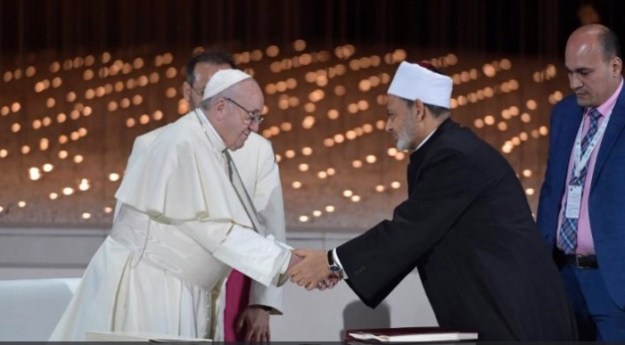
Pope Francis and the Grand Imama of Al-Azhar, Ahmad el-Tayeb,

“Something is happening.” That’s the way the great reading for our Holy Saturday liturgy, taken from an ancient homily, begins. We don’t see clearly yet, but something is happening.

And that’s the way I felt yesterday watching on YouTube a Mass at Abu Dhabi in the United Arab Emirates where more than one hundred thousand Christian migrant workers in the Middle East celebrated their faith with Pope Francis. Christianity is alive in the Middle East.

In the “Document on Human Fraternity for World Peace and Living Together” signed on Monday afternoon in Abu Dhabi by Pope Francis and the Grand Imama of Al-Azhar, Ahmad el-Tayeb, a path for the two religions and the world itself opened. Something is happening.

The document from leaders of these two great religious traditions, Christian and Muslim, is worth reflecting on.

It begins:
“In the name of God who has created all human beings equal in rights, duties and dignity, and who has called them to live together as brothers and sisters, to fill the earth and make known the values of goodness, love and peace,”

The document speaks for innocent human life, the poor, the destitute and the marginalized, the victims of destruction, calamities and war. It invokes the name of freedom, fraternity, peace and justice, the name of all people everywhere:

“In the name of God and of everything stated thus far; Al-Azhar al-Sharif and the Muslims of the East and West, together with the Catholic Church and the Catholics of the East and West, declare the adoption of a culture of dialogue as the path; mutual cooperation as the code of conduct; reciprocal understanding as the method and standard.”

“We, who believe in God and in the final meeting with Him and His judgment, on the basis of our religious and moral responsibility, and through this Document, call upon ourselves, upon the leaders of the world as well as the architects of international policy and world economy, to work strenuously to spread the culture of tolerance and of living together in peace; to intervene at the earliest opportunity to stop the shedding of innocent blood and bring an end to wars, conflicts, environmental decay and the moral and cultural decline that the world is presently experiencing.”

One commentator Tuesday said a meeting like this takes time for its meaning to be felt. “Something is happening.”

Hurricane Florence is Coming

We not preparing for the disasters brought by climate change, an article in USAToday by Rick Hampson says. “Will repeated exposures to vivid scenes of natural disaster–Western wildfires, a global heat wave, Hawaiian volcano eruptions, the 2017’s hurricane’s anniversary and a suddenly active 2018 season” prepare us to do something? “Experience counsels skepticism. So does human nature.”

“Experts say people aren’t really motivated by disaster until it come to, or through, their door.” Hampson writes.

We forget that “America, the Beautiful” is vulnerable to climate change as other parts of the world are, and our political system doesn’t help us face the change either. The earth doesn’t get to vote.

“Democracies are creatures of the present, because the public focuses on the here and now, not some future hypothetical problem… Our political system makes us vulnerable to distant crises, because we don’t try to anticipate or diffuse them.” (Robert J. Samuelson)

In a previous blog Pope Francis asks us to hear in the changing climate cries of “Our  Sister, the earth” groaning from the abandonment and mistreatment received at our hands. Is Hurricane Florence a cry of creation?

“Save us, Lord, from becoming simply ‘creatures of the present.’ looking after ourselves. Let us hear our earth and sky and sea when they cry out from our abuse and lack of care. We ourselves are dust from the earth, we breathe her air and are refreshed by her waters. May we hear the cries of our Sister, the earth,  and care for her.”


Praise be to You, My Lord.

DSC00154


“LAUDATO SI’, mi’ Signore” – “Praise be to you, my Lord”. In the words of this beautiful canticle, Saint Francis of Assisi reminds us that our common home is like a sister with whom we share our life and a beautiful mother who opens her arms to embrace us. “Praise be to you, my Lord, through our Sister, Mother Earth, who sustains and governs us, and who produces various fruit with coloured flowers and herbs”.

This sister now cries out to us because of the harm we have inflicted on her by our irresponsible use and abuse of the goods with which God has endowed her. We have come to see ourselves as her lords and masters, entitled to plunder her at will. The violence present in our hearts, wounded by sin, is also reflected in the symptoms of sickness evident in the soil, in the water, in the air and in all forms of life. This is why the earth herself, burdened and laid waste, is among the most abandoned and maltreated of our poor; she “groans in travail” (Rom 8:22). We have forgotten that we ourselves are dust of the earth (cf. Gen 2:7); our very bodies are made up of her elements, we breathe her air and we receive life and refreshment from her waters. Pope Francis, Laudato Si, 1-2

Feast of Corpus Christi

For this week’s homily, please play the video below:

Change and Automation


17. Theological and philosophical reflections on the situation of humanity and the world can sound tiresome and abstract, unless they are grounded in a fresh analysis of our present situation, which is in many ways unprecedented in the history of humanity. So, before considering how faith brings new incentives and requirements with regard to the world of which we are a part, I will briefly turn to what is happening to our common home.

18. The continued acceleration of changes affecting humanity and the planet is coupled today with a more intensified pace of life and work which might be called “rapidification”. Although change is part of the working of complex systems, the speed with which human activity has developed contrasts with the naturally slow pace of biological evolution. Moreover, the goals of this rapid and constant change are not necessarily geared to the common good or to integral and sustainable human development. Change is something desirable, yet it becomes a source of anxiety when it causes harm to the world and to the quality of life of much of humanity.

19. Following a period of irrational confidence in progress and human abilities, some sectors of society are now adopting a more critical approach. We see increasing sensitivity to the environment and the need to protect nature, along with a growing concern, both genuine and distressing, for what is happening to our planet.
Pope Francis, Laudato SI, 17-19

Avoiding an “irrational confidence in progress and human abilities”, we need to make “a fresh analysis of our present situation,” the pope says. He speaks of the “rapidification” of life– a fast changing world that cares little for nature or sustainable human development.

Like automation, smart cars, or whatever else puts people out of work and removes them from involvement in society or having a hand in the progress of our created world?

Crimes Against the Natural World


“Patriarch Bartholomew has spoken in particular of the need for each of us to repent of the ways we have harmed the planet, for “inasmuch as we all generate small ecological damage”, we are called to acknowledge “our contribution, smaller or greater, to the disfigurement and destruction of creation” He has repeatedly stated this firmly and persuasively, challenging us to acknowledge our sins against creation:

“’For human beings… to destroy the biological diversity of God’s creation; for human beings to degrade the integrity of the earth by causing changes in its climate, by stripping the earth of its natural forests or destroying its wetlands; for human beings to contaminate the earth’s waters, its land, its air, and its life – these are sins” For “to commit a crime against the natural world is a sin against ourselves and a sin against God.’

“At the same time, Bartholomew has drawn attention to the ethical and spiritual roots of environmental problems, which require that we look for solutions not only in technology but in a change of humanity; otherwise we would be dealing merely with symptoms. He asks us to replace consumption with sacrifice, greed with generosity, wastefulness with a spirit of sharing, an asceticism which “entails learning to give, and not simply to give up. It is a way of loving, of moving gradually away from what I want to what God’s world needs. It is liberation from fear, greed and compulsion” As Christians, we are also called “to accept the world as a sacrament of communion, as a way of sharing with God and our neighbours on a global scale. It is our humble conviction that the divine and the human meet in the slightest detail in the seamless garment of God’s creation, in the last speck of dust of our planet”.

Pope Francis ,Laudato SI, 8-9

Joseph and his Brothers

For the next few days we read at Mass from Genesis about Joseph, the son of Jacob, who’s betrayed by his brothers and sold into slavery in Egypt. He becomes one of Pharaoh’s chief advisors. When drought and famine strike the whole land,  Egypt is ready because Joseph has stored food to last through seven years of want.

When his brothers come looking for food, Joseph gives them food and saves them and their families from starvation. Eventually, Joseph brings Jacob, his father, and all his brothers and their families to ride out the famine in the safety of Egypt.

Like other Old Testament stories, the story of Joseph offers lessons simple and profound.  God saves his people, we’re reminded, even in a world of betrayals and natural disasters.  It’s also a story of forgiveness: Joseph forgives his brothers for betraying him and shows them God’s mercy.

It’s also a story to reflect on immigration and global solidarity. The Egyptians obviously let outsiders like Joseph’s brothers, nomads living beyond its borders, into their country. Why not build a wall around Egypt and keep strangers out?

Maybe an act of practical politics, some think. The nomads living on the borders of Egypt and on its trade routes were important allies to have in place with powerful empires to the north. You need to have good neighbors. One reason the Byzantine empire fell so quickly to Moslem invaders later on, historians say, was because it lost the support of Bedouin tribes on its borders.

These days, Pope Francis is stressing the “interconnectedness” of all life on our planet. The human family and nature are connected, for good or for ill. A story from Egypt has its lessons for today.

Healer of Withered Hearts

      The Gospel for this Wednesday, January 18th, once again reminds me of our purpose as a church, to bring the healing power of God’s love to each other and to this wounded world, as soon as possible, without delay or excuse:

     “Jesus entered the synagogue. There was a man there who had a withered hand. They watched Jesus closely to see if He would cure him on the sabbath so they might accuse Him. He said to the man with the withered hand, ‘Come up here before us.’ Then He said to the Pharisees, ‘ Is it lawful to do good on the sabbath rather than to do evil, to save life rather than to destroy it? ‘ But they remained silent. Looking at them with anger and grieved at their hardness of heart, Jesus said to the man, ‘ Stretch out your hand.’ He stretched it out and his hand was restored.” (Mk 3: 1-5)

     With all eyes upon Him Jesus took the opportunity to challenge,teach, and also to heal. Once again Jesus was breaking the rules of His Jewish religion, putting His own life at risk to show us how to live in the Kingdom.

     His challenge : paraphrasing the words of Pope Francis, are we, the Church, an empty museum for “saints”, or are we called to be “a field hospital” for the wounded, the lost, the withered, the sinner? We have many rules that damn the divorced, the gay person, the addict, the non-believer. Can we begin by welcoming, in our hearts and lives, those outsiders, the errant ones, hungry for the meaning in their lives that Jesus can most certainly provide? I don’t know that Jesus will turn them away because “it’s the sabbath “, or for any other reason. Maybe neither should we.

     His lesson: the time to accept and heal is now, today, with everyone we meet. Let us truly stop and see our brothers and sisters. Let us show interest, empathy, love. Let us risk our own lives and dare to reach out to the ones who might not even trust us. Let us risk criticism or rejection for the sake of love of neighbor.

     The healing: with every little act of mercy for others, the love of Christ reaches within our own withered hearts, and heals us as it changes us. With these hearts open to Jesus, let us accept His light, to change our hardened hearts into hearts of flesh and blood, sources of love to the world.

     Our Lord gave His life for us. May we give our lives to Him, and to the healing of His people.

     Orlando Hernandez

27th Sunday: The Gesture of Presence

To listen to today’s homily, please select the audio file below:


Like many of you, I’m sure, I still feel the warmth from Pope Francis’ visit to our country last week. I was moved, certainly, by the wise words he spoke to our congress, to the United Nations, to the various groups here, but I think what moved me most was his simple gestures– his gestures of presence.

Wherever he went, he was present there. Whether he was with the President of the United States, or with school kids in Harlem, his presence was the same. I don’t know how many hours he spent waving simply to crowds, but it seemed to me he was present as much then as he was celebrating Mass in Madison Square Garden or Philadelphia. He seemed to live in the moment.

A picture on the front page of the New York Times the other day symbolized that gift. It was the picture of the pope shaking hands with a prisoner in Philadelphia; the picture showed only the two men’s arms; the arm of the prisoner covered with tattoos, and the arm of the pope, their hands clasped together.

One person meeting the other. So simple, so moving.

At the Mass for Families in Philadelphia last Sunday Francis spoke about the gift of presence:

“Holiness, like happiness, is always tied to little gestures. ‘Whoever gives you a cup of water in my name will not go unrewarded’, says Jesus (cf. Mk 9:41). These little gestures are those we learn at home, in the family; they get lost amid all the other things we do, yet they do make each day different. They are the quiet things done by mothers and grandmothers, by fathers and grandfathers, by children. They are little signs of tenderness, affection and compassion. Like the warm supper we look forward to at night, the early lunch awaiting someone who gets up early to go to work. Homely gestures. Like a blessing before we go to bed, or a hug after we return from a hard day’s work. Love is shown by little things, by attention to small daily signs which make us feel at home. (Faith grows when it is lived and shaped by love. That is why our families, our homes, are true domestic churches. They are the right place for faith to become life, and life to become faith.)

“Jesus tells us not to hold back these little miracles. Instead, he wants us to encourage them, to spread them. He asks us to go through life, our everyday life, encouraging all these little signs of love as signs of his own living and active presence in our world.”

In an earlier talk to bishops, Francis urged them to be a “living and active presence” in the church. His words reminded me of the treatise On Pastoral Care which St. Gregory the Great wrote for the pastors of his time. Don’t get so absorbed, so fixated on your role of teaching and guiding others that you forget to look at yourselves and be yourselves, Gregory said. Don’t become automatic in what you do.

“Christianity which does little in practice, while incessantly explaining its teachings, is dangerously unbalanced,” Francis told the bishops. Give your energies, “not so much in rehearsing the problems of the world around us and the merits of Christianity’ but standing in the midst of your flock, not “afraid of questions, contact, accompaniment.” Keep watch in prayer, supporting the faith of your people, instilling confidence in the presence of the Lord, helping people lift up their gaze at times of discouragement, frustration and failure.”

The pope used an interesting phrase to describe the presence he urged the bishops to have. “Are we ready to ‘waste time’” with them? “Waste time.” The kind of presence the pope described is often described that way. Not important, a waste of time. We hear that word used by some who dismiss the contemplative vocation of someone like St. Therese of Lisieux, whose feast we celebrated October 1st. “What a waste.”

But it isn’t a waste at all.

Our Common Home

image1

The pope went home to Rome yesterday evening. But I think he stretched the meaning of that word “home,” on his visit with us here in the United States. He spoke of “our common home.”

His final homily in Philadelphia at the World Meeting of Families was based the “word of God which surprises us with powerful and thought-provoking images. Images which challenge us, but also stir our enthusiasm.

“In the first reading, Joshua tells Moses that two members of the people are prophesying, speaking God’s word, without a mandate. In the Gospel, John tells Jesus that the disciples had stopped someone from casting out evil spirits in the name of Jesus. Here is the surprise: Moses and Jesus both rebuke those closest to them for being so narrow! Would that all could be prophets of God’s word! Would that everyone could work miracles in the Lord’s name!

“Jesus encountered hostility from people who did not accept what he said and did. For them, his openness to the honest and sincere faith of many men and women who were not part of God’s chosen people seemed intolerable. The disciples, for their part, acted in good faith. But the temptation to be scandalized by the freedom of God, who sends rain on the righteous and the unrighteous alike (Mt 5:45), bypassing bureaucracy, officialdom and inner circles, threatens the authenticity of faith. Hence it must be vigorously rejected.

“Once we realize this, we can understand why Jesus’ words about causing “scandal” are so harsh. For Jesus, the truly “intolerable” scandal consists in everything that breaks down and destroys our trust in the working of the Spirit!

“Our Father will not be outdone in generosity and he continues to scatter seeds. He scatters the seeds of his presence in our world, for “love consists in this, not that we have loved God but that he loved us” first (1 Jn 4:10). That love gives us a profound certainty: we are sought by God; he waits for us. It is this confidence which makes disciples encourage, support and nurture the good things happening all around them. God wants all his children to take part in the feast of the Gospel. Jesus says, “Do not hold back anything that is good, instead help it to grow!” To raise doubts about the working of the Spirit, to give the impression that it cannot take place in those who are not “part of our group”, who are not “like us”, is a dangerous temptation. Not only does it block conversion to the faith; it is a perversion of faith! “

We live in a bigger world than the home we live in, the church we live in, the country we live in. Thank you, Pope Francis.