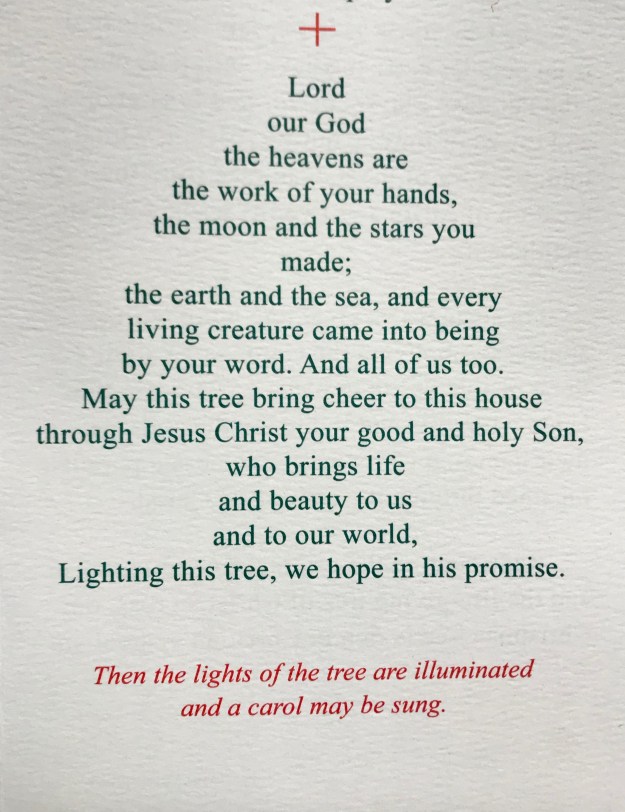
Don’t forget to bless your Christmas Tree which reminds us that, besides the blessings of the human family, we’re blessed through creation.
Long ago, God placed a tree of life in the garden of paradise as a sign of the wisdom, knowledge, and every good thing the created world brings us.
Our Christmas Tree reminds us of creation’s blessings and the blessings we receive through Jesus Christ who renews the created world through his coming.
The Pew Research Center regularly reports on trends in America and in the world and recently they reported on how Americans see their place in the world. Most Americans, the report said, think that we should deal with our own problems and let other countries deal with their problems as best they can. Reports like this don’t make a judgment whether this is a good trend or a bad trend, they just tell us the facts. But the trend seems to indicate that there’s an increasing fear in us that the world in becoming unmanageable, and so we should beware of taking on too much.
Today we’re celebrating the Feast of Pentecost, the coming of the Holy Spirit, whom Jesus promised to send not only to his disciples but to the whole world. The Holy Spirit comes not only to us as individuals, to guide us on our way, to teach us all things, to help us to pray, but the Spirit also is sent into our world. Our temptation, unfortunately, is to see faith as just a personal thing and not affecting our whole world.
As we were preparing for this feast, I have been thinking how differently we know the Holy Spirit from the way we know Jesus and, to a certain extent, God the Father. Jesus is God come to us in human flesh, and so he has our “likeness” as St. Paul says. He’s born a child, lives as a man, reacts to events and people around him, he speaks in human words, he suffers and dies and rises. However distant the time of Jesus is from ours, we see and hear him as human like ourselves.
God the Father is also described in human terms. God is “Father”, a description we know is an analogous term. Calling God “Father” doesn’t mean that God is masculine, but the term itself offers us a human reference for God, the creator and sustainer of all things.
But the description of the Holy Spirit is more difficult to grasp, I think. What does “spirit” mean? The scriptures use symbolic ways to describe the Third Person of the Trinity. Our readings for the feast speak of the Spirit as a driving wind, tongues of fire that empowers the disciples to speak with wisdom, with new words, and to act bravely instead of fearfully.
I have been thinking lately of other symbolic ways the Spirit is described. One is a familiar symbol found in the New Testament and in art. The Spirit is a dove who rests on Jesus when he’s baptized in the Jordan by John.
There’s a bird feeder outside the monastery where I live in Queens, NY, and in the early morning before Mass I usually go out with a cup of coffee to watch the birds. Mostly house sparrows, but there’s a pair of doves who are regular visitors. Every once in awhile a hawk flies over and immediately the sparrows disappear. But the doves are the last to go and first back at the feeder. You might call them simple or dumb. But you could also say they’re fearless. They’re not afraid of the hawk.
Remember the bible story about Noah in the ark. Noah wonders if the flood waters are gone, so who does he finally send out? He sends out a dove, who returns with a twig from an olive plant. There’s life there, you can get out of the ark. The dove is not afraid of dangerous places or floodwaters. The Holy Spirit is not afraid of the chaos of our world, but recreates from the chaos.
The Spirit who appears at Jesus’ baptism as a dove also leads him into the desert, the realm of Satan. The scriptures say Jesus is hungry there, but he’s not afraid. Jesus defeats Satan in his realm.
Where are the disciples of Jesus in today’s gospel? They’re locked up in a room in fear when Jesus, risen from the dead, comes into their midst. He breathed on them. “Receive the Holy Spirit,” the Spirit whom he promised to give them. And what did they do? They left that room and went out into the world they feared, a world that the Spirit promises to recreate.
Of all the gospels, St. Luke’s gospel gives the most complete account of the birth of Jesus and events leading up to it. Luke also points out the historical importance of his birth, not only for the Jews but for the world itself. He does it by noting at the beginning of his gospel that it was in the days when Caesar Augustus ruled in Rome. Previously, he noted that King Herod the Great ruled in Judea in those days.
Those men were well known to Luke’s first readers. Caesar Augustus brought about an unprecedented era of peace and prosperity in the Roman empire. He was considered godlike. Herod the Great ruled with an iron fist in Judea; there were fearful signs of his presence everywhere. People kept out of his way.
The child born in a stable in Bethlehem was more important than them and the great ones who followed them. He brought greater peace than any emperor could bring. He was more powerful and more present than Herod or anyone like him could possibly be.
Luke in his gospel gives an orderly account of Jesus, from his birth to his resurrection, and he also wrote a further account–the Acts of the Apostles– about how his message was spread by his followers from Jerusalem to the great cities of the Roman empire, and finally to Rome itself. His message went out to all the world.
I was thinking of the spread of the gospel as I read the report issued a few days ago from the Pew Research Center about religion throughout the world. There are approximately 6.9 billion people in the world in 2010. There are 2.18 Christians in the world, about a third of the world’s population.
The report notes that since 1910 a great shift has taken place among the religions of the world. Instead of being concentrated in Europe, Christianity has grown enormously in sub-Saharan Africa and the Asia-Pacific region, where there were relatively few Christians at the beginning of the 20th century. “Christianity has become a global religion. Christians are also geographically widespread – so far-flung, in fact, that no single continent or region can indisputably claim to be the center of global Christianity.”
A third of the world’s population call themselves Christian. Half of them are Roman Catholic.
Over two thousand years ago, Jesus Christ was born in Bethlehem, of poor unknown parents. He grew up unrecognized in a small discounted Galilean town called Nazareth. For a few years he taught, he healed people of illnesses, he raised the dead to life, he gathered disciples who followed him. They abandoned him when he was put to death on a cross. Then he rose from the dead.
He shot across the sky of time like a meteor. However, you would might expect that history would forget him as it does so many others. But Jesus Christ hasn’t been forgotten. Over two billion people in our world today remember him and follow him.
We believe he’s still present and his promise of peace is still waiting to be fulfilled.
This causes me to wonder at the mystery we celebrate at Christmas when we come to the stable and see the tiny Child.


 The Victor's Place