Tag Archives: Peter

St. Paul Outside the Walls

 Paul the Apostle is buried in the Church of St. Paul Outside the Walls in Rome. His sarcophagus lies under the church’s main altar. Until 2008, when archeologists uncovered it, it was concealed underground in the same spot.

After their execution in the mid 60s, Peter was buried on the Vatican Hill and Paul was buried along the Via Ostia. Churches honoring the two apostles were built in the 4th century by the Emperor Constantine over their graves. Constantine didn’t initiate devotion to the apostles, though. Christians from Rome and elsewhere came in great numbers from earliest times to these places to honor these great heroes.

Here’s a video of the church:

St. Paul Outside the Walls, Rome

A statue of St. Paul welcomes us outside the church’s entrance. He’s an old man, clothed in a heavy traveler’s cloak, bent and tired from years on the road. Yet, the apostle holds a sword firmly in hand, not a military sword, but a symbol of a faith that won hearts and banished the powers of darkness. He has “fought the good fight” and “kept the faith,” and here in Rome his earthly journey ended. Pictures on the church doors recall Paul’s final hours, when he died decapitated by an executioner’s sword not far from this spot.

Lifting our eyes to the façade of the church, we see his dramatic journey in outline, from Jerusalem to Rome, as Paul carried the gospel of Jesus Christ announced beforehand by prophets of the Old Testament.  A more detailed description of his mission appears in the paintings around the church walls inside, from his conversion on the way to Damascus, to his death here in the capitol of the Roman world.

If we look higher before we go in, Paul appears on the church’s façade in the light of glory, his traveling days done. With Peter, a fellow disciple, he sits at the feet of Jesus Christ, the Risen Lord who taught him so well. “Who are you, Lord?” Paul once cried, thrown to the ground. Now he sees Jesus face to face.

This same scene of glory is repeated within the church itself where columns in procession lead our eyes to a triumphal arch defining the apostle’s grave below and the altar above it. On the dome of the apse, Jesus sits in triumph, surrounded by Paul and his companion apostles and evangelists. “Come, blessed of my father, receive the kingdom prepared for you,” Jesus proclaims in the book of life he holds up to them.

Today,  we can see the apostle’s tomb, recently uncovered by archeologists, under the main altar.

Outside the Walls

The description “Outside the Walls” is a reminder that this church, now in a crowded city suburb, was once outside Rome’s city walls on a desolate stretch of the Via Ostia, part of a little cemetery where the apostle was first buried. As they did over St.Peter’s grave, early Christians built a modest memorial immediately after Paul’s death to mark his grave; then in the early 4th century the Emperor Constantine erected a small church facing the Via Ostia honoring the apostle.

It did not end there, however. Later that same century, a larger church replaced the small church, as large as that of St.Peter on the Vatican. Why build an immense building like this in an out-of-the-way place, we may ask? Was it devotion or Christian pride?

Perhaps. Yet, some speculate other reasons were behind it. In the late 4th century, hordes of “barbarians” were pouring through the frontiers of the empire, and the Romans–most likely Christians among them–  saw the newcomers as pesky strangers: violent, crude and uncultured. The latin word they used for them, “barbari,” dismisses them as little less than savages, unwelcome intruders to an orderly Roman world.

St. Paul once scolded the proud Corinthians for looking down on others and forgetting how God raised them up from nothing by his grace. “The door to faith has opened to the nations,” he said; God welcomes all, no matter who they are. Wouldn’t God welcome these new immigrants?

Did the new church call Roman Christians to open their hearts to these new gentiles as the apostles Peter and Paul had done before? Early popes like Leo the Great and Gregory the Great promoted this new church. Gregory not only welcomed newcomers to the Italian peninsula but inspired by Paul reached out to peoples beyond the borders of the empire, to the misty shores of England and the dark forests of Northern Europe.

To be catholic the church had to reach out to the world.

Peter and Paul complement each other. Paul, a complex intellectual, forged beyond the boundaries of Judaism to address the whole world.  Peter, the Galilean fisherman, was a cautious captain for the ship of the church. Their gifts are different, but we gain from both of them. Paul’s sword points to an unknown future and tells us not to be afraid to embrace it. Peter, holding firmly the keys given him by Jesus, calls us to stay close to the Good Shepherd, whose wisdom and love supports us.

The Church treasures their different gifts.

Websites:

http://www.vatican.va/various/basiliche/san_paolo/index_en.html

http://news.nationalgeographic.com/news/2006/12/061211-saint-paul.html

2nd Sunday of Lent B Jesus is Transfigured

To listen to today’s homily, select the audio file below:

Immediately before the account of his transfiguration on the mountain, which we read in Mark’s gospel this Sunday, Jesus and his disciples go up north to the villages around Caesarea Philippi, a major gentile city of the day. Mount Hermon, the great snow capped mountain that’s the principal water source for the Lake of Galilee and the Jordan River dominates that region. In bible, mountains are places close to God, where God reveals himself.

So here Jesus asks his disciples, “Who do people say that I am?” Some say you’re Elijah, John the Baptist come back from the dead, the disciples say. “Who do you say I am?” he said. “You are the Messiah,” Peter replied.

But as Jesus goes on to tell them he’s going to “suffer greatly, be rejected by the elders, the chief priests and the scribes and be killed and rise after three days,” Peter stops him. No, that’s not going to happen to you. That’s not the Messiah I mean. Jesus turns to him and says “Get behind me Satan, you are not thinking as God does, but as human beings do.”

‘You are not thinking as God does, but as human beings do.” Mark’s gospel, more than the others, insists that despite his teaching and the wonders Jesus works, his own disciples whom you would expect would know him best, don’t understand him that well. They think as human beings do. Of course we do too.

And so Jesus takes them up the mountain and is temporarily transfigured before them. It’s a temporary experience. A brief encounter. His clothes become a dazzling white. The great traditional figures of Moses and Elijah appear; a terrifying cloud overshadows them, a voice says “This is my beloved Son, listen to him.” That’s the way the gospels describe it.

The disciples want more. Peter wants to set up tents so they can stay there. But then it’s over. They only have a glimpse of the One who walks with them. After they come down from the mountain they still don’t understand him.

But, still, they follow him.

The mystery of the transfiguration of Jesus reminds us that God periodically reveals himself to us. Periodically,we have intimations,  glimpses of God. We can’t create that experience on our own. God makes himself known. In St. Luke’s account of the transfiguration, he seems to indicate that prayer is one way to enter God’s presence.

And so we do all we can, we wait for him like  the disciples, but we’re absorbed in our human thinking. “Thinking like human beings.”

The mystery of the transfiguration also offers the promise of something that awaits us, something that is permanent, and not temporary. “Follow me.” Jesus says. We try to get ready for him. God will come, but here in this life he comes when he wills. We wait, we watch, we listen.  Jesus saysa Kingdom is coming, where the limitation of human thoughts and actions passes away and our waiting is ended and we shall see God face to face, not for a time but for eternity.
“This is my beloved Son, listen to him.”

The first reading for today is from the Book of Genesis. It begins “God put Abraham to the test.” He’s tempted. He takes his only son up a mountain to kill him. What a test that is to our human way of thinking. His only son, his beloved son. Everything he put his hopes in.

For Abraham this was the greatest temptation he or anyone could face. Everything’s lost; nothing more to live for. But God tells him  he’s not lost everything. No, he hasn’t. Go beyond your human thinking. God is for us, not against us.

22st Sunday of the Year. A. Thinking Like Human Beings


To listen to this weeks homily just select the audio below:

Last week in the gospel Jesus called Peter the rock on which he would build his church. Today he calls him “Satan” and tells him to get away from him.

In the gospels Peter is usually the voice of common sense. That’s what you would expect from a fisherman making his living on the sea. When storms come, get out of their way and head for port.

And so when Jesus speaks of the storms of suffering and death he will face on his journey to Jerusalem, Peter advises him to turn away. “God forbid, Lord, no such thing shall ever happen to you.” The voice of common sense.

But Jesus reminds Peter (and us along with him) that he is thinking “as human beings do.” He even calls him “Satan.” He tells Peter, and all of us, to think as God thinks.

Our readings today remind us of the limitations of human thinking. Jeremiah the prophet says to God in our first reading “You have deceived me.” “You have let me down; you don’t love me; you don’t care.” We only see so far as human beings. When the mystery of the cross casts shadows of sickness, failure and disappointment over us, it’s hard for us to say “I see, I understand, your will be done.”

We’re limited in the way we think. How, then can we think as God wishes us to think? Certainly we can’t know all that God knows. God’s thoughts, God’s mind is infinitely beyond ours.

Thinking like God means knowing the world God made and living in it as God wants us to.

I wonder if the signs of the bread and the wine we bring to the altar can help us see what it means to know the world God made and live in it as God wishes us to live in it.

As we offer the bread to God at Mass we say: “Blessed are you, Lord God of all creation. Through your goodness we have this bread to offer, fruit of the earth and work of human hands, it will become for us the bread of life.”

The bread is a sign of everything, of all creation, we say, creation as it has been given to us by God and creation our hands have fashioned.

Scientists say that our universe came into existence about 15 billion years ago.

About 3.5 billion years ago life began on our planet. The universe is represented in this bread; it holds the story of the universe.

About 200,000 years ago human life emerged on our planet. 200,000 years of human life are represented in this bread. Our lives are part of the human story.

We believe that God created our world and it’s is good. The Book of Genesis tells us that. God has a plan for this universe. The scriptures say there’s wisdom and love in that plan. His kingdom will come.

We all have to care for this world, each of us has a part to play in that greater plan.

But we also know the mystery of evil is at work in our world and the mystery of evil is also represented in this bread.

When Jesus took bread into his hands at the Last Supper we have to see the magnitude of that action. He took all created reality, all human existence, the goodness and evil of life in his hands. He was a sign of God’s love and care for all of it. He took it in his hands and gives it to us, in turn, blessed by his presence.

“This is my body.” “This is my blood.”

How significant it is that he gives himself to us in bread and wine. It’s an invitation to live in this world, depending on his wisdom and power. He will show us the way.


21st Sunday of the Year: Listen to the Prayers


To listen to the audio for the Homily, please select the link below:

One of the most important things we do as Catholics is to come to Mass and pray. I’d like to reflect on the prayers of the Mass, in particular the Eucharistic Prayer. They’re good guides to prayer at Mass, but before reflecting on the prayers themselves I want to say something that has to be said today.

Praying at Mass begins with us being there. Praying at Mass begins with us showing up.

Someone once said “Most of life is showing up.” I don’t think we realize how much we need each other “showing up” in church. Suppose the music ministers didn’t show up, the readers, the ministers of communion, the altar servers, the ushers, the deacon, the priest didn’t show up?

We notice people at Mass week after week, year after year. We encourage each other. I often feel in awe watching someone coming into church in a wheelchair or on oxygen support, or mothers and fathers dragging their kids in. Showing up together is a key to praying at Mass.

We’re at Mass to give thanks. “Let us give thanks to the Lord our God,” the priest says at the beginning of the Eucharistic Prayer. When we celebrate Mass, the Sacrament of the Eucharist, we give thanks to God together.

What does it mean to thank God? The English writer, C.S. Lewis, has a wonderful reflection on thanking God in a little book he wrote on the psalms. (Reflections on the Psalms) Lewis turned away from God for awhile. When he returned and began to pray again he was bothered by the way our prayers urge us again and again to thank God. Why do we keep on praising God, he wondered? Was God a “prima donna” or a dictator looking for our adulation?

After thinking about it, Lewis said he realized that thanksgiving and praise are embedded in ordinary human life. To be thankful and to praise are actually signs of a healthy life. Ordinary life rings with praise and thanksgiving, he wrote:

There’s “…praise of weather, wines, dishes, actors, motors, horses, colleges, countries, historical personages, children, flowers, mountains, rare stamps, rare beetles, even sometimes politicians and scholars.”

Healthy people praised most, Lewis noticed; cranks and malcontents praise least. He came to the conclusion that praise and thanksgiving are indications of an “inner health made visible.”

That’s true, isn’t it? People who are inwardly healthful praise most; cranks and discontented people praise least. The self-absorbed see only themselves and their little world. Those who lose an appreciation of life because of hurt, loss, or disappointment can lose the ability to enjoy and give thanks and praise.

When we come to Mass, it seems to me, we’re looking for the inner health God wants us to have. It’s so easy to sink in smallmindedness, self-absorption. It’s so easy to let the hurts and sufferings of life get us down. We need to be lifted up to a higher vision of things.

That’s what happens in the mystery of the Eucharist. Do you remember the prayers at beginning of our Eucharistic prayer, the little dialogue that introduces the prayer?

“The Lord be with you.” “And with your spirit.”

“Lift up your hearts.” “We have lifted them up to the Lord.”

“Let us give thanks to the Lord, our God.” “It is right and just.”

The Lord is with us, lifting up our hearts and minds to a greater world that God wants us to see. Like the water poured into the wine, we enter the prayer and vision of Jesus Christ and are lifted up into another, higher world, the world of God’s creation. We give thanks to the Lord, our God in that world, and it’s the right thing to do.

In the Eucharistic Prayer we give thanks for the special gift of the God of Creation: Jesus Christ, who came into the world as God’s Son. Remembering the mysteries of his birth, his life, his death and resurrection, we give thanks for him. And he blesses us with the blessings of his birth, his life, his death and resurrection.

He refreshes us by these mysteries. We’re fed by them. They’re food from heaven that gives us a heavenly vision.

Listen carefully to the prayers of the Mass and make them your own

The Storm at Sea: 19th Sunday A

You can hear the homily here: 

I visited Magdala along the Sea of Galilee a few months ago and since then I think differently about the apostles, especially  fishermen apostles like Peter and Andrew, James and John. Magdala, the city of Mary Magdalen, was a center for the fishing industry in Galilee in Jesus’ time, according to archeologists who recently uncovered the city.

It evidently was a prosperous place, and so far from being “poor and ignorant” many of the Galilean fishermen were well-off, savy businessmen who knew their way around.

Did Jesus choose them and the tax-collector, Matthew, because they knew the territory well and would be good guides to  the places he wanted to visit? They knew where to go and how to get there: the Sea of Galilee was their usual highway

But a storm like that described in our gospel today (Matthew 14,22-33) would shake anybody, even the most self-asssured.

When we read a miracle story like the calming of the sea and someone walking on water, we shouldn’t just stop in amazement at the power of Jesus. There’s a lesson to be learned in the story. What’s the lesson here?

Perhaps  like Peter and the rest of the disciples we can easily fall into thinking that there are some things beyond God’s power–and ours– to do. These were confident men, yet their faith was shaken, like ours often is. When told by Jesus to walk on the water, Peter believed up to a point, then he said, “This can’t be; it’s not possible; it’s beyond his power and mine to do.” In fear and doubt he began to sink.

Doesn’t this happen to us too? We believe, up to a point, and then we doubt. Our doubts about God’s power can be brought about by major events in our world, as ovewhelming as a storm at sea. Wars, terrorist attacks, global warming. How quickly we throw up our hands as if this is all beyond God’s power and ours.

We are all in the same boat. Take a look at the boat on the Sea of Galilee–it’s  the world on the sea of history, it’s the church in time. In storms, they may both look like they’re going to sink. But they wont. Jesus is in the boat.

That’s what the mystery of the Incarnation tells us.

2nd Sunday of Lent

Lent 1
en español
for Swahili
Matthew 17,1-9

The Transfiguration of Jesus takes place at the midpoint of Matthew’s gospel, after Jesus announces to his disciples that “he must go to Jerusalem and undergo great suffering at the hands of the elders and chief priests and scribes, and be killed, and on the third day be raised.”

Take up your cross and follow me, he tells his disciples.
“God forbid, Lord,” says Peter. who doesn’t understand this at all. We find it hard to understand too.

Six days later, Jesus takes Peter, James and John up a mountain where they experience him glorified, surrounded by Moses and Elijah. It’s a transitory experience, even though Peter, awed by the vision, asks to prolong it. After falling to the ground, the disciples looked up and “saw no one except Jesus himself alone.” But the experience strengthens them for the journey they’re called to make.

“The main purpose of the transfiguration was to remove the scandal of the cross from the hearts of Christ’s disciples,” says Pope Leo the Great. God doesn’t want us to be weighed down by suffering.

So, like Peter, James and John, Jesus takes us up a mountain throughout our lives to strengthen us as we share in his cross. What mountain do we ascend? St. Paul of the Cross and other spiritual guides say it’s the mountain of prayer, where we experience intimations of God’s glory, brief encounters, transfigurations of a lesser kind. We’re strengthened as we pray.

“Don’t think that the trials and crosses you experience turn you to go another way. Trials don’t indicate you’re straying from God. We know it’s just the opposite from the scriptures we read and the saints we honor. The way to go is the way our Savior gives us grace to go. Saint Bernard wasn’t the first to know this truth when he said: ‘The cross is the way to life, the way to glory, the way to the Kingdom, and the way to the inhabited City.’”

(Letter 1194)

Lord Jesus,
lead me to that mountain place
of stronger light and surer sound
where I may see your glory.
Strengthen me through prayer.

Light and truth,
bright as blinding snow,
whom Peter, James and John saw,
“Bring me to your holy mountain,
to your dwelling place.”
Spanish

en español
2do domingo de cuaresma (Año A)
Mateo 17.1-9

La Transfiguración de Jesús ocurre en el medio del Evangelio de Mateo, después de Jesús haber anunciado a sus discípulos que ” él tendría que ir a Jerusalén, y pasar grandes sufrimientos bajo las manos de los ancianos, los jefes de los sacerdotes y los maestros de la ley, ser matado, y al tercer día resucitar.”

Carguen con su cruz y síganme, les dice a sus apóstoles. ” Diós no lo quiera, Señor!” le dice Pedro, que no entiende esto en lo absoluto. Nosotros lo encontramos muy difícil de entender también.

Seis días después Jesús toma a Pedro, a Santiago y a Juán a una montaña donde ellos tienen la experiencia de verlo a él glorificado, rodeado por Moisés y Elías. Esta parece ser una experiencia transitoria; después de postrarse en la tierra, ellos levantaron la cabeza y ” ya no vieron a nadie, sino a Jesús solo.” Pero esta experiencia los fortalece para el resto de la jornada que les espera.

“El propósito principal de la transfiguración de Jesús es de remover el escándolo de la cruz de los corazones de los discípulos de Cristo,” dice el Papa Leo el Grande. Diós no quiere que nosotros seamos oprimidos por el sufrimiento.

Así, como a Pedro, Santiago y Juán, Jesús nos lleva arriba a una montaña durante todas nuestras vidas mientras compartimos su cruz. ¿Qué montaña es la que ascendemos ? San Pablo de la Cruz y otros guías espirituales dicen que es la montaña de la oración, donde experimentamos intimaciones de la gloria de Diós, encuentros breves, y transfiguraciones pequeñas que nos fortalecen.

Nos dice San Pablo de la Cruz ; ” No créas que las pruebas y las cruces que experimentas te viran hacia otro camino. Las pruebas no son indicaciones de que te estás descarriando de Diós. Nosotros sabemos que lo opuesto es cierto basado en las Escrituras que leemos y los santos que veneramos. La ruta que tomar es el camino por donde Diós nos da la gracia para ir. San Bernardo no fue el primero en reconocer esta verdad cuando exclamó; ‘ La cruz es el camino a la vida, el camino a la gloria, el camino al Reino, y el camino a la Ciudad Habitada.’ ” (Carta 1194)

Señor Jesús,
guíame hacia ese lugar montañoso
de fuerte luz y sonido claro
donde pueda ver tu gloria.
Fortaléceme a través de la oración.

Luz y verdad, brillante como la nieve deslumbradora,
a quién Pedro, Santiago y Juán vieron.
” Tráeme a tu monte sagrado ,
al lugar de tu morada.”
Swahili
Lent

Tafakari ya jumapili ya pili
Kugeuka sura kwa Yesu kulitokea katika kipindi muhimu cha Enjili ya Mathayo, baada ya Yesu kuwatangazia wafuasi wake kwamba “atapaswa kwenda Yerusalem na kupitia mateso makali katika mikono ya wazee wa kanisa, makuhani wakuu na mafarisayo, atauwa na siku ya tatu atafufuka.”

Chukua msalaba wako na unifuate, anawaambia wafuasi wake. “Mungu apishe mbali, Bwana, “alisema Peter, ambae hakulielewa hili hata kidogo. Inakuwa vigumu kwetu pia kulielewa.

Siku sita baadae, Yesu akamchukua Petro, Yacobo na Yohana kwenye mlima ambapo waliuona utukufu wa Yesu, kando yake wakiwepo Musa na Elia. Ilionekana kuwa kipindi cha mpito ambacho wasingerefusha zaidi. Baada ya kuanguka chini, waliinua macho, na hawakumuona yeyote ila Yesu peke yake.” Hali hiyo iliwaimarisha kwa kipindi cha safari yote waliyoifanya.

Lengo kuu la kugeuka sura ilikuwa ni kuondoa uzushi juu ya msalaba katika mioyo ya wafuasi wa Kristo,” Anasema Papa Leo Mkuu.

Ni katika mlima gani yesu anatuchukua sisi ili kutuimarisha katika safari ya kuibeba misalaba yetu? Mt. Paulo Wa Msalaba pamoja na viongozi wengine wa kiroho wanasema ni mlima wa sala ambapo tunapata ukamilifu wa utukufu wa Mungu, kwa kifupi tunakutana na utukufu wa Mungu.

Follow Me

Galilee shore

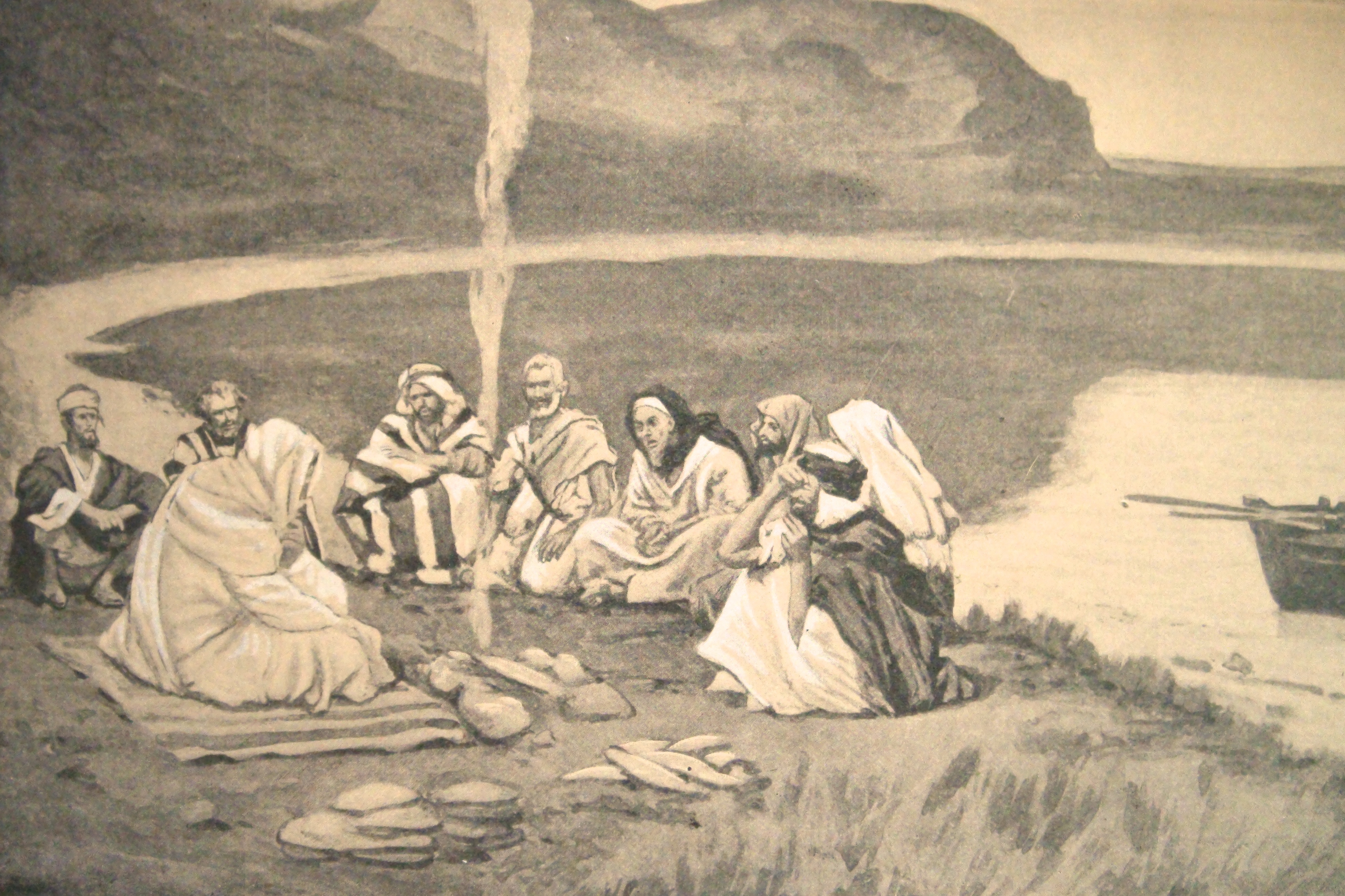
The gospel of John is read at Mass these last days before the Feast of Pentecost. We’re brought to the Sea of Galilee where the Lord first called Peter and John and others to follow him. Now, from the shore the Risen Jesus calls them again. They’ve fished all night and caught nothing. Not only are their boats empty; some days earlier in Jerusalem they deserted the One they promised to follow forever. Their spirits are empty.

From the shore Jesus tells them to cast their nets into the sea again and an abundant catch of fish pours into their boats. Calling them ashore, Jesus feeds them some loaves and fish. As he did in the supper room the night before he died, Jesus offers them his life-giving love.

Taking Peter aside, he asks the disciple who denied him three times “Do you love me?” “Yes, Lord, you know I love you,” Peter answers three times. “Feed my sheep,” Jesus tells him.

Then, renewing the invitation he made at this same shore at the beginning of his ministry, Jesus says to his disciple, “Follow me.”

The Feast of Pentecost is a feast for a church that has failed, for disciples facing their weakness and broken promises, for those who work and have nothing to show for it. The Holy Spirit, whom Jesus breathed upon the disciples after his resurrection, comes to our world as he promised, to renew the face of the earth. “Come follow me,” the life-giving Spirit says.

Following Jesus Christ: Monday Night– Oct 3

Following Jesus Christ in St. Matthew’s Gospel into the days of his death and  resurrection, we hope to learn from him. In a previous post,  we considered lessons Jesus taught as he began his last days.

He recognized that God was with him, even as he faced death.  “Thy will be done,” Jesus taught his disciples to pray in Galilee. “Thy will be done,” Jesus cried trembling as he faced death before his arrest that dark night in Jerusalem. God’s with you, he says to us, even in life’s darkest moments.

It’s a lesson we hope to learn. We welcome God’s will when life’s good, but find it hard to accept when times are bad. “My thoughts are above your thoughts, and my ways above your ways,” God says. God’s plans are often hidden, like seed in the ground or treasure in a field. We find God’s plan especially hard to understand in suffering and death.

And so, many today deny a plan of God exists in our world. If God exists–and some would say he really doesn’t– God is uninvolved in our world in any way. Some say there are no plans at work in our world at all; life is random, without rhyme or reason; everything just happens.

Or some say life is what I want it to be. I can make it happen, and there’s no point in looking for God’s will. I decide.

We believe God has a plan and his plan is for our good. God’s wills our good, even though it may sometimes be hard to see.

“Thy Kingdom come, thy will be done, on earth as it is in heaven.”

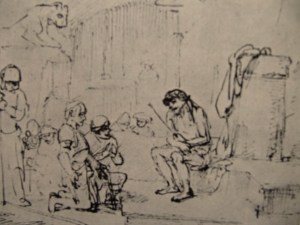
Jesus before Caiaphas

After his arrest in the Garden of Gethsemane Jesus is taken to “Caiaphas the high priest, where the scribes and elders were assembled,”  Matthew’s Gospel continues. What shall we learn here?

Caiaphas’ residence would be somewhere in Jerusalem’s Upper City where influential Jews lived. It was an area close by the Temple and Herod’s Palace, where Pontius Pilate, the Roman Governor also resided when he was in the city. Jesus would be taken to that well-to-do area of the city.

Recently, archeologists have excavated some of the homes of Jewish officials in the Upper City and they’ve found  Roman style villas with courtyards and elegant furnishings. They would be among the red-roofed buildings seen in the model below of Jerusalem at the Israel Museum.

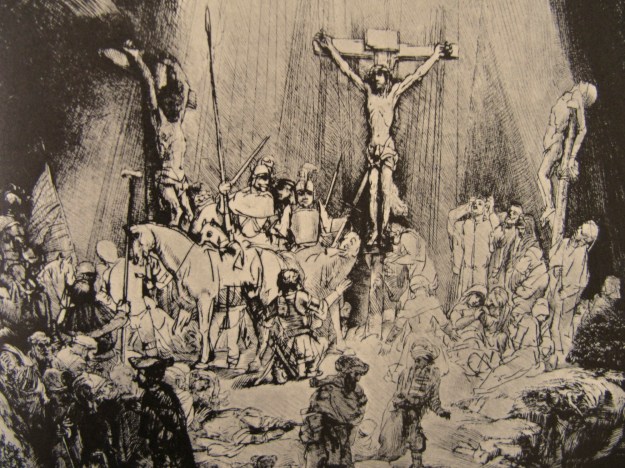
Jesus would be judged and sentenced to death, scourged and crowned with thorns in the Upper City. His followers would be few there,  unlike Bethany where we said previously  he had strong support. 
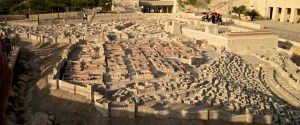
Matthew presents Jesus’ appearance before the Jesus leaders in dramatic form. Caiaphas probes his identity thoroughly in what is more of a cross examination than a court trial.  At the same time Jesus is being questioned, Peter the Apostles is also  questioned.  Earlier in Matthew’s Gospel, Peter strongly professed that Jesus was the Christ, the Son of the living God, now just as strongly he denies he ever knew him.
The gospel invites us into this story to ask what we say.  For Caiaphas Jesus is a trouble-maker or maybe a religious fanatic. He and his friends are worried that Jesus might start a revolution endangering all  they held dear.

Who do we say Jesus is? If he’s only a healer, a teacher, a social revolutionary with delusions of grandeur, then he’s only  another innocent person victimized by powerful enemies. Is he only another human being?

But if he’s God’s Son, the face of God to us, then he’s tremendously important to us and to our world.  “Who is he?” “Who is this who suffers and experiences such humbling?” “Why?”  are new questions before us.  God is here, and attention must be paid. Jesus, God in human form, not distant or untouched by human circumstances, suffers and dies and lives and loves as we do.

“Tell us under oath whether you are the Messiah, the Son of the living God.”   Caiaphas asks Jesus.

“You have said it,”  Jesus answers.

Jesus who prayed in fear in the garden, who feels abandoned and alone, whose sweat falls to ground as the dark engulfs him is the face of God before us. Jesus who gave himself to his disciples in bread and wine, who knelt before them in the Supper Room and washed their feet is the face of God. He comes humbly before us that we might meet him unafraid.

With Peter, we say “You are the Christ, the Son of the Living God.” With Thomas, we say, “My Lord and my God.”

Notice how Matthew’s gospel strongly asserts the reality of Jesus’ human experience  He really suffers, he really fears, he really knows our sorrows and pains, for he has borne them himself.   He does not “seem” to be human, he is human.

“Why did be come among us?” we ask. Because God who lives in light inaccessible, wishes to draw us into his light. Jesus who shares our human experience leads us into that light.

We remember the Passion of Jesus to grow in love of him. His Passion is a book to be read over and over,  always wise, always new, always true. It leads us to peace. From its pages we know a loving God wants to be near us.

St. Paul of the Cross, the founder of my community, called the Passion of Jesus the door into the presence of God. It invites us to approach God bravely, to enter God’s presence with confidence and then rest in the presence of the God who loves you.

Judas

As the Jewish leaders send Jesus off to Pontius Pilate, Matthew recalls the tragic end of Judas, who betrayed Jesus. “I have sinned in betraying  innocent blood,” the disciple says as he flings the 30 pieces of silver into the temple. What lesson can be draw from this event?

“His second tragedy,” Pope Benedict says of Judas,”is that he can no longer  believe in forgiveness. His remorse turns into despair. Now he see only himself and his darkness; he no longer sees the light of Jesus, which can illumine and overcome the darkness. He shows the wrong type of remorse; the type unable to hope, that see only its own darkness.” (Jesus of Nazareth, p 68)

Judas would not believe the story of the Prodigal Son. Such sadness hangs over the fate of Judas. We learn from the tragedy of Judas to believe in God’s forgiveness, even for the greatest sinner.

When you read Matthew’s  account of the Passion  notice the gradual silence of Jesus. As the hours go by, his words become fewer and fewer. He works no obvious wonders, no obvious cures. His own power seems to slip away leaving him more and more helpless, and his powerful enemies more in control.

In the garden, he prays a short troubled prayer, over and over: “Father, if it is possible, let this cup pass from me, yet not my will, but your will be done.”

He looks for the comfort of friends but finds none. They fall asleep and seem to not notice.  “Pray that you don’t enter temptation. The spirit is willing but the flesh is weak,” Jesus tells them.

His words are few before Caiaphas. Quick to answer false charges before, he says nothing to the false witnesses bringing charges against him.  Only when Caiaphas directly asks if he is the Messiah, the Son of God,  does Jesus answer: “ You have said so. I tell you from now on you will see the Son of Man seated at the right hand of the power and coming on the clouds of heaven.”

Similarly, Jesus is mostly silent before Pilate. “Are you the king of the Jews?” Pilate asks him. “You say so,” Jesus answers. Then, he says no more.

He’s silent when the crowd calls for Barrabas; he has no words but cries of pain when the soldiers scourge him. He makes no response to their mockery as they lead him away to be crucified.

The only words he says towards the end in Matthew’s gospel–Mark’s Gospel also reports these words–  are the final words from psalm 22, which the evangelists quote in Aramaic, as well as Greek:  “My God, my God why have you forsaken me.?”

“It is not ordinary cry of abandonment. Jesus is praying the great psalm of suffering Israel, and so he is taking upon himself all the tribulation, not just of Israel, but of all those in this world who suffer from God’s concealment. He brings the world’s anguished cry at God’s absence before the heart of God himself. He identifies himself with suffering Israel, with all who suffer under “God’s darkness”; he takes their cry, their anguish, all their helplessness on himself–and in so doing he transforms it.” (Jesus of Nazareth, )

In the Passion of Jesus we find God as a companion, as “one like us in all things but sin.”
“My God, my God, why have you forsaken me?”

Who Do You Say Jesus Is?

“Who do you say I am?” is the question Jesus asks his disciples at Caesaria Philippi. It’s a question  at the center of Matthew’s Gospel, which we read today in our liturgy.  Before this, Jesus has taught and done marvelous things in Galilee, mostly around the Sea of Galilee.  Now he’s going up to Jerusalem. “Who do your say I am?”

He asks the question at Caesaria Philippi, a place we don’t know much about, because the city fell into ruins after Jesus’ death and resurrection,  but it’s a place that has an important role in our gospel story.

Caesaria Philippi was located about 40 miles from the lake area where most of Jesus’ ministry took place. It was a gentile city, devout Jews tended not to go there, so we might ask why Jesus took his disciples there to ask this important question.

Caesaria Philippi was located right at the base of Mount Hermon, the great mountain that was the origin of most of the water that flowed into the Sea of Galilee and the Jordan River. It was a large Greco-Roman city built  in Jesus’ time as part of a big economic boom going on in Galilee. Under the Herods, especially Herod Antipas, a number of large cities like Tiberias, Sepphoris and Caesaria Philippi were built in Galilee to handle the developing trade in agriculture and fish from the Sea of Galilee. The Herod’s wanted this area to be a supplier of food for the Roman Empire.

Some scholars think that Joseph moved his family to Galilee from Judea to get work in this new economy. Sepphoris, one of its booming cities, was only four miles from Nazareth.

“Who do people say I am?”  Jesus’ disciples answer his question in typical Jewish terms. “Some say you are Elijah, John the Baptist, or Jeremiah, or one of prophets.”

In sight of Caesaria Philippi, Jesus’ question might also be posed: “Who do these people say I am?”  The unspoken answer might be “Nobody.”

Would that be the answer we would give if we were asked what any of our great cities think of Jesus Christ today? “They think he’s nobody.”

“And you, who do you say I am?”

“You are the Christ, the Son of the Living God.”

God of Storms and Tiny Sounds

Sometime in the summer I go down to the Jersey Shore and just sit by the water. The other day some young boys were looking out at the ocean and one said to the other: “What do you think is out there where we can’t see?” The other said, “ I don’t know, but something’s out there.”

Little children were playing along the shore that day, and as mothers and fathers have always done, they stood close to the children telling them to watch themselves, the waves can be dangerous.

The sea is fascinatingly beautiful and dangerous at the same time. For St. Paul of the Cross, the founder of the Passionists, the sea was a favorite symbol of the infinite love of God and our spiritual passage to a new, uncharted future. He lived for many years on a mountain on Italy’s Tuscan coast and I think he spent a lot of time looking at the sea and learning from it too.

It’s a book that teaches us about life. We may believe in God’s love all right, but sometimes storms come that seem more powerful and we’re sure we’re going to sink.

That’s what happened to Peter in Sunday’s gospel. When told by Jesus to come to him over the water, he set out bravely, but “ when he saw how strong the wind was he became frightened; and, beginning to sink, he cried out, “Lord, save me!”
Immediately Jesus stretched out his hand and caught Peter.”

The sure hand of God is stronger than the raging storms of the sea, our gospel reminds us. Hold on to that hand.  At the same time, our first reading from the Book of Kings reminds us that God is just as strong in quiet times when nothing much seems to be happening.

As the Prophet Elijah watches from his mountain cave, strong winds, earthquakes, fire strike the mountain, but he finds God, not in these, but in the “tiny whispering sound” where one might not expect God at all. God works in quiet times too.