The daily Mass readings for Eastertime, from the Acts of the Apostles and the Gospel of John, are so different in tone. The Acts of the Apostles is a fast-moving account of a developing church spreading rapidly through the world through people like Paul of Tarsus and his companions. Blazing new trails and visiting new places, they’d be frequent flyers today, always on the go.
The supper-room discourse of Jesus from the Gospel of John, on the other hand, seem to move slowly, repeating, lingering over the words of Jesus to his disciples. Listen, be quiet, sit still, they say. Don’t go anywhere at all.
St. Paul of the Cross, the founder of the Passionists, was inspired by St. Paul, the Apostle, to preach and to teach. Many of his letters end telling readers he has to go, he’s off to preach somewhere. He was a “frequent flyer.”
But the Gospel of John also inspired him; it was the basis for his teaching on prayer. Keep in God’s presence, in pure faith, he often said. Enter that inner room and remain there. Don’t go anywhere.
“It’s not important for you to feel the Divine Presence, but very important to continue in pure faith, without comfort, loving God who satisfies our longings. Remain like a child resting on the bosom of God in faithful silence and holy love. Remain there in the higher part of your soul paying no attention to the noise of the enemy outside. Stay in that room with your Divine Spouse…Be what Saint John Chrysostom says to be: silent clay offered to the potter. Give yourself to your Maker. What a beautiful saying! What the clay gives to the potter, give to your Creator. The clay is silent; the potter does with it what he wills. If he breaks it or throws away, it is silent and content, because it knows it’s in the king’s royal gallery.” (Letter 1515)
Monday Acts 6,8-15; John 6,22-29
Tuesday Acts 7,58-8,1; John 6,30=35
Wednesday Acts 8,1-8; John 6,35-40
Thursday Acts 8,26-40; John 6,44-51
Friday Acts 9,1-20; John 6,52-59
Saturday Acts 9,31-42; John 6,60-69
The Mass readings this week continue from the Acts of the Apostles with the story of the Greek-speaking deacon Stephen. His fiery preaching against temple worship and “stiff-necked” Jewish opposition to Jesus results in his death and a persecution that drives Hellenist Christians out of Jerusalem. (Monday and Tuesday) But Stephen’s death, like the death of Jesus, brings new life. The church grows. “The death of Christians is the seed of Christianity.” (Tertullian )
Philip the Deacon, one of those displaced, preaches to the Samaritans north of Jerusalem. Then, led by the Spirit, he converts the Ethiopian eunuch returning home after his pilgrimage to Jerusalem. (Wednesday and Thursday} Following Philip’s activity, Paul, the persecutor, is converted by Jesus himself. (Friday)
Before Paul’s ministry begins, Peter leaves Jerusalem to bless the new Christian communities near the coast; at Joppa he’s told by God to meet the Roman centurion in Caesarea Maritima. The mission to the gentile world begins with that meeting. (Saturday)
Stephen, Philip, Peter and Paul serve God’s mysterious plan. It’s not human planning. The Holy Spirit is at work.
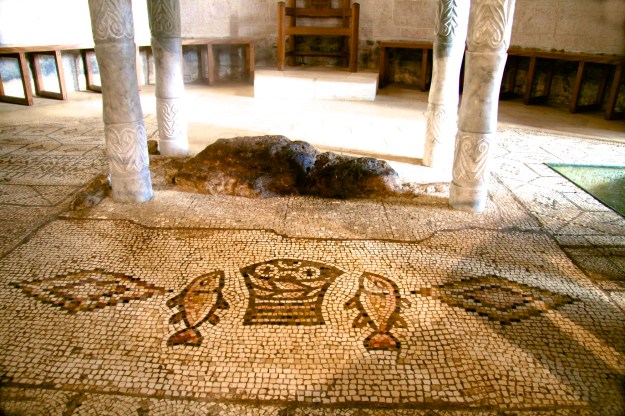
The gospel readings this week are from St.John’s gospel– segments of Jesus’ long discourse on the Bread of Life to the crowd at Capernaum after the miracle of the loaves. (John 6) In the Eucharist we meet the Risen Christ. He not only feeds us personally, but a growing church is fed.
In today’s reading at Mass from 1 Corinthians ( 11, 17-26.33) we have the earliest written account of the institution of the Last Supper in the New Testament:
“For I received from the Lord what I also handed on to you,
that the Lord Jesus, on the night he was handed over,
took bread and, after he had given thanks,
broke it and said, “This is my Body that is for you.
Do this in remembrance of me.”
In the same way also the cup, after supper, saying,
“This cup is the new covenant in my Blood.
Do this, as often as you drink it, in remembrance of me.
For as often as you eat this bread and drink the cup,
you proclaim the death of the Lord until he comes.”
The simple account stresses that Jesus, taking bread and wine, gave himself, Body and Blood, “for you.” He gave himself for all. When we do this “in remembrance of me” we are called to be like him, to give ourselves for all.
Paul warns the Corinthians that by what he hears of their divisions and factions they’re failing to do what the Lord commands. Instead of imitating what Jesus d, they’re driving others away in their celebrations and thus bringing judgment on themselves.
Therefore, my brothers and sisters,
when you come together to eat, wait for one another.
A beautiful phrase Paul uses, “wait for one another.” A phrase that comes from the family meal in Paul’s time, when someone might miss the meal if the family did not wait for them. “We have to wait for them.”
So we wait for the grace Jesus offers at the Eucharist, to see all at the table of the Lord, loved by God who loves all.
When we read the Acts of the Apostles in the easter season, we see another form of church. The church of Paul and Barnabas is certainly different in structure from the church we know today.
There were no parishes or dioceses then. In Rome, if you asked where the Vatican was, they’d point you to a race course on a hill on the fringe of the city where the emperor had his private games. There were no monasteries or religious communities or other Christian institutions.
When Paul and Barnabas went to different places, they went to the Jewish synagogues where they spoke about Jesus as the Messiah. The reaction to their message was mixed, at best. At times they were violently rejected, but some Jews and some “God-fearing gentiles” – non-Jews who appreciated Judaism and its spirituality– accepted their message about Jesus and his promise of salvation.
The synagogue was the normal “catechumenate” where early Christian missionaries like Paul and Barnabas found converts to the faith. No synagogues, as far as we know, became Christian churches.
Where, then, did new believers go? They gathered in the houses of other believers, in “house churches”, usually bigger houses belonging to merchants. The owners and their families lived in these houses, but they also conducted their business in part of the house. Their servants and slaves would live and work there too.
In his Letter to the Romans Paul sends his greeting to Prisca and Aquila and the “church in their house.” They were husband and wife, a couple of merchants who ran a leather business in Corinth. Paul lived with them for almost two years; he worked and taught in their house. After that, he lived in their house in Ephesus and founded the church in that city. He calls them “ my co-workers in Christ Jesus, who risked their necks for my life. I am grateful to them but also all the churches of the gentiles.”
In Rome there were no churches as we know them till the 4th century, but historians count 25 house churches where Christians met in the early centuries in that city.
Our church structure developed since then, we can see a development in our first reading today. Paul is appointing leaders in every church. But there’s something important this early time can teach us. At the end of his Letter to the Romans, after expounding on some of his most profound teachings, Paul remembers a number of people in Rome he wants to greet. Prisca and Aquila and all the church in their house are the first; they must have moved back to Rome. Then there are a number of other names that seem to come spontaneously to his mind. They’re the names of ordinary Christians, not just the owners of the houses where Christians meet and their families, but the servants, the slaves, the ordinary people whom Paul lived with and worked with and prayed with side by side.
Unfortunately, this section of his letter is never read in church. It should be; it breathes with affection and appreciation and love for all the people who are the body of Christ. Listen to it.
Greet Prisca and Aquila, my co-workers in Christ Jesus,
who risked their necks for my life, to whom not only I am grateful but also all the churches of the Gentiles; greet also the church at their house. Greet my beloved Epaenetus, who was the firstfruits in Asia for Christ.
Greet Mary, who has worked hard for you.
Greet Andronicus and Junia, my kinsmen and my fellow prisoners; they are prominent among the apostles and they were in Christ before me.
Greet Ampliatus, my beloved in the Lord.
Greet Urbanus, our co-worker in Christ, and my beloved Stachys.
Greet Apelles, who is approved in Christ. Greet those who belong to the family of Aristobulus.
Greet my kinsman Herodion. Greet those in the Lord who belong to the family of Narcissus.
Greet those workers in the Lord, Tryphaena and Tryphosa. Greet the beloved Persis, who has worked hard in the Lord.
Greet Rufus, chosen in the Lord, and his mother and mine.
Greet Asyncritus, Phlegon, Hermes, Patrobas, Hermas, and the brothers who are with them.
Greet Philologus, Julia, Nereus and his sister, and Olympas, and all the holy ones who are with them.
Greet one another with a holy kiss. All the churches of Christ greet you. ( Romans 3,3-16)
Paul doesn’t want to leave anybody out. You can hear his love for them all. That’s the love Jesus had for his disciples. “Love one another, as I have loved you.” That’s the love that should be in our church, no matter what its structure is.
What Paul the Apostle praises in our 1st reading today at Mass and Jesus urges in the gospel is a love that reaches out beyond our friends and those close by. Paul sees this love in the collection taken up by the Macedonians for the poor in Jerusalem. It’s a graced love, Paul says, expanding your care and your vision. Your love is like God’s.(2 Corinthians 8,1-9)
Jesus urges the same kind of love in the gospel. God’s love is like the sun that shines on everyone, life the rain that falls on the just and the unjust. It’s not an easy love, but if you wish to be perfect “Be perfect just as your heavenly Father is perfect. (Matthew 5,43-48)
A couple of years ago CNN carried a story of that kind of love. Paula Cooper was released from the Rockville Correctional Facility in Indiana yesterday, a free woman. In 1985 as a young girl of 15 she decided to steal some money from a 76 year old bible teacher, Ruth Pelke. After smoking marijuana and drinking wine, she went to her home, hit Pelke with a vase and stabbed her in the stomach thirty times–for $10.
Leading the pleas for Cooper’s release, was Pelke’s grandson, Bill Pelke, who said he forgave her shortly after Cooper was sentenced to death.
Here’s the CNN story:
“’I became convinced beyond a shadow of a doubt that my grandmother would have had love and compassion for Paula Cooper and her family,’ Pelke told CNN. ‘I felt she wanted someone in my family to have that same sort of love and compassion. I didn’t have any but was so convinced that’s what she would have wanted, I begged God to give me love and compassion for Paula Cooper and her family and do that on behalf of my grandmother.’”
“He said it was ‘a short prayer,’ but it was answered.
“’For a year and a half, whenever I thought about my grandmother, I always pictured how she died. It was terrible,’ he said. ‘But when my heart was touched with compassion, forgiveness took place. I knew from that moment on when I think about her, I would no longer pictured how she died, but I would picture how she lived, and what she stood for, what she believed in — the beautiful, wonderful person she was.’”
“Pelke tried to visit Cooper in 1986, but the two didn’t come face to face until eight years later. The two struck up an unlikely friendship over the years, exchanging messages through the prison e-mail system every week. And in 1989, the Indiana Supreme Court reduced Cooper’s death sentence to 60 years in prison.”
“Pelke said he would like to help Cooper with her transition to life outside of prison.
‘I hope that we’re able to go out and have a meal. I’ve told her when she got out of prison I’d like to buy her a computer and I have a friend that would like to buy her some clothes. Hopefully we’ll get together within the next few days and go shopping,’ he said.”
“Pelke said he’s never asked Cooper to explain her actions – ‘There’s not a good answer for that’ — but said she has shown remorse for the killing.
‘She would take it back in a heartbeat if she could, but she knows she has to live with it for the rest of her life,’ he said. ‘She knows she took something valuable out of society. She wants to try to give back. She wants to help work with other young people to avoid the pitfals she fell into.’”
Today, the Feast of the Conversion of St. Paul, the liturgy invites us, not to look on Paul from a distance, but to share the mystery of his life. So I can say:
“Victor, my grace is sufficient for you; my power is made perfect in weakness.” “God’s grace in me has not been without fruit; it is always at work in me.”
By looking on Paul simply as a distant historical figure or a Christian hero we diminish what we share with him.
Here’s how St. John Chrysostom sees him:
“Paul more than anyone else, shows us what we really are, and in what our nobility consists, and what we are capable of. Each day he aimed ever higher; each day he rose up with greater ardor and faced with new eagerness the dangers that threatened him. He summed up his attitude in the words: I forget what is behind me and push on to what lies ahead. When he saw death imminent, he bade others share his joy: Rejoice and be glad with me! And when danger, injustice and abuse threatened, he said: I am content with weakness, mistreatment and persecution. These he called the weapons of righteousness, thus telling us that he derived immense profit from them.
“ He boasted of constant beatings, abuse and cursing as though he were taking trophies home on a triumphal procession, giving thanks to God for it all. The only thing he really wanted was always to please God.
“He knew himself to be loved by Christ. Enjoying this love, he considered himself happier than anyone else; were he without it, it would be no satisfaction to be the friend of principalities and powers. He preferred to be thus loved and be the least of all, or even to be among the damned, than to be without that love and be among the great and honored.
“Paul set no store by the things that fill our visible world, any more than someone sets value on the withered grass of the field. As for tyrannical rulers or the people enraged against him, he paid them no more heed than gnats. Death itself and pain and whatever torments might come were but child’s play to him, provided that thereby he might bear some burden for the sake of Christ.”
The gospels tell the good news of Jesus Christ– what he did and said. They don’t tell it all.
We’d like to know more about him, of course, but how about some others the gospels mention in passing?
Like Peter’s mother-in-law, for example, whom Mark’s gospel recalls. After leaving the synagogue at Capernaum where he expelled an unclean spirit from a man, Jesus entered the house of Peter and Andrew where Peter’s mother-in-law has a fever. Not quite as bad as being possessed by an unclean spirit, we may think, but most of us know a bout with the flu can take a lot out of you too.
Jesus took her by the hand and helped her up. The fever left her and she waited on them.
That final phrase “and she waited on them” – says a lot.
She was one of those who cooked their meals, washed and mended their clothes, fussed over them when they came home, wanted to know what happened that day, tried to protect them when too many people were knocking on the door to see them. Cook, Cleaner, Advisor, Gatekeeper, Supporter, and much more.
We all know what it means when someone like her waits on us.
Peter’s mother-in-law not only received the blessing of Jesus but kept it alive in what she did. She welcomed Jesus in the way she alone could. Without what she did, do you think he and his disciples could have carried on?
The church exists on many levels. Paul used the analogy of a body. We tend to think it’s just a few that bring the gospel to the world, but it’s never been the work of a few. Many, like Peter’s mother-in-law, have a part in it too.
The church is not made up of “Lone Rangers.” The final chapter of Paul’s Letter to the Romans has a litany of people in the Roman church whom the apostle greets as friends and co-workers. Most of them we know nothing about. Some of them, like Peter’s mother-in-law, probably “waited on him.”

 The Victor's Place