Tag Archives: Passionists

The Feast of St. Barnabas

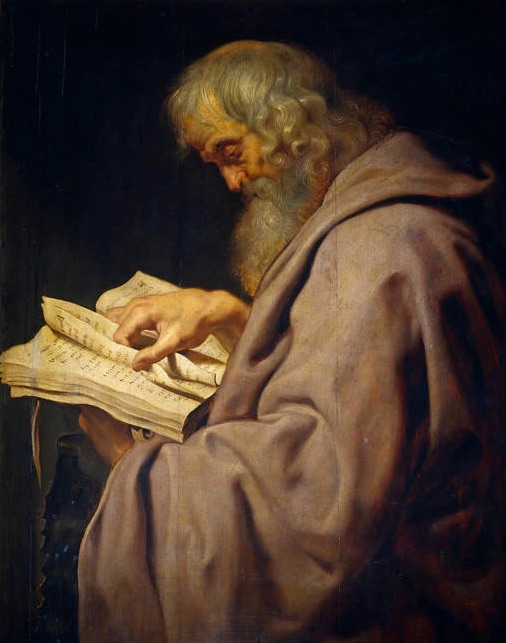
St. Barnabas, 18th century anonymous

Saints share their gifts, and recognize the gifts of others. That’s what St. Barnabas did. He was a gifted teacher of the Gospel; he also recognized the gift of Paul of Tarsus. His feast is June 11.

After his dramatic conversion on the way to Damascus, Paul preached the gospel in Damascus and then in Jerusalem, but his past caused some in Jerusalem to be suspicious of him. “They were all afraid of him, not believing that he was a disciple.”

“Then Barnabas took charge of him and brought him to the apostles, and he reported to them how on the way he had seen the Lord and that he had spoken to him, and how in Damascus he had spoken out boldly in the name of Jesus.” (Acts 9, 25-27) Barnabas recognized the grace of God in Saul.

Then, as gentiles in Antioch became increasingly interested in the gospel, the leaders of the Jerusalem church sent Barnabas to see what to do. “When he arrived and saw the grace of God, he rejoiced and encouraged them all to remain faithful to the Lord in firmness of heart, for he was a good man, filled with the holy Spirit and faith. And a large number of people was added to the Lord. Then he went to Tarsus to look for Saul, and when he had found him he brought him to Antioch. For a whole year they met with the church and taught a large number of people, and it was in Antioch that the disciples were first called Christians.” (Acts 11,23-26)

Barnabas recognized Paul’s gifts once again and sought him out to bring the gospel to the gentiles. Previously, the Apostle Peter encountered the gentile Cornelius in Ceasaria Maritima and baptized him and his friends. Now, Barnabas chooses Paul to come to Antioch, and the two embark on a mission to the gentiles. The Acts of the Apostles refer first to “Barnabas and Saul”, then gradually it becomes “Paul and Barnabas.”

Paul emerged as a gifted apostle. The Acts of the Apostles follows him all the way to Rome, while Barnabas is hardly mentioned at all. There are indications he returned to Cyprus where he came from. Did he get sick, or was he too old to embark on something new?

Whatever it was, Barnabas first recognized Paul and his gifts. I noticed on his feast, Paul is quoted in his letter to the Corinthians. “I handed on to you what I myself received…” Part of that was from Barnabas.

Praying in Jesus Christ

Farewell Discourse of Jesus. Duccio

“I pray for them,” Jesus says in John’s gospel as he looks at his disciples in the supper room and also at us who are his own today. We’re so conscious how poorly we pray. We need to remember Jesus is praying for us and in us. 

Is it possible to speak to God, we ask ourselves? We’re so easily distracted, so weak in faith, so bound to life as it is. How can we approach God in prayer?

“Let the Son who lives in our hearts, be also on our lips,” St. Cyprian says in his commentary on the Our Father. Jesus joins our weak and stumbling prayers to his own. He prays in and for us and assures us we will be welcomed and heard.

“I pray for them,” Jesus said in the supper room. He prayed for his disciples there in the supper room. When they left they entered the Garden of Gethsemani where they fell asleep, forgetful of everything. A stone’s throw away, Jesus prayed. His prayer was not only for himself but for them as well.

“I pray for them,’ Jesus says in our liturgical prayers. We speak to God the Father “through Jesus Christ, your Son, who lives and reigns with you and the Holy Spirit, One God, forever and ever. Amen.”

Whenever we pray, whether with others in public prayer or praying alone, he enters our prayer. “Let us pray with confidence to the Father in the words our Savior gave us,” we say as we begin the Our Father at Mass.

Our confidence in prayer comes, not from our own wisdom, or holiness or faith, but from Jesus who says “I pray for them.”


The Holy Spirit: Water Poured Out

IMG_0943
The Holy Spirit is “poured out on all flesh,” Peter tells the crowd at Pentecost who represent all peoples.  The Spirit is like water poured out, St. Cyril of Jerusalem tells his hearers:

“The water I shall give him will become in him a fountain of living water, welling up into eternal life. This is a new kind of water, a living, leaping water, welling up for those who are worthy. But why did Christ call the grace of the Spirit water? Because all things are dependent on water; plants and animals have their origin in water. Water comes down from heaven as rain, and although it is always the same in itself, it produces many different effects, one in the palm tree, another in the vine, and so on throughout the whole of creation. It does not come down, now as one thing, now as another, but while remaining essentially the same, it adapts itself to the needs of every creature that receives it.
 
 “In the same way the Holy Spirit, whose nature is always the same, simple and indivisible, apportions grace to each one as he wills. Like a dry tree which puts forth shoots when watered, the soul bears the fruit of holiness when repentance has made it worthy of receiving the Holy Spirit. Although the Spirit never changes, the effects of his action, by the will of God and in the name of Christ, are both many and marvellous.
 
 “The Spirit makes one person a teacher of divine truth, inspires another to prophesy, gives another the power of casting out devils, enables another to interpret holy Scripture. The Spirit strengthens one person’s self-control, shows another how to help the poor, teaches another to fast and lead a life of asceticism, makes another oblivious to the needs of the body, trains another for martyrdom. His action is different in different people, but the Spirit himself is always the same. In each person, Scripture says, the Spirit reveals his presence in a particular way for the common good.
 
“The Spirit comes gently and makes himself known by his fragrance. He is not felt as a burden, for he is light, very light. Rays of light and knowledge stream before him as he approaches. The Spirit comes with the tenderness of a true friend and protector to save, to heal, to teach, to counsel, to strengthen, to console. The Spirit comes to enlighten the mind first of the one who receives him, and then, through him, the minds of others as well.
 
 
“As light strikes the eyes of a person who comes out of darkness into the sunshine and enables him to see clearly things he could not discern before, so light floods the soul of someone counted worthy of receiving the Holy Spirit and enables him to see things beyond the range of human vision, things hitherto undreamed of.”  (Catechesis)

The Visitation of the Blessed Virgin Mary: May 31


Faith gives you life and calls you to a mission. That’s what it did for Mary, the mother of Jesus. Mary believed in the message of an angel at Nazareth. She welcomed the Son of God to be born of her, and he brought life to her and to the world.

He gave her a mission, Luke’s gospel says today.  Mary set out “in haste” for the hill country of Judea to visit Elizabeth, the wife of Zechariah, who also was with child. Mary has a mission.                                                                                                                        

When Elizabeth heard Mary’s greeting, the infant leaped in her womb.” The infant who would be John the Baptist, leaped for joy, the gospel says.

Both of these women had exceptional faith. Mary, the younger woman, accepted what the angel asks, even as she questions how it will take place and the meaning of it all.                                                                                                                                 

Elizabeth, the older woman, conceives with her husband, Zechariah. But she’s an old woman, pregnant with a child. However miraculous her pregnancy was, she must have felt fear and uncertainty for having a child in her old age. Like Mary, she must have asked, “How can this be?” “What does this all mean?”

Mary’s visit took those fears away from her. The child in Elizbeth’s womb leaped for joy. Elizabeth’s fears were turned into joy. Faith gives you life and sends you on a mission. Exceptional faith, in the case of Mary and Elizabeth led to exceptional missions. 

In spite of what some people think, faith is not a burden that cripples you. Faith is a gift that empowers you. It takes you beyond your dreams and what you hope for. 

“Blessed are you who believed,” Elizabeth says to Mary.

“You too, my people, are blessed,” comments St. Ambrose, “ you who have heard and who believe. Every soul that believes — that soul both conceives and gives birth to the Word of God and recognizes his works.

“Let the soul of Mary be in each one of you, to proclaim the greatness of the Lord. Let the spirit of Mary be in each one of you, to rejoice in God. According to the flesh only one woman can be the mother of Christ, but in the world of faith Christ is the fruit of all of us.”

As with Mary so with us, faith gives life and sends us on a mission..

The Song of Birds

Noah
Before 7 :
AM  I sit for a few minutes on the porch as the weather gets warmer, watching the birds. There are almost 40 different birds in our garden, just up from the E train.   The sparrows and the doves are usual visitors,  singing away, but the other day they couldn’t be seen or heard.  I soon saw why: a big hawk flew by overhead.

After awhile the birds were back,  chirping and moaning  as usual. Someone told me our ears are wired to hear the song of birds. Why? They tell us no dangerous enemies nearby, all is well.

Birds singing tell us the world’s in good hands. Is that why Noah sent a dove from the ark? The dove not only brought back olive branches signifying all was well, but sang the good news to those in the closed boat.

The Holy Spirit descends in the form of a dove. The ancients saw birds as mysterious visitors from heaven. I notice something fearless in the doves at our feeder. The sparrows scatter quickly at the least sign of danger; the doves stay and hold their ground. Like the dove, the Holy Spirit is a giver of life to our land and won’t abandon us.

By baptism we’re wired to hear God’s voice. We listen for God’s good news, despite the dangers. We listen for a world redeemed, a higher plan at play. Good reason to begin the day, listening to birds singing..

7th Week of Easter: Last Instructions

To listen to today’s homily, please select the audio file below:

The Ascension of Jesus into heaven is recalled briefly in Mark’s gospel (Mark 16,19) and described in more detail in Luke’s gospel (Luke 24, 44-53} and in the Acts of the Apostles. (Acts 1, 1-14) As he leaves his disciples, Jesus promises to send them his Spirit.

What are his final instructions to them before he ascends into heaven? They are to be witnesses to him. They will have power from the Holy Spirit to witness, but there’s no promise of security, safety, or immunity from fear or suffering. Just the opposite, Jesus sends them on a mission that’s insecure, unsafe and hard.

Here’s what Jesus says in Mark’s gospel, “Go into the whole world and proclaim the gospel to every creature.” “The whole world?” we might say. “To every creature?” It’s a dangerous world out there, and there are creatures in it I don’t particularly like. Yet, that’s the mission Jesus entrusts to his disciples–and us.

“These signs will accompany those who believe,” Jesus continues. “In my name they will drive out demons, they will speak new languages, they will pick up serpents and if they drink any deadly thing, it will not harm them. They will lay hands on the sick, and they will recover.”

That seems to mean if you really believe in Jesus you confront the evil in this world, you learn new things all your life, you deal with snakes–they’re out there too, you can recover from the deadliest experiences, and you can bring healing to those who need healing.

In Luke’s Ascension account in the Acts of the Apostles the disciples wonder if this is the time when God’s kingdom will come now, her and now. Heaven on earth. “Lord, are you at this time going to restore the kingdom to Israel?”

We have hopes like that too, don’t we? That God’s kingdom come here and now, and everything will be perfect. Jesus tells his disciples they wont know the day or the hour. Perfection doesn’t happen here on earth.

As the disciples stand looking at the Lord ascending, Luke writes, angels ask them “Why are you standing here looking up into the sky?” Jesus will return. Go back into the city and live as he asks you to live. You will receive what he promised there. No standing looking up into the sky. Stay where you are; that’s where the promises will be kept.

Luke goes on to describe the disciples making their way back to Jerusalem and praying there with Mary, the mother of Jesus. Prayer prepares them for the Spirit who comes. Prayer prepares us too.

5th Week of Easter: Readings and Feasts

Spanish

The Acts of the Apostles, read this week, describes  the church’s growth after the Resurrection of Jesus as Paul and Barnabas bring the gospel tos the gentiles in the Asia Minor cities of Lystra, Derbe, and Pisidia. Yet, the mission raised questions in the Jewish Christian community at Jerusalem. Are the gentiles taking over?

To meet what some considered a threat,  a council was called in Jerusalem, which had enormous consequences . Councils are usually important events in the life of the church. The Second Vatican Council that took place in the 1960s was an important event for the church in our time.

The Council of Jerusalem is described on Wednesday to Saturday of this week.

The gospel readings for the remainder of the Easter season are from the Farewell Discourse from John’s gospel. They help us understand the presence of Jesus in the Eucharist and the other sacraments.

“I will not leave you orphans,” Jesus says, yet he will not be with them as he was before. The Paraclete, the Spirit of truth, will teach them all things; Jesus will be present to them –and to us– in signs.

St. Gemma Galgani

SONY DSC

Gemma Umberta Pia Galgani
(1878-1903)

Gemma Galgani died on Holy Saturday, 1903 in Lucca, Italy. Her death should have been completely unnoticed. She was often sickly in her 25 years of life and had to be taken care of. She left no children or family/. No hospitals, schools or any human achievement bear her name. Disappointments marked her life at every turn. She never got her wish to enter the Passionist Nuns or any other religious community.

Yet, at the news of her death on Holy Saturday, her neighbors gathered quickly in the Lucca’s ancient streets proclaiming “A saint has died.” Today in the Easter season we’re celebrating her feast.

Holy Saturday, the day after Jesus suffered and died, is the day before Jesus rose from the dead and appeared to his disciples. They report that he ate and drank with them for some days before ascending into heaven. He showed them the wounds in his hands and his side. He appeared to them, not just to prove he was alive, but affirm his love for them and for the whole world. He promised life. 

Gemma knew the mysteries of Jesus’ death and resurrection in a special way. She spoke familiarly with the Risen Jesus, as we see from her writings, and in a unique way she bore his wounds in her body.

“Poor Gemma”, she called herself; but she was’t poor. Frail in body and mind, she wasn’t a  failure. In declaring her a saint, Pope Pius XII said that Gemma experienced what the great apostle Paul experienced: “I have been crucified with Christ and the life that I live is not my own: Christ lives in me.

The stigmata, the bodily experience of the wounds of Christ, is a rare experience. It was not reason Gemma was declared a saint. Her heroic life of faith, patience and humility revealed her union with Christ, living in her.

The stigmata is a rare experience given to individuals, but it’s not meant for individuals themselves; it’s given to strengthen the belief of many. In Gemma’s time, “enlightened” thinkers like Freud and Jung were beginning to explore the human person. They were little concerned with God’s presence in human life. They would likely have dismissed Gemma’s spiritual experiences as delusional. A number of  Lucca’s “enlightened” people had that opinion of her.

Gemma’s Passionist spiritual director, Father Germano, was introduced to her while preaching in Lucca. He saw God working in her. The church concurred in his judgment by declaring Gemma a saint in 1940.

Many today still define humanity in human terms and sees success here on earth as our ultimate goal. Gemma is a strong reminder of God’s presence in humanity, in ordinary people, even in unsuccessful, imperfect people. Her devotion to the Passion of Jesus gave her a deep sense that Jesus loved her and lived in her.  She saw her life fulfilled in him and she believed his promise of life beyond this. 

Many today think the spiritual world faraway; for Gemma it wasn’t faraway at all– saints and angels, Jesus himself, were ever at her side. She once wrote: “Often I seem to be alone; but really I have Jesus as my companion…I am the fruit of your passion, Jesus, born of your wounds. O Jesus, seek me in love; I no longer possess anything; you have stolen my heart.”

Lucca Streets
SONY DSC
Lucca St. Michael 3

We’re not alone. Jesus Christ is our companion as well.

You can get St. Gemma’s Autobiography or a The Life of St. Gemma Galgani by writing to the Passionist Nuns, 1151 Donaldson Highway, Erlanger, Kentucky 41018
(859)371 8568

“Then one day I became very discouraged because I saw that it was impossible for me to become a Passionist, because I have nothing at alI: all I have is a great desire to be one. I suffer much seeing myself so far from realizing my desires. No one will be able to take this desire away from me. But when will it come about?” Letter to Germano

Gemm’a buried at the Convent of the Passionist Nuns in Lucca, Italy. The house where she lived before she died has been turned into a museum honoring her. Both places worth a visit.

Her feast day is May 16th.

Feast of St. Matthias: May 13

Thomas

May 14th is the Feast of St.Matthias, chosen by lot to take the place of Judas. Appropriately, the feast falls in the Easter season, the time he was selected. Matthias brings the number of apostles back to twelve, symbolic of the twelve tribes of Israel who await the promises of God. The Spirit comes after Matthias is selected in Luke’s account.

The qualifications for a new apostle seem simple enough. Peter says it should be someone “who accompanied us the whole time the Lord Jesus came and went among us, beginning from the baptism of John until the day on which he was taken up from us. He joins us as a witness to his resurrection.”

Two have those qualifications. Joseph called Barsabbas and Matthias.

Then, they pray:
“You, Lord, who know the hearts of all,
show which one of these two you have chosen.”
Then they gave lots to them, and the lot fell upon Matthias,
and he was counted with the Eleven Apostles.” (Acts 1,15-17, 20-25)

Yet, it isn’t as easy as it sounds. To be a witness to Jesus it wasn’t enough to get all the details right about what Jesus did or said, as a reporter or witness at a trial might do. In John’s gospel read for Matthias’ feast, Jesus describes a disciple as one who abides in him, who remains in him– a friend committed to him. So, a disciple cannot be just an on-looker, but one who enters the mystery of Jesus’ death and resurrection. He’s one who weathers doubts and uncertainties as the disciples listening to Jesus’ Farewell Discourse did. He’s like Thomas who sees the wounds in the Lord’s hands and side and learns to trust and believe through them.

I think also that the disciples of Jesus were conscious of their own failures as they selected Matthias. They thought Jesus was the key to an earthly kingdom, but he was not. Surely, they wanted someone who looked beyond their vision as a successor for Judas. They were looking for someone with a new vision of things.

Rembrandt’s wonderful portrayal of Jesus showing his wounds to Thomas (above) presents Thomas, not as a lonely skeptic, but someone representing all the disciples. All the disciples must look at Jesus’ wounds.

Pope Francis in a homily  spoke of the importance of the wounds of Christ for a disciple of Jesus. We’re on an exodus beyond ourselves, he said, and there are two ways open for us. “one to the wounds of Jesus, the other to the wounds of our brothers and sisters.”

“If we are not able to move out of ourselves and toward our brothers and sisters in need, to the sick, the ignorant, the poor, the exploited – if we are not able to accomplish this exodus from ourselves, and towards those wounds, we shall never learn that freedom, which carries us through that other exodus from ourselves, and toward the wounds of Jesus.”

The wounds of Christ and the wounds of our brothers and sisters– we learn from both to see victory over death and to trust in the passion of Jesus.

Like Matthias, we’re called to be witnesses..

Peter

Peter the Apostle, Cloisters, New York

Keep Peter in mind as we read the story of the conversion of Cornelius, the Roman centurion and his household. It was a decisive event for him and the other followers of Jesus. Peter was ministering to Jews in Joppa on the seacoast, when he’s called to Caesarea Maritime to baptize a Roman soldier. Joppa, remember, was the seaport where Jonah began his perilous journey to Nineveh and the gentile world.

In Joppa, the sleeping apostle on the roof of Simon the Tanner’s house overlooking the vast sea has a disturbing vision. Instead of the usual kosher food,  a gentile banquet is poured out before him. As a good Jew Peter pushes it away. Three times the vision invites him to eat.

Then, messengers appear at the door from Cornelius, a Roman soldier stationed in Caesaria Maritime, Rome’s headquarters just up the coast. Peter is to come and speak about “the things that had happened.” He’s invited to the gentile banquet he saw in his dream.

Peter made the journey up the coast and described their meeting: “As I began to speak, the Holy Spirit fell upon them as it had upon us at the beginning.” It was a Gentile Pentecost. Peter baptized the Roman soldier, his family and household. “I truly understand that God shows no partiality, but every nation is acceptable to him,” 

Would Peter know then where this visit to Cornelius would lead? He was a fisherman who spoke Aramaic with a Galilean accent, who felt the pull of home, family and fishing boats. I doubt he would ever be comfortable in a gentile world. After Caesaria he traveled to Antioch in Syria and then finally to Rome where he was killed in the Neronian persecution in the 60’s.

Artists usually portray Peter in Rome as a church leader firmly in charge of the church, holding its keys tightly in hand. Clearly, he is a rock and a strong leader.

I saw another image of Peter years ago in the Cloisters Museum in New York. He’s softer, reflective, more experienced, not completely sure of himself. There’s a consciousness of failure in his face. He seems to be listening humbly for the voice of the Shepherd, hoping to hear it and ever surprised by the unexpected coming of the Holy Spirit.

The early Roman church directed those newly baptized in St. John Lateran at Easter to visit the Church of St. Peter on Vatican Hill on Easter Monday. There they were to remember Peter, who came to Rome from afar to preach the gospel. He was a faithful follower of Jesus and a shepherd of flock. He would help them know Jesus and follow humbly lead the flock wherever Jesus told him to lead it.

Bless our new Pope Leo, Lord.