Saints are raised up by God to meet the needs of their time. What need did the 18th century world of St. Paul have ? The church of Paul’s day was weakened and humbled by politics, revolutions and new ways of thinking. The popes then were losing power and influence in Europe, the Jesuits were suppressed, revolutions like the French Revolution brought persecution, the suppression of church schools, religious houses, the confiscation of church assets. Some said the church was dying.
A humbled church needed to be reminded of the humble Christ, who took the form of a slave and died on a cross and was raised up by God’s power. That’s what St. Paul of the Cross did through his preaching and ministry. His message was a message the church of his time needed to hear. His message was of an abiding hope.
An “abiding hope.” That was the hope needed then. Most of Paul’s preaching and ministry took place in the Tuscan Maremma, a region north of Rome in Italy, the size of Long Island, NY. “Maremma” means swamplands. The Maremma was region of small towns and a few small cities suffering from chronic poverty and neglect. Only at the end of the 18th century did the region inch forward with some reforms. Ironically, Tuscany today is a tourist destination after Mussolini dealt with the swamplands in the 20th century. The world loves Tuscany now.
In Paul’s time, though, it was known for disease, poverty, beggars, the homeless, and bandits. Year after year things never got better. Year after year the future never got bright. Year after year Paul and his companions went from town to town, set up a cross in a church or town square and spoke of the “abiding hope” promised by Jesus Christ to the people who gathered to hear..
His preaching of the Passion of Jesus brought an abiding hope to them. God was with them, no matter how dark things were, or how long the darkness lasted.
Are we living in a church and a world like his today? I wonder, as we struggle with politics, pandemics, climate change, if we’re becoming like the Tuscan Maremma. Some say it will all be over when the political scene settles and wars are over and when science produces a new miracle that makes everything perfect. But I don’t know.
I think we are going to need an “abiding hope” to keep us going. I think the Passionists still have something to do.
May God send laborers into our vineyard. St.Paul of the Cross, pray for us.
In the United States October 20 is the feast of St. Paul of the Cross, founder of the Passionists. You can find more out about him and the Passionists here and here.
The Feast of St. Luke is October 18th. If you’re beginning to read the New Testament Luke’s Gospel is a good place to start. His gospel is the longest gospel, followed by the Acts of the Apostles. Together they present a magnificent picture of the life of Jesus followed by the life of his church.
Luke’s gospel provides many of readings for the various liturgical feasts we celebrate yearly in the church, especially the feasts celebrating Jesus’ early life, like those in the Christmas season, for example. We are reading from Luke’s Gospel these days.
Luke takes over into his gospel about 65% of Mark’s Gospel, which he modifies for his own purposes. He shares with Matthew’s Gospel material from another source, and he also offers material not found in the other gospels–the infancy narratives, for example. (Luke 1-2). He must be the companion St.Paul mentions in his letter to Timothy, read in today’s Mass. “Luke is the only one with me.” (2 Tim 4: 10 ff) He’s the narrator of Paul’s missionary journey in Acts.
Like other evangelists, Luke has his own plan. In his commentary on Luke’s gospel, Timothy Johnson speaks of the way Luke’s positive outlook on the world influences his writings:
“Luke-Acts is positive toward the world, not only as God’s creation but also as the arena of history and human activity. It is perhaps the least apocalyptic of the NT writings, and the least sectarian. Not only is Luke relatively unconcerned about the end time, his historical narrative bestows value on time itself. Luke is also generally approving of those outside the Christian movement. Outsiders-not counting the Jewish opponents who are not outsiders at all– are generally regarded as reasonable and open-minded, which is a high compliment paid by apologetic literature.” (The Gospel of Luke, Liturgical Press, Collegeville, Md. 1991)
Carry the cross with me each day, Jesus says, and don’t worry or be anxious. Be vigilant and prayerful each day, the Lord will return on the clouds of heaven. No, we don’t know the day or the hour, but we’ll we ready for the last day if we prepare for that day each day. Jesus says we can stand strong and fearless on that day, if we live each day well in the meantime. Be especially mindful of the poor. Luke emphasizes that teaching of Jesus in his writings especially.
Isn’t that good advice for times like ours when enormous problems confront our world and clear solutions and grand designs are nowhere to be found? We can so easily fall into pessimism (a form of spiritual sleep) and lose hope. We can also turn away from the poor.
We can use Luke’s optimism today.
Father, you chose Luke the evangelist to reveal by preaching and writing the mystery of your love for the poor. Unite in one heart and spirit all who glory in your name, and let all nations come to see your salvation. Grant this through our Lord Jesus Christ, your Son, who lives and reigns with you in the unity of the Holy Spirit, God, for ever and ever. Amen.
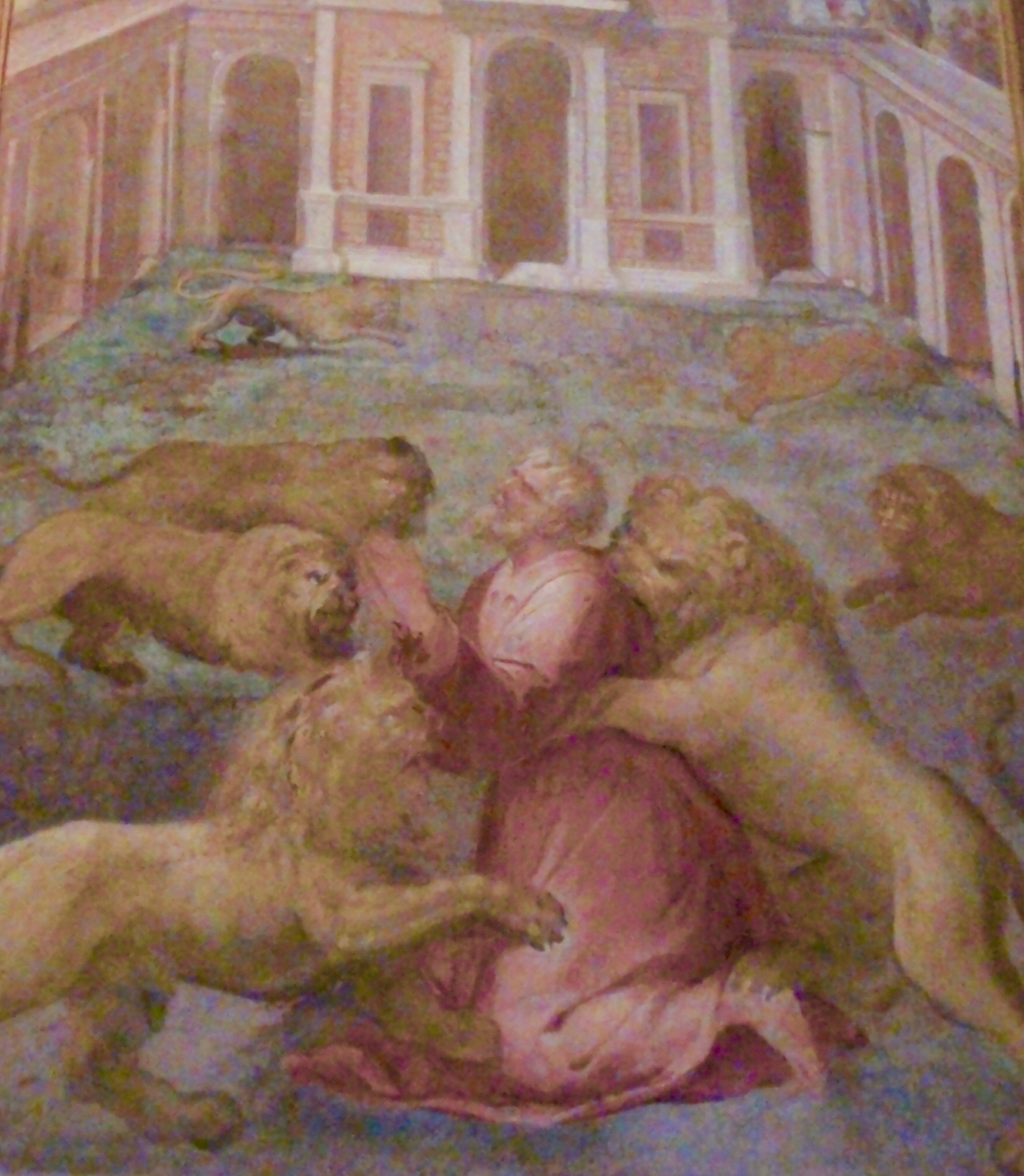
Ignatius, bishop of the large early Christian center of Antioch, was put to death in the third century in the Colosseum in Rome during the reign of Trajan. His death by wild animals is vividly portrayed in the picture (above) in the church of San Stefano Rotondo in Rome. We celebrate his feast October 17th..
On the way to Rome, Ignatius wrote seven letters to important Christian churches. The letters show him as a skillful teacher and writer; he must have been an eloquent preacher.
In his letter to the Christians at Ephesus, however, you sense his days for words are coming to an end. He’s entering the silence of death where words are not important, Ignatius writes– faith and “ being faithful to the end,” are what count:
“It is better to remain silent and to be than to talk and not be. Teaching is good if the teacher also acts. One teacher ‘spoke, and it was done,’ yet what he did in silence was worthy of the Father. He who has the word of Jesus can also listen to his silence…”
What does Ignatius mean? The Word of God silent? True, in his early years at Nazareth, Jesus is silent. Before his baptism in the Jordan by John he’s silent, until the voice of the Father says, “This is my beloved Son, listen to him.”
Then his public ministry began, yet many didn’t hear him at all. Finally, when he’s arrested and taken to the cross to die, the evangelists say Jesus was silent.
Silence is part of facing the mystery of God. Here and now, some things can’t be known or explained. Like terrorism, natural disasters, the suffering of children. Why? God is silent. Again, Ignatius:
“He who has the word of Jesus can truly listen also to his silence.”
Martyrs like Ignatius made early Christians aware of what it meant to follow Jesus. It meant following Jesus into the silence of his death and his promise of resurrection. Some, however, were not so brave. As religious persecutions increased, many Christians abandoned their faith rather than face death. All they could see was this world.
The martyr became a significant figure in Christianity, a faithful follower of Jesus, an example for Christians to see further than this life. That’s why martyrs are so frequent in our calendar.
The martyr was also a powerful advocate for the mercy of God, who could turn our fear of death into hope. In the pictures of above, powerful lions tear into the saint, but his face is not turned to them, but to the One who promises life “I believe in the resurrection of the body and life everlasting. Amen.”
We’re reading at Mass from the long portion of Luke’s gospel describing Jesus’ journey from Galilee to Jerusalem–chapters 9,51-18,14. One sentence dominates this part of Luke’s gospel. “Follow me,” Another sentence we hear repeatedly: “Don’t look back.”
Notice how Jesus’ miracles on this journey help people stuck in one place move on. So, he cures the ten lepers confined outside a village in Samaria and sets them free. “Stand up and go,” Jesus says to them. (Luke 17,11-19) The blind man begging beside the road outside Jericho seems doomed to sit there forever. Jesus immediately gives him his sight and getting up he “followed him, giving glory to God.” {Luke 18, 35-43)
“Follow me,” Jesus says on his way to glory, but not all hear. Leprosy and blindness aren’t the only things stopping them. In Luke’s journey narrative; lots of things get in the way..
In Lot’s day, Jesus says, “they were eating, drinking, buying, selling, planting , building on the day Lot left Sodom.” It was time to see beyond these things and get going, but Lot’s wife looked back instead of looking ahead. Fixed on life she knew, she’s frozen there, and she’s.not the only one.
Jesus gives other examples in Luke’s journey narrative. The rich fool building bigger barns, (Luke 12,16-21) the rich man absorbed in himself and his riches, (Luke 16, 19-31) the man absorbed in a lawsuit with his brother, (Luke 12,13-15) the disciples absorbed in maneuvering politically for first place.(Luke 18,15-17) How can they make the journey?
Jesus returns often to another theme that’s a remedy for our lack of faith. Pray constantly, he says. Never stop praying, for prayer opens your eyes and your mind and your heart. Prayer gives us the grace to take up our cross each day and follow him.
Since their founding in the mid 1800s, the Passionists have given the church a variety of saints and blessed. St. Paul of the Cross, a preacher and mystic, St. Vincent Strambi, a holy bishop during the Napoleanic Suppression, Blessed Dominic Barberi, a fervent missionary to England, St. Gabriel Possenti a young Italian saint who died in his early 20s, Blessed Eugene Bossilkov, a martyr bishop under the Communists in Bulgaria in the 1950s.
October 6th we honor Blessed Isidore de Loor 1881-1916, from the Flemish part of Belgium, who entered the Passionists as a lay brother at 26.
The opening prayer for a feast usually indicates why a saint or blessed is honored.
Lord God, in Blessed Isidore’s spirit of humility and work you have given us a life hidden in the shadow of the Cross. Grant that our daily work be a praise to you and a loving service to our brothers and sisters. We ask this through Christ our Lord.
A life hidden in the shadow of the Cross. That’s Isidore. He was a humble, hard worker all his life. . He spent the first 26 years of his life working the family farm in Vrasene, Belgium, with his parents, brother and sister. Farming was tough at the time, demanding long hours and offering little to show for it. The agricultural sector in Belgium was near collapse. Yet, Isidore praised God and served his brothers and sisters through hard continuing work.
Prayer was the hidden power in his life. Isidore taught catechism in his parish; prayed at local shrines and made the Stations of the Cross daily. He wanted to enter religious life, but delayed till his brother Franz was free from a call-up for military service and could keep the family farm going.
Entering the Passionists as a brother, Isidore took on whatever responsibilities they gave him to do. At first, they told him to be the community cook. “Before I dug the earth, planted seed and harvested crops, now I cut vegetables, put them in pots on the stove and cook them till they’re ready,” he told his family. Whatever his work, he saw it as God’s will and a way to serve.
In 1911, cancer developed in Isidore’s eye and it had to be removed. He was not cancer free, the doctors said, cancer eventually would take his life. God’s will be done, he said.
As his strength declined, he became porter at the monastery door. World War 1 was beginning and German troops invaded Belgium. The frightened people who came to the monastery found support in the quiet faith of “Good Brother Isidore”.
In late summer 1916 Isidore’s health worsened. He died of cancer October 6, 1916, as German troops occupied the area and some were billeted in the monastery itself. He was buried quietly; his family and religious community were not allowed to attend. Yet, he would not be forgotten.
When the war ended, people came to the “Good Brother’s” grave. Cures from cancer and other illnesses occurred. They recognized a holy man who worked and prayed each day and served his brothers and sisters. A friend of God, hidden in the
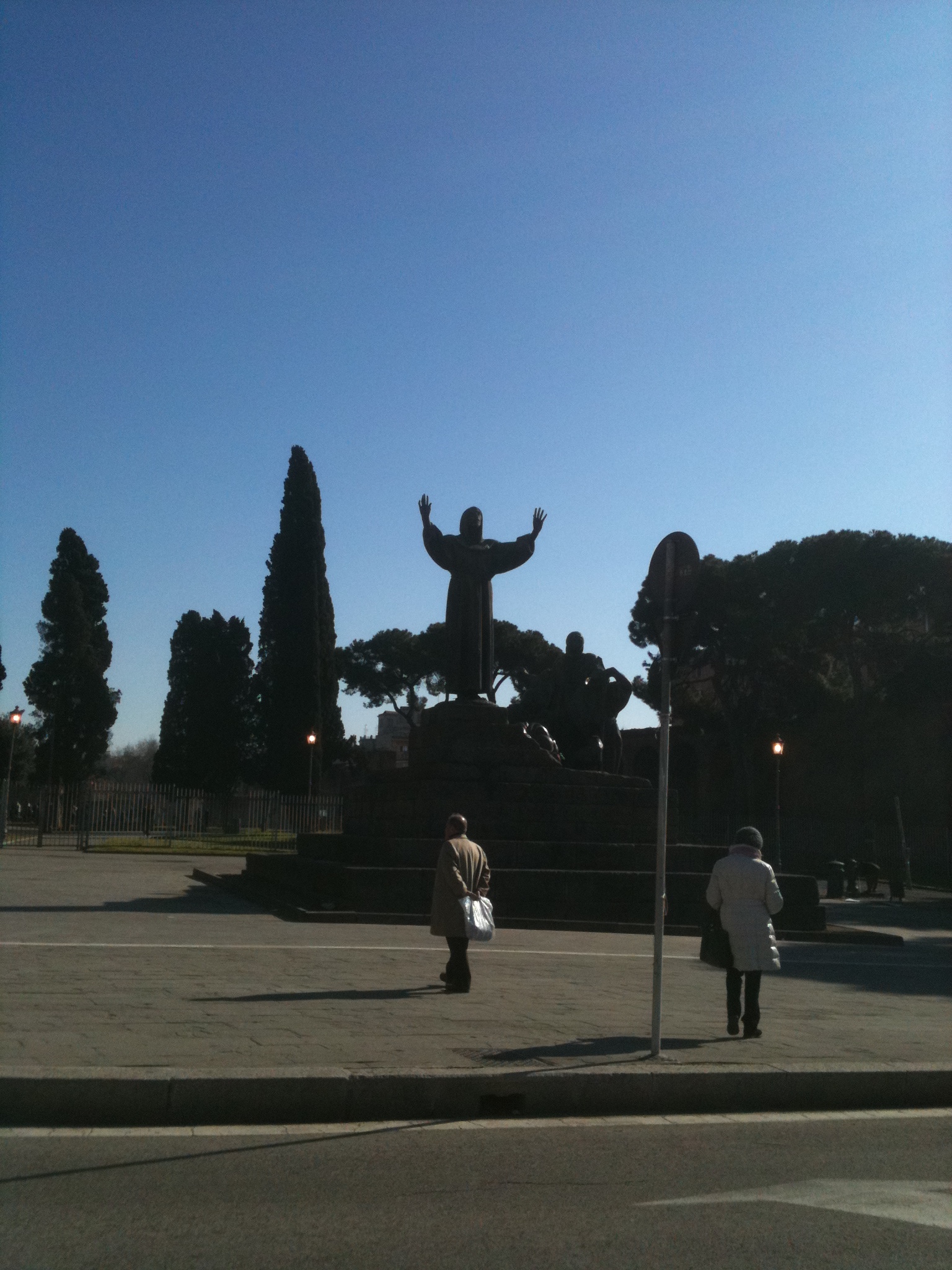
October 4th is the Feast of Francis of Assisi. A large statue of Francis with arms outstretched stands facing the Basilica of St. John Lateran in Rome. If you face the the basilica from behind the statue, you might think the saint was holding up the church in his arms. And that’s what he did: Francis raised up a church that was falling down
We need to see saints in the light of their times as they met the needs of their day. Chesterton called saints “God’s antidotes for the poison of their world”.
What was poisoning Francis’ world? Twelfth century Italy’s economy was booming when Francis was born. His family was among its new rich merchant class. As a young man he had everything money could buy, but then, as now, money could be a poison.
Italy’s cities, often at war, fiercely competed with one another, fighting for power.. It was the time of the crusades and everything was settled through force of arms.
It was a time too when the church had become weak and in need of reform. Before Francis, saints like Bernard of Clairvaux (1090-1153) and popes like Gregory VII (1015-1085) and Innocent III (1160-1216) sought renewal and change. The church was looking for a saint.
And so when Francis of Assisi came with twelve disciples to see the pope in Rome about reforming the church in the summer of 1220, he came at the right time. They say that the pope had a dream the night before that St. John Lateran, the mother church of Christendom, was falling down and a young man resembling the 28 year old Francis came to hold its walls up.
The pope asked Francis what would he do and Francis replied with three verses of scripture. The first was from the gospel of Matthew in which Jesus says to the young man ‘If you wish to be perfect, go, sell your possessions, and give the money to the poor, and you will have treasure in heaven; then come, follow me.’(19,21) The second from Luke’s gospel in which Jesus sends his disciples out saying “Take nothing for your journey, no staff, nor bag, nor bread, nor money—not even an extra tunic.”( 9,3) The third from Matthew: Jesus says, “If anyone wishes to come after me, let him deny himself and take up his cross.” (16,24)
The pope was a good judge of people and, sensing the grace of God in Francis, told him to live those gospel teachings, sending him on his way. Francis and his companions started a movement that spread like fire throughout Europe.
Francis made Jesus’ teachings his own. He embraced poverty, not just renouncing the rich lifestyle that he was born into, but renouncing any way that led to power. For example, he never became a priest or a bishop or a pope, because they were positions of power fought for and sometimes paid for in his day.
He did not want a monastery or a religious order as a base of power. Saints like St. Bernard and St Norbert before him thought monasticism was the way to bring about church reform, but Francis wanted a life style where you had nothing, “no staff, nor bag, nor bread, nor money—not even an extra tunic.” He distanced himself and his movement from the religious institutions of his day, because he feared them becoming places of power.
He took the gospel teachings literally and lived them literally. His renunciation of power became an antidote to the poisonous attraction to power that crippled his world and his church. He imitated the “Son of Man” a poor man who said to his followers the “foxes have dens and birds of the sky have nests, but the Son of Man has nowhere to rest his head.”
Like the Son of Man, who suffered and died on a cross and rose again, Francis experienced the mystery of the cross and was blessed by it.
Remembering him, we might pray: God send us saints to deal with the poison of our time.
“Time present and time past/Are both perhaps present in time future.”
St. Thèrése put two titles to her name after she became a Carmelite nun. She holds those two titles in this photo. One was Thèrése of the Child Jesus, the other was Thèrése of the Holy Face of Jesus. She wished to be known by these two titles: Thèrése of the Child Jesus and the Holy Face.
The titles came from religious experiences she had. The first occurred on Christmas day, 1886, when she was 13 years old. Shorlty afterwards, she had an experience of the Passion of Jesus, which took place one Sunday of the next year, when she was 14. She describes the two experiences in chapter 5 of her autobiography. Her experience of the Passion of Jesus involved a murderer.
“One Sunday, looking at a picture of Our Lord on the Cross, I was struck by the blood flowing from one of the divine hands. I felt great sorrow when thinking this blood was falling to the ground unnoticed. I was resolved to remain in spirit at the foot of the Cross and to receive the divine dew. I understood I was then to pour it out upon souls.
The cry of Jesus on the Cross sounded continually in my heart: “I thirst!” These words ignited within me an unknown and very living fire. I wanted to give my Beloved to drink and I felt myself consumed with a thirst for souls. As yet, it was not the souls of priests that attracted me, but those of great sinners; I burned with the desire to snatch them from the eternal flames.”
At the time a notorious murderer, Pranzini had been condemned to death and refused to see a priest. Thèrése was deeply affected by the sensational story and asked Jesus, “feeling that I myself could do nothing,” to be merciful to him. She had Mass offered for him, she begged God’s mercy.
Afterwards the newspaper reported a priest offered Pranzini a crucifix as he went to his death and he kissed it fervently three times. Thèrése believed her prayers were answered “Then his soul went to receive the merciful sentence of him who declares that in heaven there will be more joy over one sinner who does penance than over ninety-nine just who have no need of repentance!”
For Thèrése the Passion of Jesus was a sign of God’s mercy. His words “I thirst,” were more than an expression of physical thirst, they expressed his desire to show a merciful love to the world.
The teen age girl’s experience reminds us that God’s graces can come to anyone, at any time. The experience left her with a lasting conviction, “I myself can do nothing.” One of her prayerbooks carries a remembrance of her experience.
We celebrate the feast of three archangels today, September 29th. St. Gregory the Great says of the angels: “There are many spirits in heaven, but only the spirits who deliver a message are called angels.” Archangels like Michael, Gabriel and Raphael, “are those who proclaim messages of supreme importance…And so it was that not merely an angel but the archangel Gabriel was sent to the Virgin Mary. It was only fitting that the highest angel should come to announce the greatest of all messages.”
Their names, Gregory says, tell the service they perform. “Thus, Michael means “Who is like God”; Gabriel is “The Strength of God”; and Raphael is “God’s Remedy.
“Whenever some act of wondrous power must be performed, Michael is sent, so that his action and his name may make it clear that no one can do what God does by his superior power…So too Gabriel, who is called God’s strength, was sent to Mary. He came to announce the One who appeared as a humble man to quell the cosmic powers. Thus God’s strength announced the coming of the Lord of the heavenly powers, mighty in battle. Raphael means, as I have said, God’s remedy, for when he touched Tobit’s eyes in order to cure him, he banished the darkness of his blindness. Thus, since he is to heal, he is rightly called God’s remedy.”
St. Paul of the Cross, the founder of the Passionists, dedicated his first foundation on Monte Argentario in Italy to St. Michael and he said the archangel preserved his community from harm. Paul was a Lombard. Historians say the Lombards believed the Saracens were stopped from invading Lombardy in the 6th century by Michael, which fostered devotion to the archangel afterwards.
In a world so convinced that human power is the only power, it’s comforting to have another level of power to look towards.
The opening Mass prayer for St. Vincent’s feast day describes succinctly what made him a great saint:
O God, for the relief of the poor
and the formation of the clergy
you endowed the priest St.Vincent De Paul
with apostolic virtues.
grant, that afire with the same spirit
we may love what he loved
and put into practice what he taught.
God gave Vincent de Paul grace to reach out to the poor and form the clergy. Both the poor and the clergy in France needed the grace of God.
Vincent as a young priest, met a Protestant once whom he invited to convert to Catholicism. The Protestant said:
“You told me, Monsieur, that the Church of Rome is led by the Holy Spirit, but I find that hard to believe because, on the one hand, we see Catholics in the countryside abandoned to pastors who are ignorant and given over to vice, with so little instruction in their duties that most of them hardly know what the Christian religion is. On the other, we see towns filled with priests and monks who are doing nothing; there are perhaps ten thousand of them in Paris, yet they leave the poor country people in this appalling state of ignorance in which they are lost. And you want to convince me that all this is being guided by the Holy Spirit! I’ll never believe it.”
That’s a picture of the French church in Vincent’s time. One reason for its sad condition was that the French crown appointed bishops and they, in turn, appointed men from important French families who supported them. Political considerations largely influenced church appointments.
As a result, the priesthood in France was badly off, priests had little education, some could hardly read or write. For financial support, they looked for benefices, usually found in the larger cities among rich families, where they could say Mass and celebrate the sacraments. As a young priest, Vincent himself was chaplain for a wealthy family in Paris.
The decision to become a priest was mostly a family’s decision, which might designate one of its sons as its “offering” to God. The priesthood became a way to get a son some education and some social standing. Vincent’s own family, who were peasants, were influenced by motives like these. For many the priesthood was a job and not a call.
What Vincent did was to appeal to priests, religious, and even bishops, to begin to look at their roles spiritually. They were called by God to a vocation, not a job or career, They had a sacred mission to follow Jesus Christ. Vincent, in fact, called the community he founded the Congregation of the Mission (Vincentians), because they were to go to those neglected. He encouraged, not only priests, but communities of women to care for the poor, without living the usual cloistered life of that time. Vincent’s network embraced laypeople too, who worked for those Jesus called “the least.”
Through the efforts of this saint communities of Daughters of Charity, Societies of St. Vincent de Paul, are found throughout the world today.
The following reading for Vincent’s feast captures his powerful message:
Although in his passion he almost lost the appearance of a man and was considered a fool by the Gentiles and a stumbling block by the Jews, Jesus showed them that his mission was to preach to the poor: He sent me to preach the good news to the poor. We also ought to have this same spirit and imitate Christ’s actions, that is, we must take care of the poor, console them, help them, support their cause.Even though the poor are often rough and unrefined, we must not judge them from external appearances nor from the mental gifts they seem to have received. On the contrary, if you consider the poor in the light of faith, then you will observe that they are taking the place of the Son of God who chose to be poor.
Since Christ willed to be born poor, he chose for himself disciples who were poor. He made himself the servant of the poor and shared their poverty. He went so far as to say that he would consider every deed which either helps or harms the poor as done for or against himself. Since God surely loves the poor, he also loves those who love the poor. For when one person holds another dear, he also includes in his affection anyone who loves or serves the one he loves. That is why we hope that God will love us for the sake of the poor. So when we visit the poor and needy, we try to understand the poor and weak. We sympathise with them so fully that we can echo Paul’s words: I have become all things to all men. Therefore, we must try to be stirred by our neighbours’ worries and distress. We must beg God to pour into our hearts sentiments of pity and compassion and to fill them again and again with these dispositions.
It is our duty to prefer the service of the poor to everything else and to offer such service as quickly as possible. If a needy person requires medicine or other help during prayer time, do whatever has to be done with peace of mind. Offer the deed to God as your prayer. Do not become upset or feel guilty because you interrupted your prayer to serve the poor. God is not neglected if you leave him for such service. One of God’s works is merely interrupted so that another can be carried out. So when you leave prayer to serve some poor person, remember that this very service is performed for God. Charity is certainly greater than any rule. Moreover, all rules must lead to charity. Since she is a noble mistress, we must do whatever she commands. With renewed devotion, then, we must serve the poor, especially outcasts and beggars. They have been given to us as our masters and patrons.”
Today the Passionists celebrate the feast of St. Vincent Strambi, CP (1745-1824). In his early years as a Passionist priest Strambi was a well known preacher, writer and spiritual director. He was a close associate of St. Paul of the Cross and wrote his biography after his death.
He was chosen to be bishop of Marcerata during tumultuous years in Italian history when Napoleon moved to take over Italy, the papacy and the Catholic Church. Strambi was an heroic supporter of the pope and fought for the freedom of the church.
To understand most saints you have to understand the times in which they lived. They’re antidotes for the poison of their time. Unfortunately historians pay little notice to the challenging times Vincent Strambi lived in.
In 1789, following the French Revolution, a Reign of Terror struck the church in France, religious orders were suppressed, priests and religious were imprisoned, exiled, put to death. Word of the terror quickly reached Italy and Rome; the defenseless Italian peninsula would be the next target for France’s fierce revolution.
Pope Pius VI asked for prayers that Rome be spared, and he called on Vincent Strambi, then one of the church’s best preachers, to prepare the people for a blow sure to come. In packed churches and piazzas in Rome Strambi promised that God would not abandon his people. The Roman people gained strength from his words.
In 1796 Napoleon Bonaparte turned to Italy, demanding heavy tribute from the Pope and the Papal States. The murder of the French General Duhot in Rome gave him the pretext for invading the city, deposing and imprisoning the pope and declaring the Papal States a Republic.
Religious houses were suppressed, their goods systematically confiscated. Strambi, a well-known opposition figure, fled to Monte Argentario, a Passionist sanctuary on the Mediterranean Sea.
In 1799 Pius VI died in exile and was succeeded by Pius VII who, in 1801, appointed Strambi bishop of Macerata and Tolentino, two important cities in the Papal States along Italy’s Adriatic coast, poverty-stricken from years of political and military turmoil.
The bishops of the Papal States were largely responsible for temporal as well as spiritual affairs and Bishop Strambi became a champion of the poor in his diocese. He lived sparingly himself, without signs of wealth or position. The poor were constantly on his mind. “Don’t you hear the cries of the poor?” he said one day to the treasurer of his seminary, looking out his window.
The education of poor children interested him especially and he urged his priests to care for them. In sermons he constantly looked to the Passion of Jesus for wisdom in the struggles of the time. His devotion to the Precious Blood of Jesus was influenced, at least in part, from reflection on the bloodshed the Napoleonic Wars brought to millions in Europe. Almost 4 million died as warfare rose to a level never seen before. Their blood was precious to God.
On May 5, 1809, after occupying Rome and most of the Papal States. Napoleon declared the region under French control and the temporal power of the pope abrogated. On June 6, 1809 Pius VII placed notices on church doors throughout Rome excommunicating anyone cooperating with the French. July 6, the French general Radet arrested the pope and brought him north to Savona.
Napoleon then demanded bishops sign an oath of loyalty to his new government. Refusal meant exile and imprisonment, signing was an act of disloyalty to the pope.
“I am ready for prison and for death. I am with the pope,” Strambi declared. On September 28,1808 he left his diocese under guard for northern Italy where he remained for 5 years under house arrest.
After Napoleon’s defeat in 1814 the church’s exiled leaders returned. Bishop Strambi returned to his diocese in May, 1814; immediately the pope asked him to come to Rome to preach a nine day “retreat of reconciliation” in late July and early August. Not all met the French invasion heroically.
In 1816 a typhoid epidemic followed invading armies. Food shortages and inflation spread through the bishop’s diocese. He opened hospitals for the dying and sought supplies for his suffering flock.
Physically frail from birth, Bishop Strambi became increasingly ill and found it harder to manage his diocese. By 1814, the world too had changed. The Papal States had no bishops in the long chaotic period of the Napoleonic invasion and new forces demanding change came to power. Strambi recognized it was too much for him.
In 1823 he asked the new pope, Leo XII, to allow him to retire. The pope accepted his resignation on one condition, that he come and live with him as an advisor in the Quirinal Palace, then the pope’s residence in Rome. A local commentator said of the departing bishop: “ He was a man who lived a holy life, giving alms to all and content with only the necessary for himself. We are sorry to see him go, for we lose a good pastor. The cries of the poor are especially loud, for they lose one who cared for and sustained them.”
Vincent died in Rome on January 1, 1824, having offered his life to the Lord in place of that of the pope who was seriously ill.
Pope Leo ordered the process for his canonization 8 days after his death. He was declared a Saint in 1950 and his relics now rest in Macerata, the city where he was a zealous pastor for twenty-two years.
St. Vincent Strambi’s room, Saints John and Paul Monastery, Rome
With the help of the Holy Spiirt, I on my part will do all I can that the living image of Jesus crucified be imprinted in the hearts of each of you. I do this gladly, not counting the cost. I consider myself fortunate to give my lifeblood so that Christ might be formed in you. I can say, like the apostle, that because of my love for you, I want to share with you “not only God’s message, but our very lives, so dear have you have become to us.”
I urge you, then, to look attentively on the Image of the Crucified, the bishop of your souls, on his throne of grace. In that way I shall fulfill my obligation to announce to you the death of the Lord, an obligation arising from my profession in the Congregation of the Holy Cross and Passion of our Lord Jesus Christ. I shall do all I can to urge you all to fulfill your duty to love him who first loved us, who offered himself on the altar of the cross for us, who shed his blood for us.
( Letter to the people of Marcerata on becoming their bishop)






 The Victor's Place