Tag Archives: Passionists

In Christ

What does that mean when we say we are “in Jesus Christ,”  when we pray “through Jesus Christ,” when we say we are “the body of Christ?”  Here’s Blessed Isaac of Stella from today’s Office of Readings:

“What Jesus, the Son of God, is by generation, his members are by adoption, according to the text: As children you have received the Spirit of adoption, enabling you to cry, Abba, Father.

“Through his Spirit, Jesus gave us the power to become children of God, so that all those he has chosen might be taught by the firstborn among many brothers and sisters to say: Our Father, who are in heaven. Again he says elsewhere: I ascend to my Father and to your Father.

“By the Spirit, from the womb of the Virgin, was born our head, the Son of Man; and by the same Spirit, in the waters of baptism, we are reborn as his body and as children of God. And just as he was born without any sin, so we are reborn in the forgiveness of all our sins. As on the cross he bore the sum total of the whole body’s sins in his own physical body, so he gave his members the grace of rebirth in order that no sin might be imputed to his mystical body. It is written: Blessed is the one to whom the Lord imputes no guilt for sin.

“The ‘blessed one’ of this text is undoubtedly Christ. Insofar as God is his head, Christ forgives sins. Insofar as the head of the body is one, there is no sin to forgive; and insofar as the body that belongs to this head consists of many members, there is sin indeed, but it is forgiven and no guilt is imputed.

“ In himself he is just: it is he who justifies himself. He alone is both Saviour and saved. In his own body on the cross he bore what he had washed from his body by the waters of baptism. Bringing salvation through wood and through water, he is the Lamb of God who takes away the sins of the world which he took upon himself. Himself a priest, he offers himself as sacrifice to God, and he himself is God. Thus, through his own self, the Son is reconciled to himself as God, as well as to the Father and to the Holy Spirit.”

Harold Camping’s Church

I watched Harold Camping respond to reporters yesterday after the earthquakes and the rapture never came on May 21st. The poor reporters didn’t have a chance. Harold has been answering questioners like them for years. At the end of the interview he thanked them for being so gracious. They didn’t rattle him at all.

His answer to their main question was that everything occurred spiritually. There was a spiritual earthquake. He hasn’t given up.  The world’s going to end in October. He’s sure of it.

Harold claims to know all this from his calculations from the bible. He’s also dead against the Christian churches–all of them–which he says are inhabited by Satan. All you need are the bible and Harold for going through this world and  getting into the next.

In one way, Harold is a perfect example of why we need churches. He’s also an example of why private interpretation of the bible is rejected by the Catholic Church. Once you say that every individual has the primary role in interpreting the bible, you are on the way to creating as many churches as there are people like Harold.

The other danger Harold illustrates is that he make the bible he holds on his lap the sole authority for everything spiritual. Yes, it’s God’s word. But where did that  book come from, you want to ask him? It didn’t appear mysteriously from heaven. It was a book that came from believers. Parts of it were “memoirs of the apostles,” parts of it were “writings of the prophets,” letters from Paul and others. It’s a library of different experiences and expressions.

You need a living church to help you interpret it and give you balance. You need a living church to express and develop its wisdom. You need more than Harold.

Celebrating in Bayonne

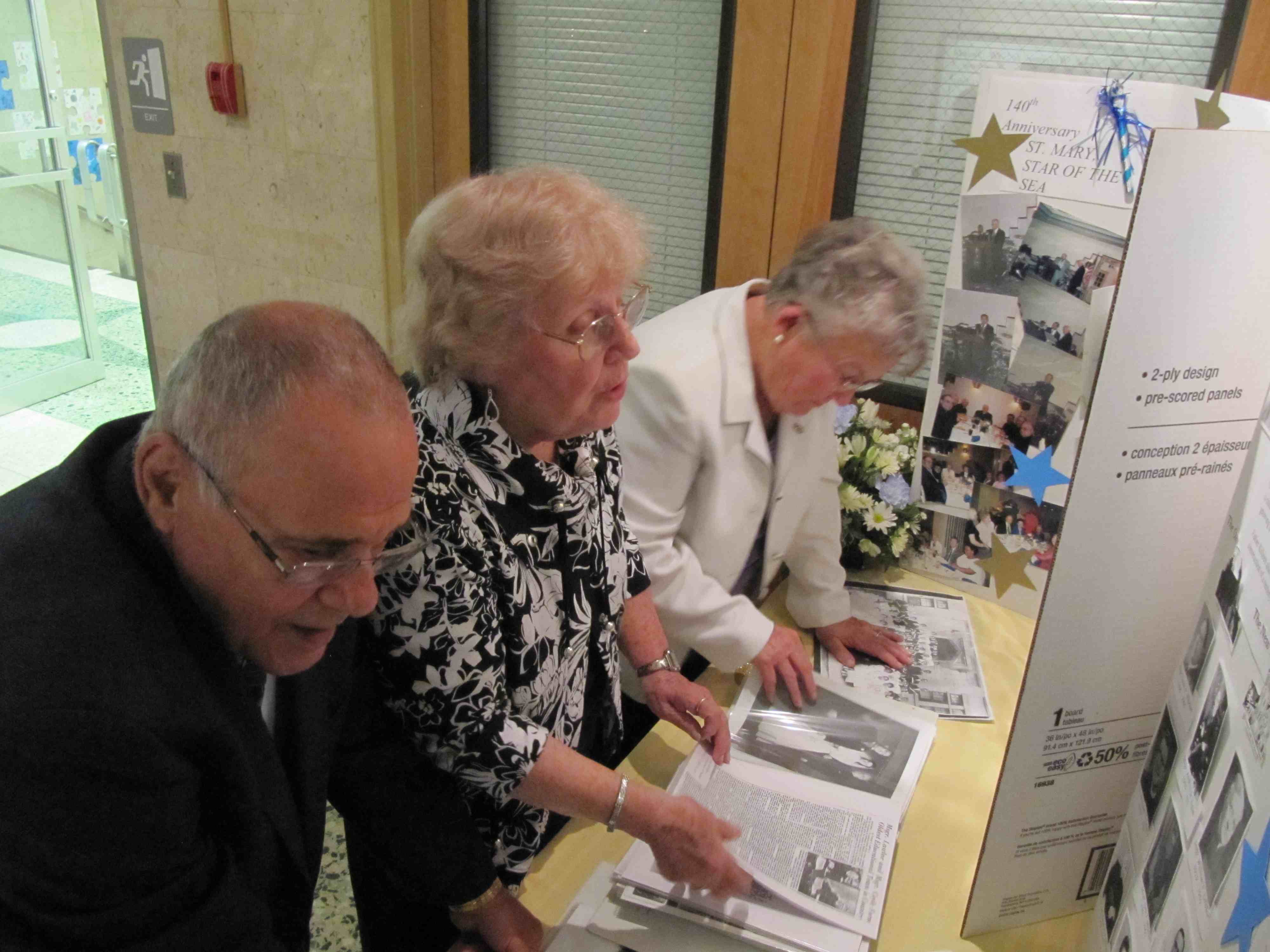
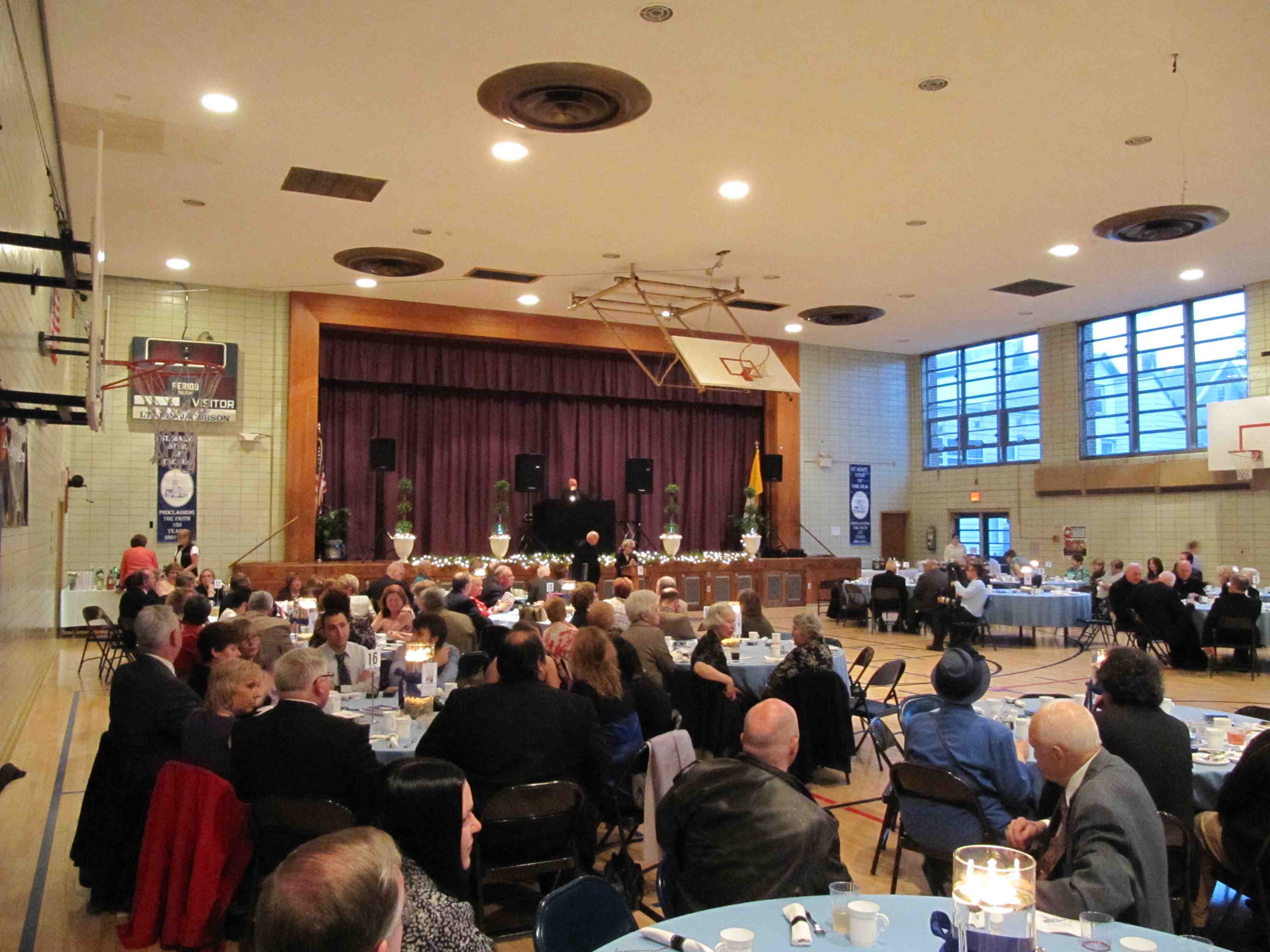
Our Lady Star of the Sea Parish in Bayonne, NJ celebrated its 150th anniversary Saturday evening, May 14, with Mass presided over by Archbishop Peter Gerety, the retired archbishop of Newark. About 30 priests, 4  like myself raised in the parish, concelebrated the Mass. Msgr. Frank Seymour, the diocesan archivist–also from the parish– preached the homily.

A number of former parishioners came back to celebrate at the Mass and at the dinner that followed in the school hall, along with the present parishioners.  Most Reverend Joseph Younan, Bishop of Our Lady of Deliverance Syriac Catholic Diocese came to the anniversary. Like so many immigrant groups before, the Syrian Catholics from places like Iraq in the Middle East have found a home in Bayonne. Now they have their cathedral at St. Joseph Church, which formerly belonged to the Slovak community.

The bishop and the wonderful choir from St. Dominic’s Academy that sang latin polyphony at the Mass says that  Bayonne is still a city for immigrants.

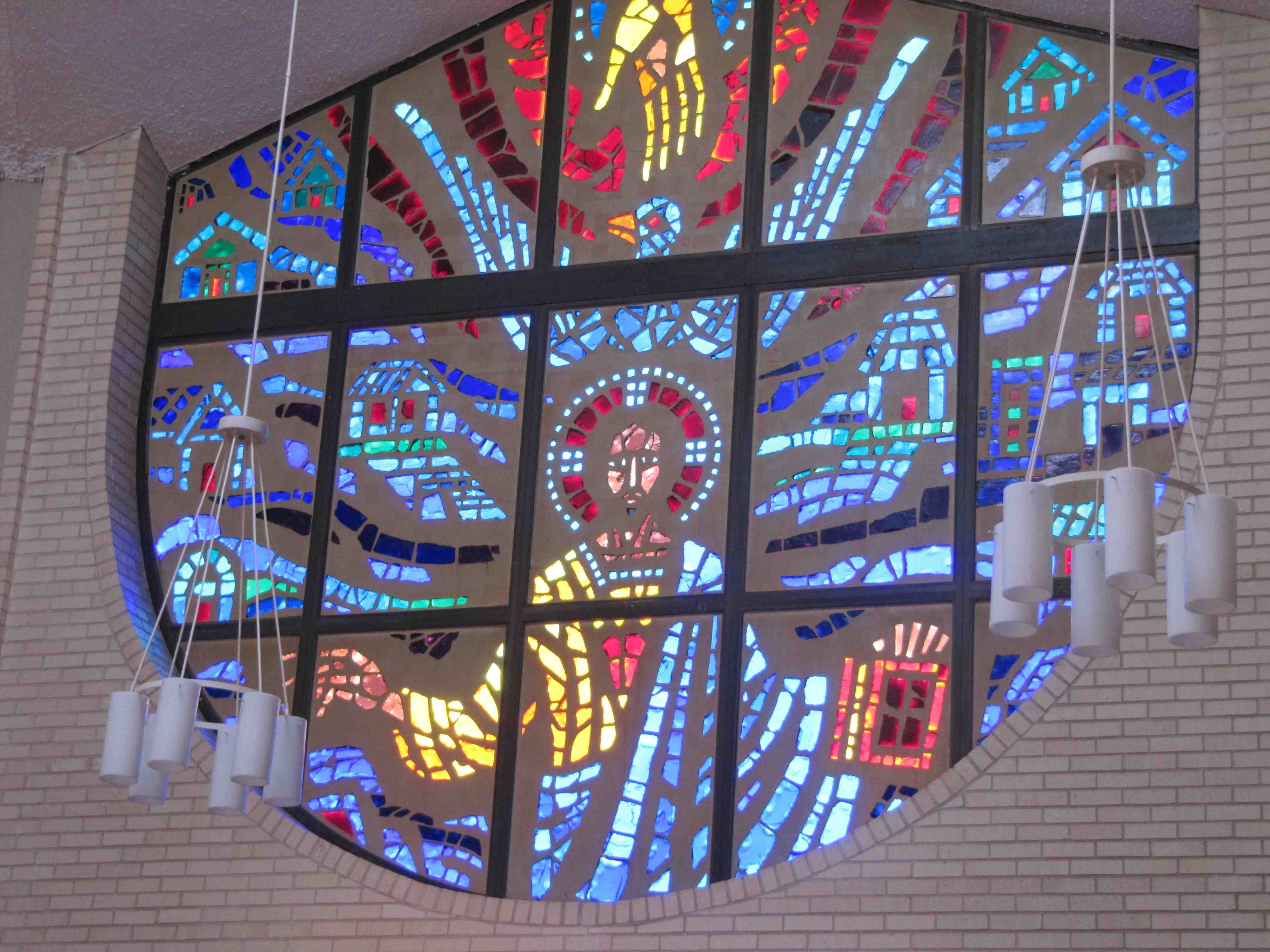
Memories flooded into my mind. I arrived early to walk through the church where I grew up and where so many important moments of my life took place. The church I remember so well still bears the stamp of its Irish origins. I counted three statues and windows of St. Patrick and the familiar scenes in the windows of the life of Mary, the Mother of Jesus, bright and fresh as when they were put there.

Baptisms, weddings, funerals, anniversaries took place here. I celebrated my first Mass here; afterwards at the parish meal Msgr. William F. Lawlor, our pastor, fell over and died of a heart attack as he offered some remarks. That event made headlines in The Bayonne Times the next day.

I sat at the banquet after Mass with some of the “living stones” of St. Marys, which we used to call the parish years ago.  One has been a member of the parish council for decades. The others lived there for most of their lives, although now they have moved away. Watching them easily connect with each other , trading stories, reliving memories, singing and dancing with delight, makes you appreciate the deep delight and faith that kept this place alive for 150 years.

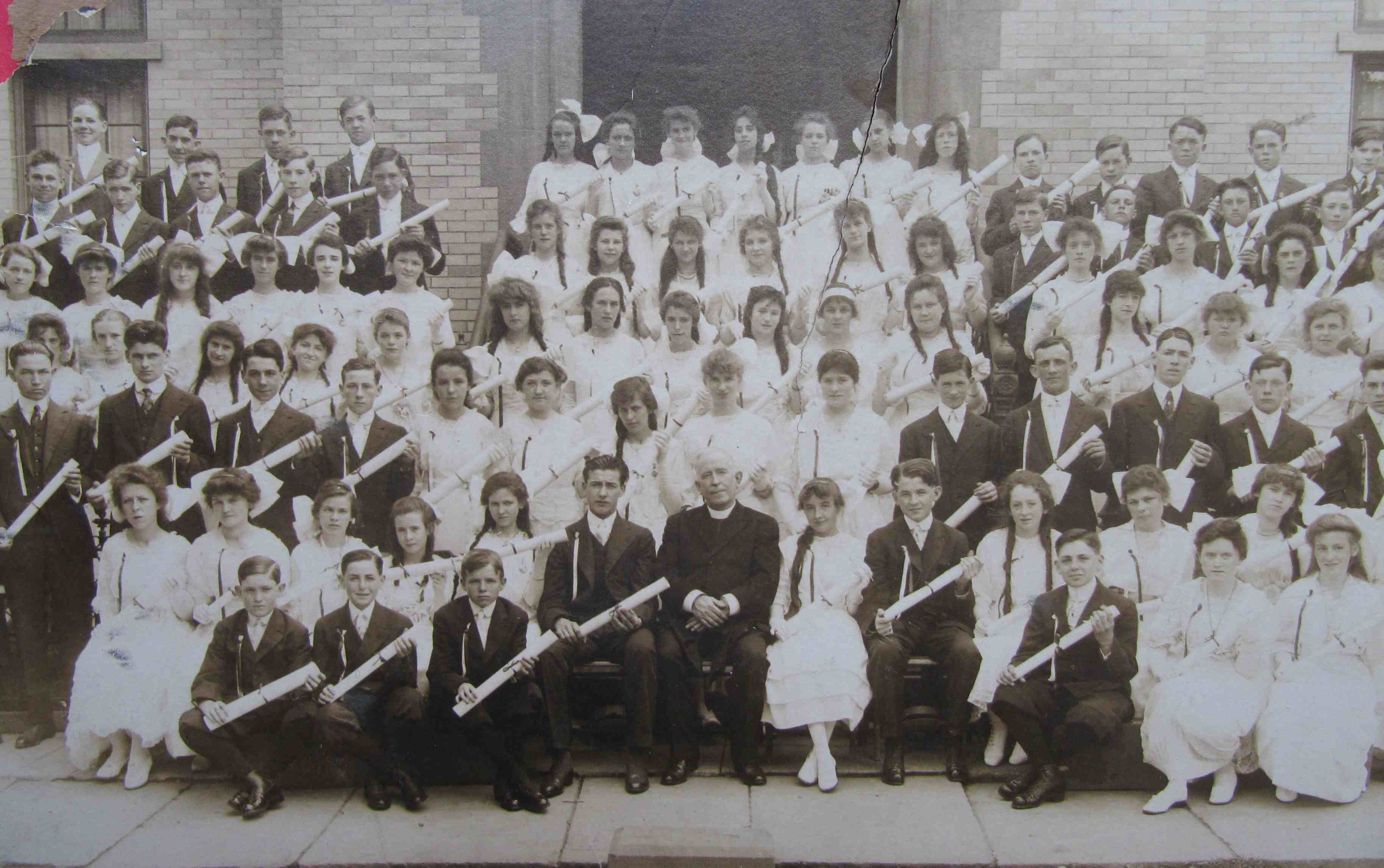
I have a treasured picture from 1914 of my mother’s graduation from St. Mary’s School.

She’s  clutching her diploma. Many of these kids were just off the boat or their fathers and mothers were. But they set their worlds on fire.

My mother said her class loved getting together in later years. One of them Msgr. Leo Martin became the popular pastor of St. Marys, his home  parish. Another, whose name I forget, became head of the New York Stock Exchange. (He always footed the bill for the celebration, my mother said).

The “living stones” loved the celebration Saturday evening. I loved being with them.

The Resurrection Stories

The resurrection narratives in the gospels speak to the churches for which they are written which explains partially why they differ one from the other.

Matthew’s Gospel

Matthew’s resurrection account, for example, obviously speaks to a Jewish Christian church confronted by a resurgent Judaism under Pharisaic leadership. The story of the Jewish guards at the tomb, an important part of Matthew’s resurrection narrative, was surely part of an attack on the reality of Jesus’ resurrection. His messianic origins, his parents and the leaders he had chosen to follow him were also being questioned.

Matthew insists that Jesus really died, he tasted death in all its harsh reality. “My God, my God, why have you forsaken me?” he cries out after a long silence on Calvary. He was buried, then he rose again.

An earthquake announces his resurrection and an angel clothed like lightening sits triumphantly on the stone rolled away from an empty tomb. Death has been conquered. Jesus appears to his disciples, however, not here at the tomb, but on a mountain in Galilee, according to Matthew’s gospel.  From there, he sends his disciples into the whole world to preach the gospel, baptizing in the name of the Father and of the Son and of the Holy Spirit.

The Christians of Galilee about 90 AD, when Matthew’s gospel was written, were struggling with Pharisaic Judaism for dominance in that part of Palestine; they may well have been losing the battle. In the centuries that followed, there is evidence that Christianity hardly survived in the land where Jesus began his ministry.

According to Matthew, the Risen Christ comes to urge his followers to a global mission. He does not dwell in the past;he is present where his followers are, leading them on.  At his command they are to leave Galilee which, instead of a place where the Christian movement ends, becomes a place of hope and new beginnings. Matthew doesn’t forget that the Risen Christ emerged from the tomb in Jerusalem, but he is intent on presenting him bringing new life and direction to his struggling church. Jesus constantly calls it to a wider mission.

Luke’s Gospel

The focus of the resurrection narrative of Luke is the story of the two disciples on the road to Emmaus. Like Matthew, Luke begins with the women at the tomb, but he also directs us beyond the tomb to a road where two downcast disciples sunk in disappointment are abandoning their hopes for God’s kingdom. He appears gradually to the two disciples. Slow to understand and to recognize Jesus, they see him finally in the breaking of the bread. They remember afterwards his words on the road.

Luke’s account of the Risen Jesus with the two disciples who have lost hope and are trying to find their way is a key to understanding the journey of the church the evangelist outlines in his gospel and in the Acts of the Apostles. It will be a journey from Jerusalem to the ends of the earth, Rome. But it is not a triumphant journey; it’s the road taken by the two disciples. Luke’s narrative is a wonderful corrective to a triumphalist view of the church and a perfectionist view of our personal journey of faith.

John’s Gospel

The Gospel of John, with its lengthy series of resurrection stories, begins in Jerusalem with Jesus appearing to Mary Magdalene as she goes to the tomb in the darkness of Sunday morning and finds it empty. In John’s church the eye-witnesses to what Jesus said and did are long gone. John  emphasizes the incredulity of the original eye-witnesses. Mary, first of all , is convinced that the body of Jesus has been stolen. She and Peter are not at all ready to believe. Like the Emmaus disciples who do not see him at first, Mary does not recognize the mysterious stranger.She thinks he is a gardener and only recognizes him after he calls her name. The Emmaus disciples find him “in the breaking of the bread,” Mary recognizes him as he speaks her name.

Their stories remind us that the eucharist and the word of God help us recognize the Risen Lord. “My sheep hear my voice, Jesus says.

Mark’s gospel describes Mary in his resurrection account as the one from whom Jesus cast out seven devils and that’s the way John’s gospel presents her. She is not a romantic interest as some modern sensationalists would like her to be. She is a symbol of every individual whom the Risen Lord comes to save; she represents the weakest of humanity that Jesus will bring to the Father.

As he rises from death Jesus has been changed, John’s gospel indicates. The lack of recognition of him by his disciples tells us that. Yet he is the same. “Life is changed, not ended,” we say in our prayers. He has a mission beyond this world to prepare a place for us. So Mary is not to cling to him. He will come again to take her and all of us to himself.

Like Mary Magdalen, who represents the weakness of us all.  Thomas the apostle, on the other hand,  represents institutional doubt, the doubt of the church and all humanity before the mystery of the resurrection. Thomas is not unique.

The locked doors of the Upper Room are more than a defense against the Jewish leaders. The Risen Jesus must come to his church with his gift of peace and forgiveness to renew it in its mission.  He comes to be present and to show us the wounds in his hands and his side, which remain in his risen body. When we see them in him and in also others, we will recognize him.

In John’s gospel Jerusalem is where Jesus meets his followers first. He meets them as individuals, like Mary. He meets them together as they gather on the first day of the week and on the Lord’s Day. He meets them in sacraments and signs. He empowers them with the Holy Spirit, the Creator Spirit.

After recalling his appearances in Jerusalem, John recalls the appearances of Jesus in Galilee, continuing the tradition of the two places where the early church saw the Risen One appear.

The gospel accounts of the resurrection offer a wonderful picture of how the Risen Christ comes to us as individuals, as a church and as the world.
Sing a New Song

Here’s St. Augustine’s comments on a psalm:

“Sing to the Lord a new song; his praise is in the assembly of the saints. We are urged to sing a new song to the Lord, as new people who have learned a new song. A song is a thing of joy; more profoundly, it is a thing of love. Anyone, therefore, who has learned to love the new life has learned to sing a new song, and the new song reminds us of our new life. The new person, the new song, the new covenant, all belong to the one kingdom of God, and so the new people will sing a new song and will belong to the new covenant.

“There is not one who does not love something, but the question is, what to love. The psalms do not tell us not to love, but to choose the object of our love. But how can we choose unless we are first chosen? We cannot love unless someone has loved us first. Listen to the apostle John: We love him, because he first loved us. The source of our love for God can only be found in the fact that God loved us first. He has given us himself as the object of our love, and he has also given us its source. What this source is you may learn more clearly from the apostle Paul who tells us: The love of God has been poured into our hearts. This love is not something we generate ourselves; it comes to us through the Holy Spirit who has been given to us.

“Since we have such an assurance, then, let us love God with the love he has given us. As John tells us more fully: God is love, and whoever dwells in love dwells in God, and God in him. It is not enough to say: Love is from God. Which of us would dare to pronounce the words of Scripture: God is love? He alone could say it who knew what it was to have God dwelling within him. God offers us a short route to the possession of himself. He cries out: Love me and you will have me for you would be unable to love me if you did not possess me already.”

Philip and James

We celebrate a feast of the apostles each month because they’re the foundation stones of our church. “Every family wants to find out how it began. We go back to the apostles because they were at the beginning of our church,” the early Christian writer Tertullian says. Today we have two together, Philip and James.

We celebrate the two together because their relics were placed side by side in the Church of the Twelve Apostles in Rome, which was built in the 6th century. Philip was called by Jesus to follow him the day after he called Andrew and Peter, St. John’s gospel says. James, who is also called James the Less to distinguish him from James, the brother of John, was a cousin of Jesus who later became head of the church in Jerusalem and was martyred there in the year 62.

“Don’t forget where you come from!” That’s a good thing for us to remember and that’s why the church remembers those who first heard and believed, and then went out to tell the whole world about Jesus risen from the dead. They handed the faith on to us and we now have their message and their task.

We’re meant to tag our names onto the list St. Paul sent to the church at Corinth long ago.

For I handed on to you as of first importance what I also received:
that Christ died for our sins ?in accordance with the Scriptures;
that he was buried;?that
he was raised on the third day
in accordance with the Scriptures;
that he appeared to Cephas, then to the Twelve.
After that, he appeared to more
than five hundred brothers and sisters at once,
most of whom are still living,
though some have fallen asleep.
After that he appeared to James,
then to all the Apostles.
Last of all, as to one born abnormally,
he appeared to me.

His Glorious Wounds

A reflection by Athanasius of Antioch in Wednesday’s Office of Readings speaks about the glory of Jesus. First, he had a glory before the world began. It was a glory far beyond the light of the sun, a light inaccessible to us. We could not even look at him.

None of the appearances of the Risen Jesus in the gospels reveal a glory like that. Becoming human, he relinquished that glory and experienced death on the cross

His glory now appears in the mystery of the cross, as he repeatedly shows his disciples the wounds in his hands and his side.

“ It was necessary for Christ to suffer: it was impossible for his passion not to have happened. He said so himself when he called his companions dull and slow to believe because they failed to recognise that he had to suffer and so enter into his glory.

“Leaving behind him the glory that had been his with the Father before the world was made, he had gone forth to save his people. This salvation, however, could be achieved only by the suffering of the author of our life, as Paul taught when he said that the author of life himself was made perfect through suffering.

“Because of us he was deprived of his glory for a little while, the glory that was his as the Father’s only-begotten Son, but through the cross this glory is seen to have been restored to him in a certain way in the body that he had assumed. `

“Explaining what water the Saviour referred to when he said: He that has faith in me shall have rivers of living water flowing from within him, John says in his gospel that he was speaking of the Holy Spirit which those who believed in him were to receive, for the Spirit had not yet been given because Jesus had not yet been glorified. The glorification he meant was his death upon the cross for which the Lord prayed to the Father before undergoing his passion, asking his Father to give him the glory that he had in his presence before the world began.”

For more on the wounds of Christ:

http://www.cptryon.org/xpipassio/wounds/index.html

A Child’s Question

The pope answered questions from around the world during Holy Week on Italian television. This one was from a seven year old Japanese girl, Elena, who asked why did the recent terrifying earthquake happen.  You can find the rest of the questions and answers  here.

Q. Holy Father, I want to thank you for your presence here, which fills us with joy and helps us remember that today is the day in which Jesus showed His love in the most radical way, that is, by dying on the cross as an innocent. It is precisely on this theme of innocent sorrow that is the first question that comes from a seven-year-old Japanese child who says: “My name is Elena. I am Japanese and I am seven years old. I am very frightened because the house where I felt safe really shook a lot and many children my age have died. I cannot go to play at the park. I want to know: why do I have to be so afraid? Why do children have to be so sad? I’m asking the Pope, who speaks with God, to explain it to me”.

A. Dear Elena, I send you my heartfelt greetings. I also have the same questions: why is it this way? Why do you have to suffer so much while others live in ease? And we do not have the answers but we know that Jesus suffered as you do, an innocent, and that the true God who is revealed in Jesus is by your side. This seems very important to me, even if we do not have answers, even if we are still sad; God is by your side and you can be certain that this will help you. One day we will even understand why it was so. At this moment it seems important to me that you know “God loves me” even if it seems like He doesn’t know me. No, He loves me, He is by my side, and you can be sure that in the world, in the universe, there are many who are with you, thinking of you, doing what they can for you, to help you. And be aware that, one day, I will understand that this suffering was not empty, it wasn’t in vain, but behind it was a good plan, a plan of love. It is not chance. Be assured, we are with you, with all the Japanese children who are suffering. We want to help you with our prayers, with our actions, and you can be sure that God will help you. In this sense we pray together so that light may come to you as soon as possible.

Holy Thursday

On Holy Thursday morning in my community, we would gather at prayer and one by one say, “My brothers, I ask pardon for all the scandal and bad example I have given and beg you to pray that I may make a worthy Easter communion.”

It was a simple request that originated from what Jesus called his disciples to do. After he washed their feet, he told his disciples to “wash one another’s feet.” Besides the forgiveness of God, we need the forgiveness of others.

God is the ultimate source of forgiveness. So, on that great night when this mystery is celebrated, Jesus “fully aware that the Father had put everything into his power and that he had come from God and was returning to God, he rose from supper and took off his outer garments. He took a towel and tied it around his waist. Then he poured water into a basin and began to wash the disciples’ feet and dry them with the towel around his waist.”

No one can wash away our sinfulness but God. Sin is so complex in us; we are so unaware of it. Only God knows it completely.

Yet,  Jesus calls us to join in forgiving.

“Do you realize what I have done for you? You call me ‘teacher’ and ‘master,’ and rightly so, for indeed I am. If I, therefore, the master and teacher, have washed your feet, you ought to wash one another’s feet. I have given you a model to follow, so that as I have done for you, you should also do.”

We need to join God in forgiving. Poor Peter, so unaware of himself. Yet Jesus washed his feet, so patiently. Shouldn’t I bear with those around me?  Shouldn’t I ask that they bear with me?

Tuesday Night: Matthew’s Passion

Notice in Matthew’s account of the Passion that Jesus gradually becomes silent. As the hours before his death go by, his words become fewer and fewer. He works no wonders, no cures. His power seems to slip away and he becomes more and more helpless.

In the garden, he prays a short troubled prayer, over and over: “Father, if it is possible, let this cup pass from me, yet not my will, but your will be done.”

He looks for the comfort of friends but finds none. They fall asleep and seem to not notice.  “Pray that you don’t enter temptation. The spirit is willing but the flesh is weak,” Jesus tells them.

When he’s brought before Caiaphas, the high priest, he doesn’t dispute the false witnesses that bring charges against him. Through his public ministry he’s quick to answer what’s false, but now he’s silent.  Only when Caiaphas directly asks him if he is the Messiah, the Son of God,  does Jesus answer: “ You have said so. I tell you from now on you will see the Son of Man seated at the right hand of the power and coming on the clouds of heaven.”

Similarly, when Jesus is brought before Pilate, he is mostly silent. “Are you the king of the Jews?” Pilate asks him. “You say so,” Jesus answers. Then, he says no more.

He’s silent when the crowd calls for Barrabas; he’s silent when the soldiers scourge him with whips and crown him with thorns. He’s silent when they mock him and lead him away to be crucified.

The only words he says in Matthew’s gospel, as well as in the gospel of Mark, are the final words from psalm 22, which the evangelists quote in Aramaic, as well as Greek:  “My God, my God why have you forsaken me.?”

It’s not that Jesus is unaware of what’s happening to him, or that he has steeled himself and turned away from it all. He’s not retreated into his divinity. “He humbled himself, accepting death, even death on a cross,” St. Paul, the Apostle says.

His silence is his humble acceptance of death and all it entails.

Yet, his trust in God never fails, even when God seems absent.

What kind of cross do we carry? We know it when words and human solutions fail and we can accomplish nothing on our own. Think of the silence that followed the earthquake in Japan. People could hardly take it in. It’s not just  physical pain, it’s more than that.

“My God, my God, why have you forsaken me?”

It was more than a question, Jesus was asking. It was a prayer. As he did in the garden, he threw himself into the hands of God, his Father, who knows all and receives us all. There he was safe and his soul found peace.

As he said to his disciples in the garden, he says to us, “Pray when the cross comes, put yourself in God’s presence our safety when the storm comes.”