Tag Archives: Passionists

Immaculate Conception Parish: Mission–Monday

Jesus of Nazareth

Following up on the pope’s remarks about the blurred picture of Jesus we have today, here are some reflections on what we know about Jesus today. I’m offering these reflections at our parish mission:

“Tell me the landscape where you live and I’ll tell you who you are.” (Ortega y Gasset)

Thanks to recent archeological discoveries and historical studies we know more about the land where Jesus lived and the ancient texts of the bible than has been known for centuries. These new resources help us know Jesus Christ.

New editions of the bible like the New American Bible Revised Edition and the New Jerusalem Bible Revised Edition (both Catholic sponsored) make use of these resources.

We know more about Galilee, the northern part of Palestine where Jesus lived most of his life, than we knew before. He grew up and was raised by Mary and Joseph in the Galilean hill town of Nazareth, the gospels say. Extensive excavations have gone on in Nazareth, today the busy capital city of modern Galilee.

After his baptism by John in the Jordan River Jesus made his home in the Galilean town of Capernaum on the Sea of Galilee–also extensively excavated in recent times. From there, he visited the small Jewish towns scattered nearby in the fertile plains and mountains, teaching in their synagogues, healing and performing extraordinary signs. New historical studies tell us much about Jewish life in these places.

In Galilee Jesus proclaimed the good news that God’s kingdom was at hand. He used images from this land, like the seed and the sower, in his preaching as well as the scriptures he knew so well. Today Galilee still offers a picture of the land as he knew it.

“After John had been arrested,

Jesus came to Galilee proclaiming the gospel of God:

‘This is the time of fulfillment.

The kingdom of God is at hand.

Repent, and believe in the gospel.’”  Mark 1

Under the rule of Herod Antipas, Galilee during Jesus’ public ministry was dotted with important cities like Tiberias, Bethshan, Sepphoris, and the seaport of Caesarea Maritima, all with large gentile populations. Matthew’s gospel calls it the “Galilee of the gentiles.” Hardly the backwater land once thought, the region was an important provider of food for the Roman world.

The gospels suggest that Jesus avoided these important Galilean cities. Instead, he saw himself sent first to the “children of Israel,” although  he occasionally performed cures for some gentiles, like the Syro-Phoenician woman who sought him out and the Roman centurion whose servant was sick in Capernaum.

The arrest and execution of John the Baptist by Herod may have been a practical warning about the danger of places where the powerful lived.

After his baptism in the Jordan River by John, Satan told Jesus to reveal himself in a spectacular way in the temple of Jerusalem, the religious center of Judaism; some disciples urged him to go there too.  However, Jesus made Peter’s simple home in Capernaum his home and from there brought his message to Jews and some non-Jews who lived on Galilee’s farmlands and fished in the Sea of Galilee.

Jesus grew up in Nazareth and his ministry was mainly in Galilee, but he customarily celebrated Jewish feasts, like the Passover, in Jerusalem. Visiting the Holy City, he likely camped among the olive groves that surrounded Bethany, where other pilgrims from Galilee stayed.  He had friends in Bethany– Lazarus and his sisters, Martha and Mary, and also some friends in the city itself.

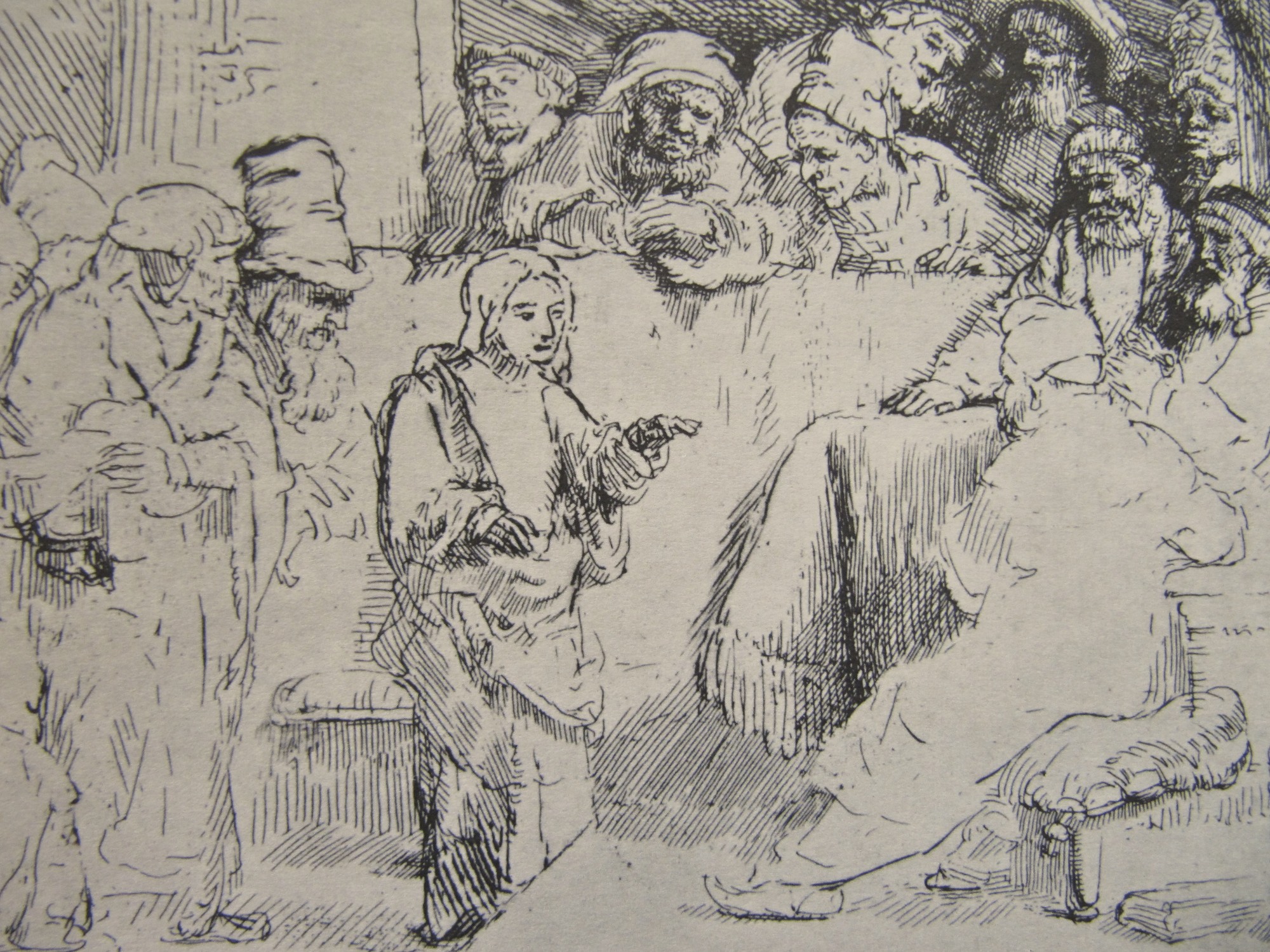
His visits to the temple at Jerusalem became more significant as the years passed. Even at twelve, he began to dialogue in the temple courtyard with the rabbis who marveled at his questions and answers; he spoke of the temple as “my Father’s house.” (cf. Luke ) After his baptism in the Jordan his dialogue with the rabbis sharpened and the claims he makes about his relationship with his Father increased.

John’s gospel, which we read extensively in the last weeks of Lent, offers some of his exchanges in the temple courtyard about his relationship with his Father. The scriptures and the prophets testify to him, he says. (John 5,31-47  Thursday 4th wk) “I am from him, he sent me.”  (John 7,1-30 Friday, 5th wk) “ Just as the Father raises the dead and gives life, so also does the Son give life to whomever he wishes.” ( John 5,17-30 Wednesday, 4th wk)  “When you lift up the Son of Man, then you will realize I AM.” (John 8,21-30Tuesday, 5th wk ) His divine claims were violently opposed by the Jewish leadership in Jerusalem.

The gospels, especially Luke’s, emphasize Jesus’ love of people. He reached out to those in need; he welcomed women as well as men to his company. His acceptance of outcasts like tax collectors and sinners brought him criticism from others. When John’s disciples asked him “Are you the one who is to come?”  he replies, “Tell John what you see and hear: the blind see, the lame walk, the deaf hear, the dead rise, and the poor have the gospel preached to them. “

“Come to me all you who are weary and I will refresh you, for I am meek and humble of heart,” he said, and he urged his followers to also welcome the weary: the sick, the prisoner, the homeless, the naked, the hungry needing refreshment.

He taught that God should be loved above all and we should love our neighbor as ourselves. He said we should forgive those who have offended us, because God forgives our offenses. He told us to pray to God thankfully and ask for what we need.

People listened to his teaching and knew that he lived what he taught himself.

After his resurrection, he appeared on a mountain in Galilee to his disciples and told them to go out to all the nations and preach the gospel, “baptizing them in the name of the Father, and of the Son, and of the Holy Spirit.”  From the “Galilee of the gentiles,” he sent his disciples out to farthest corners of the earth.

Become like children, he said, because those with the spirit of the child belong in the kingdom of heaven.

According to St. Leo the Great, Jesus does not ask us to return to our play pens. We can’t do that. The spiritual child is

  1. free from crippling anxieties
  2. forgetful of injuries
  3. sociable
  4. wonders at all things.

Immaculate Conception Parish: Melbourne Beach, Fl

Today we began a parish mission in Immaculate Conception Parish, Melbourne Beach. I’m preaching at the Sunday Masses and Monday, Tuesday and Wednesday at Masses at 8 AM and 7 Pm.

Here’s the sermon at the Sunday liturgy.

“We would like to see Jesus”

In his remarkable books on Jesus of Nazareth, Pope Benedict describes his own personal search for God as he follows Jesus through the mysteries of his life, death and resurrection. Jesus is the way to see the face of God. The pope, who spent most of his life as a theologian, understands especially how modern scholarship has influenced the way we see Jesus.

The figure of Jesus has become “more and more blurred” today by different interpretations of him, the pope says. For example, some say  that “Jesus was an anti-Roman revolutionary working–though finally failing–to overthrow the ruling powers.” For others, “ he was the weak moral teacher who approves everything and unaccountably comes to grief.” Jesus loves everybody and everything goes.

What we face today, the pope says, is widespread skepticism about our ability to know Jesus at all. “This is a dramatic situation for faith, because its point of reference (Jesus Christ) is being placed in doubt: Intimate friendship with Jesus, on which all else depends, is in danger of clutching at thin air.” The pope wrote his books on Jesus of Nazareth to affirm who Jesus is and what he means to us and to our world. They’re worth reading.

( Jesus of Nazareth, From the Baptism in the Jordan to the Transfiguration, Ignatius Press 2008,  foreward xi)

It’s true what he says, isn’t it? If you go into the religion section in a big book store like Barnes and Noble today, you face an array of books about Jesus Christ that see him in totally different ways. If you search the internet, you find the same situation. The figure of Jesus becomes “more and more blurred;” some wonder if we can see him at all. Then, of course, others say he’s totally irrelevant to our times and our lives.

That’s why today’s gospel (John 12,20-33)–part of the Palm Sunday event we’ll celebrate next Sunday– is so interesting. Let’s look at its context. Jesus has just raised Lazarus from the dead.  A crowd is ready to acclaim him by casting palm branches before him as he enters Jerusalem, crying “Hosanna to the Son of David.” Many of them see him as a political messiah, someone who is going to change the government and restore Judaism to its golden age. As his popularity grows, his enemies see him as a dangerous troublemaker in a volatile time and place. Jerusalem’s religious establishment has decided to kill him. Jesus, of course, sees death coming.

Even before he enters the Garden of Gethsemane, he’s fearful about what lies before him.

Just then, some Greeks approach Philip and Andrew and say, “We would like to see Jesus.” It seems like a minor thing, some Greeks requesting to see him, but John’s gospel loves simple signs like this, signs that point to something else, signs that point to glory.

The Greeks who come to Jesus tell us it’s not the end, but the beginning. They come as Jesus approaches his death, like the Magi who approached him at his birth. They’re people from afar; they’re the first of many, the promise that others will come from the east and the west, from centuries beyond his own.

And Jesus rejoices at their coming. At this crucial uncertain time, when so many misunderstand him, when so many oppose him, so many ignore him, these strangers want to see him.

He sees the lasting fruitfulness of his mission on earth. “Like a grain of wheat I will fall to the ground and die, but if I die I’ll bring much fruit.” “My soul is troubled now, yet what shall I say, “Father, save me from this hour. But it was for this hour I have come.” His Father gives him this sign to strengthen him.

The unnamed Greeks received an immense grace when they saw Jesus at this time. An immense grace can come to us when we see Jesus at a time like theirs, when we search for him and find him.

The Greeks see him as seed falling to the ground, as the one rejected by his own, as a suffering man who dies on a cross. Shall we join them?

Help us see signs like those you gave them, Lord,

Unexpected signs like the mystery of your cross,

Dark signs like a church in decline,

Small signs like Bread and Wine

And Words from an old Book.

We want to see you,  Jesus.


The Inhabitants of Jerusalem

In our lenten gospel for today from St. John (7th chapter) Jesus goes up from Galilee to Jerusalem where some “ were trying to kill him.” He celebrates the feast of Tabernacles, a popular autumn feast that draws crowds of visitors to the city. At his return in the spring for Passover, his enemies will fulfill their plans. Now, he draws the attention of “the inhabitants of the city.”

 Who are they? They’re not the leaders who will later put him to death. They’re the ordinary public who
know what’s happening in the city, who follow the trends and pass the gossip. They watch Jesus with curiosity as he enters the temple area and begins to teach. “Do our leaders now believe he’s the Messiah?” “How can he be, because he’s from Galilee and no one will know where the Messiah is from?”

Here are the voices of those who go back and forth, the undecided who wait to see who wins before taking sides. Jesus cried out against them, because they think they know what’s going on but know nothing. They’re blind to the Word in their midst.

Unfortunately, whether we’re learned theologians, or practiced priests, or informed church-goers, we can be like the  “inhabitants of Jerusalem.”  We need to humble ourselves before God. Prayer helps us see what’s real; it’s a way of taking sides, the right side.

Meditation on the Passion of Jesus

St. Leo the Great, in today’s Office of Readings, tells us why we meditate on the Passion of Jesus.

“True reverence for the Lord’s passion means fixing the eyes of our heart on Jesus crucified and recognising in him our own humanity…

Who cannot recognise in Christ his own infirmities? Who would not recognise that Christ’s eating and sleeping, his sadness and his shedding of tears of love are marks of the nature of a slave?

It was this nature of a slave that had to be healed of its ancient wounds and cleansed of the defilement of sin. For that reason the only-begotten Son of God became also the son of man. He was to have both the reality of  human nature and the fullness of the godhead.

The body that lay lifeless in the tomb is ours. The body that rose again on the third day is ours. The body that ascended above all the heights of heaven to the right hand of the Father’s glory is ours. If then we walk in the way of his commandments, and are not ashamed to acknowledge the price he paid for our salvation in a lowly body, we too are to rise to share his glory. The promise he made will be fulfilled in the sight of all: Whoever acknowledges me before men, I too will acknowledge him before my Father who is in heaven.”

St. Joseph: March 19

“Each year Jesus’ parents went up to Jerusalem for the feast of the Passover, and when he was twelve years old they went up according to festival custom.” Luke 2,41

At twelve, Jesus enters a new stage in life – his “Bar Mitzvah.” He took on the responsibilities of the law, which later he said was: “Love the Lord, your God, with your whole heart…Love your neighbor as yourself.”

Growing up, Joseph and Mary led him to know God and his neighbor in nature, in the scriptures and in ordinary human life at Nazareth. Their hand is evident in his later teaching; they influenced him. Now he entered a new stage in his life; “each year” the attraction to the temple increased, until he “had” to go up to Jerusalem. His destiny was there.

The young Jesus was absorbed in the life of the temple, Luke indicates. Here he questioned the rabbis in its courts, but more importantly here he experienced in a unique way the Presence of God. “Why were you looking for me? Did you not know I must be in my Father’s house.”

What did Joseph and Mary make of this as they anxiously searched for the Son they raised as their own? Certainly it raised questions, but did they too grow in love of his Father’s house when they found him? Did he deepen their thirst for the living God who dwelt there?

Jesus of Nazareth

In his book, Jesus of Nazareth, Pope Benedict presents a picture of Jesus Christ from the gospels using the tools of modern scholarship as well as insights from the long tradition of the church.

While he welcomes the resources recent biblical studies provide, he also acknowledges some limitations:

“As historical-critical scholarship advanced…the figure of Jesus became more and more blurred…The reconstructions of Jesus became more and more incompatible with one another: at the one end of the spectrum, Jesus was the anti-Roman revolutionary working–though finally failing–to overthrow the ruling powers; at the other end, he was the weak moral teacher that approves everything and unaccountably comes to grief.”

Some reconstructions of Jesus over the last fifty years are “more like photographs of their authors and the ideals they hold,” the pope says. The result is a skepticism about our ability to know Jesus at all. “This is a dramatic situation for faith, because its point of reference is being placed in doubt: Intimate friendship with Jesus, on which all else depends, is in danger of clutching at thin air.”( foreward xii, Jesus of Nazareth, From the Baptism in the Jordan to the Transfiguration, Ignatius Press 2008)

Seems to me the aim of preaching and catechesis today, as the pope suggests, is to offer a renewed picture of Jesus, enriched by modern studies and faithful to what tradition says of him. A challenge.

Mission at St. Thomas More: Wednesday Evening

Jesus is our Teacher and Lord. He is not just a human teacher who tells us how to live in this world. He also points to a world to come, the home to which he calls us.  He goes before “to prepare a place” for us.” Risen from the dead, he is “the first fruits;” we still await the harvest.


The apostle Thomas, whom Rembrandt (below) pictures acknowledging Jesus as “My Lord and my God,” represents doubting humanity called to believe. Mary Magdalen too represents our weak humanity wishing to cling to the human Jesus.

Besides our Teacher, Jesus is Lord of Creation. This aspect of the mystery of the Resurrection has been influenced by the thinking of the Enlightenment, according to Anglican Bishop W.T. Wright, who recently addressed the Italian Catholic Bishops.

I’ll be speaking tonight of the role of Jesus as Lord of Creation.

You can read what Bishop Wright said here.

Mission at St. Thomas More: Tuesday Evening

Tuesday evening at our mission in St. Thomas More Parish, Sarasota, Florida, we’re going to reflect on the Passion of Jesus Christ. Those who can’t attend our service at 7 PM (and maybe some who attended too) may find this great presentation by Rembrandt something to study. He’s a great visual teacher of scripture.


Here’s some thoughts on it:

Rembrandt’s Crucifixion.

Light from above falls on this dreadful scene, falling first on Jesus Christ, who is the Light of the World, even in this dark hour.

The same light bathes those on his left (Is it because blood and water from his pierced heart flows on them?). The thief, his face turned already toward Paradise, has a place among those who followed Jesus from Galilee. Some of them sit on the ground overwhelmed by it all; some comfort Mary his mother; some stand looking on. Mary Magdalene comes close to kiss his nailed feet.

The centurion kneels before Jesus and cries out his confession of faith, “Yes, this is the Son of God.” But his soldiers look ready to leave their grim duty for the barracks and dinner.

On the left, Jesus’ enemies are heading home too, into the darkness. The other thief’s face is turned to them, as if he wished he could go with them, away from this place.

But I notice some light seems to reach out to them too. “Father, forgive them, for they know not what they do.”


Mission: St. Thomas More Parish, Sarasota, FL

I preached at all the Masses on Sunday at this vibrant parish which is now expanding its church. Wonderful music ministry and a large congregation, some fleeing from the cold of the north.

During the mission from Monday to Wednesday, I’ll be preaching in the morning after the 8 AM Mass and at an evening service at 7 PM.

You can find a  summary of the morning homily on this blog and a video outlining the evening service.

Here’s  video for the evening service:

Calling Us Together

In a recent article in the Wall Street Journal (February 18,2012) entitled “Religion for Everyone” the British atheist Alain De Botton expressed his hopes for a future world without God, but he suggests keeping some things religions have done well in the past. One of them is the ability to create vital communities.

“One of the losses that modern society feels most keenly is the loss of a sense of community.” De Botton writes. Religions once supplied a sense of neighborliness. Now it’s “been replaced by ruthless anonymity, by the pursuit of contact with one another primarily for individualistic ends: for financial gain, social advancement or romantic love.”

We’re set on making money, getting ahead and plenty of sex, he says. We’re building more restaurants, more bars, more gated communities, but there seem to be fewer places where all of us can get together. “The contemporary world is not lacking in places where we can dine well in company, but what’s significant is that there are almost no venues that can help us to transform strangers into friends.”

Of all things, De Botton points to the Catholic Church and its liturgy of the Mass as his prime example of religion’s ability to create community:

“Consider Catholicism, which starts to create a sense of community with a setting. It marks off a piece of the earth, puts walls up around it and declares that within their confines there will reign values utterly unlike the ones that hold sway in the world beyond. A church gives us rare permission to lean over and say hello to a stranger without any danger of being thought predatory or insane.”

No one asks what you do or how much you earn when you come for Mass.  The banker and the cleaner sit side by side. The Mass places you in a setting that focuses on human dignity and its blessings. It urges you to give up being judgmental of others and look on them with respect.

“Religion serves two central needs that secular society has not been able to meet with any particular skill: first, the need to live together in harmonious communities, despite our deeply-rooted selfish and violent impulses; second, the need to cope with the pain that arises from professional failure, troubled relationships, the death of loved ones and our own decay and demise.”

De Botton makes you think, doesn’t he? Modern society is losing a sense of community as we become more and more individualistic. An atheist, he recognizes in a religion like the Catholic church a powerful remedy to the ills of our times.

Why don’t we see these same blessings in our church? Though De Botton doesn’t see them so, they’re signs of God’s lively presence.