Tag Archives: Passionists

Moving On

Tomorrow we’re moving from Union City, NJ to Jamaica, NY. Not a big move in distance, but a big move in other ways. I wonder about the place where I’m going and hold on to the place where I’ve been.

It happens that today’s reading is St. Augustine’s famous reflection about finding God. “Place” isn’t the main issue, he says, moving on means more than that:

“Where did I find you first? You could not have been in my memory before I learned to know you. Where then could I have found you in order to learn of you, if not in yourself, far above me?

“Place” has here no meaning: further away from you or toward you we may travel, but place there is none. O Truth, you hold sovereign sway over all who turn to you for counsel, and to all of them you respond at the same time, however diverse their pleas.

“Clear is your response, but not all hear it clearly. They all appeal to you about what they want, but do not always hear what they want to hear. Your best servant is the one who is less intent on hearing from you what accords with his own will, and more on embracing with his will what he has heard from you.

“Late have I loved you, Beauty so ancient and so new, late have I loved you!

Lo, you were within,

but I outside, seeking there for you,

and upon the shapely things you have made

I rushed headlong – I, misshapen.

You were with me, but I was not with you.

They held me back far from you,

those things which would have no being,

were they not in you.

You called, shouted, broke through my deafness;

you flared, blazed, banished my blindness;

you lavished your fragrance, I gasped; and now I pant for you;

I tasted you, and now I hunger and thirst;

you touched me, and I burned for your peace.

“When at last I cling to you with my whole being there will be no more anguish or labor for me, and my life will be alive indeed, alive because filled with you. But now it is very different. Anyone whom you fill you also uplift; but I am not full of you, and so I am a burden to myself. Joys over which I ought to weep do battle with sorrows that should be matter for joy, and I do not know which will be victorious. But I also see griefs that are evil at war in me with joys that are good, and I do not know which will win the day. This is agony, Lord, have pity on me! It is agony! See, I do not hide my wounds; you are the physician and I am sick; you are merciful, I need mercy.”




The Patience of Job

I think the greatest of popes was Gregory the Great, who held the church together during Rome’s free fall into poverty in the 6th century. He kept his balance by reflecting on the scriptures, and one of his favorite books to reflect on was the Book of Job.  Here he is drawing on Job’s wisdom:

“Paul saw the riches of wisdom within himself though he himself was outwardly a corruptible body, which is why he says ‘We have this treasure in earthen vessels’. In Job, then, the earthenware vessel felt  gaping sores externally; while an interior treasure remained unchanged. The gaping outward wounds did not stop the treasure of wisdom within from welling up and uttering these holy and instructive words: ‘If we have received good at the hand of the Lord, shall we not receive evil?’ By the good he means the good things given by God, both temporal and eternal; by evil he means the blows he is suffering from in the present.”

Gregory quotes from Isaiah:

“‘I am the Lord, unrivalled,

I form the light and create the dark.

I make good fortune and create calamity,

it is I, the Lord, who do all this.’

“I form the light, and create the dark, because when the darkness of pain is created by blows from without, the light of the mind is kindled by instruction within.

‘I make good fortune and create calamity…’ Notice Job’s skill as he meets the arguments of his wife.If we have received good at the hand of the Lord, shall we not receive evil?’

 “It’s consoling, when we suffer afflictions, to remember our Maker’s gifts to us. Painful things will not depress us if we quickly remember also the gifts that we have been given. As Scripture says, ‘In the day of prosperity do not forget affliction, and in the day of affliction, do not forget prosperity.’”

Love Remains

The First Letter of John, which we read this Sunday, says simply: “No one has ever seen God.” It’s true. God is  beyond what our eyes can see and our minds take in. God, the creator of heaven and earth, is everywhere. “In him we live and move and have our being.” But our eyes are too weak to see him; our minds too small to know him. We only know God in our limited way.

But we can know God, John reminds us. We know God by love, particularly by loving one another.

“If we love one another, God remains in us,

and his love is brought to perfection in us…

God is love, and whoever remains in love

remains in God and God in him.” (1 John 4, 11-16)

God is love and his love remains in us. The first place God’s love is seen is the world we live in. God’s love is in the air we breathe, the lives we enjoy, the friends, the families, the wives, the husbands, the children, the good things of the earth we’ve been given.

God is love, his love remains; it continues, and we thank God for a love so wonderfully faithful.

The greatest gift of God, the crowning sign of his love, is Jesus Christ, his Son and our Lord. As the Word of God, he’s also beyond what our eyes can see and our minds know. But the Word was made flesh and entered our world and became like us. Conceived in the womb of Mary, his mother, he was born and grew in wisdom and grace, at a certain time and place, like us. We have seen him.

He took the path we humans take, from birth to death. In a unique way, he knew our sorrows, our sufferings, our weakness and our pains. He knows our sinfulness.

His love remains. We can hear his faithful love expressed in today’s gospel. As Jesus raises his eyes to heaven, he prays for us; he guards us, he promises to lead us to where he is. Weak as we are, unsteady as our love is, sinful as those whom he ate with the night before he died, he remains with us.

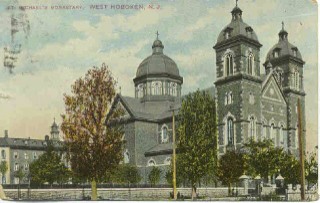
St. Michael’s, Union City

On June 1, 2012, the Passionists left Union City, NJ, after 151 years. The community came to Union City, then West Hoboken, following a mission preached by Passionist missionaries at old St. Mary’s church in 1860.

The next year they were invited to settle on the high palisades above the city of Hoboken on the Hudson River by James Roosevelt Bailey, bishop of the newly formed diocese of Newark, who hoped they would minister to the German and Irish immigrants pouring into the northern New Jersey river towns of Hoboken, Newark, Jersey City, Hackensack and Paterson as the era of mass immigration began in 1850 and New York City expanded.

Passionist priests and brothers played a large part in building the Catholic church in northern New Jersey. They helped create 16 Catholic parishes in the area {St. Joseph, West New York, St. Paul of the Cross, Jersey City, Holy Family, Union City, St. Joseph/St Michael, Union City, among them) and preached missions and retreats to the growing Catholic population taking root in the new world.

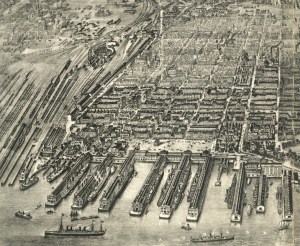
Their base was the great church and monastery of St. Michael  built on the high palisades above the Hudson River in 1875, a familiar landmark visible for miles around. The church and monastery appear on the horizon of a panoramic map of Hoboken from 1881.

Hoboken 1881

170a

Monastery 1881 copy

Monastery 1881

A missionary order, the Passionists chose their base in Union City, not just with northern New Jersey in mind, but because of its access to other places in the United States and the wider world. The first Passionists came to America from Italy in 1851. Before the advent of air travel, the busy Hoboken docks close by offered them access by sea to their headquarters in Rome and missionary fields in China (1922) and later the Philippines and Jamaica, West Indies.

Nearby too the newly-built railroads reached into the western, northern and southern parts of the United States. From Hoboken, Passionist preachers from St. Michael’s traveled to Catholic parishes and religious communities throughout the country to preach the gospel.

Hoboken railroads, docks 1881

The foundation in Union City was an ideal location for a community like the Passionists with global ambitions.

In 1921, the Passionists began publication of the Sign Magazine, which grew to become one of the most important Catholic publications in North America. The magazine was discontinued in 1982, but efforts in publishing, television and the social media continued until now.

The Passionists made Union City a center of devotion to the Passion of Jesus. One important expression was the production of Veronica’s Veil, a play produced by St. Joseph’s Parish in Union City. Catholics came to St. Michael’s in Union City to take part in its Monday devotions to the Passionist saints, St. Paul of the Cross, St. Gabriel and St. Gemma. It was a center for retreats, confessions and counseling.

The Passionists ministered to the poor in the county institutions at Snake Hill for the many years they were located there. They trained their seminarians at St. Michael’s,  and their provincial government and archives were located there.

The monastery church was a place of beauty, where the works of renown artists like Hildreth Meière, one of the great muralists of the 20th century were displayed. 

Death of St. Gabriel

Death of St. Gabriel, Hildreth Meiere

St. Gemma

St.Gemma, Hildreth Meiere

Other pictures of art from  St. Michael’s can be found on the Hildreth website.

From the dome of St. Michael’s you can see far out to New York City and the harbor to the sea eastward and to the railroads and highways westward. To me, the great church of St. Michael  expresses the Passionists: they have a message for the world.

I came from St. Mary’s Parish in Bayonne, NJ, one of the parishes the Passionists helped establish. I was ordained in St. Michael’s and much of my ministry was based here.

Places teach you how to live as well as people. Now we move on.

“The living, the living give you thanks

as I do today.

Fathers declare to their sons, O God,

your faithfulness.” Isaiah 38,20

The Fear of Death

Great mysteries are expressed and deep truths revealed in these days between Easter and the Ascension, St. Leo the Great says in a sermon:

“In those days the fear of death was removed with all its terrors, and the immortality not only of the soul but also of the flesh was established.”

To remove the fear of death, keep your eyes on the two disciples on the way to Emmaus whom Jesus accompanied “to sweep away all the clouds of our uncertainty.”

“He reproached them for the slowness of their timid and trembling hearts. Their enlightened hearts catch the flame of faith, and lukewarm as they have been, they are made to burn while the Lord unfolds the Scriptures. In the breaking of bread also their eyes are opened as they eat with him. How much more blessed is that opening of their eyes, to the glorification of their nature, than the time when our first parents’ eyes were opened to the disastrous consequences of their transgression.”

Keep your eyes on all the disciples at this time, the saint says: “the most blessed Apostles and all the disciples, who had been both bewildered at his death on the cross and backward in believing his Resurrection, were so strengthened by the clearness of the truth that when the Lord entered the heights of heaven, not only were they affected with no sadness, but were even filled with great joy.”

Sing a New Song

In the days after Easter our readings during the liturgy speak of the growth of the church as well as the source of its growth, the Risen Christ, who abides with us in signs and mysteries.

The church’s growth is never easy;  Stephen’s persecution, described in the Acts of the Apostles, tells us that.

But we have “Bread from heaven,” better than the heavenly manna. This bread  keeps you alive forever.

“Sing to the Lord a new song; his praise is in the assembly of the saints.” We’ve been given a new song to sing each day, Augustine says in his commentary.

“A song is a thing of joy; more profoundly, it is a thing of love.” To sing we’ve been  given the gift of love, a new convenant,  a new promise of a kingdom.

“You have heard the words: Sing to the Lord a new song. Now you want  to know what praises to sing. The answer is: His praise is in the assembly of the saints. If you desire to praise him, then live what you express. Live good lives, and you yourselves will be his praise. Singers become the song.”

Earth Day and Solar Panels

Saturday evening,  April 21, after the 5 PM Mass, the Parish of St. Mary’s in Colts Neck, NJ, dedicated an array of solar panels that will cut their use of energy in the parish complex by 90%.  It’s the first parish in the Trenton Diocese to do it, and one hopes an incentive to others. Congratulations to Fr. Tom Triggs and his lively environmental committee.


I offered these thoughts at two Sunday Masses the next morning:

“Bread from heaven.” How frequently Jesus uses earthly things to speak of the things of heaven. “I am the vine,” “I am the light,” “I am living water.” He calls himself the “son” of the “Father.”

Jesus takes things we know: birds of the air, flowers of the field, seed scattered in the earth, to point to things unknown. The created world reveals secrets of a world beyond here.

Shouldn’t we reverence creation then? If we follow Jesus we will. Yet, as we watch our natural world being plundered, its air and waters polluted, its environment sacrificed for human convenience and pleasure, we know our attitude toward our natural world must change. Human-centered and human-concerned, we lack respect for the non- human.

In the Book of Genesis, human beings are said to be made in the image of God and are given an important relationship to the rest of creation. We’re caretakers of creation; we don’t own it; we care for it for awhile. We have a responsibility for it; it has rights of its own, and we have to use all our ingenuity in its care.

Our understanding of God and Jesus Christ, his Son, also suffers from lack of respect for creation. Taking bread, taking wine, Jesus gave thanks; they’re creation’s ambassadors, instruments of a divine exchange. They enlarge our relationship to God by reminding us that God’s plan includes creation as well as our human family and it embraces even the simplest creative things.

Placing bread and wine on precious plates and in precious cups, we carry them to the altar in church and they bring Jesus to us. Can we begin to learn a greater respect for creation here?

Patricia Tryon

My last blog entry was “A community of believers.” You’re blessed belonging to one.

Patricia Tryon died April 14 on the Saturday within the Octave of Easter. She was part of the believing community I’ve belonged to these past years. May God bring her a believer’s reward..

“That should be on the internet,” Patricia said on the phone the first time I spoke to her, as she inquired about a book almost 17 year ago.

“I don’t know anything about the internet,” I replied.

“I’ll do it for you and tell you about it, ” she said.

And so began “Bread on the Waters,” (www.cptryon.org)  a website “to feed the web-surfer’s spirit” launched in November, 1996, that’s attracted millions since. She opened new worlds for many of us. My own work in the new media began with her.

The phone-call was the start of a long collaboration between this brilliant, faith-filled woman and me and others. We enjoyed her friendship and were welcomed into her world of family and friends, first in Portland, Oregon, and then in Longmont, Colorado.

Patricia’s  “community of believers”– not bound in the usual way to  one place– stretched over continents. It was connected by phone calls, email, Facebook, and occasional visits. It involved websites and splendid visual art and book lists and sparkling intellectual discussions and an abundance of human kindnesses. Patricia was an enlightening presence in it. “Ask Patricia,” we would say,  about all kinds of things, and she usually had an answer. Like all communities of believers, this one was held together by faith.

Her wisdom, advice and achievements we’ll remember, but I’ll remember something else about Patricia– her deep longing for God.

What does “longing for God” mean? We sense it more than describe it, I think, but the psalms give it a voice.  “Like the deer that yearns for running streams, so my soul is yearning for you, O God.”  It’s a longing for that tremendous Mystery that gave us the sun and the other stars. It’s expressed in a longing for beauty, for truth, for things that matter, and no darkness or suffering can stop it.

“Why are you cast down, my soul, why groan within me. Hope in God. I will praise him still, my Savior and my God.” That longing is tested, and Patricia surely experienced the testing in a soul cast down, groaning. Still, she hoped in God, her Savior, praising him still.

Writing in her blog at the start of this year, Patricia said, “ I have decided my word will be “hope”.

St Paul writes about hope in his letter to the Romans (ch 5):

‘Therefore, since we have been justified through faith, we have peace with God through our Lord Jesus Christ, through whom we have gained access by faith into this grace in which we now stand.

And we rejoice in the hope of the glory of God.

Not only so, but we also rejoice in our sufferings, because we know that suffering produces perseverance; perseverance, character; and character, hope.

And hope does not disappoint us, because God has poured out his love into our hearts by the Holy Spirit, whom he has given us.’

And again, in chapter 15 he writes:

‘May the God of hope fill you with all joy and peace as you trust in him, so that you may overflow with hope by the power of the Holy Spirit.’”

On the Saturday after Easter, her Savior called; her longing ended and her hope was to be fulfilled. I’m unable to get to her funeral, but like many of her Passionist friends throughout the world I celebrated Mass for her. We extend our condolences to her husband Chuck and daughter Alys on their loss.

I’ll also be listening these days to some of the great Baptist hymns she loved so much.

“So I’ll cherish the old rugged cross,

till my trophies at last I lay down;

I will cling to the old rugged cross,

and exchange it some day for a crown.”

Hope does not disappoint, Patricia.

Signs of the Risen Christ

At Easter we see the Risen Christ in sacraments, especially Baptism, Confirmation and the Holy Eucharist. St. John Chrysostom, following the Gospel of John, says that these are signs already revealed on Calvary. Jesus is dead when the soldier pierces his side; he is still on the cross. From his wounds the sacraments of Baptism and the Eucharist are given to his church.

Water comes forth and then the blood, Chrysostom says, “because first comes baptism and then the mysteries (the Eucharist).” With his spear, the soldier pierced the temple wall, the saint goes on, “but I am the one who finds the treasure and gets the wealth.” (cf. John 2,19)

From the sacraments the church is formed, the saint continues. Like Adam, who was cast into a deep sleep to form Eve, Christ dies the sleep of death and from his side the church is taken. “From his side Christ formed the church just as he formed Eve from the side of Adam.” (Baptismal Homilies, 3,16-18)

In an early baptismal homily preached in the church of the Holy Sepulcher in Jerusalem which the Emperor Constantine constructed atop of the remains of Calvary and the newly discovered tomb of Jesus, Cyril, bishop of Jerusalem (+387), says: “… you descended three times into the water and ascended, showing the symbol of the three days of Christ’s burial… How kind and loving! Christ received nails in his hands and feet, while I without pain and trials receive freely a gift of salvation because I share in his suffering.”

At Easter we recall our baptism and the Eucharist. Sacraments are real signs that bring us into the mystery of the Passion and Resurrection of Jesus. We meet the Risen Christ in them.

Reality has Come

“Reality has come,” Melito, bishop of Sardis in the 2nd century, says in a homily for Easter. “The type has passed away… The lamb gives place to God, the sheep gives place to a man, and the man is Christ, who fills the whole of creation.

“The sacrifice of the lamb, the celebration of the Passover, and the prescriptions of the Law have been fulfilled in Jesus Christ. Under the old Law, and still more under the new dispensation, everything pointed toward him.

“Both the Law and the Word came forth from Zion and Jerusalem, but now the Law has given place to the Word, the old to the new. The commandment has become grace, the type a reality. The lamb has become a Son, the sheep a man, and man, God.

“The Lord, though he was God, became man. He suffered for the sake of those who suffer, he was bound for those in bonds, condemned for the guilty, buried for those who lie in the grave; but he rose from the dead, and cried aloud… I have freed the condemned, brought the dead back to life, raised men and women from their graves… I am the Christ; I have destroyed death, triumphed over the enemy, trampled hell underfoot, bound the strong one, and taken men and women up to the heights of heaven: I am the Christ.

“Come, then, all nations, receive forgiveness for the sins that defile you. I am your forgiveness. I am the Passover that brings salvation. I am the lamb who was immolated for you. I am your ransom, your life, your resurrection, your light. I am your salvation and your king. I will bring you to the heights of heaven. With my own right hand I will raise you up, and I will show you the eternal Father.”