Tag Archives: Passionists

Hosea: “I will allure her.”

Hosea and Gomer , from the Bible Historiale, Wikipedia Commons

Commentators say the Book of Hosea, the 8th century Jewish prophet we’re reading at Mass in the 14th week of the year, is one of the most difficult books of the bible to understand. Its language and its references are often obscure. But one part of Hosea’s story you can recognize in any television soap opera or romantic novel today: It’s a story of marital infidelity, a broken marriage.

Hosea had trouble with his wife, whose name is Gomer. He was very much in love with her; they married and had some children. But Gomer’s not satisfied with Hosea and her family and she leaves them. She wants something else– romance, freedom, new things to see and to do, a new life. Who knows what?

So Hosea is heartbroken and crushed when she leaves him. He doesn’t understand why it’s happened, he’s bewildered and angry and feeling rejected.

Yet he still loves her and tries to win her back. He wants to renew the love they had for each other. Eventually, Gomer comes back, but we’re not really sure if she will stay. What we do know is that Hosea wants to have her back and have their love renewed.

Hosea’s story is an example of God’s relationship to humanity. God loves the world and its people. Yet, we can be unfaithful.  But God’s relationship is like the marital relationship, or as we also see in the Book of Hosea, the relationship of a father or mother to their children. God always wants us back.

You can hear the yearning of Hosea for his wife and the love of God for his people in Monday’s  reading:

Thus says the LORD:

I will allure her;
I will lead her into the desert
and speak to her heart.
She shall respond there as in the days of her youth,
when she came up from the land of Egypt.

On that day, says the LORD,
She shall call me “My husband,”
and never again “My baal.”

I will espouse you to me forever:
I will espouse you in right and in justice,
in love and in mercy;
I will espouse you in fidelity,
and you shall know the LORD.

(Hosea 2:6, 17-18,21-22)

Hosea is a wonderful prophet paired with Jesus’ call for preachers for the harvest, which also read from Matthew’s Gospel this week. God always wants us back.

The Letter of James

James,_the_Just1

We’re reading at Mass for the next few days from the Letter of James. Modern commentators aren’t sure who greets his hearers as “James, a servant of God and of the Lord Jesus Christ, to the twelve tribes in the dispersion.” He doesn’t seem to be James, the brother of John. Possibly he is a relative of Jesus and leader of the Jewish-Christians in Jerusalem as some say.

James was stoned to death in the mid 60s as the Jewish establishment turned against the followers of Jesus and forced many of them to flee. Jerusalem itself fell in 70 AD when Roman armies destroyed the city and crushed the Jewish revolt. Jewish-Christian exiles were exiled from their beloved city and would never return. Some commentators believe this letter contains an original letter of James sent to support the exiles and other material was later added to it.

The letter opens with words of support. It’s tough to be thrown into exile, but tough times test your faith, so be brave, your faith will become stronger. God will give you the wisdom to know what to do; keep asking for it. But be “doers of the word,” the author of the letter says. Be practically concerned for others.

What does it mean to be practically concerned? The letter couldn’t be clearer about it:

“If a brother or sister has nothing to wear and has no food for the day, and one of you says to them,’Go in peace, keep warm, and eat well,’ but you do not give them the necessities of the body, what good is it?

Though the letter speaks of “a brother or a sister” as the one in need, it isn’t just a family member or a friend you’re called to care for. Concern doesn’t end with your own; it’s impartial and extends to all in need, even our enemies.

The letter surely isn’t directed only to concern by individuals either. Don’t countries and communities have to look out for the needy? “Don’t worry, work hard, aim high and good luck.” Is that any answer to the poor among us?

The Letter of James says it isn’t.

Some consoling words are given to the exiles, but not many.  The letter is challenging;  no relaxing of standards, no permission for self-pity. Keep your standards high, the letter insists and as the old song says: “When you’re down and out, lift up your head and shout: There’s gonna be a great day.”

Voice of the Faithful

Apollos is mentioned  in Saturday’s reading from the Acts of the Apostles (18,23-28).   He reminds us that Peter, Paul and the other apostles were not the only teachers in the early church. Others brought the message of Christ to the cities and towns of the Roman Empire. Apollos was one of them.

He’s an eloquent, learned teacher who came to Ephesus from Alexandria, one of the great centers of Jewish and Christian learning, and he drew a following by preaching about Jesus. But Apollos doesn’t know everything, so a Jewish couple, Priscilla and Acquila, “took him aside and explained to him the Way of God more accurately.”

They were disciples of Paul who supported him with a job in their tent business. They traveled with Paul and certainly listened to his teaching, but I don’t think they were ever considered teachers as he and Apollos were. They were considered “hearers of the word,” more likely. Well informed, for sure, but still among those we would call today “the faithful.”

Yet, let’s not forget what important teachers “the faithful” are, as Priscilla and Aquila remind us.

I remember a story a brilliant priest told me long ago about a baptism he was conducting for an infant born to a member of his family. His father was the baby’s sponsor and according to the rite then was expected to recite the Creed.

“Can you say the Creed, Dad?” the priest said to his father.

“Who do you think taught it to you?,” the father sharply replied.

Faith can’t survive in this world without the faithful, ordinary Priscillas and Aquilas explaining it and  passing it on. It begins with parents, godparents and family passing on the faith to children. It continues in daily life as ordinary Christians share their faith with others. The church today needs to strongly acknowledge this key mission of the laity.

Pope Francis is urging the laity to speak out in his call for a synodal church.

Reinterpreting Life

IMG_0500

Reinterpreting life is at the heart of the Easter mystery. It calls us to see life differently. Like the artist who reinterpreted the Cross on Calvary and made it the glorious sign we see above, we’re called to reinterpret the Calvary of our world today. Listen to the 4th century Saint Ephrem the Syrian:

Glory be to you, Lord,
You raised your cross like a bridge to span the jaws of death, that we might go from the land of death to the land of the living.
Glory be to you, Lord,
You took on a human body that every human being might live.

You are alive. Those who killed you sowed your living body in the earth as farmers sow grain, and it sprang up and brought forth an abundant harvest of human beings from the dead.

Come, brothers and sisters, let’s offer our love. Pour out our treasury of hymns and prayers before him who offered himself on the cross to enrich us all.”

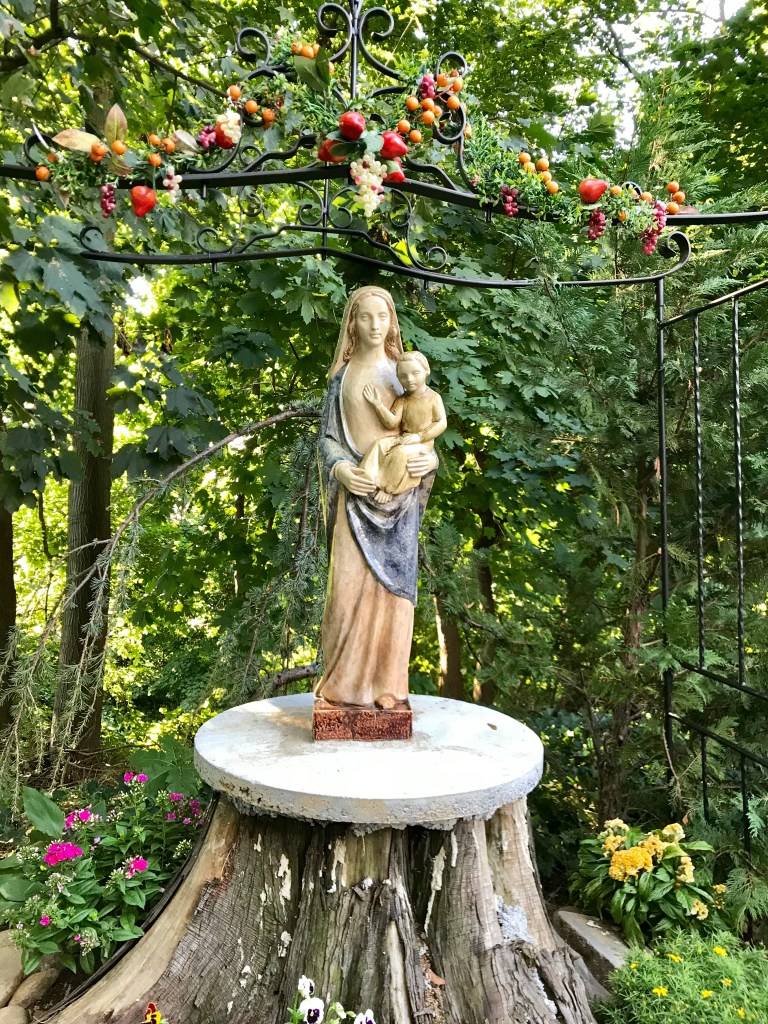
Reinterpreting life through the mystery of the Cross is at the heart of the charism of my community, the Passionists. In our Mary Garden here at the monastery, Mary stands with her Son on the stump of a cedar tree. A dead tree, yet brought to life by the presence of Jesus carried in Mary’s arms.

The Cross of Jesus helps us see life in our world, a “Faithful Cross” it’s called in an ancient hymn. And it is.

There is so much death in our world today. We need to reinterpret our time by the light of the mystery of the Cross of Jesus.

Life Comes from His Wounds

ICON

The Passionists celebrate the Feast of the Glorious Wounds of Jesus on Friday of the second week of Easter. The four gospels tell the great story of the passion of Jesus, each in its own way. More than the others, John’s gospel focuses on his wounds, unlikely signs revealing the mystery of the Word made flesh.

On Calvary  a small symbolic group stands beneath the cross of “the King of the Jews”– Mary, the mother of Jesus, the disciple whom he loved, and a few others. A gentile soldier joins them.

This group represents the “new Jerusalem,” “the inhabitants of Jerusalem who look on the one whom they have pierced…and mourn for him, as one mourns for an only child.” (Zechariah 11, 10 )

They receive a precious gift. “It is finished!” Jesus declares, and bowing his head, he pours out his spirit on them. A Roman soldier thrusts a spear into Jesus’ side. “Immediately blood and water flowed out.” (John 19, 34)

Blood, a sign of his life, flows on those standing beneath his cross. Water, signifying the Spirit within him, is poured out on the world they represent. Far from ending his life, his death is the moment Jesus shares his life.“This is the one who came by water and blood, Jesus Christ.” (I John 5,6)

Artists afterwards picture the wounds of Christ as cosmic signs. They place the grave of Adam beneath the cross — generations wait for the new life Jesus brings. Creation, symbolized by the sun and moon, looks on expectantly, for Calvary is where creation too is redeemed. Angels collect the blood and water from Jesus’ wounds in cups representing the mystery of the Eucharist. All days are found in this one day. On Calvary, the glory of the Lord is revealed in his wounds.

St. Paul of the Cross in his letters often wished the one to whom he’s writing to be placed in the “wounds of Christ” or the “holy Side of Jesus” or his “Sacred Heart.”  “I am in a hurry and leave you in the holy Side of Jesus, where I ask rich blessings for you.”

These expressions may seem pious phrases until we read the story of Thomas from John’s gospel. Jesus shows the doubting disciple the wounds in his hands and side, and Thomas believes.

Belief is not something we come to by ourselves. God gives this gift through Jesus Christ. We all stand beneath the life-giving Cross of Jesus. May his life give new hope to us and our world.

Rembrandt and the Woman at the Well

Samaritan woman
Though he’s known best for his portrayal of the Dutch world of his time, Rembrandt was very interested in stories from the Bible, both from the Old and New Testament. Possibly one third of his work is devoted to biblical subjects, about 700 drawings among them.

What led him to paint and draw biblical events? It wasn’t mainly a patron’s commission, as was the case of his contemporaries– Rubens, for instance. Rembrandt seems genuinely attracted to the bible and felt compelled to draw from the biblical narrative, not because he could make money on it, but because it spoke to him and his situation in life.

“Rembrandt’s relation to the biblical narrative was so intense that he repeatedly felt impelled to depict what he read there. These sketches of Rembrandt have the quality of a diary. It is as though he made marginal notes to himself…The drawings are testimonies, self-revelations of Rembrandt the Christian.” (Rembrandt’s Drawings and Etchings for the Bible. p. 6)

It seems this interest in the bible came, in part, from his mother, a devout woman, who had a Catholic prayerbook that featured the Sunday gospels with illustrations on facing pages. As she prayed from this book, did she show them to her little boy growing up?

His portrayal of scriptural stories are so insightful. Just look at his portrayal of Jesus at the well with the Samaritan woman, which is found in John’s gospel. Jesus deferentially asks for a drink of water, bowing to the woman as he points to the well. And she stands in charge, her hands firmly atop her bucket. She’s a Samaritan and a woman, after all. He wont get the water until she says so. Jesus looks tired, bent over by the weariness of a day’s long journey.

Certainly, this is no quick study of a gospel story. Obviously, Rembrandt has thought about the Word who made our universe and humbled himself to redeem us. Perhaps he’s also thinking of the way Catholics and Protestants at the time were clashing among themselves, their picture of Jesus a strong, vigorous warrior. But here he stands humbly outside a little Dutch village that the artist’s contemporaries might recognize. Some of them may be pictured looking on at the two.
Artists have a powerful role in relating truth and beauty.
And what about Rembrandt’s mother? A 19th century French Sulpician priest, Felix Dupanloup, who had a lot to do with early American Catholic catechetical theory said to parents:
“Till you have brought your children to pray as they should, you have done nothing.”
Looks like she did her job.

Tuesday, 3rd Week of Lent

Lent 1

Readings

In Today’s lenten reading Peter’s question about forgiveness (“How many times must I forgive my brother?”) isn’t just his question. It’s a question we all ask.

Jesus answers that we should forgive as God forgives–beyond measure –and he offers a parable about two servants who owe money (a big reason people fight among themselves). The first of the servants owes his master five thousand talents, a huge sum. His master forgives the entire debt In an unexpected display of mercy.

After being forgiven so much, however, that servant sends off to debtors prison another servant who owes him a few denarii, a mere pittance compared to his debt of ten thousand talents. He won’t forgive this small thing.

Now, isn’t the reason we don’t forgive others often just as small? So many grievances and grudges people have against one another are based on small slights they receive, real or imagined. And the small slights never stop. They’re constant and they need constant forgiveness.

In this holy season, we look at God’s immeasurable forgiveness found in the passion and death of Jesus and learn from him. “Father, forgive them for they know not what they do.” Seeing God’s forgiveness, the saints say, helps us to forgive. He’s forgiven us so much. Shouldn’t we forgive too?

We need to keep the example of Jesus always in mind, especially the example he gave from the Cross. The founder of my community always  recommended that:
“Always bring to prayer some mystery of the life and passion of Jesus Christ. If then, the Holy Spirit draws you into deeper recollection, follow the breath of the Spirit, but always by means of the Passion. You will thus avoid all illusion.” ( St.Paul of the Cross, Letter 791)

How many times must I forgive today, Lord,
how many times must I be patient, kind, understanding,
willing to carry on even if no one sees or cares?
How many times did you?
Bless me with the graces of your passion and death.

St. Gabriel Possenti and Theodore Foley, CP

St. Gabriel PossentiToday is the feastday of St. Gabriel Possenti, the young Italian Passionist who died in 1862 and was canonized in 1920. I’m interested in his connection with Fr. Theodore Foley (1913-1974), an American Passionist whose cause for canonization was recently introduced in Rome. As a young boy of 14, Theodore read about  St. Gabriel and decided to become a Passionist;  other young men joined the community in the early 1920s and 30s also influenced by the young Italian saint.

What was St. Gabriel’s appeal ?

The cause for beatification of Father Theodore Foley, C.P. (1913-1974) opened officially on May 9, 2008 in Rome, just two years after the North American Passionist Province of St. Paul of the Cross and affiliate members met in a provincial chapter, which endorsed a proposal requesting that Father Theodore, a member of St. Paul of the Cross province and former superior general of the community, be considered as a candidate for canonization. Appreciation for him has grown steadily over time, for Father Theodore exemplifies the quiet, steady loyal holiness needed today– rooted firmly in the past and reaching with Christian hope to the future. In his preface to Saint Gabriel, Passionist, a popular biography by Fr. Camillus, CP published in 1926, the powerful archbishop of Boston ,William Cardinal O’Connell, denounced the “flood of putrid literature which, for the past ten years of more, has deluged the bookshelves and libraries of our great cities, fueling disappointment and emptiness in a false romanticism.” He urged young Catholics to reject this falseness and live in the real world, like St. Gabriel:

“To live a normal life dedicated to God’s glory, that is the lesson we need most in these days of spectacular posing and movie heroes. And that normal life, lived only for God, quite simply, quite undramatically, but very seriously, each little task done with a happy supernaturalism,-that such a life means sainthood, surely St. Gabriel teaches us; and it is a lesson well worth learning by all of us.”

Young Theodore Foley took Gabriel’s path. He followed the saint into the undramatic life of the Passionists.

Gabriel Possenti’s decision to enter the Passionists has always been something of a mystery, even to his biographers. Did he choose religious life because he got tired of the fast track of his day? And why didn’t he enter a religious community better known to him, like the Jesuits, who could use his considerable talents as a teacher or a scholar? Why the Passionists?

Gabriel–and Theodore Foley after him– was attracted to the Passionists because of  the mystery of the Passion of Christ. It was at the heart of God’s call.

The Passionists were founded in Italy a little more than a century before Gabriel’s death by St. Paul of the Cross, who was convinced that the world was “falling into a forgetfulness of the Passion of Jesus” and needed to be reminded of that mystery again. Paul chose the Tuscan Maremma, then the poorest part of Italy, as the place to preach this mystery, and there he established his first religious houses for those who followed him. He chose the Tuscan Maremma, not to turn his back on the world of his day, but because he found the mystery of the Passion more easily forgotten there.

When Gabriel became a Passionist, the community like others of the time, was recovering from the suppression of religious communities by Napoleon at the beginning of the century. In one sense, it had come back from the dead .  The congregation was now alive with new missionary enthusiasm. Not only were its preachers in demand in Italy, but it had begun new ventures in England (1842) and America (1852).

Paul of the Cross, the founder, was beatified in 1853. Ten years earlier, the cause of St. Vincent Strambi, a Passionist bishop, was introduced. Dominic Barbari, the founder of the congregation in England, would receive John Henry Newman into the church in 1865; the English nobleman, Ignatius Spencer, who became a Passionist in 1847, began a campaign through Europe in the cause of ecumenism. New communities of Passionist women were being formed.

Respected for their zeal and austerity, the Passionists were a growing Catholic community, and their growth in the western world continued up to the years when Theodore Foley became their superior general and then saw its sharp decline.

Success was not what drew Gabriel–and Theodore Foley after him–to the Passionists. Their charism–the mystery of the Passion of Christ– was at the heart of God’s call.

As a boy growing up, Gabriel Possenti understood this mystery, even as he danced away the evening with his school friends. Twice he fell seriously ill and, aware that he might die, promised in prayer to serve God as a religious and take life more seriously. Both times he got better and forgot his promises. Then, in the spring of 1856, the city of Spoleto where he lived at the time was hit by an epidemic of cholera, which took many lives in the city. Few families escaped the scourge. Gabriel’s oldest sister died in the plague.

Overwhelmed by the tragedy, the people of Spoleto gathered for a solemn procession through the city streets carrying the ancient image of Mary, the Mother of Jesus, who stood by the Cross. They prayed that she intercede for them and stop the plague, and they also prayed that she stand by them as they bore the heavy suffering.

It was a transforming experience for Gabriel. Mysteriously, the young man felt drawn into the presence of the Sorrowing Woman whose image was carried in procession. Passing the familiar mansions where he partied many nights and the theater and opera that entertained him so often, he realized they had no wisdom to offer now. He took his place at Mary’s side. At her urging, he resolved to enter the Passionists.

Can we speculate, then, how the life of the Italian St. Gabriel drew the young American Theodore Foley to the Passionists? What similarity was there between them? What grace led him on?

Brought up in a good family and a strong religious environment , Theodore Foley still felt  “dangers and temptations” around him. No, he didn’t experience the social life that tempted Gabriel Possenti a century before. But he did experience the new mass media then sweeping the country.  By 1922 movies, and to a lesser extent the radio, became powerful influences in people’s lives, and Hollywood’s heroes preached a new gospel of fun and success. Through the new media, the “Roaring Twenties” came to Springfield as it did to other prosperous parts of America when Theodore Foley was growing up. Did it bring the  “the dangers and temptations” he feared?

Theodore Foley must have sensed the selfishness, the carelessness about others, the failure to appreciate suffering and weakness and sin in this new gospel. It promised life without the mystery of the Cross, but that was not real life at all. Only 14, he entered the Passionists.

We’re Not Statistics: Mark 7:31-37

healing crowds

Rembrandt, 

Jesus’ initial ministry in Galilee, starting with his miracles in Capernaum, brought excited crowds to him looking for healing for themselves or those with them. Wherever he went, whether in Jewish or Gentile territory, crowds came to him.

In today’s gospel, the deaf man brought to him isn’t identified as either Jew or gentile. He’s just deaf and can’t speak. He has no name. What’s significant about this miracle is the way Jesus heals him. “He took him off by himself away from the crowd.” (Mark 7,33)

Jesus takes the man aside privately, he meets him personally, face to face– and is deeply touched– “groans”–at the deaf man’s plight. He touches the man, putting his finger in his ears and his spittle on his tongue. When the deaf man speaks, Jesus says to him and his friends not to tell anyone. One reason may be that Jesus doesn’t want to be typed simply as a healer. But they went and proclaimed it anyway.

Still, why did he take him off “by himself away from the crowd?” A reminder that God does not look on us as a crowd, but knows each of us? We’re not statistics, part of a list. God meets each of us face to face.

And that’s a reminder to treat others that way too. Each has a face of their own and a story that’s unique. That’s hard to do. It’s easier to deal with people as statistics, numbers, people next in line.

For Jesus people were not statistics, one of a crowd, next in line. That’s not God’s way.

How Lovely is Your Dwelling Place, O Lord: 1 Kings 8

Mt.olives


How is God present ? Pilgrims looking towards where the Jewish temple once stood in Jerusalem may be asking that question. Today’s reading describes the temple Solomon built.

David before him wanted to build a temple, but the Prophet Nathan told him God doesn’t need a fixed place to dwell in. ( 2 Samuel 7, 4-17) He dwells in a tent so as to go with his people wherever they are. A beautiful reminder– God is with us wherever we are.

Solomon built a great temple for God on the threshing floor in the upper city in Jerusalem, and God makes his dwelling place there. A dark cloud fills the Holy of Holies of Solomon’s temple, so awesome the priests can’t remain in the place. “… The priests could no longer minister because of the cloud, since the LORD’s glory had filled the temple of the LORD.” (1 Kings 8,22-30)

God is transcendent yet immanent. “Can it indeed be that God dwells on earth? If the heavens and the highest heavens cannot contain you, how much less this temple which I have built!” Still, Solomon asks God to bless him and his people there: “Listen to the petitions of your servant and of your people Israel which they offer in this place. Listen from your heavenly dwelling and grant pardon.”

A good reading to reflect on the presence of God in our lives. God has promised to be with us, yet God’s presence will always be mysterious, beyond our understanding. He goes with us wherever we go, but then there are also holy places where God meets us– sacraments, signs, places he’s promised to be.

Jesus, the new temple of God, fulfills these Old Testament realities. As God’s Word, he dwells among us, accompanying us on our journey of life in signs and sacraments. Yet his presence is also “a dark cloud,” the mystery of his death and resurrection. Awesome, mysterious, beyond our understanding. Yet we draw close and pray and ask that he listen and bring us life.