Two worlds are described in the readings at Mass these weekdays. The Gospel of Mark tells of the world around Capernaum by the Sea of Galilee, where Jesus called his first disciples, encountered a demon in the synagogue, cured Peter’s mother in law, the paralyzed man and the leper– where he was fiercely opposed. (Mark 1,14-2,12) He became involved in a world like ours..
The world described in the Letter to the Hebrews is a world beyond this one, the world of the Risen Lord where he sits at the right hand of God the Father Almighty..
The Letter to the Hebrews describes him further as a High Priest entering a heavenly sanctuary to intercede for us, a merciful High Priest. He is the same Jesus who entered Capernaum and cured Peter’s mother in law, the paralyzed man and the leper. He’s knows our humanity with its yearning, its weakness and hardness; he carries the wounds of suffering and death.
It’s hard to keep these two worlds in mind, but our readings, like our creed, tell us to do it. The worlds are not sealed off, they’re joined. They have a common goal: “Our Father, thy will done, thy kingdom come.” The Risen Jesus is present in both of these worlds as Savior and Redeemer. Through him, God’s kingdom will come.
Unfortunately, we may think only of the world we see now, unsure or confused about a world beyond this one. We may see the world beyond as an escape from this life, an isolated world in the clouds.
Both worlds are important to keep in mind. Together they help us see life in the full. A gift of God, greater than we can imagine.
Timothy and Titus were companions of St.Paul on his missionary journeys and continued his mission. Timothy led the church at Ephesus; Titus assumed leadership of the church in Crete. Paul wrote letters of advice to them: one letter to Titus and two letters to Timothy, most likely written from house arrest in Rome.
Like Jesus, Paul never saw himself handing on a church that was completely developed. He ministered to a church evolving from a “way”, a movement, to a church settled in places like Ephesus and Crete. He had men and women companions at his side.
Timothy and Titus were important companions who represent another stage in Paul’s ministry. While Paul and other apostles went out to the nations, the church had to be firmly established in every place they visited. The roles of bishops, priests and other ministries evolved to fulfill that task. A local church needed to be organized. The church is missionary, global, sent by Jesus to the nations, but it’s also local, part of a town. city, neighborhood.
The feasts of the Conversion of Paul and Timothy and Titus represent those two aspects of the church.
Paul’s advice to Timothy is especially interesting. “Stir into flame the gift of God that you have through the imposition of my hands. For God did not give us a spirit of cowardice, but rather of power and love and self-control. So do not be ashamed of your testimony to our Lord, nor of me, a prisoner for his sake; but bear your share of hardship for the Gospel with the strength that comes from God.”
Is Paul trying to bolster Timothy’s confidence as he loses a powerful mentor. Timothy needs the gift of God to make the church in Ephesus a flourishing local church.
Timothy and Titus were given “apostolic virtues” by God to continue the work of Paul and the other apostles, the opening prayer of their feast says. And “May we merit to reach our heavenly homeland” by “living justly and devoutly in this present age.” Like them “we” also are given a task –to work for the church’s growth and development in this present age.
Let’s remember them as our mentors, mindful that God “ does not give a spirit of cowardice, but rather of power and love and self control.” Like the two followers of Paul, we have to hold on to what we’re given and continue their work: “Go into all the world, and proclaim the gospel. I am with you always, says the Lord.”
I see in the notes in the American Bible that the deacons Paul refers to in I Timothy 3, 8-13 may include women as well as men. “This (deacons) seems to refer to women deacons, but may possibly mean the wives of deacons. The former is preferred because the word is used absolutely…”
Why not today? We need women in roles of leadership. I have some in mind who would fit the role very well. I wonder if Timothy’s mother Eunice and grandmother Lois found a home and were involved there. I wonder what my mother would say.
Our yearly church calendar celebrates saints from every age and place because saints are examples of God’s grace present always and everywhere. Some saints are singled out for their importance. St. Paul the Apostle, whose dramatic conversion is celebrated on January 25th, is one of them. His martyrdom, along with Peter, is celebrated June 29th and we read extensively from his writings throughout the church year.
An account of Paul’s conversion ( Acts 22: 3-13) – one of three found in the Acts of the Apostles – is read first at his feast day Mass. Mark’s gospel for the feast recalls Jesu after his resurrection telling his disciples to “Go into the whole world and proclaim the gospel to every creature.” (Mark 16: 15-18) St. Luke devotes much of the Acts to Paul’s missionary journeys ending in Rome. The apostle fulfilled that command of Jesus.
Paul writes to the Corinthians:
“I am the least of the apostles; in fact, since I persecuted the Church of God, I hardly deserve the name apostle; but by God’s grace that is what I am, and the grace that he gave me has not been fruitless. On the contrary, I have worked harder than any of the others: or rather, not I but the grace of God that is with me. ( 1 Corthinians 15:9-10)
St. Paul is an example of how far we can rise, from the depths to the heights, and for that reason the church celebrates his conversion. He never forgot that God’s grace raised him from the dust to become a powerful force in his church and in the world. He never forgot he was a Pharisee who became one of Jesus’ most loyal disciples. His conversion gave him a boldness to go fearlessly to the ends of the earth
“Saul, Saul, why do you persecute me?” Jesus says to him from a blinding light. He never forgot the moment he was blinded by a light that made him see.
“Paul, more than anyone else, has shown us what we really are, and in what our nobility consists, and of what virtue a human being is capable. Each day he aimed ever higher; each day he rose up with greater ardour and faced with new eagerness the dangers that threatened him. He summed up his attitude in the words: I forget what is behind me and push on to what lies ahead. When he saw death imminent, he bade others share his joy: Rejoice and be glad with me! And when danger, injustice and abuse threatened, he said: I am content with weakness, mistreatment and persecution. These he called the weapons of righteousness, thus telling us that he derived immense profit from them… ” ( St. John Chrysostom)
O God, who taught the whole world through the preaching of the blessed Apostle Paul, draw us, we pray, nearer to you through the example of him whose conversion we celebrate today, and so make us witnesses to your truth in the world.Through our Lord Jesus Christ, your Son, who lives and reigns with you in the unity of the Holy Spirit, God, for ever and ever.Amen.
Pope John XXIII called for a Second Vatican Council on the Feast of the Conversion of Paul, January 25, 1959. He called for the church to be converted.
Francis de Sales, Bishop of Geneva in the 16th century, had a wonderful approach to holiness. He believed in the uniqueness of every person and recognized the variety of ways God works in people’s lives. That led him to believe in respect and dialogue, especially with someone who doesn’t think like you or is from another religious tradition.
Some years ago, I visited a church in Geneva, Switzerland, center of Calvinism in the 16th century, where Francis was the Catholic bishop. A statue in that church (above) pictures him holding a book and a pen in his hand – not a sword.
Geneva was a city of swords then, real and verbal; religious differences led toconflict and even bloodshed. Francis believed instead in peaceable dialogue.
Dialogue did not mean for him abandoning your own beliefs or being silent about them. It meant examining and measuring your own beliefs more deeply while listening carefully and respectfully to the beliefs of others to find the truth.
Francis de Sales prepared the Catholic Church for the approach to ecumenism it would take in the 20th century at the Second Vatican Council. He would certainly support the ecumenical movement today.
The spiritual writings of Saint Francis de Sales have become classics. Here’s something from “An Introduction to a Devout Life” that reveals the way he thought and taught. God works in quiet ways, as we see in creation itself.
“When God the Creator made all things, he commanded the plants to bring forth fruit each according to its own kind; he has likewise commanded Christians, who are the living plants of his Church, to bring forth the fruits of devotion, each one in accord with his character, his station and his calling.
“I say that devotion must be practised in different ways by the nobleman and by the working man, by the servant and by the prince, by the widow, by the unmarried girl and by the married woman. But even this distinction is not sufficient; for the practice of devotion must be adapted to the strength, to the occupation and to the duties of each one in particular.
“Tell me, please, my Philothea, whether it is proper for a bishop to want to lead a solitary life like a Carthusian; or for married people to be no more concerned than a Capuchin about increasing their income; or for a working man to spend his whole day in church like a religious; or on the other hand for a religious to be constantly exposed like a bishop to all the events and circumstances that bear on the needs of our neighbour. Is not this sort of devotion ridiculous, unorganised and intolerable? Yet this absurd error occurs very frequently, but in no way does true devotion, my Philothea, destroy anything at all. On the contrary, it perfects and fulfils all things. In fact if it ever works against, or is inimical to, anyone’s legitimate station and calling, then it is very definitely false devotion.
“The bee collects honey from flowers in such a way as to do the least damage or destruction to them, and he leaves them whole, undamaged and fresh, just as he found them. True devotion does still better. Not only does it not injure any sort of calling or occupation, it even embellishes and enhances it.”
The opening prayer in today’s liturgy asks God to give us tooFrancis’ gentle approach to life:
O God, who for the salvation ofsouls willed that the bishop St. Francis de Sales become all things to all, graciously grant that, following his example we may always display the gentleness of your charity in the service of our neighbor. Through Christ our Lord. Amen.
A good prayer and a good saint for our contentious times.
Agnes, a popular Roman woman martyr of the 3rd century, ranks high among the seven women mentioned in the First Eucharistic Prayer. “Agnes, Cecilia, Anastasia…”
That prayer goes back to St. Gregory the Great in the 6th century. Some say his mother and aunt may have promoted the women, all strong women who died for their belief. They come from all parts of the church of their time. Felicity and Perpetual are from North Africa, Agatha and Lucy from Sicily, Agnes and Cecilia from Rome, Anastasia originally from Greece.
Details of the story of Agnes, from 5th century sources, may be questioned, but the essential facts about her are true.
St. Agnes, Via Nomentana
A young Roman girl of 13 or so, Agnes was put to death because she rejected the offer of a highly placed Roman man to become his bride. Incensed, he tried to force Agnes to change her mind; eventually she died for continuing to refuse him.
Women were expected to marry young in those days, to marry men chosen for them, and to have two or three children. They were to produce children for Rome, especially soldiers needed for the empire’s many wars.
Agnes’ refusal then to marry one of Rome’s elite was a dangerous decision. With no support from family or friends, alone in a male-dominated society, at a time suspicious of Christians and their beliefs, the little girl sought strength in Jesus Christ. She was a martyr put to death for her faith.
The Golden Legend, a favorite saint book from the Middle Ages, says that Agnes was true to her name. She was a lamb (Agnus) who followed the Good Shepherd. Though young, she followed truth, never turning away from it. God gave her strength beyond what’s expected for her years.
The story says they put Agnes among the prostitutes found near the racecourse then on the Piazza Navona in Rome. God warded off those who tried to rape her. A church in her honor stands today in the busy piazza; another church over her grave is on the Via Nomentana in Rome. (above)
They finally killed her with a knife to her throat. Heavenly signs surrounded Agnes even then, her story says, assuring her that her faith was not in vain. The One she loved was with her as she struggled.
Agnes, the prayer for her feast says, is an example of how God chooses “what is weak in this world to confound the strong.” The young girl was stronger than her powerful killers. “May we follow her constancy in the faith, through our Lord Jesus Christ, who lives and reigns with you, in the unity of the Holy Spirit, one God, forever and ever. Amen.”
The Parable of the Talents. which we read today in Luke 19: 11-28 is also found in Matthew 25,14-30 and in a much shorter version in Mark 13, 34.
Why is Jesus so hard on the servant with one talent? A crucial point in the parable is that the Master entrusts talents to his servants according to what they can do. He gives to each one “according to his ability,” Matthew says. God certainly doesn’t expect anyone to do what’s beyond one’s ability, but God does expect us to use what we have, to trade till he comes, to live responsibly.
This is a lazy servant, who could do something and doesn’t do it. In a subtle way he blames his Master instead of himself. I suppose we might say, he’s guilty of sloth.
Sloth doesn’t seem to be a big sin. Pride, lust, anger, envy are more notorious. But sloth brings on inertia, uncaring, non-involvement that prevents the coming of the kingdom.
St. Paul the Apostle saw it as a problem in his community at Thessalonika, it seems. “Anyone who would not work, should not eat. We hear that some of you are unruly, not keeping busy, but acting like busy-bodies. We enjoin all such, and we urge the strongly in the Lord Jesus Christ, to earn the food they eat by working quietly. You must never grow weary of doing what’s right, brothers.” 2 Thessalonians, 3, 10-13)
Luke tells many stories of God’s mercy. Today’s reading at Mass is the story of Zacchaeus, the chief tax collector in Jericho, a wealthy man, Jesus called him down from a tree and stayed with on his way to Jerusalem. (Luke 19, 1-10)
As chief-tax collector, Zacchaeus was an agent for Herod Antipas, ruler of Galilee and Perea in Jesus’ day. Uncovering the ruins of Herod’s building projects in Galilee and elsewhere, archeologists point out that Herod built on a grand scale and lavishly, to impress his allies the Romans.
You needed money for building like that, of course, and that’s where tax-collectors came in. There was no dialogue or voting on government spending then. Herod told his army of tax-collectors, “Here’s how much I need; you go out and get it. Go to the fishermen along the Sea of Galilee and the farmers around Nazareth and the shepherds in the Jordan Valley and the merchants in Jericho and get what I need; I don’t care how, but get it.”
And so the tax collectors went out and got the money, keeping some for themselves. You needed to be tough and relentless for the job. It left you hard headed and hard hearted. An unsavory profession. The people resented them.
Zacchaeus, the chief tax collector in Jericho, was the one whom Jesus called and the one he stayed with on his way to Jerusalem. Objections came, not just from the Pharisees and scribes, who usually objected to Jesus’ actions, but everyone objected.
The only thing Jesus says is: “Today salvation has come to this house because this man too is a descendant of Abraham. For the Son of Man has come to seek and to save what was lost.” No thunderous warnings or stern corrections. Salvation has come and they sit down for a feast. You can hear in the story echoes of the Parable of the Prodigal Son, also from Luke’s gospel.
J
Notice that Jesus doesn’t call Zacchaeus to follow him to Jerusalem, like the blind man cured by Jesus in Jericho. He does not call him to follow him as he did the other tax collector, Matthew. He doesn’t tell Zacchaeus to give up his job and get out of that dirty, complicated situation. No, as far as we can tell Zacchaeus was still chief tax-collector in Jericho after Jesus left, still taking orders from Herod Antipas, still part of a sinful world. But that’s where Zacchaeus will experience salvation, even there.
God’s mercy works in the real world and in real life.
“The Vatican said recently he doesn’t exist,” our guide informed us as we looked up at the imposing statue in Cologne Cathedral in Germany a few years ago, Then, we passed quickly on.
Afterwards, I told him the Vatican didn’t say Christopher never existed, but as of now there is no historical evidence for the popular saint who carries the little child on his shoulders. For one reason or another, no historical evidence exists for a good number of our early saints.
It’s more than finding a Christopher in history, however. If you look at what he’s doing, there have been–and still are– many Christophers. (Bearers of the Christ Child) His holiness can be unrecognized, but very real. He’s there in the women and men who day after day carry children on their shoulders, getting them where they must go and keeping them from the dangers little children face.
Caregivers of all kinds do the same thing. I watch them here at our place, where we have a number of priests and brothers who can’t get around, getting them into wheelchairs and getting them to where they have to go. Not much glamor in that job, but a lot of people need carrying, especially today.
The media seems to thrive on violence today. Gangs taking on gangs, macho heroes blowing up cities, killing thousands. Non-stop violence.
Christopher was a sign to generations past that strength is more than swinging a sword. You’re strong when you serve the weak.
We need you today, St. Christopher. Pray for us. Inspire us.
The North American Martyrs, eight Jesuits and their associates were killed by warring Indian tribes in the 17th century. They’re the first saints of North America and we celebrate their feast October 19th. I’ve visited Auriesville in New York State and the Midlands in Canada where they were martyred; in both places their heroic faith and bravery are remembered.
The missionaries came to the New World expecting a new Pentecost among the native peoples of this land, but it didn’t turn out that way. Instead, disease and political maneuvering made the native peoples suspicious of the foreigners and the seed of the gospel seemed to fall on hard ground. The martyrdom of the eight Jesuits witnesses that resistance.
Letters back to France from the early Jesuits–marvelously preserved in “The Jesuit Relations”–often express the missionaries’ disappointment over their scarce harvest, but it didn’t stop them. They were well grounded in the mystery of the Cross.
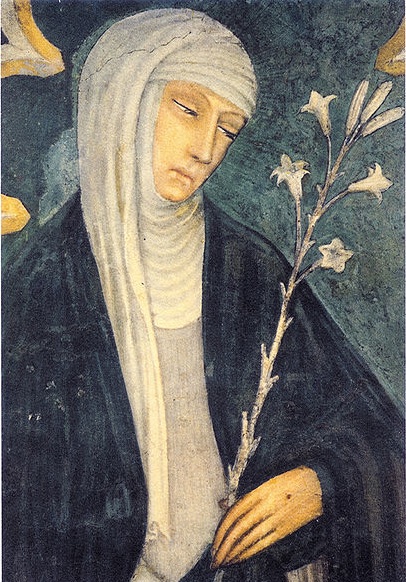
Not far from Auriesville, near Fonda, NY, is the Indian village called Caughnawaga. In the spring of 1675, after the Jesuits were killed in Auriesville in 1646, Father Jacques de Lamberville visited Caughnawaga . The priest entered a lodge where a young Indian girl Kateri Tekakwitha was alone because a foot injury prevented her from working in the fields. She spoke to him of her desire to receive baptism and on Easter, 1676, the young Indian girl was baptized and took the name Kateri, after St. Catherine of Siena, the mystic and a favorite patron of Christian Indian women. She was 20 years old.
Her uncle and relatives in the long house opposed her conversion to Christianity and pressured her to marry and follow their ways. The early Jesuits considered it a miracle that Kateri resisted family and tribal pressure. Her early biographer says “She practiced her faith without losing her original fervor and her extraordinary virtue was seen by all. The Christians saw her obeying their rules exactly, going to prayers everyday in the morning and evening and Mass on Sunday. At the same time she avoided the dreams feasts and the dances,” practices endangering her belief. (The Life of the Good Catherine Tekakwitha, Claude Chauchetiere, SJ , 1695)
Father de Lamberville finally recommended that Kateri escape to the newly-established Indian Christian village in Kahnawake near Montreal, where she could live her faith freely. In 1676, aided by other Christian Indians, she made the dangerous journey northward. There she lived a fervent life of prayer and faith; she died and was buried on April 17th, 1680.
Kateri was canonized October 21th in Rome by Pope Benedict XVI. “The blood of martyrs is the seed of Christians.” (Tertullian)
Our first readings this week at Mass are from the Letter to the Galatians, who were non-Jews St. Paul converted probably on his second missionary journey through Asia Minor. When Paul left, some Jewish Christians arrived and were enticing the new converts to adopt Jewish practices, especially that of circumcision. They also called Paul’s authority into question, saying he wasn’t among the original witnesses to Jesus’ life and resurrection.
Paul responds in this emotional letter written in 54 or 55 AD in which he voices amazement that the Galatians are listening to the newcomers and losing sight of the faith they’ve learned. Paul gives an account of his own call; he defends his authority to preach the gospel and his communion with the other apostles.
But the theme of his letter is belief in Jesus Christ, who was crucified. “Stupid Galatians! Who has bewitched you, before whose eyes Jesus Christ was publicly portrayed as crucified?” ( Gal 3,1) Don’t lose sight of what’s most important, what’s central to your faith–Jesus Christ!
Of course, the Galatians are not the only ones who lose sight of what’s most important ; we do too. That’s especially true in times like ours today.
Some of Paul’s most beautiful expressions of his own faith are found in this letter. He describes his own conversion as a “revelation of Jesus Christ,” a grace by which God “revealed his Son to me.” It wasn’t a book he read or a blinding light. Jesus revealed himself to him and that revelation continued. “I have been crucified with Christ,yet I live, no longer I, but Christ lives in me; insofar as I now live in the flesh, I live by faith in the Son of God who has loved me and given himself up for me.” (Gal 2,19-20)
Do we need to remember too the Lord’s revelation of himself to us today?
Living in Christ means living in his Spirit, Paul continues. The Galatians are enticed by practices of the Jewish law; Paul reminds them of the law Jesus taught. “The whole law is fulfilled in one statement,’ You shall love your neighbor as yourself.’” (Gal 5,14) Bearing one another’s burdens is the way you fulfill the law of Christ, by sharing good things with one another you fulfill his law. Don’t tire of doing good, keep doing it, Paul says to his children in faith. (Gal 6,2;6:9)
Paul doesn’t give the Galatians a book he wrote once about Jesus, he speaks to them from his own faith in Jesus which is living and constantly growing. He’s likely just read the verse from the Old Testament about the curse one bears who hangs on the tree. The Son of God took on that cursed condition of hanging on a tree! What greater love can there be? Paul’s thinking too of the promise Abraham embraced who lived long before the mosaic law existed. That was the promise Abraham saw in faith and that’s the revelation the gentiles see in the Crucified Christ.
The Letter to the Galatians is about forgotten essentials that are replaced by something else. Paul recalls the essentials. “I live by faith in the Son of God who has loved me and given himself up for me.”