Tag Archives: Passionists

The Martyrs of Daimiel

Damiel

Civil wars are hard to understand. The American Civil War, the war in Rwanda in the 1990s, the war in Bosnia. That’s true also of the Spanish Civil War, which took place from 1936-1939 between forces of the left and the right. Great numbers of innocent people lost their lives. Outsiders from Germany, Russia and Italy made the war a testing ground for their own war machines. The scars are still there.

Many Catholic clergy were killed, especially in the early months of the war, including 13 bishops, 4,172 diocesan priests and seminarians, 2,364 men religious and 283 nuns in a period referred to as Spain’s “Red Terror.” Today the Passionists remember their Martyrs of Daimiel, Spain.

Between July 22nd and October 24th, 1936, twenty-six religious from the Passionist house of studies, Christ, the Light, outside the city of Daimiel, about eighty miles south of Madrid, died at the hands of anti-religious militiamen at the outbreak of the Spanish Civil War

They were: Niceforo Diez Tejerina, 43, provincial superior, who previously served as a missionary in Mexico and Cuba after being ordained in Chicago, Illinois.; Ildefonso García Nozal, 38; Pedro Largo Redondo, 29; Justiniano Cuestra Redondo, 26; Eufrasio de Celis Santos, 21; Maurilio Macho Rodríguez, 21; Jose EstalayoGarcia, 21; Julio Mediavilla Concejero, 21; Fulgencio Calv Sánchez, 19; Honorino Carraced Ramos, 19; Laurino Proáno Cuestra, 20; Epifanio Sierra Conde, 20; Abilio Ramos Ramos, 19; Anacario Benito Nozal, 30; Felipe Ruiz Fraile, 21; Jose Osés Sainz, 21; Felix Ugalde Irurzun, 21; Jose Maria Ruiz Martinez, 20; Zacarias Fernández Crespo, 19; Pablo Maria Lopez Portillo, 54; Benito Solano Ruiz, 38; Tomas Cuartero Gascón, 21; Jose Maria Cuartero Gascón, 18; German Perez Jiménez, 38; Juan Pedro Bengoa Aranguren, 46; Felipe Valcobado Granado, 62.

Most of those killed were young religious studying for ordination and destined for missionary work in Mexico and Cuba. Others were priests who taught them and brothers who served in the community. Father Niceforo, the provincial, was visiting the community at the time.

Militiamen entered the Passionist house on the night of July 21st and ordered the thirty-one religious to leave in one hour. Father Niceforo gathered them in the chapel, gave them absolution, opened the tabernacle and said:

“We face our Gethsemane. . . all of us are weak and frightened, , ,but Jesus is with us; he is the strength of the weak. In Gethsemane an angel comforted Jesus; now he himself comforts and strengthens us. . .Very soon we will be with him. . .To die for him is really to live. . . Have courage and help me by your example.”

He then distributed the sacramental hosts to them.

The militiamen ordered the group to the cemetery and told them to flee. At the same time, they alerted companions in the surrounding areas to shoot the religious on sight.

The Passionists split into five groups. The first group of nine was captured and shot outside the train station of Carabanchel in Madrid on July 22, 1936 at 11pm.

The second group of twelve, Father Niceforo among them, was taken at the station at Manzanares and shot by a firing squad. Father Niceforo and four others died immediately. Seven were taken to a hospital where one later died. Six of them recovered, only to be shot to death later on October 23, 1936

Three other religious, traveling together, were executed at the train station of Urda (Toledo) on July 25th. Two gave their lives at Carrion de Calatrave on September 25th. Only five of the thirty-one religious were spared.

Numerous eye-witnesses testified afterwards to the brave faith and courage shown by the Daimiel Community in their final moments, especially the signs of forgiveness they gave their executioners.

They were beatified by Pope John Paul II on October 1, 1989, who said of them: “None of the religious of the community of Daimiel was involved in political matters. Nonetheless, within the climate of the historical period in which they lived, they were arrested because of the tempest of religious persecution, generously shedding their blood, faithful to their religious way of life, and emulating, in the twentieth century, the heroism of the Church’s first martyrs.” (Homily: October 1, 1989)

Today their bodies are interred in the Passionist house at Daimiel, Spain.

Their feastday is July  24th.

Parables of the Kingdom

The Sower James Tissot, Brooklyn Museum

Jesus answers the opposition described in chapters 11-12 in Matthew’s gospel with a series of parables that begin with the parable of the sower sowing his seed. (Chapter 13) The seed doesn’t always fall on good ground, he reminds his disciples. Sometimes it falls on the path where it quickly dries up– like the  towns that welcome him enthusiastically and soon forget him.

The parable of the weeds and the wheat points to enemies who want to poison the power and beauty of his words and deeds because of their own claims.  The Pharisees did that.

The kingdom of God comes in smallness. It’s like the mustard seed, not a full grown tree. You can miss it if  you’re looking for something fully grown and done. The treasure is hidden in a field; you may discover almost accidentally. Maybe Jesus’ own extended family in Nazareth still saw him as just the little boy they knew before and could not appreciate him now. We underestimate small things and  what they can grow to be.

But the kingdom of heaven is also like a merchant in search of fine pearls. You have to keep searching for it all your life. You can’t give up that search. Keep looking, hoping searching.

Jesus concludes his teaching with the parable of the net cast into the sea that catches fish of every kind, good and bad. At the end of time, the net will be dragged to shore and the good will be separated from the bad. God is the ultimate judge, leave judgment to him.

His parables are about the real world, the world Jesus experienced. They also help us look at the world we live in, which is not far from his.

St. Mary Magdalene: July 22

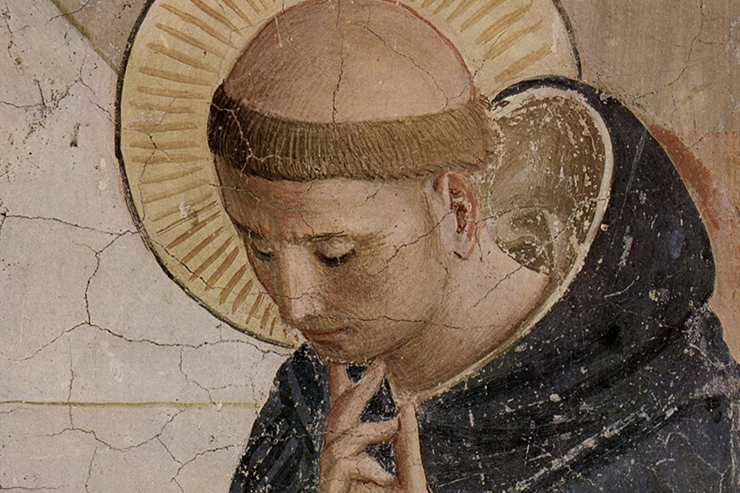
Mary Magdalene, Fra Angelico

In 2016, Pope Francis raised the liturgical celebration of Mary Magdalene, July 22, from a memorial to a feast and directed she be referred to as an “Apostle to the apostles”. Today, the pope said, we must recognize more fully the dignity of women and their role in bringing the gospel to the world. Mary Magdalene is an example.

Gregory the Great, an early pope, got it wrong when he identified Mary Magdalene with Mary, the sister of Lazarus and the sinful women in Luke 7: 33ff, who washed Jesus’ feet. She is neither one. She was a star witness at his resurrection. Unfortunately, Gregory’s picture of Mary influenced the way western Christianity saw Mary. The eastern Christian churches, for the most part, have not seen her that way.

The composite view of Mary Magdalene in the western church could be found until recently in the Tridentine mass texts for her feast. The collect identified her as Mary of Bethany and the gospel was the story from Luke of the penitent woman anointing Jesus’ feet. That picture of her is often found in western Christian art.

Instead of the gospel of the sinful woman, our present lectionary offers John’s account of the appearance of Jesus to Mary after his resurrection. (John 20:1-18) 

Unfortunately some recently, using flimsy evidence from 3rd and 4th century gnostic writings, want to “de-mythologize” Jesus and romanticize his relationship with Mary. Some even claim he was married to her. Their claims have been sensationalized in the  media and unfortunately get a wide hearing.

Better to listen to the four gospels, especially St. Luke’s Gospel, and the evidence of the New Testament. They see Mary as a disciple among other important woman followers of Jesus who loved him. Their witness is older and more reliable. There’s also new archeological evidence about Magdala, Mary’s hometown, that helps us understand Mary Magdalene. Take a look.

Yet,  Gregory the Great’s description of Mary’s spirituality is right on. Here’s an excerpt from his beautiful sermon in today’s Liturgy of the Hours:

“We should reflect on Mary’s attitude and the great love she felt for Christ; for though the disciples had left the tomb, she remained. She was still seeking the one she had not found, and while she sought she wept; burning with the fire of love, she longed for him who she thought had been taken away. And so it happened that the woman who stayed behind to seek Christ was the only one to see him. For perseverance is essential to any good deed, as the voice of truth tells us: Whoever perseveres to the end will be saved.

“At first she sought but did not find, but when she persevered it happened that she found what she was looking for. When our desires are not satisfied, they grow stronger, and becoming stronger they take hold of their object. Holy desires likewise grow with anticipation, and if they do not grow they are not really desires. Anyone who succeeds in attaining the truth has burned with such a great love. As David says: My soul has thirsted for the living God; when shall I come and appear before the face of God? And so also in the Song of Songs the Church says: I was wounded by love; and again: My soul is melted with love.

“Woman, why are you weeping? Whom do you seek? She is asked why she is sorrowing so that her desire might be strengthened; for when she mentions whom she is seeking, her love is kindled all the more ardently.

“Jesus says to her: Mary. Jesus is not recognized when he calls her “woman”; so he calls her by name, as though he were saying: Recognize me as I recognize you; for I do not know you as I know others; I know you as yourself. And so Mary, once addressed by name, recognizes who is speaking. She immediately calls him rabboni, that is to say, teacher, because the one whom she sought outwardly was the one who inwardly taught her to keep on searching.”

Here’s Pope Francis on Jesus’ words to Mary in the garden, “Do not cling to me.”

“It is specifically in the garden of the resurrection that the Lord says to Mary Magdalene: “Do not hold on to me”. This is an invitation directed not only to Mary, but also to the entire Church, to enter into an experience of faith that surpasses any materialistic appropriation or human understanding of the divine mystery. A disciple of Jesus is not to seek human securities and worldly titles, but faith in the Living and Risen Christ! “

The article on Mary Magdalene in Wikipedia deals extensively, and generally fairly, with the interpretations of Mary in religious and popular culture through history. She is an importance reference for recognizing women’s role in the world and in the church today. An importance saint to know.

Traditions about St. Ann

In my part of the world, novenas to Saint Ann have begun in churches and dioceses, like Scranton, PA. Where did the story of Saint Ann come from? From earliest times Christians wondered who the parents of Mary were and, as you would expect, that interest was particularly strong in Palestine. Ann and Joachim were first honored there as the mother and father of Mary, the mother of Jesus Christ.

Around the year 550, a church in her honor was built in Jerusalem on the site where her home was said to be, near the Pool of Bethesda, where Jesus cured the paralyzed man. Since then, many churches honoring Ann and Joachim have been built throughout the Christian world; The saints appear frequently in Christian art.

Feasts of St. Ann

Feasts honoring Mary’s birth (September 8) and her presentation in the temple (November 21) – inspired by the Protoevangelium– were introduced into the liturgies of the Eastern churches in the 6th century. Feasts in honor of St.Joachim and Ann (September 9), the conception of St Ann (December 9), and St.Ann alone (July 26) have been celebrated from the 7th century in the Greek and Russian churches.

The western church, adopting the eastern traditions, has celebrated the feast of St. Ann on July 26 since the 16th century. In 1969 her feast was joined with her husband Joachim to become the Feast of Saints Joachim and Ann.

Why was the story of Ann and Joachim so popular?  Besides satisfying curiosity about the family background of Mary and Jesus, they supported traditional belief that Jesus is the Son of God, born of the Virgin Mary, a belief questioned by heretical elements in the church as well as outsiders of the faith from the beginning.

Ann and Joachim also offered inspiration to mothers and fathers, wives and husbands, grandmothers and grandfathers in their roles in family life.

Devotion to St. Ann in Europe

In the western church, devotion to St.Ann was fed by a popular belief that relics of her were brought to France by Mary Magdalen, Lazarus, Martha, and other friends of Jesus who crossed the stormy sea from Palestine to bring the Christian faith to the region around Marseilles.

Her relics were buried in a cave under the church of St.Mary in the city of Apt by its bishop, St. Auspice, the story goes. Barbarians invaded the area and the cave was filled with debris and almost forgotten, only to be unearthed 600 years later during the reign of Charlemagne. You can see why sailors and miners would be devoted to St. Ann.

Crusaders from Europe – many from France – went to the Holy Land in the 11th century, and they rebuilt the ancient church of St. Ann in Jerusalem. The date the crusader church was consecrated, July 26, is the day we celebrate the feast of Joachim and Ann in the western church today.

By the 14th century, devotion to St. Ann was on the rise throughout Europe as the Black Death struck the continent and raged everywhere for over 150 years, wiping out almost 30 percent of its population. Families bore the brunt of the catastrophe as they tended their sick and cared for the healthy.

They needed models like Mary and Joseph, Ann and Joachim, who supported their child and grandchild. Mothers and grandmothers were particularly important for raising children.

When the plague ended, Europe’s population expanded dramatically in the late 15th and 16th centuries; new towns and cities sprang up everywhere and families were uprooted from places and people familiar to them. Families needed help to stay together and survive.

Faith suggested Mary and Joseph, Ann and Joachim as models to be imitated.  Images of the nursing Madonna and the caring grandparents became important sources of Christian inspiration.

Christians joined Confraternities of St. Ann, dedicated to caring for widows, orphans and families under stress. Images of Mary and Ann, nursing their children, playing with the Christ Child and/or John the Baptist were more than pious pictures; they had a social purpose as well.

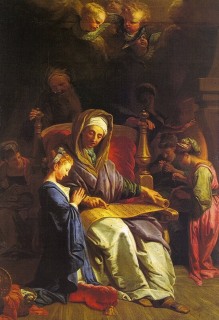
One picture from this era, still popular today, portrays St. Ann teaching her little daughter how to read.  Sometimes the words on the book are words of scripture; sometimes they’re basic numbers or letters of the alphabet: 1,2,3,4-A,B,C.

Playing with children, teaching them the ABC’s, passing on the mysteries of God to them are vital actions. Simple as they may seem, they’re holy actions and they can make those who do them saints.

The Troubled Crowds: Matthew 9:34-38

“At the sight of the crowds, Jesus’ heart was moved with pity for them because they were troubled and abandoned, like sheep without a shepherd.Then he said to his disciples, “The harvest is abundant but the laborers are few; so ask the master of the harvest to send out laborers for his harvest.” (Matthew 9, 34-38)

In every age, Jesus calls his disciples to speak to the troubled and abandoned crowds. In this 14th week of the year we have Matthew’s account of that first time Jesus called disciples to preach and enter his ministry. How should laborers in the harvest approach the troubled crowds today ?

In his 1977 novel “Lancelot” Walker Percy tells the story of Lancelot, a man confined to a prison hospital after setting fire to his beautiful ancestral home in Louisiana and murdering his wife and her lover. The man’s fed up with today’s world and turned against it, but he’s still trying to figure out what life’s all about. He’s on to something, one of Percy’s phrases.

An old priest visits him frequently in the prison hospital– his only visitor, it seems– and listens to him, but hardly says a word. That’s partially because Lancelot doesn’t think much anymore of the faith the priest represents.

Yet, the priest listens. Lancelot occasionally asks him if he understands. “Perhaps I talk to you because of your silence. Your silence is the only conversation I can listen to,” Lancelot remarks. Only as the book ends does he say to the priest: “Very well, I’ve finished. Is there anything you wish to tell me?”

In Pope Francis’ exhortation, “Gaudete et exultate”, there’s a wonderful exploration of holiness today. At one point, the pope says “Nor can we claim to say where God is not, because God is mysteriously present in the life of every person, in a way that he himself chooses, and we cannot exclude this by our presumed certainties. Even when someone’s life appears completely wrecked, even when we see it devastated by vices or addictions, God is present there. If we let ourselves be guided by the Spirit rather than our own preconceptions, we can and must try to find the Lord in every human life.”
(42)

We’re sent as laborers for today’s harvest, but words may not be the only tools we have to use. Is silence, along with a persevering concern, ways to engage the troubled crowd today? The way of silence doesn’t mean we don’t have to search for the words to say today. We need to find out how the mysteries of the gospel speak in “new wineskins.”

Silence and new words?

Today’s readings here.

St. Thomas: Going to God through Questions

Thomas

Today, July 3rd, we remember Thomas the apostle. We’re tempted to think that belief does away with troublesome questions and shelters us from unbelief, making our way to God smooth and undisturbed. Not so, Thomas reminds us; he found faith through his questions and by placing his finger into the wounds of Christ.

Gregory the Great reminds us today of the importance of Thomas the Apostle.

“In a marvellous way God’s mercy arranged that the disbelieving disciple, in touching the wounds of his master’s body, should heal our wounds of disbelief. The disbelief of Thomas has done more for our faith than the faith of the other disciples. As he touches Christ and is won over to belief, every doubt is cast aside and our faith is strengthened. So the disciple who doubted, then felt Christ’s wounds, becomes a witness to the reality of the resurrection.”

That’s an interesting statement, isn’t it? “The disbelief of Thomas has done more for our faith than the faith of the other disciples.” Is an unbelieving world strengthening our faith now?

We go to God through questions, and some troubles too. We’re healed by touching the wounds of Christ. How do we touch the wounds of Christ? Is it by touching those who are wounded like him?

Grant, Almighty God,
that we may glory in the Feast of the blessed apostle Thomas, so that we may always be sustained by his intercession
and, believing, may have life
in the name of Jesus Christ your son,
whom Thomas acknowledged as the Lord.
Who lives and reigns with you in the unity of the Holy Spirit, one God, for ever and ever.

The First Martyrs of Rome: June 30

Today is the feast of the early Roman martyrs who suffered in Nero’s persecution along with the apostles Peter and Paul. The persecution began with an early morning fire on July 19, 64, that broke out in a small shop by the Circus Maximus and spread rapidly to other regions of Rome, raging for nine days through the city’s narrow streets and alleyways,  where more than a million people lived in apartment blocks of wooden construction.

Only two areas escaped the fire; Trastevere, across the Tiber River, which had large Jewish population, was one.

Nero was at his seaside villa in Anzio when the blaze began, but he delayed returning to the city. They say that when he heard the news, he began composing an ode comparing Rome to the burning city of Troy. His absence caused resentment among the people. Rumors began that Nero himself set the fire in order to rebuild the city from his own plans.

To quell the rumors, Nero decided to blame someone else, and he chose a group of renegade Jews called Christians, who had caused trouble before, and had a bad reputation in the city. Earlier, about the year 49, the Emperor Claudius had banished some of them from Rome for starting upheavals in the city’s Jewish synagogues with their disputes about Christ.

“Nero was the first to rage with Caesar’s sword against this sect,” wrote the early-Christian writer, Tertullian. “To suppress the rumor,” the Roman historian Tacitus says, “Nero created scapegoats. He punished with every kind of cruelty the notoriously depraved group known as Christians.” Just how long the process went on and how many were killed, the Roman historian does not say.

The early Roman Christians came mostly from the 60,000 Jewish merchants and slaves with strong ties to Jerusalem. Even before Peter and Paul arrived in Rome, Jewish-Christians, clearly identified as followers of Jesus Christ, were counted among the city’s Jews.

At the time of the fire Jewish Christians had become alienated from the larger Jewish community and began separating from it. Where they lived and met was well known. The authorities, following the usual procedure, seized some of them, brought them to the Prefecture and forced them by torture to give the names of others.

“First, Nero had some of the members of this sect arrested. Then, on their information, large numbers were condemned — not so much for arson, but for their hatred of the human race. Their deaths were made a farce.” (Tacitus)

Instead of executing the Christians immediately at the usual place, Nero executed them publicly in his gardens and in the circus on Vatican hill. “Mockery of every sort accompanied their deaths. Covered with the skins of beasts, they were torn by dogs and perished, or were nailed to crosses, or were doomed to the flames and burnt, to serve as a nightly illumination, when daylight had expired.” (Tacitus)

Most thought Nero went too far. “There arose in the people a sense of pity. For it was felt that they (the Christians) were being sacrificed for one man’s brutality rather than to the public interest.” (Tacitus)

We celebrate the memory of the victims of Nero’s persecution, our ancestors in faith, on June 30th, following the feast of Saints Peter and Paul.

Further Reading

It would be good to have two New Testament writings in mind as we celebrate this feast– the Gospel of Mark and the First Letter of Peter.

Many scholars believe the Gospel of Mark was written in Rome following Nero’s persecution and before the destruction of Jerusalem in 70.  Roman Christians, reeling from persecution and fearing troubles ahead, learned from this gospel.

Most belonged to a Jewish community that enjoyed extensive privileges under Rome’s emperors; they felt safe and secure– until Nero’s reign. There were brave martyrs, but there were others who betrayed their fellow Christians.

Mark’s Gospel presents the Passion of Jesus as a stark, brutal martyrdom that can’t be explained. How appropriate for Christians facing absurd, unmerited suffering meted out by a capricious emperor. At the same time, more than other gospels, Mark portrays Peter as a disciple who fails his Master and then receives mercy. He seems to remind Rome’s Christians that not only the strong, but the weak are part of their church.

Mark’s Gospel is meant for hard times. Jesus Crucified calls his disciples to follow him to the Cross.

First Letter of Peter

Another New Testament writing offered a similar message to the Roman community and Christians beyond the city. Like Mark’s Gospel, the First Letter of Peter, written in Rome, calls for courage in suffering, even unjust, absurd suffering.

“Christ suffered for you, leaving you an example that you should follow in his footsteps. He committed no sin and no deceit was found in his mouth. When he suffered he did not threaten; instead he handed himself over to the one who judges justly.” (1 Peter 2, 21-23)

The followers of  Jesus should stay the course when suffering comes,  Peter says. Stay where you are, the letter says, and “maintain good conduct among the Gentiles,” (1 Peter 2:12) “give honor to all, love the community, honor the king.”(1 Peter 2:17)

Following the Neronian persecution, many Jewish Christianss fled Jerusalem before Titus’ advancing legions. Seeing a sign of the last times, they prepared for the end. Rome’s Christians stayed where they were, it seems, and with their neighbors rebuilt their burnt city, waiting in hope for God’s kingdom to come.

They must have wondered whether to stay in this city, an evil city like Babylon. Should they go to a safer, better place? The Christians remained in the city. I wonder if the “Quo Vadis?” story was a story prompted by questions like these ?

The martyrs of Rome strengthen us to stand where we are and do God’s will, inspired by the Passion of Christ.

The Sacred Heart: A Heart Says it All

IMG_0291

Faith says great things in simple ways. Sometimes a few words say it all, like the few words of the Creed. Sometimes signs like bread and wine point far beyond themselves to an infinitely generous God.

How is it possible to sum up the love of Jesus Christ for us? Today’s Feast of the Sacred Heart expresses divine love, which cannot be measured, through the human heart. Pope Francis offered an important recent reflection on the Sacred Heart in his Encyclical Letter, Dilexit nos,

The Feast of the Sacred Heart is always celebrated on Friday, the day Jesus showed the depth of his love, the day he faced rejection and gave himself for us. On that day a soldier pierced his heart as he hung on the cross, and blood and water poured out. “Immediately blood and water poured out.”

See these signs with eyes of faith, John’s gospel says. They reveal God’s love for us and for our world. His pierced heart says it all. The heart can never be separate from the Person whose heart it is: Jesus Christ. He can never be separate from the Father and the Holy Spirit, so his heart represents the love of the Trinity for the world.

Consider

Consider who hangs on the cross for you, his death gives life to the dead, his passing heaven and earth mourn,  even the hard stones split. Consider how great he is, who he is. He slept on the cross that the church be formed from his side and scripture might be fulfilled:

“They shall look on him who they have pierced,  One of the soldiers pierced his side with a spear, blood and water flowed out paying the price of our salvation. He gave his blood that the sacraments might give grace, living water, eternal life.

Bride of Christ, arise and like the dove, like the sparrow finding a home, drink from the wells of your Savior. He is the spring flowing in the midst of Paradise. from him four rivers flow to every heart, watering the whole world and making it fruitful.

Run with longing, cry out from your inmost heart: Beauty of God most high, Shining everlasting light, Life that gives life to all life, Light that illumines every light, Water eternal and unseen, clear and sweet, flowing from a spring hidden from all, A spring whose depths can’t be plumbed, whose height can’t be measured, whose shores can’t be charted, whose purity can’t be muddied. From him flows the river that makes glad the city of God. 

So with songs of thanksgiving, we sing hymns of praise. With you is the fountain of life and in your light we shall see light.  Adapted from St. Bonaventure.

Almighty God and Father,  we glory in the Sacred Heart of Jesus, your beloved Son,  as we call to mind the great things his love has done for us.Fill us with the grace that flows in abundance  from the Heart of Jesus, the source of heaven’s gifts. Who lives and reigns with you in the unity of the Holy Spirit,  one God, for ever and ever.Amen.

The Birth of John the Baptist

June 24, three months after the angel announces to Mary that Elizabeth is six months pregnant (March 25) John the Baptist is born.

From his birth John the Baptist was destined by God, not to follow Zachariah his father as a priest in the temple, but to go into the desert to welcome the Messiah, Jesus Christ. John is the last of the Jewish prophets, the first to recognize Jesus. His birth and death are celebrated in our church calendar.

It may have changed, but there’s an interesting Sunday walk in Rome I’d recommend.  Go out the city gate at the Porta di San Sebastiano and walk south along one of the oldest roads in the world, the Via Appia, to the catacombs and church of San Sebastiano. Outside the city gates, you’re in what the ancient Romans called the “limes,” the limits, the world beyond the city, a different world altogether.

To the ancient Romans the “limes” was the end of civilized, reasonable life. No place to live, they thought. Get where you’re going as soon as you can. “Speed limit” comes from the word. Go beyond the limit and you can lose your life.

Few people today are usually on that road, deserted fields all around. The only sound  you can hear is the sound of your own breathing and your footsteps.

The last line of St. Luke’s gospel for today’s feast says of John:

“The child grew and become strong in spirit, and he was in the desert until the day of his manifestation to Israel.”

How did John become strong in a desert? Centuries before, God told Abraham to go into a land he would show him. He led Jews from Egypt into the desert, and with no map or provisions, to a world unknown. They were in the hands of God, their strength.

Most of us stay within our limits; we don’t go to live in physical deserts. Yet, try as we may, we face them anyway in things we didn’t expect, like sickness or death or separation or divorce or the loss of a job or lost friends or lost places we know and love. The desert’s never far from any of us.

The Via Appia brings you to the catacombs, the great underground tunnels where early Christians buried their dead. They buried them there, I think,  not to hide them, but because this place was an image of a new unknown world.  The “limes,”  marked the end of this life and foreshadowed a new life. The dead no longer belonged in the city; they were going to  a new city.

Life holds its doubts, fears, uncertainty. But we don’t face limits alone. In the “limes” God alone has you in his hands. God gives you strength and brings you where you’re meant to be. God is there.  God is there.

Readings for the Feast:

Like other ancient church feasts, the Nativity of John the Baptist, June 24, is tied to cosmology. Three months after the angel announces to Mary that Elizabeth is six months pregnant (March 25) John the Baptist is born.John’s birth coincides with the summer solstice. He begins to decrease to make way for the one who will increase. Jesus will be born December 25. The Feast of the Nativity of John the Baptist is celebrated by all the ancient Christian churches. The Orthodox Church celebrates it June 24.

Birth of John the Baptist. Orthodox Church of America.

Readings here.

.

Matthew 6: 19-23. The Treasures We Bring to Heaven.

In Matthew’s gospel today, Jesus speaks of treasures in heaven. Usually the treasures we think of are gold, silver, works of art, gems, degrees from school, signs of achievement. They’re the “treasures of earth” Jesus speaks of in the gospel. Thieves can steal them away; they can be eaten by moths and forgotten. They don’t last. (Matthew 6,19-23)

Other treasures are for heaven. St. Paul sees some of them in his trials for the gospel that we read today in his 2nd Letter to the Corinthians. God won’t forget his sufferings: the beatings, imprisonments, brushes with death, the long journeys over seas, rivers, and wildernesses where robbers waited. Paul lists dangers he faced, both from enemies and his own people. God wont forget any of them, down to his sleepless nights and bouts with the cold.

He ends his list with what might be the biggest treasure of them all; “the daily pressure upon me of my anxiety for all the churches. Who is weak, and I am not weak? Who is led to sin, and I am not indignant?” He’s tried to be responsible everyday with the people around him, whether they’re the weak or the trying. That’s the lasting treasure God holds in heaven. (2 Corinthians 11,18 ff)

We might not be able to match Paul’s of missionary travails, but let’s keep Paul’s last important achievement in mind. If we do what we have to do each day as well as we can, if we are faithful to our daily duty, if we bear our daily cross, if we bear with the weak and the difficult, won’t that be our treasure?

God counts it so.

Before he was executed St. Thomas More. wrote to his daughter Meg:

 “ I trust only in God’s merciful goodness. His grace has strengthened me till now and made me content to lose goods, land and life as well, rather than swear against my conscience.  I will not mistrust him, Meg, though I shall feel myself weakening and being overcome with fear. I shall remember how St. Peter at a blast of wind began to sink because of his lack of faith, and I shall do as he did: call upon Christ and pray for his help. And then I trust he shall place his holy hand me and in the stormy seas hold me up from drowning. “