The Lord’s Prayer is the norm for every prayer. That’s true, especially, for the Eucharistic Prayer in which we thank God, our Father, for blessing us “always and everywhere.” The Eucharistic Prayer is the Lord’s Prayer in another form.
As we do in the Lord’s Prayer, we call God “Our Father” at Mass and thank him for the blessings we receive as his children.
God’s blessings are symbolized in bread and wine. At Mass bread has the same manifold meaning it has in the Lord’s Prayer. “Give us this day our daily bread.” Daily Bread stands for the whole of creation, the bread of everything, It also stands for “the True Bread come down from heaven,” Jesus Christ.
Bread and wine are signs of God’s past and present blessings. They also promise of a new creation and new life to come.
In bread and wine, we bring to the Father everything that’s given to us. At Mass, Jesus Christ, our priest, takes them in his hands as he did at the Last Supper and gives them new meaning. Giving thanks to his Father he gives himself to us as God’s supreme Gift. “Take, eat and drink, this is my body; this is my blood.”
He gives us all the gifts of creation as well as the promise of a new creation surpassing this one. “God’s kingdom is coming,” he said and he himself is the way to it.
“Your will be done.” Jesus fulfilled God’s will when he came as God’s love “poured out” for the forgiveness of sins. In his death and resurrection we’re promised a way to a kingdom to come.
The Lord’s Prayer is at the heart of the Eucharistic Prayer. With Jesus we pray to Our Father in heaven, whose gifts are without measure. With Jesus we ask to do his will and work that his kingdom come. We receive Jesus Christ as our daily bread, our food and drink, our teacher and Lord. He is the shepherd who leads us through the temptations of this life.
After the Eucharistic Prayer said by the priest, we pray the Lord’s Prayer together, to prepare for receiving the Bread of Life.
St. Augustine was born in North Africa in 354 to Patricius, a pagan, and Monica, a fervent Christian. Monica, venerated as a saint, raised Augustine as a Christian, but he drifted away from that faith and practice, finding no wisdom in the Christian scriptures.
Intelligent, ambitious, and interested in everything the world had to offer, he found prestigious teaching positions in Rome and later in Milan, constantly searching for meaning in the philosophies of the day. For some years he lived with a woman with whom he had a son, Adeodatus.
In Milan, his mother Monica encouraged him to listen to the bishop Ambrose, who introduced him to the beauty and truth of the scriptures. Augustine was baptized and for more than 35 year was bishop of Hippo in Roman Africa, where he died on August 28, 430, as Vandal armies prepared to lay siege to the city.
Augustine’s many writings are treasured in the church. The classic account of his life, his Confessions, describes his discovery of how God was with him from life’s beginning till the present. He was thirsting for God and only God brings true happiness, he said. Augustine came to know God in an intimate way:
“Late have I loved you, O Beauty ever ancient, ever new, late have I loved you! You were within me, but I was outside, and it was there that I searched for you. In my unloveliness I plunged into the lovely things which you created. You were with me, but I was not with you. Created things kept me from you; yet if they had not been in you they would have not been at all. You called, you shouted, and you broke through my deafness. You flashed, you shone, and you dispelled my blindness. You breathed your fragrance on me; I drew in breath and now I pant for you. I have tasted you, now I hunger and thirst for more. You touched me, and I burned for your peace.”
“O eternal Truth, true Love, and beloved Eternity, you are my God, and for you I sigh day and night. As I first began to know you, you lifted me up and showed me that, while that which I might see exists indeed, I was not yet capable of seeing it. Your rays beamed intensely on me, beating back my feeble gaze, and I trembled with love and dread. I knew myself to be far away from you in a region of unlikeness, and I seemed to hear your voice from on high: ‘I am the food of the mature: grow, then, and you shall eat me. You will not change me into yourself like bodily food; but you will be changed into me’”
Here’s a biography of Augustine by Pope Benedict XVI
We remember a mother and her son this week, St. Monica and her son St. Augustine. I heard a song long ago that said: “A Mother’s Love’s a Blessing.” Augustine could have sung that song.
In his “Confessions,” he praised God for bringing him “late” to a faith he found beautiful; he also acknowledged a mother’s tears and prayers helped bring him to Jesus Christ. She was like the woman in the gospel. As she brought her dead son to be buried, she met Jesus. He saw her tears, stopped the funeral procession and raised her son to life.
“ I was like that son,” Augustine says. ‘I was dead. My mother’s tears won me God’s life.”
Like many women of her time, we don’t know much about Monica. She married a man named Patricius, a tough husband who put her down and went out with other women. They had three kids, but Augustine was special; she followed him, hoping be would be the person she knew he could be. Above all, she wanted him to have faith.
He was a hard son to deal with, smart, well educated, hooked on the “lovely things” about him, deaf to her advice, blind to the path she wanted him to take, but she followed him anyway, convinced God had something big for him to do, and she finally got her wish
Doesn’t she sound like many today? How many today love their kids, or their husbands or their wives or their friends, but worry they’ll get mixed up in the wrong things–not going to church, deaf to the gospel? But they stick by them anyway.
That’s not easy to do and so it’s good to remember Monica and the moving words to God Augustine wrote in his Confessions. Did he ever show them to her, I wonder?
“O beauty every ancient, O beauty ever new. Late have I have loved thee. You were within me, but I was outside, and it was there that I searched for you. In my unloveliness I plunged into the lovely things which you created. You were with me, but I was not with you. Created things kept me from you; yet if they had not been in you they would have not been at all. You called, you shouted, and you broke through my deafness. You flashed, you shone, and you dispelled my blindness. You breathed your fragrance on me; I drew in breath and now I pant for you. I have tasted you, now I hunger and thirst for more. You touched me, and I burned for your peace.”
Fittingly, the church celebrates Monica’s feast on August 27th, the day before her son’s.
Like many Catholic religious communities in the western world my community, the Passionists, is shrinking in North American and Europe and growing elsewhere. I wonder why we’re not getting vocations.
Our readings this week at Mass – Paul’s First Letter to the Thessalonians and the Gospel of Matthew – make clear that Jesus and his followers were sharply opposed. Scholars say the gospel describe a time later on in Matthew’s community, after Jesus’ death and resurrection, but even so Jesus faced strong opposition in his day.
The letters to the Thessalonians describe the opposition Paul faced. Unfortunately, our lectionary readings, leaving out most references to that opposition, may cause us to lose sight of what Paul and his followers accomplished.
It’s true generally that when you don’t see the challenges and crosses people face, you don’t get to know them well. That’s true of individuals and groups– like the Passionists. Bumps on the road are part of your story.
Fr. Alessandro Ciciliani in a Passionist International Bulletin from Rome, The Congregation at the Time of the Canonization of St. Paul of the Cross 1867, describes some bumps on the road my community faced then. It’s a wonder we survived.
From our foundation in the 18th century by St. Paul of the Cross our survival was threatened. In Paul’s day, there was strong opposition to new religious communities in the church and in society. (The time was unfavorable to older religious communities too. In 1774, the Jesuits were suppressed) Humanly speaking, we shouldn’t have gotten started.
In our early days, the popes were strong allies, but shortly after the death of St. Paul of the Cross (1775) the papacy as an institution was severely weakened and almost disappeared. When Pope Pius VII died exiled by Napoleon in 1799, smart people predicted he was the last of the popes.
Threats to our survival continued in the 19th century. In his article Ciciliani describes the closure and seizure of most of our foundations in Italy shortly after St. Paul’s death. By 1850 we had three provinces and 27 houses in Italy. In the space of 20 years 21 of those houses were seized by the government, and the religious told to go home. Anticlerical laws issued by the Kingdom of Savoy and the Kingdom of Italy insisted that communities like ours weren’t needed; the new governments also saw properties and assets as sources of revenue for themselves.
“There was a lot of confusion among the religious and little hope for the future. Consequently there was a temptation to return to their families or look for accommodation with the diocesan clergy,” Ciciliani writes.
What’s surprising, though, were the creative thrusts emerging in the church and in our community in those dark days. In 1817, Pope Pius VII– the pope supposed to be the last – created the Propaganda Fidei, a papal arm that built up the church in South America and Asia, and in 1834 organized the church in North America.
In 1844 the Passionist, Blessed Dominic Barberi, began a vital mission in England. In 1861 4 Passionists arrived in Philadelphia and planted the community in North America. Other new missions were started and flourished. It was not the last gasp of survivors, but people dreamed new things. A dream was alive in them.
The scripture readings tell us the church grows in response to challenge and opposition. The history of my own community says the same. Father Ciciliani writes of the “terrible experience” my community faced in the 19th century, but ends by recalling that the mystery of the cross is terrible too, but it does not end in death; it brings life.
August 20th we remember St. Bernard, a spiritual teacher who never goes out of date and a major figure in the renewal of the church in the 12th century.
The image of Jesus communing with Bernard from a painting from 16th century Florence captures the spirituality of the saint. Bernard was attracted to the humanity of Christ, especially his love shown on Calvary. In this scene, Jesus bends down to Bernard to embrace him. The nails cannot hold him from loving the one kneeling before him. Christ’s love is stronger than the images of death, pictured beneath the cross. That has to be the City of Florence in the background. Christ’s love in never confined to one person or age or place.
Bernard lived in “an age of love”, which saw Jesus reaching out to humanity, not primarily humanity crippled by sin, but humanity as his beloved. It’s not surprising that Bernard’s sermons on “The Song of Songs” is considered his greatest work. “The Bridegroom’s love, or rather the love which is the Bridegroom, asks nothing in return but faithful love. Let the beloved, then, love in return. Should not a bride love, and above all, Love’s bride? Could it be that Love not be loved?… It is true that the creature loves less because she is less. But if she loves with her whole being, nothing is lacking where everything is given.”
Bernard was a leader in the 11th century Cistercian reform of Benedictine monasticism which emphasized simplicity of life and devotion to the humanity of Christ. He became a monk at the monastery of Clairvaux in 1112, and then its abbot. By the time of his death in 1153 the order numbered 339 monasteries throughout Europe.
Growth of the Cistercians was due to their support of church reform initiated by Pope Gregory VII, who enlisted monastic orders in his crucial efforts for reforming the papacy. Bernard played an important part in the Gregorian reform as advisor to popes, bishops and secular leaders.
He was a tireless writer whose letters and sermons inspired Christians throughout Europe. He was a healer whose presence drew crowds of people seeking healing. He was a powerful voice promoting the Crusades to rescue the Holy Land..
Here is how he advises we approach God::
“The first involves humbling ourselves before God: “Heal me, Lord, and I shall be healed; save me and I shall be saved. And again, Lord, have mercy on me; heal my soul because I have sinned against you.
Then, leaving sorrow and ourselves behind, it’s time to “abide rather in the Spirit of God with great delight. No longer do we consider what is the will of God for us, but rather what it is in itself.
Under the guidance of the Spirit who gazes into the deep things of God, let us reflect how gracious the Lord is and how good he is in himself. Let us join the Prophet in praying that we may see the Lord’s will and frequent not our own hearts but the Lord’s temple; and let us also say, My soul is humbled within me, therefore I shall be mindful of you.
These two stages sum up the whole of the spiritual life: when we contemplate ourselves we are troubled, but our sadness saves us and brings us to contemplate God. That contemplation in turn gives us the consolation of the joy of the Holy Spirit.
Contemplating ourselves brings fear and humility; contemplating God brings us hope and love.”
“Jesus, what made you so small? Love.”
Lord God, you made Saint Bernard burn with zeal for your house, and gave him grace to enkindle and enlighten others in your Church.Grant that by his prayer we may be filled with the same spirit and always live as children of the light.Through our Lord Jesus Christ, your Son, who lives and reigns with you in the unity of the Holy Spirit, one God, for ever and ever.Amen.
We celebrate the Feast of the Assumption of Mary into heaven August 15th. It’s the most important feast of Mary in the church’s calendar. Where did it come from?
There’s no account of Mary’s death or assumption into heaven in scripture. An account in the apocryphal body of literature called the Transitus Mariae, popular in the Christian churches of the east from the 5th century, describes the return of the apostles to Jerusalem for Mary’s burial and their discovery that her body was taken up to heaven. The writings attest to an early interest in the death of Mary in some parts of the early church.
The first liturgical celebrations of Mary’s death and assumption to heaven took place in Jerusalem at her tomb (above) on the Mount of Olives about the 5th century. The Roman Catholic Church draws her present belief from this early tradition and her conviction that Mary is “wholly united with her son in the work of salvation.” For scriptural support, the church looks to sources like Paul’s First Letter to the Corinthians–the second reading at Mass for August 15th – to understand this mystery.
Paul wrote that letter about the year 56 AD to Corinthian Christians who had questions about the resurrection of Jesus. Their precise difficulty seems to be that they saw only the soul surviving death and not the body, a common conception of the Greek mindset of the day. That belief brought a low appreciation of the body and the place of creation itself in the mystery of redemption. The created world wasn’t worth much and was passing away, so let it go.
Paul countered that opinion with the belief he received, a belief from the beginning: “For I handed on to you as of first importance what I also received: that Christ died for our sins in accordance with the scriptures; that he was buried; that he was raised on the third day in accordance with the scriptures; that he appeared to Cephas, then to the Twelve. After that, he appeared to more than five hundred brothers at once, most of whom are still living, though some have fallen asleep” (1 Corinthians 15: 3-6).
Jesus was raised bodily from the dead, Paul affirms, and we will rise bodily too. Jesus is “the first fruits of those who have fallen asleep.” Mary’s bodily assumption follows the bodily resurrection of Jesus. Because of her unique role in the mystery of redemption she is among the “first fruits of those who have fallen asleep.” Her assumption is part of the mystery of the resurrection; it’s an affirmation we will follow Jesus who rose body and soul.
In her prayer, the Magnificat – the gospel read on the Feast of the Assumption – Mary accepts her mission from God to share in the mission of her Son, the Word made flesh, who came to redeem the world.
The church gradually understood the mystery of Mary’s Assumption over time. A rising Gnosticism in the 3rd and 4th centuries certainly promoted appreciation of this mystery. Gnosticism promised escape from the limits of bodily life through a higher knowledge. As a result, human life and creation itself didn’t matter.
Mary’s Assumption claims they do.
The Roman Catholic Church formally defined the dogma of the Assumption on November 1, 1959, on the Feast of All Saints, but the belief was firmly held for centuries before:
“…the Immaculate Virgin, preserved free from all stain of original sin, when the course of her earthly life was finished, was taken up body and soul into heavenly glory, and exalted by the Lord as Queen over all things, so that she might be the more fully conformed to her Son, the Lord of lords and conqueror of sin and death.” The Assumption of the Blessed Virgin is a singular participation in her Son’s Resurrection and an anticipation of the resurrection of other Christians: ‘In giving birth you kept your virginity; in your Dormition you did not leave the world, O Mother of God, but were joined to the source of Life. You conceived the living God and, by your prayers, will deliver our souls from death'” (Catechism of the Catholic Church 966).
Mary’s Assumption was defined in a century when human life and the planet itself were threatened. World War I ended in 1918 after four years when millions perished. World War II, ending in 1945, left the real possibility that war and nuclear weapons could bring about the destruction of the human race. The Holocaust seemed to prove the capability of human evil.
Threats to human life continue and creation itself is increasingly endangered by climate change and consequent poverty. August 15, the date for the celebration of this feast from earliest times, is the time of harvest for most of the Western Hemisphere. Our belief in the resurrection of the body sees creation itself promised a share in this mystery. The readings and prayers of the feast describe Mary in heaven as the woman clothed with the sun, the moon and the stars beneath her feet. (Revelation 11)
The Feast of Mary’s Assumption is the oldest and most important of Mary’s feasts in our church calendar.
St. Dominic, who’s feast is August 8th, is a saint universally celebrated in the Catholic Church. Why is he universally celebrated?
Dominic, who lived at the beginning of the 13th century, faced the Albigensians , a gnostic movement strongly entrenched around Toulouse in France that was drawing believers away from the church. Dominic gathered preachers to bring the teaching of the gospel to the area. Preaching the gospel, according to Dominic, meant not only to understand your faith, but to know what those who differ from you believe. He established communities of followers, the Dominicans, near universities such as Paris and Bologna.
They were to study and pray. Study and prayer and a simple life would help them know the truth and bring it to their world.His community still has that vital role in the church today.
The prayers for Dominic’s feast ask that the gifts of study and prayer and a simple life remain in the church. We need people who think and pray and preach.
One of Dominic’s biographers mentions something about him that’s true of all the saints, I think. Saints look redeemed. Dominic’s face was joyful, which came from a joyful heart and a soul at peace. He believed God was with him.
“He was a man of great equanimity, except when moved to compassion and mercy. And since a joyful heart animate the face, he displayed the peaceful composure of a spiritual man in the kindness he manifested outwardly and by the cheerfulness of his countenance.”
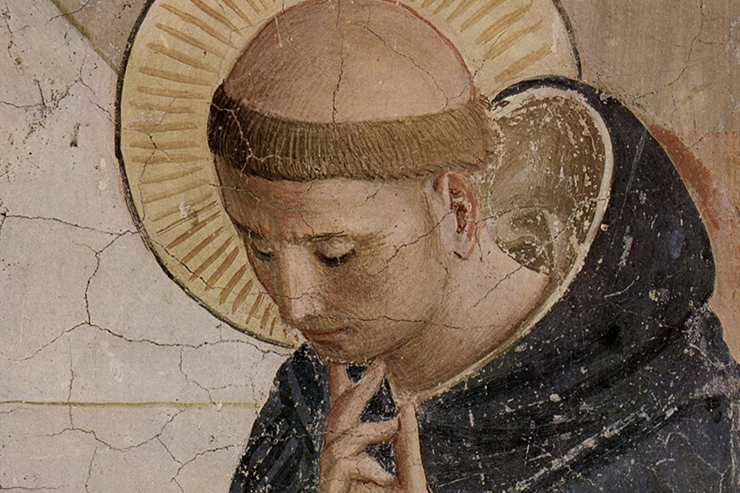
That same “cheerfulness of countenance” seems to be what people remark about Pope Francis. That doesn’t mean smiling continuously, but that joy is our “default,” it’s the attitude usually there. Fra Angelico seems to capture the peacefulness of Dominic in his portrait of the saint. (above)
On their journey through the desert they set up a meeting tent:
“Whenever Moses went out to the tent, the people would all rise and stand at the entrance of their own tents, watching Moses until he entered the tent. As Moses entered the tent, the column of cloud would come down and stand at its entrance while the LORD spoke with Moses. On seeing the column of cloud stand at the entrance of the tent, all the people would rise and worship at the entrance of their own tents. The LORD used to speak to Moses face to face, as one man speaks to another.”
The tent, the cloud, the pillar of fire were signs of God’s dynamic presence, a presence not fixed, but leading them to another place. The Exodus story is a story of God’s presence leading humanity on.
God leads them to a place they don’t know. God’s not a wall making them safe and settled; God’s on the move, and God moves them on.
In his book “The Mystery of the Temple” the theologian Yves Congar, OP, says we need these “long” Old Testament stories to remind us of the dynamic presence of a God of tents who is a pillar of fire by night and a cloud by day.
God is our guide, the only map we have, who moves each of us and all of history to a new stage. “We are always tempted to confine ourselves to what we see and touch, to be satisfied with this and to think that a preliminary achievement fulfills God’s promise, ” Congar writes.
“Abraham thought God’s promise was fulfilled in Ismael, Joshua thought it was the conquest of Canaan. Solomon thought it was in his immediate descendants…”but these promises were capable of more complete fulfillment which would only materialize after long periods of waiting and urgently needed purification. Only the prophets–and this, in fact, is their task–draw attention to the process of development from seminal promises and to the progress of the latter towards their accomplishment through successive stages of fulfillment continuously transcending one another.” (p 31-32)
We may think it’s the end, but it’s only a beginning.
Finally, God speaks most familiarly with Moses in the desert, a place of homelessness and unease, the Book of Exodus says: “The Lord used to speak to Moses face to face, as one man speaks to another.”
Will that be true for us too? Does God speak most familiarly with us when we’re in the desert, not sure where life is heading?
We celebrate the Feast of Ann and Joachim today, parents of Mary, the Mother of Jesus. The New Testament says nothing about them, but an early 2nd century document called the Gospel of James tells their story,
Ann and Joachim lived in Jerusalem, the ancient source says, where Joachim, a descendant of David and a wealthy man, provided sheep and other offerings for the temple sacrifices. The two had ties to Bethlehem nearby and Nazareth in Galilee.
They were well off but for twenty years disappointment clouded their marriage: they had no child. Even after vowing to dedicate their child to God, no child came. And so, at a time when children were treasured, they were thought poor. Descendants of David, they were blamed also for failing to continue the line the Messiah would come from.
Stung by criticism, Joachim spent more time in the mountains, brooding among the shepherds and their flocks. As her husband distanced himself from her, Ann too grew sad. God seemed far away.
In the garden one day, noticing some sparrows building a nest in a laurel tree, Ann burst into tears: “Why was I born, Lord?” she said, “birds build nests for their young and I have no child of my own. The creatures of the earth, the fish of the sea are fruitful, and I have nothing. The land has a harvest, but I have no child in my arms.”
At that moment, an angel of the Lord came and said, “Ann, the Lord has heard your prayer. You shall conceive a child the whole world will praise. Hurry to the Golden Gate and meet your husband there.”
At the same time, In the mountains an angel in dazzling light spoke to Joachim, “Don’t be afraid, the Lord hears your prayers. God knows your goodness and your sorrow and will give your wife a child as he did Sara, Abraham’s wife, and Hannah, mother of Samuel. You will have a daughter and name her Mary. Give her to God, for she will be filled with the Holy Spirit from her mother’s womb. Go back to Jerusalem. You’ll meet your wife at the Golden Gate and your sorrow will turn into joy.”
Joachim and Ann met at the Golden Gate to the temple, the place of God’s presence. They embraced as they spoke of the angel’s promise. Returning home, Ann conceived and bore a daughter, and they called her “Mary.”
When she was three years old, Ann brought Mary to the temple to learn the scriptures, to pray and take part in the Jewish feasts. She watched her father bring lambs to be offered in sacrifice. She grew in wisdom and grace in God’s presence.
When Mary approached marriage age– then 15 or so–her parents arranged for her marriage as it was customary. They sought the high priest’s advice, tradition says, and Joseph of Nazareth was chosen as her husband. Nazareth was then their home.
The angel Gabriel appeared to Mary and announced that she was to be the Mother of Jesus. By the power of the Holy Spirit she conceived the Child.
After Jesus was born in Bethlehem, Mary and Joseph returned to Nazareth where Jesus grew up. He was raised in a large extended family that included his grandparents, Ann and Joachim, who cared for him as a child.
No one knows just when or where Ann and Joachim died, but Jesus must have treasured them in life and on their passage to God.
The 2nd century Protoevangelium of James repeats a fundamental theme of the Book of Genesis: God promises Adam and Eve many children who will enjoy the blessings of the earth. God repeats the promise to an aged, childless couple, Abraham and Sarah, and again to Hannah, who bemoans her childlessness to the priest Eli in the temple. In the same way, God gives a child to Ann and Joachim. Mary, their daughter, brings blessings to the nations through her son Jesus Christ, born of the Holy Spirit.
Giotto’s 14th century illustrations (above) from the Arena Chapel in Padua. helped popularize the story of the parents of Mary in Italy, Europe and the rest of the western world.
It’s an important story for grandmothers and grandfathers. Like Ann and Joachim they have a big role raising the next generation. More than they think.
A novena preparing for the Feast of Saints Ann and Joachim, the parents of Mary, the mother of Jesus, July 26 has begun, reminding us of the role parents and grandparents play in raising children. Some years ago I visited the ancient temple ruins in Jerusalem where Jewish women were fervently praying with their daughters before the temple’s western wall.
Ann and her daughter Mary must have prayed here too.
The picture above is a model of the temple from Jesus’ time at the Israel Museum. Tradition says Ann and Joachim were closely associated with the temple and may have lived nearby. An ancient church honoring St. Ann stands today near the Pool of Bethesda, near the temple. There, a paralyzed man was healed by Jesus. (John 5, 1-18) That’s the church in the ruins below.
Church of St. Ann, Jerusalem
A statue of Ann and her daughter Mary is in the Jerusalem church. Ann is teaching her daughter at her side.
What is she teaching her? Some statues show her teaching Mary the scriptures, but I’ve seen a statue, like the one below, showing Ann teaching her the ABCs and numbers. That’s what parents and grandparents do, isn’t it? They teach children life’s basics: how to live and how to pray.
Cathedral, Tegucigalpa, Honduras
Still true today. We put the little statue below of the two of them under our chapel altar for the novena. Parents and grandparents, the next generation is at your side. Ann and Joachim pray for us; show us the way.




 The Victor's Place