Tag Archives: Passionist Monastery

Our Mary Garden

We take for granted the ground we stand on. We live at 86-45 Edgerton Boulevard, Queens, Long Island, New York, USA, but the ground we stand on goes deeper than that. 

The monastery we live in stands on the highest point of a spine of volcanic rock that goes back at least 400 million years, when the continent was being formed. 

About 22,000 years ago the last glacier, the height of a skyscraper, came down from Canada and stopped here. Our monastery stands where the glacier stopped. As it receded and melted the glacier gave us the land we stand on now. 

Southeast of us the glacier formed clay flatlands and sandy beaches facing the Atlantic Ocean. The winding depressions in our area, like Midland Parkway next to us, were streams from the glacier bringing sand and clay and rocks to the flatlands east of us. 

North of us the last glacier left the waters that became Long Island Sound. The glaciers also left water in the aquifer that still provides drinking water for most of Long Island today.

About 12,000 years ago, the first humans arrived here. Small bands of Indians lived in settlements near streams and waterways where they fished and hunted for game.Then, we came here.

Pope Francis says in his encyclical Laudato Si that we need a long view of life for the days ahead, because we’re facing a world that will be radically transformed by climate change. To prepare, Pope Francis says, we need “an ecological conversion.” 

That certainly means knowing more about the physical world we live in, so that we can understand it and care for it. Some say since the time of the Enlightenment in the 17th century we have concentrated too much on the human world and prioritized it too much. We’ve neglected creation and the ground we stand on. 

That means also remembering that God created the heavens and the earth and God has a plan for the world. God must remain in the picture of the changing physical world, otherwise life becomes chaotic. We can’t depend on science alone.

Pope Francis, in Laudato Si, while accepting science and its findings, said that besides scientific knowledge, we should mine our own religious traditions for the wisdom and hope they give and he said to look at the Book of Genesis and our spiritual and sacramental traditions to face the future.  

Our location here in Queens, particularly our garden, on the edge of a spine of volcanic rock, offers a valuable place for cosmic reflection. Our Mary Garden, based on the garden of Genesis, sees creation with eyes of faith and also with eyes of earthy experience. Water creates the garden, bringing life to everything else. Four rivers flow to the four corners of the earth. The plants in the four quadrants of the garden represent the staples of life– beauty, medicine and food. 

Mary stands in our garden as the representative of redeemed humanity, holding in her arms Christ, the Redeemer. She rejoices in creation before her and presents the one, “through whom all things were made,” who blesses the world with hope. Mary also, as a witness to the resurrection of Jesus, knows he has promised a new heaven and a new earth. “Behold, I make all things new,” 

Mary’s statue stands on the stump of a large cedar tree, a tree whose roots reach deepest into the earth. At the base of the stump are rocks; most come from parts of our continent swept up by the ancient glacier and deposited here. We put some rocks from the Holy Land there, and a friend recently gave us a rock from Ireland to add to it.
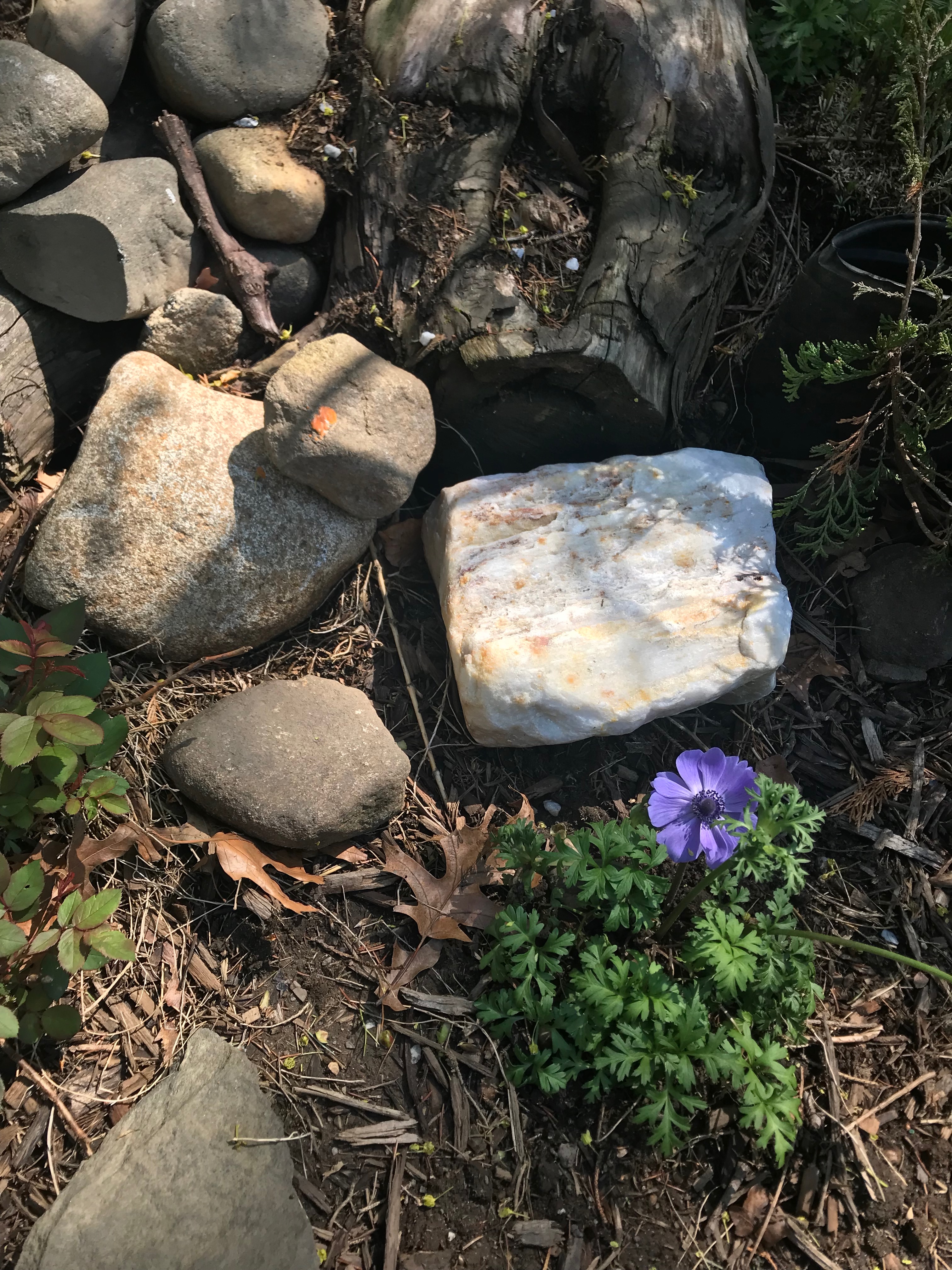
The flowers in the Mary Garden bring the various colors and shapes of the world’s plant life here. Flowers are perhaps the most popular “immigrants” of the plant world, coming from everywhere, welcomed everywhere. Many of them, like the marigold, “Mary’s Gold”, are particularly associated with the Mother of Jesus.

Our Mary garden stands next to a grotto recalling Mary’s appearance at Lourdes in the 19th century when faith in France was eroding in an age of skepticism. Her appearances later at Fatima and the strong devotion to her that persists today remind us she is a permanent witness to Jesus Christ, who promised to remain with us “all days”, even days when the foundations of the earth are shaken. Mary’s a witness who comes when times are bad.

The concept of the Mary Garden developed in 13th century Europe when, during the “Black Death”,  people believed a cursed earth caused millions to die. Today as the earth enters its own “passion” the Mary Garden offers a rich resource of Christian wisdom and hope for the days ahead. 

God loves the world. It is good. 

Solemnity of Christ the King

Statue of Christ the King at the Passionist Monastery in Jamaica, NY (Photo: Gloria M. Chang)

Christ the King Reigns Forever

“On the last Sunday of each liturgical year, the Church celebrates the Solemnity of Our Lord Jesus Christ, King of the Universe, or Christ the King. 

Pope Pius XI instituted this feast in 1925 with his encyclical Quas primas (“In the first”) to respond to growing secularism and atheism. He recognized that attempting to ‘thrust Jesus Christ and his holy law’ out of public life would result in continuing discord among people and nations. This solemnity reminds us that while governments come and go, Christ reigns as King forever.”

-The United States Conference of Catholic Bishops, About Christ the King

House of Prayer

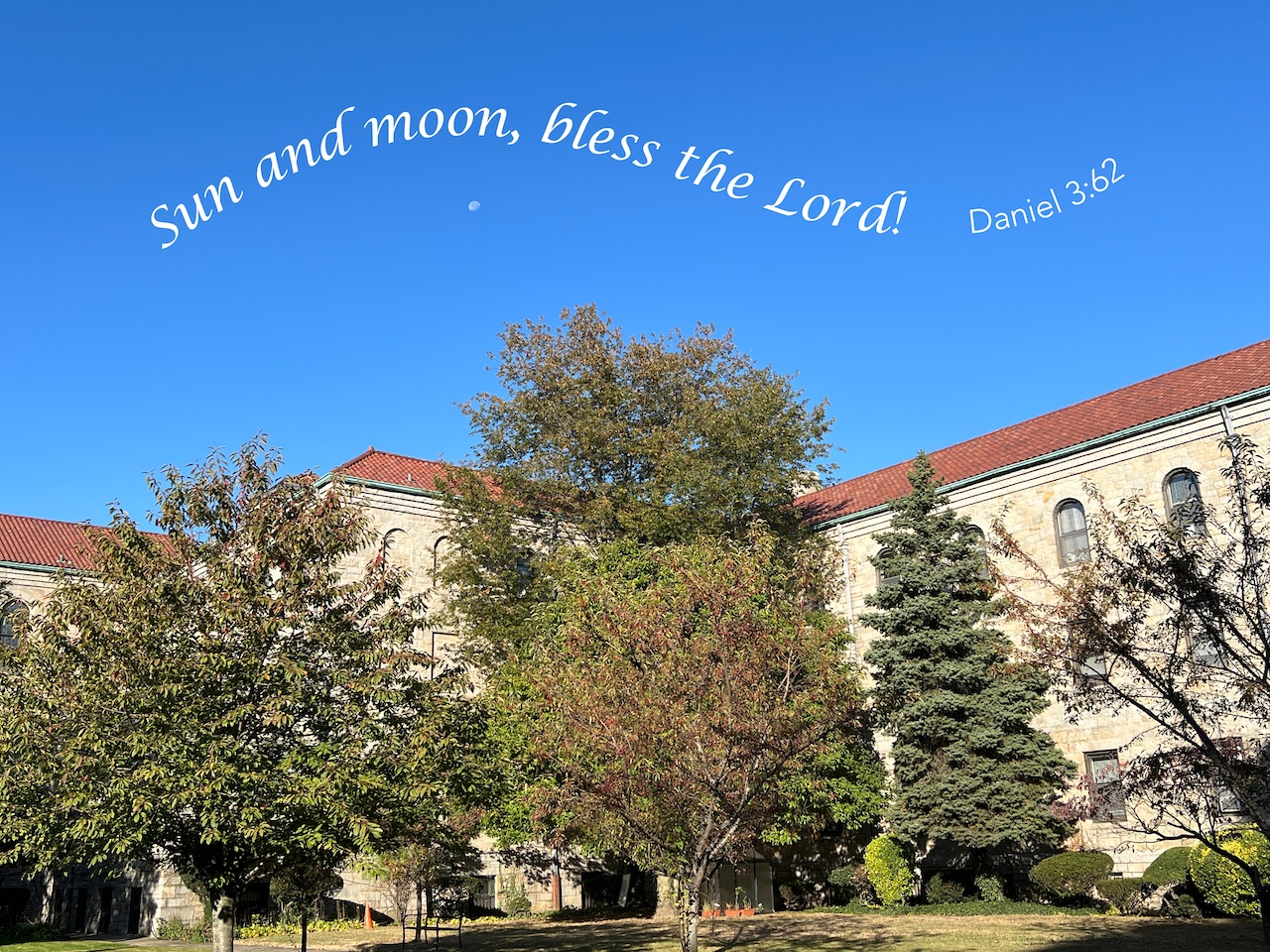
Photo of Passionist Monastery in Jamaica, NY with the text of Daniel 3:62, "Sun and moon, bless the Lord!"
Passionist Monastery in Jamaica, NY

By Gloria M. Chang

A monastery is a house of prayer to pursue the “happy” or blessed life. Our Passionist priests and brothers in Jamaica, NY faithfully pray the Liturgy of the Hours every morning and evening, which prepares them to give the bread of the Word and the Eucharist at Mass and to serve in various ministries. Prayer and the Eucharist, the daily bread of apostles, fuel works of mercy.

In a letter to a Roman noblewoman named Proba, St. Augustine offers valuable insights on prayer. The bishop of Hippo, whose rule of life continues to guide monastic communities today, understood the value of “prayer at appointed hours.” Although he was an extremely busy bishop, St. Augustine kindled his desire for God throughout the day by lifting his heart in prayer from sunrise to sunset. Forgetfulness of God in the midst of constant work makes the heart “lukewarm” and “chill” over time.

Thankfully, we can redeem the time. As the earth revolves around the sun, children of God revolve in the orbit of the Blessed Trinity. Space and time, the materials of our journey from birth to eternity, belong to the Father, Creator of all things through his Word and Spirit. Jesus, who frequently spent the night in prayer, models our way home to the Father.

Can one pray during a busy schedule? St. Augustine teaches that “even in these actions” (work responsibilities), we pray by continually longing for God. Many words are unnecessary. The desert monks discovered that short but frequent prayers, “hurled like swift javelins,” keep the heart and mind fixed on the Lord.

“Ask and it will be given to you; seek and you will find; knock and the door will be opened to you” (Matthew 7:7). Persistence in prayer with sighs and tears unite us with the ineffable God, “for he has established all things through his Word and does not seek human words.” As a monastery is a house of prayer, so are all of us “temples” of prayer in the Holy Spirit (Romans 8:26-27).

The Passionists Pray website offers resources for daily prayer, which can be accessed here.

From a letter to Proba by Saint Augustine, bishop

Let us turn our mind to the task of prayer at appointed hours

Let us always desire the happy life from the Lord God and always pray for it. But for this very reason we turn our mind to the task of prayer at appointed hours, since that desire grows lukewarm, so to speak, from our involvement in other concerns and occupations. We remind ourselves through the words of prayer to focus our attention on the object of our desire; otherwise, the desire that began to grow lukewarm may grow chill altogether and may be totally extinguished unless it is repeatedly stirred into flame.

Therefore, when the Apostle says: Let your petitions become known before God, this should not be taken in the sense that they are in fact becoming known to God who certainly knew them even before they were made, but that they are becoming known before men through boasting.

Since this is the case, it is not wrong or useless to pray even for a long time when there is the opportunity. I mean when it does not keep us from performing the other good and necessary actions we are obliged to do. But even in these actions, as I have said, we must always pray with that desire. To pray for a longer time is not the same as to pray by multiplying words, as some people suppose. Lengthy talk is one thing, a prayerful disposition which lasts a long time is another. For it is even written in reference to the Lord himself that he spent the night in prayer and that he prayed at great length. Was he not giving us an example by this? In time, he prays when it is appropriate; and in eternity, he hears our prayers with the Father.

The monks in Egypt are said to offer frequent prayers, but these are very short and hurled like swift javelins. Otherwise their watchful attention, a very necessary quality for anyone at prayer, could be dulled and could disappear through protracted delays. They also clearly demonstrate through this practice that a person must not quickly divert such attention if it lasts, just as one must not allow it to be blunted if it cannot last.

Excessive talking should be kept out of prayer but that does not mean that one should not spend much time in prayer so long as a fervent attitude continues to accompany his prayer. To talk at length in prayer is to perform a necessary action with an excess of words. To spend much time in prayer is to knock with a persistent and holy fervor at the door of the one whom we beseech. This task is generally accomplished more through sighs than words, more through weeping than speech. He places our tears in his sight, and our sighs are not hidden from him, for he has established all things through his Word and does not seek human words.

Reference

The passage from St. Augustine can be found in the Office of Readings for Monday of the 29th Week in Ordinary Time.

You Want a Sign


    In this Wednesday’s Gospel (Lk 11: 29-32) our Lord says :

    ” This generation is an evil generation; it seeks a sign, but no sign will be given it, except the sign of Jonah. Just as Jonah became a sign to the Ninevites, so will the Son of Man be to this generation.”

    Our Lord seems so frustrated and annoyed with the people of His time ( and I’m sure with us too!) . Like them we want easy fixes to so many sufferings, complications, and problems that plague our personal lives and our society. ” God, please manifest Your great power and heal our world!”

    Our Lord seems to imply that the solutions begin with our changes of heart, where, like the people of Nineveh, we listen to God’s word, repent, and become servants of God’s will which is always our welfare and happiness.

    But we want a ” great sign” to startle us out of our stupor. Our Lord seems to say that His own death and resurrection is that sign.

    Only 2 weeks ago we remembered the anniversary of the passing of my wonderful friend, Fr Owen Lally,CP, the leader of our prayer group. His spirit still lives in us. Our group still stands strong. Through Fr Owen’s guidance we always strove to be ” the sign of Jonah”. Fr Owen wrote:

    ” Our Resurrection with the Lord is the sign of Jonah. Our old self transformed by grace into our true self IS our resurrection. Our entire life’s journey has as it’s goal the renewal of the old man of sin into the new man of grace in Christ. Individually this is wonderful to see, but to bring several brothers and sisters into unity is the true icon of the risen Lord.

    Mutual Indwelling is the result of becoming human together. The sign of Jonah was the survival of our Lord’s being in the belly of the earth. We are in the belly of the whale by our baptism and deep immersion into the water. Whoever is in Christ is a new creation. ‘ Whenever two or three are gathered together in my name I am there.’ ‘ This is the Sign by which all shall know that I have come forth from God, that you love one another.’ The primary way to make new Christians and to get vocations is to love one another and become one in community.”

    The Passionist Community has graciously allowed our Prayer Group (Fr Owen’s Prayer Group) to meet on Sundays, after mass, at the Passionist Monastery in Jamaica, NY. Sometimes when I walk into that Monastery Chapel in the middle of our prayer meeting, I am struck by the awesome power of 30 to 40 people, who have given themselves fully to song and praise, to love and support for one another.  In this place the Spirit of the Risen Jesus is alive in all His Glory, a sign to the world that Love is supreme, that there is hope, that our Lord reigns!  In a way we feel like God’s prophets. We are compelled to walk through our own Nineveh and proclaim the Good News of the Kingdom!

Orlando M. Hernández