Tag Archives: nuclear family

MATTHEW 12:47-50: Family Values

Our readings from St. Matthew this week deal with the growing opposition to Jesus as he preaches and performs miracles in Galilee. IT foreshadows his final rejection in Jerusalem. Concluding this section, Matthew adds another source of opposition to Jesus that may surprise us. His own family from Nazareth seems to oppose him.

“While he was still speaking to the crowds, his mother and his brothers appeared outside, wishing to speak with him. [Someone told him, “Your mother and your brothers are standing outside, asking to speak with you.”]*But he said in reply to the one who told him, “Who is my mother? Who are my brothers?” And stretching out his hand toward his disciples, he said, “Here are my mother and my brothers. For whoever does the will of my heavenly Father is my brother, and sister, and mother.” (Matthew 12,47-50)

A little about family life at the time of Jesus may help us appreciate this gospel. For one thing, in Jesus’ day nuclear families– a mother, father and children living alone– were not the norm. In Jesus day families were extended families or clans, living and working together.

And so, the picture we sometimes have of the Holy Family– Mary, Joseph and the Child Jesus all by themselves in a small house in Nazareth– is not a realistic picture. Families in Nazareth, as we know from excavations in towns like Capernaum, lived in compounds, as they often do today in the Middle East, working together in the fields or in a business and offering each other support.

There were obligations to your extended family or clan. Everyone had to help in the harvest; you were expected to promote your family’s interest. The mother of James and John approaching Jesus looking for a good place for her sons in his kingdom was only doing what she was expected to do.

What we see in this gospel is the extended family of Jesus descending on him as he speaks to the crowds to remind him of his family obligations. What did they want to remind him of, we wonder? Were they off to a wedding or a funeral of a relative and were telling him to come along? Or, was the wheat harvest ready at Nazareth and they came looking for help? Or, they just wanted him for themselves for awhile? From Mark’s gospel we know some thought he was out of his mind.

Whatever it was, Jesus said that his family was those before him h meant to be with them.  “ I belong here now,” Jesus seems to be saying to them. The kingdom of God, God’s family, God’s purpose, is greater than his family’s interests.

Today, of course, individualism is our predominant value, and it often stands in the way of family interests. It’s what “I” want that counts. But even today, family interests, family pressure can be strong and can get in the way of what God wants. Sometimes those closest to us, our own family, can be hard to manage, even though they want the best for us.

Jesus experienced that too.
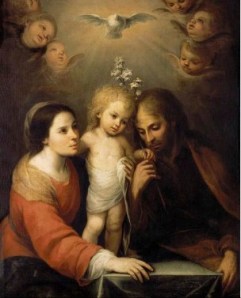
The Holy Family


Luke 2,41-52

For most people, Christmas is over– the music’s stopped; Santa Claus is gone from the malls. The decorations are down and put away. It’s over.

But in church Christmas isn’t over. We’re still singing  carols and continue to celebrate as we think  about what it means when we say “our God was made visible.”

Today’s the feast of the Holy Family. The Word was made flesh, and as the child of Mary and Joseph Jesus was part of a family in the small town of Nazareth in  hills of  Galilee.

For one thing, families then were extended families or clans, living close together and working side by side. Archeological excavations in Nazareth and Capernaum (pictures below) make that clear. Families worked together in the fields or in  business, they ate together and moved together, as they still do in parts of the Middle East and elsewhere today.

holy familyCapernaumruinsDSC00062

It’s safe to say that nuclear families didn’t exist then. A nuclear family– mother, father and children– is a modern form of family life. Mary, Joseph and the Child Jesus were not all by themselves in a small house in Nazareth. Rather, Jesus was raised in an extended family where  grandfathers and grandmothers, uncles, aunts and cousins lived together and were involved in bringing him up.

That doesn’t take away the part Mary and Joseph played in his upbringing, of course. They weren’t props, standing by while angels brought him up. Some of the apocryphal gospels – early stories about Jesus which the church rejected  – seem to say that.  One  story describes the Child Jesus forming  the figure of a bird from clay, then breathing on it, and instantly it becomes a living bird and flies away. Stories like that presented him exercising  miraculous powers as a child.

The church rejected those stories because they gave a  false picture of Jesus growing up. He “was subject” to Mary and Joseph, the gospel of Luke says. He grew up in their care as an ordinary child would.

Like mothers and fathers everywhere, they saw to his needs, they held him in their arms,  fed him, clothed him,  stayed up at night when he was sick. They taught him his first words,  guided his first steps,  nudged him along this way and that.

They  brought him to church–the synagogue, the temple–as we see in today’s gospel from Luke. They instructed him in his tradition. They taught him to pray,  interpreted events for him,  listened to his questions,  encouraged him over and over. They had their misunderstandings, as today’s gospel  indicates. In fact, they  influenced his life.

Yes, angels were there, but at a distance.  Mary and Joseph and that larger family and village around him raised the Child.

Today’s  feast of the Holy Family takes in the years of Jesus’ childhood and early adult life called his “Hidden Life.” His  years in that nondescript town among those ordinary people were truly hidden, yet were they less important than his Public Life, the few years he taught and did great miracles,  suffered and died and rose from the dead? In those hidden years “he humbled himself.”  A hidden life is important; it’s what mostly characterizes life in a family.

We need to think about family life today, because it’s in trouble.  For one thing, the nuclear family– father, mother, children– is  in trouble. I read some disturbing statistics recently. In every state in our country, families where children have two parents have declined significantly in the last 10 years. One of three children live in a home without a father. Almost 5 million children live in a home without a mother. A single mother may have an income of $24,000. Two parents are likely to have an income significantly greater.

What can we do? How can we help? Feasts  like the Holy Family focus our attention on important things.  They remind us what’s important in God’s eyes. The feast of the Holy Family focuses on the family. It’s important, it says.  At the same time, it tells us God’s grace will be ours when we work to make families go and when we support them all we can.  God points to family life today. It’s vitally important in our world.