King David wonders, in our first reading today of the 4th Sunday of Advent, what he can do for God after all God has done for him. David had built himself a palace of cedar wood in Jerusalem, while the ark of the covenant, the sign of God’s presence, is in a tent. Should I build God a temple, a place of beauty where God would dwell and be honored,” the king asks?
The prophet Nathan tells the king: instead a building, God wants to dwell with you and your people.
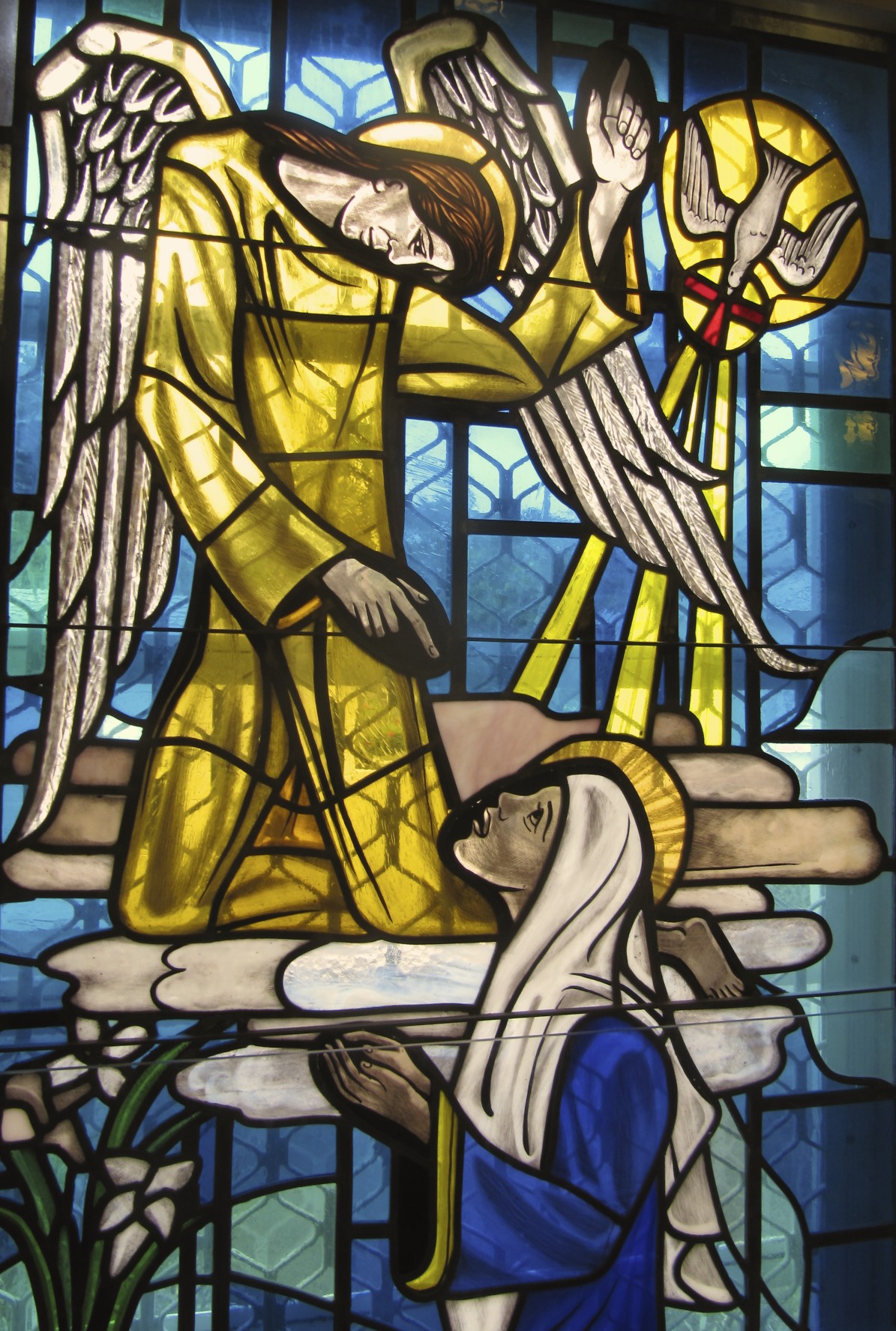
In today’s gospel, God goes further. God will dwell in Mary’s womb, to take flesh from her and be cared by her.
Our gospel begins:
The angel Gabriel was sent from God
to a town of Galilee called Nazareth,
to a virgin betrothed to a man named Joseph,
of the house of David,
and the virgin’s name was Mary.
And coming to her, he said,
Hail, full of grace! The Lord is with you.
This gospel says so much about Mary. God showered graces upon her: “Hail, full of grace! The Lord is with you.” Just a young girl of 15 or 16, Mary answers: “Be it done to me according to your word. She accepts God’ s call, but she has her questions: “How can this be?”
The power of God will overshadow you, the angel tells her. The only sign she’s given is that her cousin, Elizabeth, “has also conceived a son in her old age, and this is the sixth month for her who was called barren; for nothing will be impossible for God.”
“Nothing will be impossible for God.”
Then, the angel leaves, and never returns, as far as we know. Mary meets the days as they come with faith, gathering her experiences and treasuring them in her heart.
At Christmas, we’ll see Mary in Bethlehem, humbly, silently holding the Infant, her Child, God with us. At Easter, we’ll see her standing beneath the cross of Jesus.
She’s his mother, a woman of faith. We learn from her and ask her to pray for us: “Pray for us, O holy Mother of God, that we may be made worth of the promises of Christ.
The angel came to Mary in Nazareth, the last place we might expect an angel’s message. In this little known place, Jesus became flesh. In this young unknown woman, he came to dwell among us.
It wasn’t in Jerusalem, in the temple where God’s Presence was proclaimed. It was in Nazareth, in the quiet hills of Galilee, on a routine day, that He came.
We celebrate the mystery of the Incarnation and pray, “Pray for us, O holy mother of God, that we may be made worthy of the promises of Christ.”
In today’s Gospel we read about Jesus’ return to “His native place,” and the reception He got from His peers when He began to teach them. They found it hard to take Him seriously, asking,
“Is he not the carpenter, the son of Mary, and the brother of James and Joseph and Judas and Simon? And are not his sisters here with us?” And they took offense at him. Jesus said to them, “A prophet is not without honor except in his native place and among his own kin and in his own house.”
Why such a reaction? Why were they not proud of their hometown boy? We’re they jealous of Him? Did they believe that a humble carpenter’s son had no right to teach about the divine? Were they startled because He no longer acted like a “regular guy”, one of them?
When I started testifying about my newfound faith at men’s retreats and at prayer groups, some people would come up to me and thank me for helping them in their search for healing, and for God, while others treated me like I was just some upstart who didn’t know anything! Well, I guess one of the lessons of this Gospel is that you just can’t please everybody, especially if they’re your friends and relatives .
After my conversion, many of them could not believe that I was for real. One of my drinking buddies winked at me and said, ” You gotta be kidding! Common, have fun. You only live once.” Another said, “Hey, don’t turn into a religious fanatic! That’s not the guy I know! What about that temper?”
A nice cousin of mine said, “You’re dedicating your life to God now that you’re retired? That’s a nice hobby. I guess you gotta do something with your free time.”
A very intelligent, cynical, clever friend would use her language skills to prove me wrong, and justify her way of thinking and acting towards others. I was no match for her smart talk. But another fiercely atheist friend synthesized the feelings of all the others:” Don’t come preaching to me! I don’t want to hear anything about God! If you’re my friend, let’s talk about anything but that!”
Like Jesus, I was ” amazed at their lack of faith!” I certainly wasn’t able to perform any “mighty deeds” there, except perhaps keep my composure, shake my head, and smile. I really love these persons. I guess the best I can do is show them this, knowing how much greater than mine is the love that our Lord Jesus has for them.
If they ask me I will tell them about the peace I feel in my heart. Maybe I’ll be able to show them how I have changed, even if a little, perhaps reflect the words of the scholar of mythology, Joseph Campbell: ” Preachers err by trying to talk people into belief, better they reveal the radiance of their own discoveries.”
My spiritual director, Fr John Powers C.P., once wrote, ” I begin the telling of my tale with the assumption that my story is, in some measure, everyone’s story.”
For most people, Christmas is over– the music’s stopped; Santa Claus is gone from the malls. The decorations are down and put away. It’s over.
But in church Christmas isn’t over. We’re still singing carols and continue to celebrate as we think about what it means when we say “our God was made visible.”
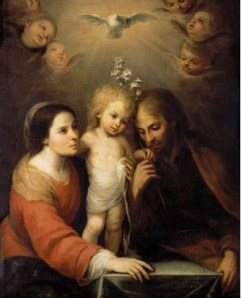
Today’s the feast of the Holy Family. The Word was made flesh, and as the child of Mary and Joseph Jesus was part of a family in the small town of Nazareth in hills of Galilee.
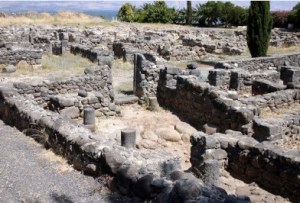
For one thing, families then were extended families or clans, living close together and working side by side. Archeological excavations in Nazareth and Capernaum (pictures below) make that clear. Families worked together in the fields or in business, they ate together and moved together, as they still do in parts of the Middle East and elsewhere today.
It’s safe to say that nuclear families didn’t exist then. A nuclear family– mother, father and children– is a modern form of family life. Mary, Joseph and the Child Jesus were not all by themselves in a small house in Nazareth. Rather, Jesus was raised in an extended family where grandfathers and grandmothers, uncles, aunts and cousins lived together and were involved in bringing him up.
That doesn’t take away the part Mary and Joseph played in his upbringing, of course. They weren’t props, standing by while angels brought him up. Some of the apocryphal gospels – early stories about Jesus which the church rejected – seem to say that. One story describes the Child Jesus forming the figure of a bird from clay, then breathing on it, and instantly it becomes a living bird and flies away. Stories like that presented him exercising miraculous powers as a child.
The church rejected those stories because they gave a false picture of Jesus growing up. He “was subject” to Mary and Joseph, the gospel of Luke says. He grew up in their care as an ordinary child would.
Like mothers and fathers everywhere, they saw to his needs, they held him in their arms, fed him, clothed him, stayed up at night when he was sick. They taught him his first words, guided his first steps, nudged him along this way and that.
They brought him to church–the synagogue, the temple–as we see in today’s gospel from Luke. They instructed him in his tradition. They taught him to pray, interpreted events for him, listened to his questions, encouraged him over and over. They had their misunderstandings, as today’s gospel indicates. In fact, they influenced his life.
Yes, angels were there, but at a distance. Mary and Joseph and that larger family and village around him raised the Child.
Today’s feast of the Holy Family takes in the years of Jesus’ childhood and early adult life called his “Hidden Life.” His years in that nondescript town among those ordinary people were truly hidden, yet were they less important than his Public Life, the few years he taught and did great miracles, suffered and died and rose from the dead? In those hidden years “he humbled himself.” A hidden life is important; it’s what mostly characterizes life in a family.
We need to think about family life today, because it’s in trouble. For one thing, the nuclear family– father, mother, children– is in trouble. I read some disturbing statistics recently. In every state in our country, families where children have two parents have declined significantly in the last 10 years. One of three children live in a home without a father. Almost 5 million children live in a home without a mother. A single mother may have an income of $24,000. Two parents are likely to have an income significantly greater.
What can we do? How can we help? Feasts like the Holy Family focus our attention on important things. They remind us what’s important in God’s eyes. The feast of the Holy Family focuses on the family. It’s important, it says. At the same time, it tells us God’s grace will be ours when we work to make families go and when we support them all we can. God points to family life today. It’s vitally important in our world.
To listen to today’s homily, please select the audio file below:
“I wonder as I wander out under the sky,
why Jesus, our Savior, was born for to die,
for poor, orn’ry people like you and like I
I wonder as I wander out under the sky.”
Wonder is a Christmas word; we hear it in the carols we sing and in the words we hear and in the prayers we say. Wonder is our reaction to something beyond what we expect, beyond our experience and our understanding, so big it leaves us lost for words.
We need wonder these days to lift up our minds and hearts.
Listen to the gospel story from St. Luke:
‘In those days a decree went out from Caesar Augustus that the whole world should be enrolled.” Caesar Augustus, the ruler of the world gives an order. “Quirinius was governor of Syria.” Quirinius , Caesar’s enforcer for Palestine, orders his jurisdiction to be counted. The mighty and the powerful of this world have spoken.
But the high and mighty, the politicians, the generals, the money people don’t impress Luke. Rather, his eyes are drawn to a couple in the multitude being enrolled, a couple from an insignificant town in Galilee called Nazareth– Joseph and his betrothed wife Mary, who was with child. They’re on their way to Bethlehem.
“While they were there, the time came for her to have her child, and she gave birth to her firstborn son. She wrapped him in swaddling clothes and laid him in a manger,because there was no room for them in the inn.”
Luke goes on in his gospel to tell about this child born in Bethlehem, who grows up in Nazareth, who begins to preach and work marvels in Galilee, who gathers excited followers and then goes up to Jerusalem where he’s arrested, sentenced to death, crucified, then raised from the dead. Luke goes on to describe the followers of Jesus who take his message to the ends of the earth and to us today.
That marvelous story begins in Bethlehem, where a Child in swaddling clothes is laid in a manger, because there’s no room in the inn. That marvelous story goes on. It changes the way we look at ourselves and the world in which we live. God is quietly at work in our world, unnoticed, unacknowledges, God is with us.
There’s wonder in this story, a wondrous love’s behind it. This Child is God become like us, like “poor, orn’ry creatures like you and like I.” So unexpected, so beyond our experience and understanding, beyond words.
Today’s a day that calls us to wonder. Let’s not lose that gift that takes us beyond where we are. Begin with the world in which we live, the world around us as we “wander out under the sky.” However difficult and dark this world can be, there’s a wonder to it. We’ve been gifted with the wonderful gift of life, which we carry in the flesh and blood that is ours, the gift of life we have in our families and our friends and all of those around us. Let’s not take them for granted.
Then, there’s the gift of God we remember today, a God not distant but close, a God not removed from our experience but sharing it, a God who loves us so much that he wishes to become one with us, a God who would die for us and bring us the promise of life that never ends. Let’s not take God for granted.
“I wonder as I wander out under the sky, why Jesus our Savior was born for to die, for poor orn’ry people like you and like I. I wonder as I wander out under the sky.”
To listen to today’s homily, select the audio file below:
For two Sunday’s we have been reading the long account from St. Luke’s gospel of Jesus’ return to Nazareth, his hometown, as he begins his ministry in Galilee. I mentioned last week Luke’s interest in Jesus’ early life. More than any other evangelist, he writes about Jesus early years.
The four gospels take a dim view of Nazareth, the hometown of Jesus Christ. Early in his gospel, John says that Philip, one of Jesus’ first disciples, invited Nathaniel to meet “Jesus, son of Joseph, from Nazareth.” “Can anything good come from Nazareth?” Nathaniel replies. (John 1,46).
The gospels of Mathew and Mark recall the sad rejection of Jesus by his hometown after his baptism by John the Baptist. Matthew places it after Jesus has spoken to a large crowd in parables. Then, he goes to Nazareth and speaks in the synagogue to his own townspeople, who are at first astonished at his wisdom, but they wonder where did “the carpenter’s son” get all this. They know his mother and his family, and they reject him. (Matthew 13,54-58)
Mark’s gospel puts the event after Jesus has raised a little girl from the dead. Going to Nazareth with his disciples, he’s greeted in the synagogue with astonishment because of his wisdom; they’ve heard of his mighty deeds, but then they ask where did this “carpenter” get all of this? He’s “Mary’s son” and they know his family. Jesus “was amazed at their lack of faith.” (Mark 6,1-5)
In Luke’s gospel Jesus goes into the synagogue at Nazareth almost immediately after his baptism and reads from the Prophet Isaiah the passage: “The Spirit of the Lord is upon me; He has anointed me…” Jesus says he’s fulfilling the words of the prophet. He’s the Messiah.
In the reading today the people of Nazareth not only reject him but try to put him to death. They are people who have known him all his life, we presume even members of his family are among them.
Here is a concrete example of what’s said in another gospel: “He came to his own and his own received him not.” Of course, their reaction surprises us. How could they be so blind? How could they not see?
Our first reading today may offer some insight into their reaction. It’s about the Prophet Jeremiah who also met opposition from his own people and was put to death for his claims. Maybe he can help us understand what happened at Nazareth?
The prophet speaks for God. “Stand up and tell them what I command you,” God says to Jeremiah, “I have appointed you a prophet to the nations.” But when God first calls him, Jeremiah shrinks from the task. ” Don’t send me, I’m just a child.” They know me too well; I
I don’t have the status, the aura of a prophet.
That seems to be what happened at Nazareth. They knew Jesus too well. “Isn’t this the carpenter’s son?” They doubt, they want more proof. “The prophet is honored, except in his native place,” Jesus says,amazed at their unbelief.
The prophet speaks for God, but what God says through the prophet may not be to our liking. Sometimes it seems too good to be true. We’re cynical people. We think like human beings, not like God. Would God promise us a life beyond death, beyond suffering, beyond disappointment, beyond failure. Could God be the carpenter’s son? Could it be true,as the Letter to the Hebrews says, “In times past, God spoke to our ancestors through the prophets,but in these last days he has spoken to us through his Son.” (Hebrews 1, 1-2) Could God so love the world that he would send his Son to bring us life?
Let’s not be too harsh with the people of Nazareth. When we are looking at them, we are looking at ourselves.
Let’s ask for faith, faith like Mary his mother had. Let’s ask that we listen to his words and believe in his promises. Let’s ask that we follow Jesus Christ in the mysteries of his life, death and resurrection, till he reveal himself to us and we share in his glory. Help us, Lord, to believe in you.
Luke begins his account of Jesus’ public life by recalling his return to Nazareth after his baptism by John in the Jordan. This Sunday and next Sunday we read from Luke’s long account of that event.
Mark and Matthew tell this story later in their gospels, but Luke, who concentrates more on Jesus’ early life than the other evangelists, puts the beginning of Jesus’ public life in Nazareth, in the synagogue where he worshipped, among those who knew him best. (Luke 4, 14-21)
Luke paints the coming of Jesus into this world in broad, sweeping terms in his gospel. Caesar Augustus was the world’s ruler, Herod ruled in Palestine, others ruled under them. At the same time, he focuses on Jesus’ own personal history. Born in Bethlehem, Jesus’ first home is an obscure village in northern Galilee– Nazareth, where he grows “in wisdom and age and grace, before God and man.” There he was brought up.
The synagogue at Nazareth was probably like other synagogues in the towns of Galilee. Some, like that at Magdala on the Sea of Galilee, have been excavated in recent times. It was a small one story rectangular building, with two tiers of seating all around its walls, made for a town of no more than 500 people. In the middle of the synagogue was a stand holding copies of the various books of the scriptures. The synagogue was the center of life in those towns.
Jesus has returned to Nazareth after beginning his ministry “all through Galilee, teaching in their synagogues and praised by all. (Luke 4, 14-15) Now, back home, he goes into the synagogue on the Sabbath, “as he was accustomed to do.”
He gets up from his place to read the scriptures. (From the same place where he sat for years? Was Mary his mother there with him?) He’s “ handed a scroll of the prophet Isaiah.
He unrolled the scroll and found the passage where it was written:
The Spirit of the Lord is upon me,
because he has anointed me
to bring glad tidings to the poor.
He has sent me to proclaim liberty to captives
and recovery of sight to the blind,
to let the oppressed go free,
and to proclaim a year acceptable to the Lord.
Rolling up the scroll, he handed it back to the attendant and sat down,
and the eyes of all in the synagogue looked intently at him.
He said to them,
“Today this Scripture passage is fulfilled in your hearing.”
A short sermon, and a powerful statement. “This scripture passage is fulfilled in your hearing.” The Spirit of the Lord is upon me, Jesus says. I’m anointed to bring glad tiding to the poor. Jesus claims a messianic calling.
His neighbors, who have known him for years, are first impressed, then question him, then deny his claims, then threaten to put him to death.
In their gospels, Mark and Matthew describe opposition to Jesus coming first from the scribes and Pharisees, the leaders from Jerusalem, but Luke sees opposition to Jesus coming first from his own hometown, from family, neighbors and friends. He knows how important this rejection is.
It’s true, isn’t it? When we enter this world, we enter the small unit of human life, a family, and beyond the family, the people and places that shape us early in life. We’re subject to this important smallness, our “Nazareths” where we grow “in wisdom and grace.” We’re first nourished there; we look for lasting love and support there. It means so much to us.
Throughout his ministry, Jesus will know opposition. Leaders of the people, public officials will oppose him. In his final days, his own disciples will abandon him. Only a few will stand by his cross. The physical sufferings he endured were great. He was scourged, his head was crowned with thorns, his hands were nailed to a cross, he died hanging there long hours alone.
But rejection from his own at Nazareth will weigh heavily on him. It was a big part of the mystery of his cross. “He was amazed at their unbelief.” Yet, Jesus who embraced humanity with love, embraced Nazareth too. He loved it with God’s great love.
We have to pay a lot of attention to where we’re born, where we’re brought up, our families, the people we live and work with. Nazareth is important to us.
The four gospels take a dim view of Nazareth, the hometown of Jesus Christ. Early in his gospel, John says that Philip, one of Jesus’ first disciples, invited Nathaniel to meet “Jesus, son of Joseph, from Nazareth.” “Can anything good come from Nazareth?” Philip replies. (John 1,46).
The other gospels recall the sad rejection of Jesus by his hometown after his baptism by John the Baptist. According the Matthew, it takes place after Jesus has spoken to a large crowd in parables. Then, he goes to Nazareth and speaks in the synagogue to his own townspeople, who are at first astonished at his wisdom, but then wonder where did “the carpenter’s son” get all this. They know his mother and his family, and they reject him. (Matthew 13,54-58)
Mark’s gospel puts the event after Jesus has raised a little girl from the dead. Going to Nazareth with his disciples, he’s greeted in the synagogue with astonishment because of his wisdom; they’ve heard of his mighty deeds, but then they ask where did this “carpenter” get all of this? He’s “Mary’s son” and they know his family. Jesus “was amazed at their lack of faith.” (Mark 6,1-5)
Why do they reject Jesus? The reason seems to be that they know his family and what he’s done for a living, and they can’t believe someone like him could be a messenger of God to them. He’s just a carpenter. What does he know? He came from an ordinary family, some of whom may not have been nice people at all. So they dismiss him.
At Nazareth we see an example of what’s called the “scandal of the incarnation.” People can’t believe that God could come to us as Jesus did.
That scandal still continues. One obvious instance of it is when people claim to be “spiritual, but not religious.” They want God and not the human ways God comes to us. They want God to be in the beauty of a sunset, but not in a church. They want God as they would like him to be, and not in the messiness of humanity.
I think of that line from one of the English poets:
“I saw him in the shining of the stars, I marked him in the flowering of the fields, but in his ways with men, I knew him not.”
The pope raised some eyebrows a month or so ago when he saw a little baby crying in its mother’s arms as he was going through the crowds in St. Peter’s Square in his pope mobile. “Give the baby something to eat, Madam,” he was reported to have said to the baby’s mother. Breast feeding in St. Peter’s Square! It seems he did the same thing last week on the Feast of the Baptism of Jesus in the Sistine Chapel when he baptized 35 infants. “If your baby is hungry, don’t be afraid to feed it,” he said to the mothers there according to reports.
In one of the magazines, an art historian wrote asking why should we be surprised at the pope’s words. Catholic artists have pictured nursing Madonnas for centuries. That’s what Mary did.
I spoke about Mary to priests on retreat from the Austin diocese this morning. We easily forget Mary’s fundamental role in the life of Jesus.
“Blessed is the womb that bore you and the breasts that nursed you.” “Blessed is the fruit of your womb, Jesus.”
Her role meant more than giving him birth. The apocryphal gospels often picture Jesus as showing signs of divine powers growing up, but the church condemned them because they negate the role of Mary and Joseph and the whole extended family that raised him in Nazareth.
Mary especially raised him as his mother. She did all those things a mother does for an infant, a young child and an adolescent. She fed him and took care of his basic needs. Her motherly care embodied a spirituality that’s still fundamental for the advance of human life.
The church makes her motherly spirituality its own.
If you extrapolate Mary’s spirituality to a wider arena, as I think Pope Francis does, you have to be concerned with the children of God in our world who hunger. We have to feed them. We can’t let poverty weigh them down with worries and cares. We have to relieve global poverty.
According to Luke’s gospel, you live when you believe and faith always sends you on a mission.
After the angel announces the coming of Jesus in Nazareth and then leaves her, Mary’s not alone. The Spirit remains with her, and the Word of God dwells in her womb. Unlike Zechariah struck dumb, Mary’s faith grows stronger. She does not lapse into silent darkness but seeks light.
She sets out “in haste” for the hill country of Judea to visit Elizabeth, the wife of Zechariah, who also was with child. It’s not an ordinary visit. She hurries on because she’s filled with a sense of her mission. She hurries to Judea, where her relatives serve in the temple of God.One woman will speak to another.
“Blessed are you who believed,” Elizabeth says to Mary.
“You too, my people, are blessed,” comments St. Ambrose, “ you who have heard and who believe. Every soul that believes — that soul both conceives and gives birth to the Word of God and recognizes his works.
“Let the soul of Mary be in each one of you, to proclaim the greatness of the Lord. Let the spirit of Mary be in each one of you, to rejoice in God. According to the flesh only one woman can be the mother of Christ but in the world of faith Christ is the fruit of all of us.”
Approaching Christmas we ask that our souls be like the soul of Mary.”Lord,grant that enlightened by the Holy Spirit and encouraged by the example of the Blessed Virgin Mary, our hearts may always seek out and treasure the things that are yours.”


 The Victor's Place