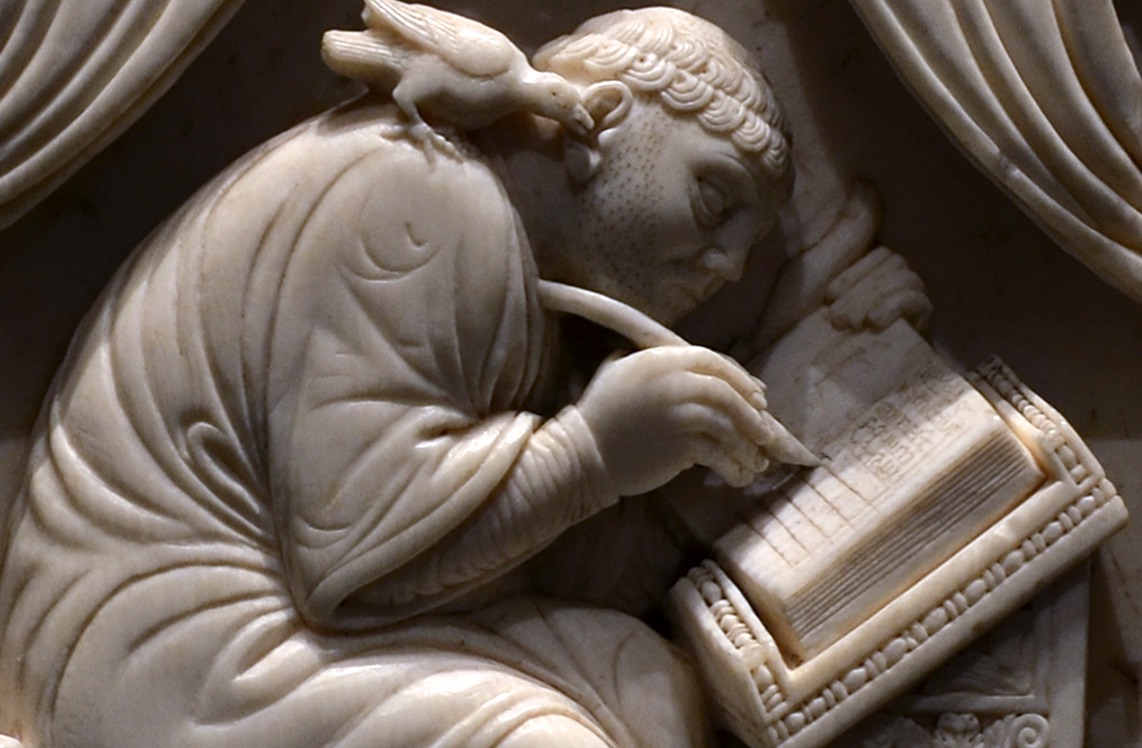
September 3rd is the feast of St. Gregory the Great, many say the greatest of the popes. I’m sure he never thought of himself as great, he was too absorbed in the troubled times he lived in. Usually saints are recalled on the day of their death or martyrdom, but Gregory’s remembered the day he became pope, September 3, 590. That was a day of martyrdom for him.
Years ago, I lived across the street from Gregory’s home on the Celian Hill in Rome. On my way to school, I would peek through the ancient doors of the library of Pope Agapitus, a relative of Gregory’s, where archeologists were trying to learn about what was once the largest Christian library in Rome. Barbarian tribes later plundered the place on their regular sweeps through the city.
Those were bad times. Gregory was called from his monastery here on the Celian to become pope, but also to take charge of a city under siege. He never was a healthy man and he never had much support. Most of Rome’s leading families fled to safer parts; the imperial government relocated in Milan. The burden of the city and the church fell on him.
Called to a job he didn’t want, Gregory drew wisdom and strength from the scriptures, especially from figures like Job and Paul the Apostle, who taught him that strength can come to weak “earthen vessels” like himself.
In his Commentary on Ezechiel, which we read in the Office of Readings, Gregory describes what he went through. Like Ezechiel, he was appointed a watchmen in the city, supposed to go up to the heights and see what’s coming, but “I’m not doing this very well, ” Gregory said.
“I do not preach as well as I should nor does my life follow the principles I preach so inadequately.
“I don’t deny my guilt, I get tired and negligent. Maybe by recognizing my failure I’ll win pardon from a sympathetic judge. When I lived in the monastery I was able to keep my tongue from idle topics and give my mind almost continually to prayer, but since taking on my shoulders the burden of pastoral care, I’m unable to keep recollected, with my mind on so many things.
“I have to consider questions affecting churches and monasteries and often I have to judge the lives and actions of individuals; I’m forced to take part in certain civil affairs, then I have to worry about barbarians attacking and wolves menacing the flock in my care; I have to do my political duty to support those who uphold the law; I have to put up patiently with thieves and then I have to confront them, in all charity.
“My mind is torn by all the things I have to think about. Then I have to put my mind on preaching. How can I do justice to this sacred ministry?
“Because of who I am I have to associate with all kinds of people and sometimes I say too much. But if I don’t talk to them the weaker kind of people wont come near me, and then we wont have them when we need them. So I have to listen to a lot of aimless chatter.
“But I’m also weak myself and I can get drawn into gossiping and then find myself saying the same things I didn’t care to listen to before.
“Who am I — what kind of watchman am I? I’m not standing on the heights, I’m in the depths of weakness. And yet the creator and redeemer of all can give me, unworthy though I am, the grace to see life as it is and power to speak effectively of it. It’s for love of him that I do not spare myself in preaching him.”
We have to admire Gregory, don’t we? He feels weak, but he’s a watchman looking out for his city and his church. Weakness doesn’t prevent him from serving or being far-sighted. From the Celian Hill Gregory sent monks to England, to the ends of the world, to found the church there. On his tomb in the Vatican is the simple inscription that describes him so well. “Servant of the servants of God.”
Today, Mother Theresa’s community lives on the land where Gregory’s home once was, on the Celian Hill, next to the ancient church of Saints John and Paul. They say Gregory took in 12 poor people for a meal almost every day. The poor are still taken care of where he once lived.
I hope to visit there in a few weeks.
 The Victor's Place