Tag Archives: mission

An Unclean Spirit

Our gospel today is from the first chapter of Mark.  Jesus has come from his baptism in the River Jordan,  gathered disciples and is living at Peter’s house in Capernaum along the Sea of Galilee. He enters the synagogue in the town and amazes people with his teaching. They’ve never heard anyone like him.

But a man in the synagogue with an unclean spirit challenges him.  I’m not sure what an unclean spirit is, and neither do most of the commentators on this gospel. The man certainly reacts violently to Jesus, shouting out:
“What have you to do with us, Jesus of Nazareth? Have you come to destroy us? I know who you are—the Holy One of God!” (Mark 1,21-28)

In other words: “Keep away from us; you’re only going to bring us trouble.” The man just wants to be left alone. Even in the synagogue he wants to be left alone. Even if Jesus is from God, the man just wants to be alone. “Get away from us!” he says.

That strong reaction to Jesus was not limited to the synagogue in Capernaum. It continued as he made his way to Jerusalem. The rejection was sometimes strong, sometimes people just ignored him. Mark see that rejection as diabolic.

No matter how wise his teaching, how compassionate his healing, how loving his words, Jesus was rejected.  In the end, his enemies killed him.

We believe the gospel repeats itself, and so it’s repeated today as we hear it.  “If today you hear his voice, harden not your hearts.” Can we reject Jesus too? As we sit in our synagogue today, do we reject him in signs of his presence and in faith?

Belief in Jesus Christ is at the heart of everything. “I believe in God, the Father Almighty…I believe in Jesus Christ…I believe in the Holy Spirit.” Believing means hearing Jesus, listening to him, offering ourselves to him, entering into friendship with him, hoping in his strength, waiting patiently to receive what he promises.

Believing is not something we do occasionally; we believe day by day. There’s always the danger of losing faith in him. “Leave us alone,” we say, “You want to destroy us.” We can prefer isolation to communion with the One God has sent.

So maybe an unclean spirit is not rare at all. Maybe we could call it that cloudy, dark spirit that can take hold of us, so we don’t see the light. Deliver us, Lord, from an unclean spirit.

Rejection of Jesus was not unusual in his day, as the gospel of Mark reminds us, and it’s not unusual today. Today, however, it’s influenced by some different factors.

For example, our western world resists the idea of Jesus as a unique Savior and Teacher. We live in a pluralistic society, and so when we say Jesus is a unique Savior and Teacher, we seem to deny the truth in other religions and religious teachers.

What about the Dalai Lama? What about Buddhism, Hinduism, the religion of native Americans? Don’t they teach the truth? When you claim that Jesus is unique, do we deny there’s truth in other religions and religious teachers?

In answer to that, we can say that we believe a human search for God goes on from the beginning of the human race. The human spirit is always searching for God and its search has been blessed by wisdom and spiritual insight. So other religions religions have been blessed with truth.

But the uniqueness of Jesus comes from the fact that God approaches us.  He sends us his Son. Jesus is his Word to us. His revelation is something we couldn’t arrive at on our own. We didn’t earn it. “This is my beloved Son, hear him,” God says from the heavens when Jesus is baptized. God takes the initiative and calls us into friendship with him, eternal friendship. It’s a promise beyond what we could dream of.

And Jesus not only promises new life, but he takes away what hinders us from enjoying a life with God. He takes away sin. He took away the unclean spirit that was there in the man in the synagogue.

I think there are other factors today that contribute to the rejection of Jesus, particularly in our western world. We’re proud of our individuality and there’s a fear following Jesus causes us to lose our own personalities and dreams. Jesus will take over our lives and impose on us a mold of his own.  We don’t like losing our individuality–not at all.

There’s a fear too that a code of morality will be imposed on us that will deaden our lives and make us scared to love and to live. For many Christianity appears to be a religion of cold moralism, but it isn’t.

The man in the synagogue with the unclean spirit may not be too far from us, then. “Be quiet! Come out of him!” Jesus cried out. We may need that healing ourselves.

Palm Sunday

We call this week “Holy Week,” because it’s the week the church follows Jesus closely to his death and resurrection. Today we go with him into Jerusalem where people clapped their hands and shouted out his name and sang his praises; a few days afterwards they put him to death by crucifixion.

This is a week to ask “Who is this?” and “Why did this happen to him?” We ask these questions because they answer the great questions of life. “Who are we?” and “Why are we here?”

Jesus Christ came upon earth, not just to teach us but through his death to take away the death we all face, and through his resurrection to give us the promise of life, eternal life.

The first few days of Holy Week, Monday, Tuesday and Wednesday, the gospel readings follow Jesus as he prepares to die. He stays away from the temple area in Jerusalem where he spoke previously to mostly hostile listeners. In these first days of Holy Week he looks for the company of “his own,” his friends in Bethany and the disciples who have followed him up from Galilee.

On Thursday of Holy Week Jesus goes with his disciples into the city, to an upper room near the temple, and at that meal he offers himself to his Father as a new sacrifice for the life of the world.

On Good Friday he faces death on a cross in a drama that has never been equaled and has hardly been understood.

Holy Saturday is a day when the world is silent. Like the disciples of Jesus before us, we wait with the little faith and hope we have for the light that will come from the empty tomb.

Easter Sunday Jesus Christ rises from the dead.

This week at Immaculate Conception Parish in Melbourne Beach, Florida, I’m preaching a mission for the first three days of Holy Week. My reflections will be mostly from the Gospel of Mark, but they will include the other scriptures that speak of the mysteries of Holy Week.

On Monday, I’ll speak about the supper at Bethany and the Last Supper in Jerusalem.

On Tuesday I’ll speak about the Passion narrative of Mark from the arrest of Jesus in the Garden to his burial in the tomb.

On Wednesday, I’ll speak about his Resurrection from the dead as the scriptures describe it.

Shelter Island

photo

I’m preaching a parish mission at Our Lady of the Isle in Shelter Island, NY today till Tuesday evening and I’ll be commenting each morning after Mass and in the evening at 7PM on parts of Luke’s gospel, the gospel we’re reading most Sundays this year in church.

Tonight it will be on the Journey of Jesus to Jerusalem, which Luke begins in Chapter 9 and continues to the 19th chapter, when Jesus reaches the Holy City.  “When the days for him to be taken up were fulfilled (Jesus) resolutely determined to journey to Jerusalem.” (Luke 9,51-19,28) In preceding chapters, Luke recalled Jesus’ ministry in Galilee. (Luke 4,13-9, 50)

Luke isn’t concerned with a neat catalogue of miles traveled or places reached in describing Jesus’ journey. This is the time he gathers and instructs disciples, who accompany him on the way to Jerusalem and, after his ascension into heaven, bring his message to the ends of the world. Not only the twelve go with him, but “great crowds” follow him besides “a further seventy-two.” (Luke 14,25; 10,1-14); Luke doesn’t forget that women are among them. (Luke 23,49)

Jesus meets opposition throughout his journey. His own town of Nazareth opposed him as he began his Galilean ministry. Now the Samaritans turn back his messengers at the start of this journey. (Luke 9,53-56) Opposition continues as he goes on his way.  The Pharisees ensconced in their synagogues pour their criticism on him. (Luke 11, 37-43)  Others are too preoccupied with riches or too caught in their own interests to pay him any attention. (Luke 12,16-21)

Some of his new disciples surprise us, like Zacchaeus the chief publican of Jericho, who welcomes Jesus into his house on his journey. (Luke 19,1-10) The poor, like the blind man outside Jericho, are also likely to follow him up the road. (Luke 18,35-43) Luke describes a merciful Jesus on this journey, who searches for the lost sheep and welcomes the prodigal son. (Luke 15,1-32)

Sure to follow Jesus into the kingdom of heaven are the childlike, who don’t cling to power and rank.  Luke sees Jesus praising the childlike both in his Galilean ministry (Luke 9,46-48) and on his journey to Jerusalem. (Luke 10, 21;  18.15-17)  It’s also a common theme in the gospels of Matthew and Mark who have Jesus pointing to his disciples the example of the child. (Matthew 18.1-5; Mark 9,35-37)

It’s essential that a disciple of Jesus be childlike. (Luke 18,15-17) Is childlikeness the secret of Zacchaeus, the chief tax collector from Jericho, the little man who climbed a sycamore tree to see Jesus passing by?

St. Leo the Great, an early pope, said that becoming like a child does not mean becoming a child physically. We can’t go back. But the childlike can go forward to the kingdom of God, because they’re small enough to pass through the narrow gate.

Becoming a child means to be free from crippling anxieties, to be forgetful of injuries, to be sociable, and look in wonder at all things.

Tomorrow I’m going to comment on the Passion narrative from Luke’s Gospel. On the journey to God, Jesus must pass through death. His disciples will accompany him.

Tuesday evening, I’ll talk on the Resurrection narrative from Luke.

The Passion According to Luke

DSC00234

Last night at the mission in St. Augustine Church, Ocean City, NJ,  I read from St. Luke’s Passion narrative. (Luke 22, 26-49) Luke sees Jesus beginning his journey back to God from Galilee. After his condemnation by Pilate he goes to his death on Calvary, but his journey does not end here; it ends when he ascends into heaven.

Jesus did not make the journey from Galilee to Jerusalem  alone; he gathered disciples to accompany him. Now, as he goes to Calvary, he does not go alone into the mystery of death.  Simon of Cyrene and a large crowd of people including “many women who mourned and lamented him” go with him.

Luke notes that “after laying the cross on him, they made him carry it behind Jesus.” Simon, like all the other followers of Jesus, must be part of his journey. He must take up his cross and follow him, a theme emphasized in Luke’s gospel.

Jesus’ words to the women “who mourned and lamented him” are puzzling. Some say he offers them comfort, even as he goes to his death. But other commentators  see his words as a prophetic announcement of the judgment that must inevitably come from such an injustice as his condemnation and death. The great city Jerusalem will be destroyed as a consequence. He tells us every unjust act, every sin has consequences that cannot be waived away.

Two criminals accompany Jesus to Calvary, the place of execution just outside the Jerusalem city gates where so many people passed. The Romans saw it as an ideal place to display their fierce justice. Jesus would die at this hellish place of torture and death. Not a place one wished to be or to see.

Luke, like the other evangelists, sees this place of death in another light. Instead of harsh justice, injustice and death, Jesus offers forgiveness and new life here: “Father, forgive them, for they know not what they do.”

Here God is revealed, who does not just forgive but brings new life. The two criminals crucified with Jesus reveal God’s power at work.  One criminal mocks Jesus on the opposite cross. “Are you not the Messiah. Save yourself and us.” The other rebukes him and turns to Jesus with a plea to be remembered.  “Jesus, remember me when you come into your kingdom.”

More than simply remembering him, Jesus promises to take him on his journey to God. “Amen I say to you, today you will be with me in paradise.” As he did so often, in tender mercy Jesus reaches to one without hope.

Like Simon of Cyrene, the thief symbolizes humanity. He’s been promised life and safe passage through the mystery of death. He dies with Jesus. He’s the first, a reminder that eternal life is never denied to anyone.

The thief is a powerful sign of the promise made to us all. We will die, but we die with the Lord.

Spiritual Childhood

peaceable kingdom copy

This evening at the Catholic Chapel at Dover Air Force Base I spoke on spiritual childhood, an important part of the spirituality of Advent and Christmas. “Unless you become like a little child, you cannot enter the kingdom of heaven,” Jesus said. Isaiah saw a child at the center of the Peaceable Kingdom.

In the short catechesis as our service began, I recommended the bible as a way to know Jesus Christ as a teacher of faith and prayer. I like the New American Bible, Revised Edition (NABRE) because it’s the version we use in our liturgy and it’s got great notes. Its recent revision takes into account newly discovered biblical manuscripts, the latest archeological finds and historical and biblical scholarship.

The New Jerusalem Bible and the RSVP translations are also good.

Many still use the King James version of the bible, one of the great literary treasures of the English language, but it has drawbacks. It hasn’t benefited from the advances in biblical scholarship that have taken place since its creation in the 16th century.

According to a recent survey of Catholics in England, most English Catholics still don’t read the bible much; usually they only know it from Mass on Sundays. That’s also true here in the United States, I think.

It’s important that we take our direction from the 2nd Vatican Council which sees the bible at the heart of our spirituality and a bridge to better relationships with other Christian churches.

Pope Benedict offers a fine example of how to use the bible in his three volumes entitled Jesus of Nazareth. His last volume, on the infancy narratives, was just published before Christmas.

I spoke in my main presentation about the spirituality of childhood, reflecting on a description given by St. Leo the Great. To be a child means to be free from crippling anxieties, forgetful of injuries, sociable and wondering before all things.

Always There

Once again, our lenten gospel for today reports what Jesus said in the temple area during the Feast of Tabernacles. His urgent words address especially those who oppose him. The time is short; the Light that guides the world has appeared, but Jesus “is going away” and those who reject him will die in their sins.

We’re not detached observers of a time long ago, as we listen to this Gospel, watching others challenged to believe. The challenge is not just to someone else; we’re challenged ourselves to answer the question: Who is Jesus Christ? He is “I AM,” a divine title his enemies find blasphemous, but believers find true.

In Hebrew it means “He who is always there.” Later in John’s Gospel, Thomas bows before Jesus and says “My Lord and my God,” for he recognizes that the One lifted up on the cross is indeed “IAM.”

An interesting title for God, isn’t it? “Always there.” Another way of saying the “Eternal One” perhaps, but “Always there” puts it in another way. “Always here” “Always present” “Always powerfully present.”

Our Gospel calls us to reverence the One lifted up on the Cross as the days of Holy Week approach. He is “I AM,” true God, sent by the Father, “who so loved the world that he sent his only Son.” And he will always be there.


Lord Jesus Christ,

Draw me to your cross

and show me your wounds, your bitter death,

your triumph over the tomb.

God with us, always there,

God who loves us so much,

keep me in mind of you,

save me from forgetfulness.      Amen.  .

Immaculate Conception Parish: Mission–Monday

Jesus of Nazareth

Following up on the pope’s remarks about the blurred picture of Jesus we have today, here are some reflections on what we know about Jesus today. I’m offering these reflections at our parish mission:

“Tell me the landscape where you live and I’ll tell you who you are.” (Ortega y Gasset)

Thanks to recent archeological discoveries and historical studies we know more about the land where Jesus lived and the ancient texts of the bible than has been known for centuries. These new resources help us know Jesus Christ.

New editions of the bible like the New American Bible Revised Edition and the New Jerusalem Bible Revised Edition (both Catholic sponsored) make use of these resources.

We know more about Galilee, the northern part of Palestine where Jesus lived most of his life, than we knew before. He grew up and was raised by Mary and Joseph in the Galilean hill town of Nazareth, the gospels say. Extensive excavations have gone on in Nazareth, today the busy capital city of modern Galilee.

After his baptism by John in the Jordan River Jesus made his home in the Galilean town of Capernaum on the Sea of Galilee–also extensively excavated in recent times. From there, he visited the small Jewish towns scattered nearby in the fertile plains and mountains, teaching in their synagogues, healing and performing extraordinary signs. New historical studies tell us much about Jewish life in these places.

In Galilee Jesus proclaimed the good news that God’s kingdom was at hand. He used images from this land, like the seed and the sower, in his preaching as well as the scriptures he knew so well. Today Galilee still offers a picture of the land as he knew it.

“After John had been arrested,

Jesus came to Galilee proclaiming the gospel of God:

‘This is the time of fulfillment.

The kingdom of God is at hand.

Repent, and believe in the gospel.’”  Mark 1

Under the rule of Herod Antipas, Galilee during Jesus’ public ministry was dotted with important cities like Tiberias, Bethshan, Sepphoris, and the seaport of Caesarea Maritima, all with large gentile populations. Matthew’s gospel calls it the “Galilee of the gentiles.” Hardly the backwater land once thought, the region was an important provider of food for the Roman world.

The gospels suggest that Jesus avoided these important Galilean cities. Instead, he saw himself sent first to the “children of Israel,” although  he occasionally performed cures for some gentiles, like the Syro-Phoenician woman who sought him out and the Roman centurion whose servant was sick in Capernaum.

The arrest and execution of John the Baptist by Herod may have been a practical warning about the danger of places where the powerful lived.

After his baptism in the Jordan River by John, Satan told Jesus to reveal himself in a spectacular way in the temple of Jerusalem, the religious center of Judaism; some disciples urged him to go there too.  However, Jesus made Peter’s simple home in Capernaum his home and from there brought his message to Jews and some non-Jews who lived on Galilee’s farmlands and fished in the Sea of Galilee.

Jesus grew up in Nazareth and his ministry was mainly in Galilee, but he customarily celebrated Jewish feasts, like the Passover, in Jerusalem. Visiting the Holy City, he likely camped among the olive groves that surrounded Bethany, where other pilgrims from Galilee stayed.  He had friends in Bethany– Lazarus and his sisters, Martha and Mary, and also some friends in the city itself.

His visits to the temple at Jerusalem became more significant as the years passed. Even at twelve, he began to dialogue in the temple courtyard with the rabbis who marveled at his questions and answers; he spoke of the temple as “my Father’s house.” (cf. Luke ) After his baptism in the Jordan his dialogue with the rabbis sharpened and the claims he makes about his relationship with his Father increased.

John’s gospel, which we read extensively in the last weeks of Lent, offers some of his exchanges in the temple courtyard about his relationship with his Father. The scriptures and the prophets testify to him, he says. (John 5,31-47  Thursday 4th wk) “I am from him, he sent me.”  (John 7,1-30 Friday, 5th wk) “ Just as the Father raises the dead and gives life, so also does the Son give life to whomever he wishes.” ( John 5,17-30 Wednesday, 4th wk)  “When you lift up the Son of Man, then you will realize I AM.” (John 8,21-30Tuesday, 5th wk ) His divine claims were violently opposed by the Jewish leadership in Jerusalem.

The gospels, especially Luke’s, emphasize Jesus’ love of people. He reached out to those in need; he welcomed women as well as men to his company. His acceptance of outcasts like tax collectors and sinners brought him criticism from others. When John’s disciples asked him “Are you the one who is to come?”  he replies, “Tell John what you see and hear: the blind see, the lame walk, the deaf hear, the dead rise, and the poor have the gospel preached to them. “

“Come to me all you who are weary and I will refresh you, for I am meek and humble of heart,” he said, and he urged his followers to also welcome the weary: the sick, the prisoner, the homeless, the naked, the hungry needing refreshment.

He taught that God should be loved above all and we should love our neighbor as ourselves. He said we should forgive those who have offended us, because God forgives our offenses. He told us to pray to God thankfully and ask for what we need.

People listened to his teaching and knew that he lived what he taught himself.

After his resurrection, he appeared on a mountain in Galilee to his disciples and told them to go out to all the nations and preach the gospel, “baptizing them in the name of the Father, and of the Son, and of the Holy Spirit.”  From the “Galilee of the gentiles,” he sent his disciples out to farthest corners of the earth.

Become like children, he said, because those with the spirit of the child belong in the kingdom of heaven.

According to St. Leo the Great, Jesus does not ask us to return to our play pens. We can’t do that. The spiritual child is

  1. free from crippling anxieties
  2. forgetful of injuries
  3. sociable
  4. wonders at all things.

Mission at St. Thomas More: Wednesday Evening

Jesus is our Teacher and Lord. He is not just a human teacher who tells us how to live in this world. He also points to a world to come, the home to which he calls us.  He goes before “to prepare a place” for us.” Risen from the dead, he is “the first fruits;” we still await the harvest.


The apostle Thomas, whom Rembrandt (below) pictures acknowledging Jesus as “My Lord and my God,” represents doubting humanity called to believe. Mary Magdalen too represents our weak humanity wishing to cling to the human Jesus.

Besides our Teacher, Jesus is Lord of Creation. This aspect of the mystery of the Resurrection has been influenced by the thinking of the Enlightenment, according to Anglican Bishop W.T. Wright, who recently addressed the Italian Catholic Bishops.

I’ll be speaking tonight of the role of Jesus as Lord of Creation.

You can read what Bishop Wright said here.

Mission at St. Thomas More: Tuesday Evening

Tuesday evening at our mission in St. Thomas More Parish, Sarasota, Florida, we’re going to reflect on the Passion of Jesus Christ. Those who can’t attend our service at 7 PM (and maybe some who attended too) may find this great presentation by Rembrandt something to study. He’s a great visual teacher of scripture.


Here’s some thoughts on it:

Rembrandt’s Crucifixion.

Light from above falls on this dreadful scene, falling first on Jesus Christ, who is the Light of the World, even in this dark hour.

The same light bathes those on his left (Is it because blood and water from his pierced heart flows on them?). The thief, his face turned already toward Paradise, has a place among those who followed Jesus from Galilee. Some of them sit on the ground overwhelmed by it all; some comfort Mary his mother; some stand looking on. Mary Magdalene comes close to kiss his nailed feet.

The centurion kneels before Jesus and cries out his confession of faith, “Yes, this is the Son of God.” But his soldiers look ready to leave their grim duty for the barracks and dinner.

On the left, Jesus’ enemies are heading home too, into the darkness. The other thief’s face is turned to them, as if he wished he could go with them, away from this place.

But I notice some light seems to reach out to them too. “Father, forgive them, for they know not what they do.”


Jesus Loved Outcasts


Luke’s gospel, which we read this evening at our mission (Luke 18,31-19,10),  has been called the Gospel of the Outcasts. The New American Bible gives this overall description of it: “Throughout the gospel, Luke calls upon the Christian disciple to identify with the master Jesus who is caring and tender towards the poor and the lowly, the outcast, the sinner, and the afflicted, towards all those who recognize their dependence on God… No gospel writer is more concerned than Luke with the mercy and compassion of Jesus.”

As the name implies, outcasts can be hard to take, but Jesus embraced them in his lifetime and the gospel tells us he will always embrace people like the blind man and Zachaeus, the chief tax-collector in Jericho.

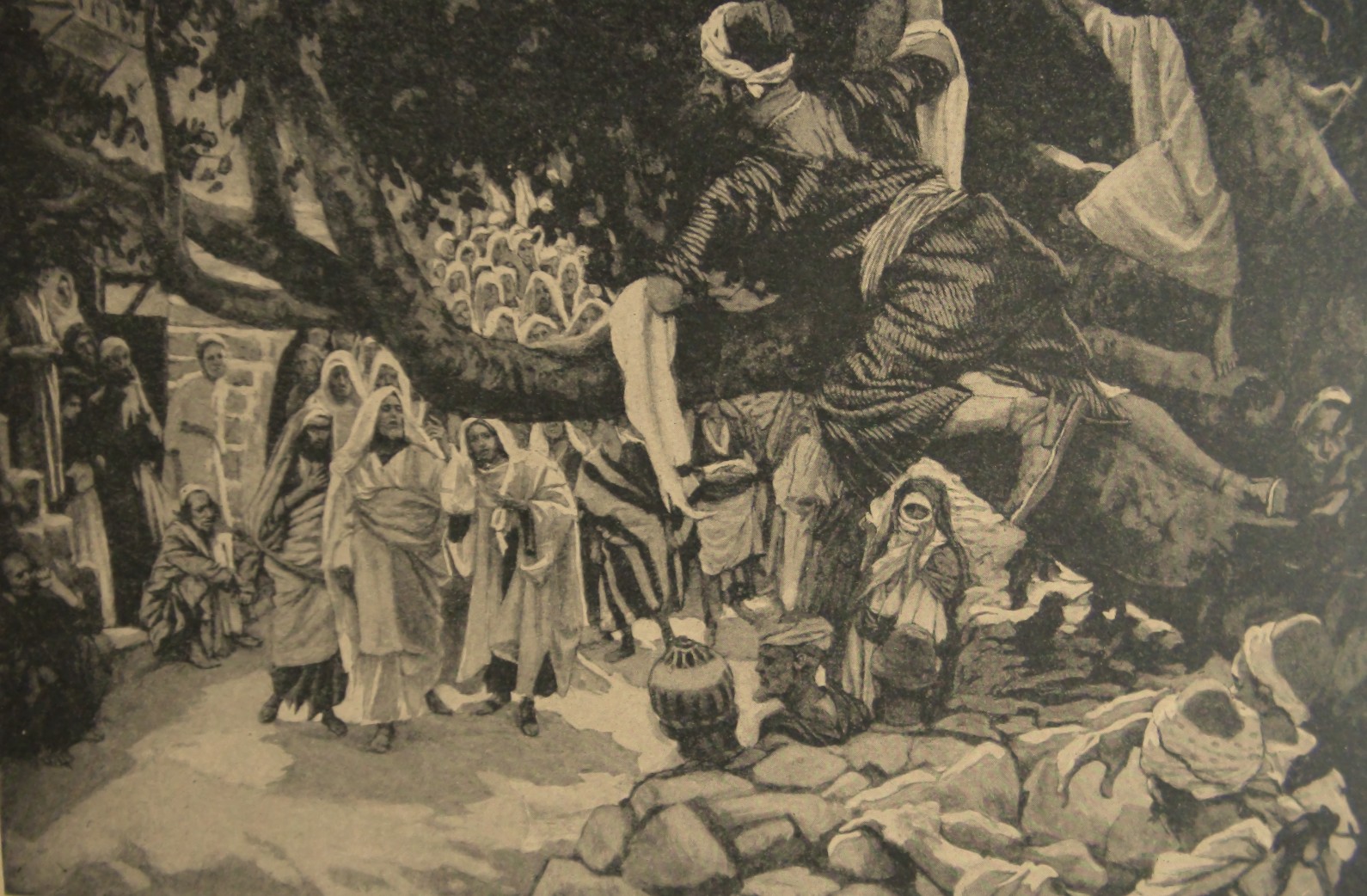
The parable of the talents follows the story of Zachaeus in Luke’s Gospel. Was Zachaeus one of those given ten talents, which he multiplies by his generous gifts to the poor?  There seems to be something of the child in him too. Climbing a tree is something a child would do, isn’t it? Was he on the way to become like a child, as Jesus taught?

I like this picture of Zachaeus by J. Tissot. (above)

In Jericho last year I took a picture of the sycamore tree they feature now in the town square. (above) Imagine Zachaeus up that tree.