Our daily liturgy gives us scriptures to read and saints to celebrate. This week in our lectionary we continue to read from the Gospel of Mark and the 1st Book of Samuel. Today we remember Fabian, an early pope and martyr, and Sebastian, a soldier saint and martyr. Tomorrow we have Agnes, a young girl and early martyr.
Our lectionary readings are not chosen haphazardly. After the feast of the Baptism we began reading each day from the Gospel of Mark, the first of the gospels to be written, an appropriate reading for following Jesus as he begins his ministry in Galilee.
The saints point out how others have followed him. . The three martyrs we remember this week are examples of some who were put to death in persecutions that took place in the early church. Fabian was put to death at the beginning of the Decian persecution (250) because he was a church leader. The Roman strategy was to kill church leaders and their followers would scatter.
Sebastian was a soldier saint martyred in the Diocletian persecution. From what we know, Christians were highly regard by the emperor when he first came to power, but then he turned against them, especially the officer class. Like Sebastian, many of them holding influential positions in the empire were put to death for their supposed disloyalty.
Agnes was not killed in a general persecution like Fabian and Sebastian. She died because Christians were legally vulnerable in the centuries before Constantine. The Romans were suspicious of them. Agnes a victim of a powerful Roman man who used the Roman judicial system to punish a young Christian girl who would not let him have his way with her.
The founders of churches throughout the world have an important place in our church calendar, because they did what Jesus commanded: “Go out to the whole world and preach the gospel, baptizing them in the name of the Father and of the Son and of the Holy Spirit.” (Matthew 25 )
Church founders are apostles like Peter and Paul, founders of the church in Rome, (June 29), or monk-bishops like Boniface, founder of the church of the Germanic peoples, (June 5), Patrick, founder of the church in Ireland, (March 17) Ansgar, founder of the church in Scandanavia, (February 3), Cyril and Methodius, founders of the church in the Slavic nations (February14).
The church in Korea, whose founding we celebrate today, can be traced back to the 17th century. Its foundation is special, as Pope John Paul II noted at the canonization of the Korean Martyrs, May 6, 1984:
“The Korean Church is unique because it was founded entirely by laypeople. This fledgling Church, so young and yet so strong in faith, withstood wave after wave of fierce persecution. Thus, in less than a century, it could boast of 10,000 martyrs. The death of these many martyrs became the leaven of the Church and led to today’s splendid flowering of the Church in Korea. Even today their undying spirit sustains the Christians of the Church of Silence in the north of this tragically divided land.” – Pope John Paul II at the canonization of the Korean Martyrs, May 6, 1984.
A priest, Andrew Kim Taegon and a layman Paul Chong Hasang, head the list of 103 martyrs canonized in 1984, but the early Korean church was from the first a church of laypeople. Decades before those celebrated today, it was without priests or bishops. All lay people, they kept faith alive at great cost and offered it to others.
By its nature, the Catholic Church draws from its member churches the gifts God has given them. The church is the body of Christ. May our churches today, old and new, be blessed with lay people like those who founded the church in Korea.
The Second Vatican Council, 60 years or so ago, called for increasing the role of the laity in the Catholic Church. It seems to me that goal has still to be met, at least in my country.
“Once again, Jesus sends lay people into every town and place where he will come (cf.Luke 10:1) so that they may show that they are co-workers in the various forms and modes of the one apostolate of the Church, which must be constantly adapted to the new needs of our times. Ever productive as they should be in the work of the Lord, they know that their labor in him is not in vain (cf. 1 Cor.15:58).” (Decree on Laity, 33)
O God, who have been pleased to increase your adopted children in all the world, and who made the blood of the Martyrs Saint Andrew Kim Tae-gǒn and his companions a most fruitful seed of Christians, grant that we may be defended by their help and profit always from their example.Through our Lord Jesus Christ, your Son, who lives and reigns with you in the unity of the Holy Spirit, God, for ever and ever.Amen.
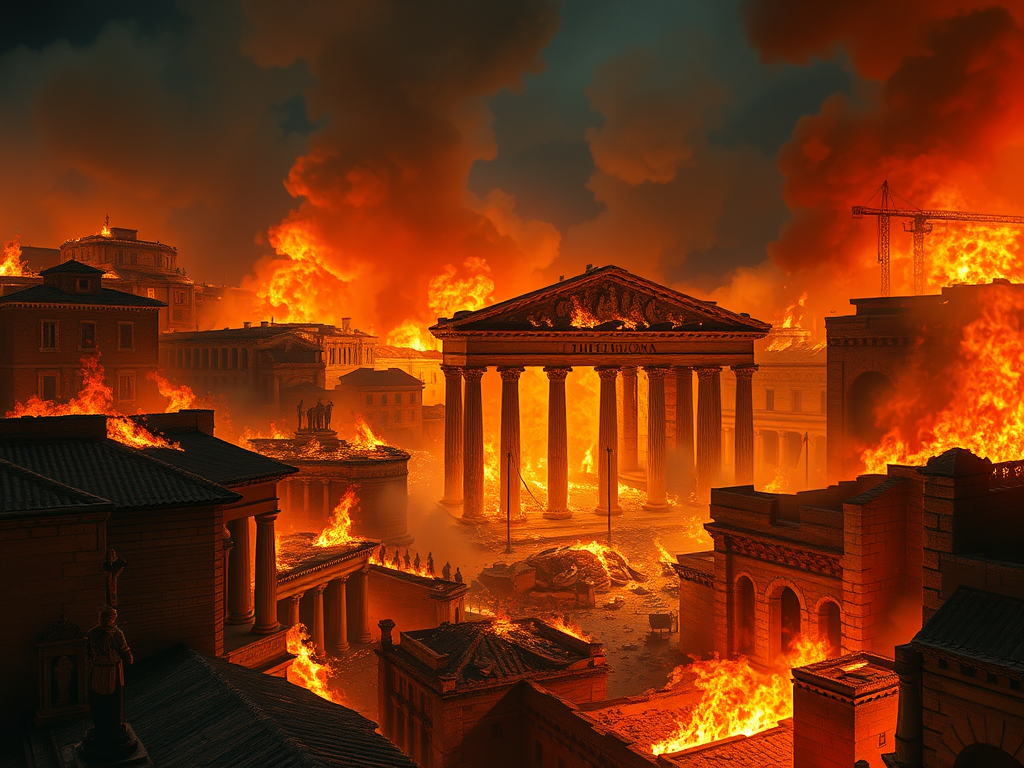
Today is the feast of the early Roman martyrs who suffered in Nero’s persecution along with the apostles Peter and Paul. The persecution began with an early morning fire on July 19, 64, that broke out in a small shop by the Circus Maximus and spread rapidly to other regions of Rome, raging for nine days through the city’s narrow streets and alleyways, where more than a million people lived in apartment blocks of wooden construction.
Only two areas escaped the fire; Trastevere, across the Tiber River, which had large Jewish population, was one.
Nero was at his seaside villa in Anzio when the blaze began, but he delayed returning to the city. They say that when he heard the news, he began composing an ode comparing Rome to the burning city of Troy. His absence caused resentment among the people. Rumors began that Nero himself set the fire in order to rebuild the city from his own plans.
To quell the rumors, Nero decided to blame someone else, and he chose a group of renegade Jews called Christians, who had caused trouble before, and had a bad reputation in the city. Earlier, about the year 49, the Emperor Claudius had banished some of them from Rome for starting upheavals in the city’s Jewish synagogues with their disputes about Christ.
“Nero was the first to rage with Caesar’s sword against this sect,” wrote the early-Christian writer, Tertullian. “To suppress the rumor,” the Roman historian Tacitus says, “Nero created scapegoats. He punished with every kind of cruelty the notoriously depraved group known as Christians.” Just how long the process went on and how many were killed, the Roman historian does not say.
The early Roman Christians came mostly from the 60,000 Jewish merchants and slaves with strong ties to Jerusalem. Even before Peter and Paul arrived in Rome, Jewish-Christians, clearly identified as followers of Jesus Christ, were counted among the city’s Jews.
At the time of the fire Jewish Christians had become alienated from the larger Jewish community and began separating from it. Where they lived and met was well known. The authorities, following the usual procedure, seized some of them, brought them to the Prefecture and forced them by torture to give the names of others.
“First, Nero had some of the members of this sect arrested. Then, on their information, large numbers were condemned — not so much for arson, but for their hatred of the human race. Their deaths were made a farce.” (Tacitus)
Instead of executing the Christians immediately at the usual place, Nero executed them publicly in his gardens and in the circus on Vatican hill. “Mockery of every sort accompanied their deaths. Covered with the skins of beasts, they were torn by dogs and perished, or were nailed to crosses, or were doomed to the flames and burnt, to serve as a nightly illumination, when daylight had expired.” (Tacitus)
Most thought Nero went too far. “There arose in the people a sense of pity. For it was felt that they (the Christians) were being sacrificed for one man’s brutality rather than to the public interest.” (Tacitus)
We celebrate the memory of the victims of Nero’s persecution, our ancestors in faith, on June 30th, following the feast of Saints Peter and Paul.
Further Reading
It would be good to have two New Testament writings in mind as we celebrate this feast– the Gospel of Mark and the First Letter of Peter.
Many scholars believe the Gospel of Mark was written in Rome following Nero’s persecution and before the destruction of Jerusalem in 70. Roman Christians, reeling from persecution and fearing troubles ahead, learned from this gospel.
Most belonged to a Jewish community that enjoyed extensive privileges under Rome’s emperors; they felt safe and secure– until Nero’s reign. There were brave martyrs, but there were others who betrayed their fellow Christians.
Mark’s Gospel presents the Passion of Jesus as a stark, brutal martyrdom that can’t be explained. How appropriate for Christians facing absurd, unmerited suffering meted out by a capricious emperor. At the same time, more than other gospels, Mark portrays Peter as a disciple who fails his Master and then receives mercy. He seems to remind Rome’s Christians that not only the strong, but the weak are part of their church.
Mark’s Gospel is meant for hard times. Jesus Crucified calls his disciples to follow him to the Cross.
First Letter of Peter
Another New Testament writing offered a similar message to the Roman community and Christians beyond the city. Like Mark’s Gospel, the First Letter of Peter, written in Rome, calls for courage in suffering, even unjust, absurd suffering.
“Christ suffered for you, leaving you an example that you should follow in his footsteps. He committed no sin and no deceit was found in his mouth. When he suffered he did not threaten; instead he handed himself over to the one who judges justly.” (1 Peter 2, 21-23)
The followers of Jesus should stay the course when suffering comes, Peter says. Stay where you are, the letter says, and “maintain good conduct among the Gentiles,” (1 Peter 2:12) “give honor to all, love the community, honor the king.”(1 Peter 2:17)
Following the Neronian persecution, many Jewish Christianss fled Jerusalem before Titus’ advancing legions. Seeing a sign of the last times, they prepared for the end. Rome’s Christians stayed where they were, it seems, and with their neighbors rebuilt their burnt city, waiting in hope for God’s kingdom to come.
They must have wondered whether to stay in this city, an evil city like Babylon. Should they go to a safer, better place? The Christians remained in the city. I wonder if the “Quo Vadis?” story was a story prompted by questions like these ?
The martyrs of Rome strengthen us to stand where we are and do God’s will, inspired by the Passion of Christ.
Wars, especially civil wars, can bring unspeakable violence. The Spanish Civil War in the 1930s is a good example. There were atrocities on both sides. Innocent people were among its victims, and suffered for no reason at all.
The Martyrs of Daimiel, Spanish Passionists from my own community, most of them young students for the priesthood preparing for missionary work in Cuba and Mexico, were killed in 1936. It’s a tragic story, but also a story of God’s grace shining through human evil..
Between July 22nd and October 24th, 1936, twenty-six religious from the Passionist house of studies, Christ of the Light, outside the city of Daimiel, about eighty miles south of Madrid, died at the hands of anti-religious militiamen at the outbreak of the Spanish Civil War. They were: Niceforo Diez Tejerina, 43, provincial superior, who previously served as a missionary in Mexico and Cuba after being ordained in Chicago, Illinois.; Ildefonso García Nozal, 38; Pedro Largo Redondo, 29; Justiniano Cuestra Redondo, 26; Eufrasio de Celis Santos, 21; Maurilio Macho Rodríguez, 21; Jose EstalayoGarcia, 21; Julio Mediavilla Concejero, 21; Fulgencio Calv Sánchez, 19; Honorino Carraced Ramos, 19; Laurino Proáno Cuestra, 20; Epifanio Sierra Conde, 20; Abilio Ramos Ramos, 19; Anacario Benito Nozal, 30; Felipe Ruiz Fraile, 21; Jose Osés Sainz, 21; Felix Ugalde Irurzun, 21; Jose Maria Ruiz Martinez, 20; Zacarias Fernández Crespo, 19; Pablo Maria Lopez Portillo, 54; Benito Solano Ruiz, 38; Tomas Cuartero Gascón, 21; Jose Maria Cuartero Gascón, 18; German Perez Jiménez, 38; Juan Pedro Bengoa Aranguren, 46; Felipe Valcobado Granado, 62.
Most of those killed were young religious studying for ordination and destined for missionary work in Mexico and Cuba. Others were priests who taught them and brothers who served in the community. Father Niceforo, the provincial, was visiting the community at the time. Militiamen entered the Passionist house on the night of July 21st and ordered the thirty-one religious to leave in one hour. Father Niceforo gathered them in the chapel, gave them absolution, opened the tabernacle and said: “We face our Gethsemane. . . all of us are weak and frightened,but Jesus is with us; he is the strength of the weak. In Gethsemane an angel comforted Jesus; now he himself comforts and strengthens us. . .Very soon we will be with him. . .To die for him is really to live. . . Have courage and help me by your example.”
He then distributed the sacramental hosts to them.
The militiamen ordered the group to the cemetery and told them to flee. At the same time, they alerted companions in the surrounding areas to shoot the religious on sight. The Passionists split into five groups. The first group of nine was captured and shot outside the train station of Carabanchel in Madrid on July 22, 1936 at 11pm. The second group of twelve, Father Niceforo among them, was taken at the station at Manzanares and shot by a firing squad. Father Niceforo and four others died immediately. Seven were taken to a hospital where one later died. Six of them recovered, only to be shot to death later on October 23, 1936.
Three other religious, traveling together, were executed at the train station of Urda (Toledo) on July 25th. Two gave their lives at Carrion de Calatrave on September 25th. Only five of the thirty-one religious were spared.
Numerous eye-witnesses testified afterwards to the brave faith and courage shown by the Daimiel Community in their final moments, especially the signs of forgiveness they gave their executioners. They were beatified by Pope John Paul II on October 1, 1989, who said of them: “None of the religious of the community of Daimiel was involved in political matters. Nonetheless, within the climate of the historical period in which they lived, they were arrested because of the tempest of religious persecution, generously shedding their blood, faithful to their religious way of life, and emulating, in the twentieth century, the heroism of the Church’s first martyrs.” (Homily: October 1, 1989) Today their bodies are interred in the Passionist house at Daimiel.
Their feastday is July 24th. They’re remembered still at their shrine in Daimiel, Spain.
The martyrdom of St. Charles Lwanga and his twenty one companions in Uganda, Africa in 1885-86 was a decisive factor in the remarkable spread of Christianity in that continent that began in that century. The White Fathers reached that remote part of the world in 1879 and the Catholic missionaries succeeded in converting a number of native Africans, some of whom were servants of King Mwanga, a local Ugandan ruler. In 1885 King Mwanga began to persecute Christians.
Charles Lwanga was in charge of the pages in the king’s court. The king wanted some of the pages as sexual partners. When the Christian pages refused he threatened them with torture and death.
Led by Charles, they rejected the king’s advances, and so the king summoned them to appear before him and asked if they were going to persist as Christians and deny what he asked. “Till death!” they answered. “Then put them to death!” the king shouted.
On the road to their execution at Namugonga three pages died. Many of the bystanders were amazed at the courage and calm of Charles and his companions. On Ascension Day, 1886, they were wrapped up in mats of reeds and set afire for their faith. The following year an extraordinary number of Ugandans became Christian. The prayer for their feast praises God for his graces to them:
Father, you have made the blood of martyrs the seed of Christians.
In today’s Office of Readings, Pope Paul VI says their sacrifice opened a new page in the history of holiness in Africa. They join the 4th century Martyrs of Scilli (whose relics are now in the Passionist church of Saints John and Paul), Cyprian, Felicity and Perpetua and other Christian martyrs and confessors from the past. And he adds:
“Nor must we forget those members of the Anglican Church who also died for the name of Christ.” A recognition that holiness is found in other Christian churches too.
“These African martyrs herald the dawn of a new age. If only our minds might be directed not toward persecutions and religious conflicts but toward a rebirth of Christianity and civilisation!”
The old churches of Rome are wonderful guides to its Christian past. As a student almost 50 years ago I went through them with books like Hertling and Kirschbaum’s The Roman Catacombs and Their Martrys, a book I still keep at hand along with newer ones.
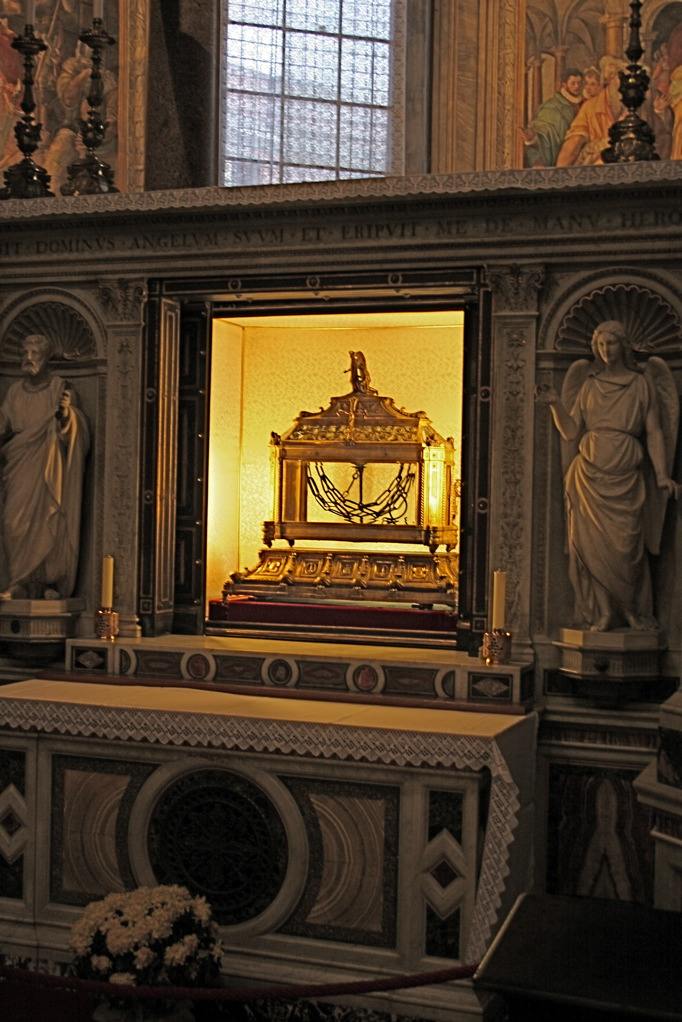
The 5th century church of Saint Peter in Chains is a church I’ve always associated with the First Marytrs of the Church of Rome, a feast we celebrate today, right after the feast of the apostles, Peter and Paul.
It was built near the Roman Prefecture, where people were dragged in chains to be interrogated, tortured, and made to face Roman justice. The Romans were sticklers for procedure. You had to be tried in court. Many Christians–we are not sure how many–were brought to justice near this church. Those chains above may actually come from the nearby Roman jail.
I wrote about it here , and I have a video you can see here.


 The Victor's Place
