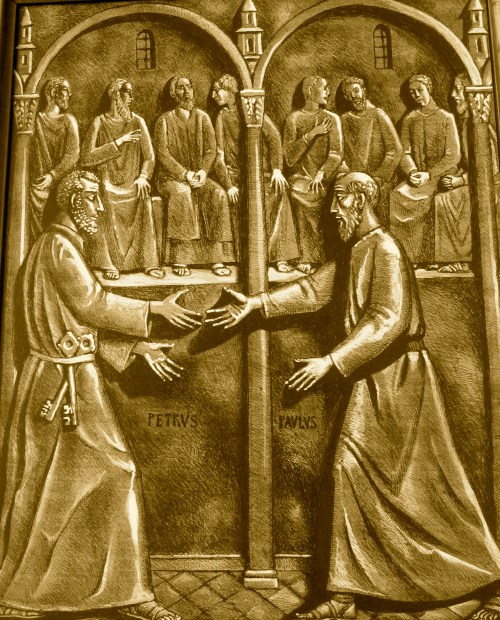
On November 18th, we honor the great apostles, Peter and Paul, remembering the dedication of the two ancient churches built over their graves. Peter is honored in the Vatican Basilica of St. Peter; Paul is honored in the Basilica of St. Paul, outside the Aurelian Walls along the Via Ostiense. The two apostles are founders and teachers of the Roman church.
Constantine built churches over the apostles’ graves in the middle of the 4th century. Besides honoring the apostles Peter and Paul, the churches were part of a wider plan of prayer, instruction and pilgrimage still seen in the Holy Year pilgrimages to Rome today. An early example of evangelization and catechesis.
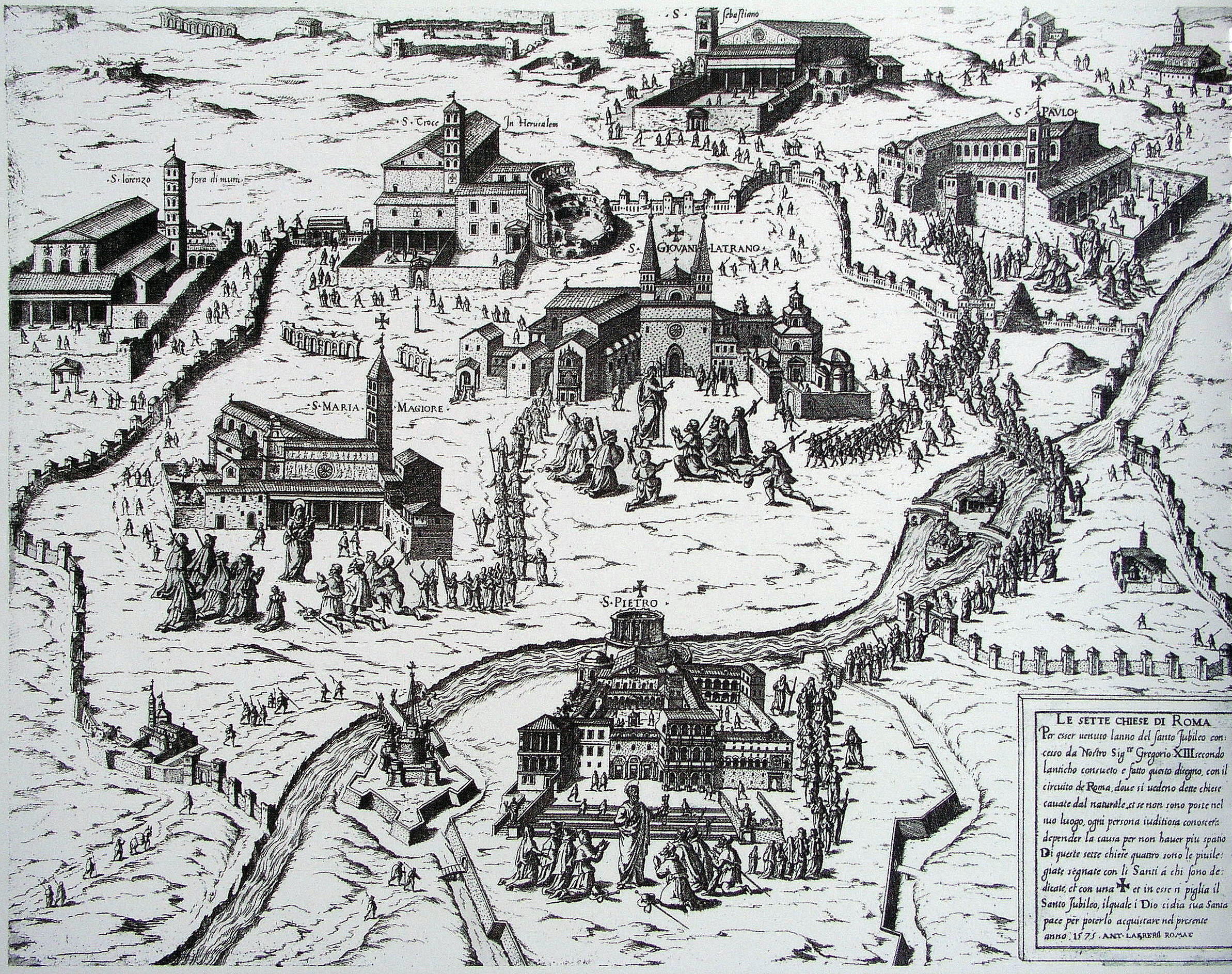
From earliest times pilgrims followed a path from one church to the other, visiting a number of other Christian shrines – St. Agnes and St. Lawrence, for example–on their way. A later pilgrim map based on that ancient pilgrimage journey offers an example.
Pilgrim Map, 17th century, Wikipedia Commons
Peter was crucified on the Vatican Hill in 64 near the obelisk not far from the circus of the emperors Caligula and Nero and was butried nearby. Constantine erected a basilica over his burial site in 326, while Sylvester was pope. Later in 1626 the present basilica replaced Constantine’s church. It’s in the process of reconstruction in the illustration above. Recent excavations have confirmed Peter’s burial place under the papal altar of this church.
Paul, tradition says, was beheaded on the Ostian Way, outside the ancient city walls, in 67. Constantine built a shrine church over the gave in 325; it was enlarged by Theodosius I in386. The church was rebuilt after a fire in 1823, according to its original measurements. The apostle’s grave lies before the main altar of the church.
Defend your Church, O Lord, by the protection of the holy Apostles, that, as she received from them. the beginnings of her knowledge of things divine, so through them she may receive, even to the end of the world, an increase in heavenly grace. Through our Lord Jesus Christ, your Son. (Collect for the feast)
Contemporary historians have problems with the accounts of early martyrs of the Roman church like Agnes, Cecilia, Anastasia, Sebastian, Lawrence, John and Paul– all honored in the Roman liturgy and commemorated in ancient churches throughout the city. We’re celebrating Sebastian, January 20, and Agnes, January 21, this month .
Our age wants facts, real evidence, so are the accounts of these early saints true? One thing I find helpful when considering the early accounts of the Christian martyrs is to remember that Emperor Diocletian, who unleashed the last and greatest persecution of Christianity, wanted to completely obliterate Christianity throughout the Roman empire. Not only did he put many Christians to death, but also tried to destroy all their written records, scriptures, places where they prayed. He wanted no record of their heroes, their saints and martyrs left. The emperor succeeded in destroying most of the records kept by the church of Rome.
Stories about the Roman saints were then reconstructed by Christians after the persecutions, and these accounts, instead of looking like court records–a form they often took before– appeared as embellished legends.
Their stories, though embellished, are basically true. They were Christians who believed so strongly in Jesus Christ that they died for their belief. Not only popes, like Fabian, deacons like Lawrence, but young girls like Agnes, women like Cecilia, soldiers like Sebastian witnessed to their faith by dying for it.
The historian Peter Brown, in one of his brilliant books on early Christianity, offers an important insight into the martyrs. The Romans were not impressed so much by the bravery of these Christian martyrs–the Romans prided themselves for their ability to die bravely. Rather, they marveled at the vision of another world they saw them professing as they died. They believed that world was far more glorious than this one, and Jesus Christ was their Lord and Savior, calling them on.
The legends of martyrs like Agnes, who dies surrounded by heavenly visions and miraculous signs, shows us a heavenly world already revealed now in this one. Do they help us look ahead? I think so.
Take a look at the video on Saint Sebastian, above.
There’s something about John the Baptist that makes us uneasy. It’s not just the way he dresses or what he eats that disturbs us. He’s in the desert, after all, where you can’t keep up appearances or eat what you want. No, I think what makes us uneasy about John is his unflinching commitment to God. He’s loyal to the mission God gives him, no matter what, even if he has to die for it.
Our reading today from Matthew’s gospel begins in a prison where John’s waiting for death. He was put there by Herod Antipas, the ruler in Galilee, because John had criticized him and Herodias his new wife. It’s a ridiculous story, if you remember it. Criticizing powerful people can cost you your life. But John wasn’t afraid to do that; he spoke the truth no matter who was offended.
Even as he faces death, John doesn’t think of himself. He urges his disciples to look to Jesus and transfer their loyalties to him. “When John the Baptist heard in prison of the works of the Christ, he sent his disciples to Jesus with this question, ‘Are you the one who is to come, or should we look for another?’”
The film director, Martin Scorcese produced a movie recently based on a novel by the Japanese writer Shusaku Endo called “Silence.” The film and the novel explore the true story of the Jesuit martyrs in 17th century Japan who were put to death by crucifixion along with thousands of Japanese Christians. The story is filled with the doubts and questions they experience in their terrible ordeal. The Jesuit has to deal, above all, with his own pride and self-assurance. The silence is the silence of God, whom the novelist says sits with his arms folded before the suffering of others.
In an interview Scorcese was asked if he thought American Catholics would be able to stand the test of martyrdom. Would we die for what we believe? He said he thought we are too conflicted. We live in a different world, a world fascinated with technology and its promise to solve everything.
I suppose that’s why John the Baptist and stories of martyrs make us uneasy. For some years John preached and baptized in the desert region near the River Jordan. The Messiah is coming, he said. The Kingdom of God is at hand. Prepare the way of the Lord. God is coming to judge us all.
Many responded and believed what he said. Some thought that he himself was the Messiah, but John said no he was not. He wasn’t worthy to tie the sandals of the One who was to come. He was just a voice in the wilderness, he said.
Just a voice, John says. In a commentary, St. Augustine says that “John is the voice, but the Lord is the Word who was in the beginning. John is the voice that lasts for a time; from the beginning Christ is the Word who lives for ever.”
John’s “voice” passes away. He no longer baptizes at the Jordan River. He cedes to the Word who will always speak. He cedes to the Word, and so should we.
Our voice passes away; something of ourselves has to go– some of the things we hold dear, the friends who surround us, institutions that upheld us. Our way must give way to God’s way. Whether we know it or not we’re all facing martyrdom in different forms. We think so little of this.
Listen again to Augustine: “What does prepare the way mean, if not be humble in your thoughts? We should take our lesson from John the Baptist. He is thought to be the Christ; he declares he is not what they think. He does not take advantage of their mistake to further his own glory.
“If he had said, ‘I am the Christ,’ you can imagine how readily he would have been believed, since they believed he was the Christ even before he spoke. But he did not say it; he acknowledged what he was. He pointed out clearly who he was; he humbled himself.
“He saw where his salvation lay. He understood that he was a lamp, and his fear was that it might be blown out by the wind of pride.”
Is that how we should look on ourselves too? We were given a lighted candle at our Baptism, symbol of the life God gives us in this world. We were given a voice, some talents to use. It’s up to us let our light shine, to speak as we can, to use our talents as best we can in the time we have here.
Jesus Christ, the Light, Sun of Justice, has come into the world. “I am not the Christ,” we say with John, “He is greater than I.”
 The Victor's Place