Tag Archives: Luke’s gospel

22nd Sunday C: Friend, Come Up Higher

Listen to audio:

Meals of every kind are described in the New Testament. Jesus begins his ministry at a wedding banquet in Cana in Galilee, John’s gospel says. Before his death, he has a meal with his disciples and after his resurrection he has some meals with them again. Martha and Mary and his friends in Bethany celebrate the return of Lazarus from the dead at a meal. His enemies say he ate too many meals with tax-collectors and sinners. Some of Jesus’ most profound teachings and actions take place at a meal.

Today in our reading from Luke’s gospel Jesus is invited to a Sabbath meal at the home of one of the leading Pharisees, but this meal is different from those just mentioned. They were carefully watching him, the gospel says. At a Sabbath meal God is thanked for his gifts, which he gives to all, but at this meal Jesus is being watched. He’s not an ordinary guest as he enters this home. He’s there to be measured and grilled by his hosts and put in his place.

At the time of Jesus it wasn’t unusual for a symposium to take place at a meal, especially in the home of someone like the leading Pharisee in today’s gospel. A symposium was an occasion when there would be a discussion of issues: questions would be raised, controversial matters would be debated. It was a time for people with quick wits and sharp tongues to show off how smart they were.

At this meal Jesus was going to be discussed; questions and controversies about him would be brought up and he would be disposed of. So we might imagine the guests at the Pharisee’s home on that occasion were like spectators at a prize fight, looking for the best seats to watch and maybe even take part in the contest themselves.

If this meal was a symposium, and I think it was, listen carefully to Jesus’ words to those who were there. He doesn’t just tell his hearers about common etiquette; he reminds them what this meal should be all about. This is a Sabbath meal. It’s a time for thanking God for the gift of life. It’s a time for rejoicing, not for showing off how smart you are. This is time when God calls us up higher. “Friend, come up higher.” From our small places here on earth, from the smallness we might consider our lives to be, God calls us up higher. It’s not a time pulling people down with your smart words.

For that same reason, this is a meal where everyone should have a place at the table, not just the wealthy and the privileged, the smart and the powerful, but “the poor, the crippled, the lame and the blind.”

Now, that’s what our Mass is about, isn’t it? Our Mass is our Sabbath meal where we give thanks for the gift of life. We give thanks to God. It’s right and just, our prayers say. We do this at all times, “always and everywhere,” but now we do it as disciples with Jesus our Lord. We listen to his word, we come to him in the bread and the wine, and through them he comes to us.

“Lift up your hearts.” “Friend, come up higher.” We lift up our hearts to the Lord. God calls us to come up higher, to see our gifts and the destiny we’re promised, to recognize our relationship with one another, to let go of the fears and doubts that cloud our minds, to feel the peace and hope God wishes us to have. The Mass prepares us for the life beyond this time. . “The Mass is ended. God in peace.” “Thanks be to God.”

Our Mass is a wonderful teacher, and we’re meant to take what it teaches and make it part of the rest of our lives. Let me give you a simple example, since we’re speaking about meals. Suppose we could make our meals, our eating together, Sabbath meals, where we enjoy the gifts of God we find in food and in one another.

That may sound like a strange suggestion. It sounds strange because eating together is becoming a endangered practice today. For one thing, a lot of people eat alone today, or if they come to a meal they might as well be eating alone.

Wouldn’t it be wonderful if all our meals became times when we experienced those words of the gospel: “Friend, come up higher,” when we build each other up instead of tearing each other down, when we all feel welcome by others, even the stranger and the outsider, when we enjoyed the gifts of God in food and human companionship.

18th Sunday C: You Can’t Take It With You

To listen to today’s homily, please select the audio file:

For the last four Sundays our gospels have been from St. Luke’s journey narrative. From chapter 9 to Chapter 18 Luke’s gospel describes the journey Jesus takes from Galilee to Jerusalem where he will suffer and die and rise again. This is not an ordinary journey. He gathers disciples on his way. He’s not making this journey alone. On his way to Jerusalem Jesus calls people to follow him and he teaches them how to follow him, so that they may be taken up into the mystery of his death and resurrection.

We learn as we listen how Jesus called people then and what following him means. We learn how he calls people now.

For one thing, we see that some of those Jesus met then didn’t seem eager to follow him at all. For example, two weeks ago our Sunday gospel was about the teacher of the law who asks Jesus “What must I do to inherit eternal life?” Jesus tells him to love God and love his neighbor. But Luke says the teacher of the law, “wishing to justify himself” says “Who is my neighbor?” You get the impression that this fellow is a self-assured teacher who knows everything. He’s one of the scribes, the Jewish teachers whom the gospels say were hostile to Jesus. He’s there not to learn or to follow but maybe to compete, to show off what he knows or to discredit Jesus as a teacher.

Jesus tells the parable of the Good Samaritan, which seems to silence the teacher of the law. You wonder if the meeting challenged him and eventually changed him. We don’t know. What we do know is that Jesus met people on the journey to Jerusalem who didn’t respond immediately to his call, like the teacher of the law.

Matthew’s gospel has a similar story, about a rich young man who approaches Jesus on the journey and asks him “ What must I do to gain eternal life?” Jesus tells him to love God and his neighbor and adds the challenge to “Go sell what you have and give to the poor and come follow me. But the young man “went away sad, for he had many possessions. ( Matthew 19, 16 ff.)

Again, we wonder if the young man ever reconsidered later? We like to think so. But the story doesn’t say. It only says that he resisted the call of Jesus. In the case of the rich young man, it looks like his life style got in the way.

Today’s gospel is about another person who doesn’t seem to answer Jesus’ invitation to follow him. “Someone in the crowd said to Jesus “Teacher, tell my brother to share the inheritance with me.” You can see what’s mainly on his mind– money and maybe getting back at his brother. Not an unusual story, by the way. A lot of family fights are about money.

Jesus tells the man “I’m not here as your lawyer or financial mediator.” In fact, he cautions him about greed. “Life does not consist of possessions.” Then he tells the story of a rich farmer feverishly building barns for storing his wealth and thinking, “This will do it! I can rest, eat, drink and be merry for the rest of my life.”

“You fool,” God says. “You and your wealth can be gone in a night.”

It’s another story of Jesus’ call on his journey from Galilee to Jerusalem going unanswered.

As we listen to these stories, it’s evident that some then didn’t answer the call of Jesus to follow him and we see some of the reasons why. In the teacher of the law, it seems to be pride. He knows everything. In the rich young man, it was his life style, the good life. In the man in today’s gospel, it was money and greed and maybe anger with his family. The things make them deaf to the call that can bring them so much; they can’t hear.

It’s the same today. The journey of Jesus goes on in our time and in our lives. He calls us now and we may resist him, for many of the same reasons we’ve mentioned. We can be just as deaf as some were then.

But there’s something else we should remember as we read the gospel narrative of Luke about the journey of Jesus to Jerusalem. The journey is a favorite theme in Luke’s gospel. It occurs over and over. A key to its meaning is found in the journey reported in the last chapters of Luke’s gospel when Jesus, risen from the dead, journeys from Jerusalem to Emmaus with two of his disciples. They don’t recognize him, but he keeps walking with them unrecognized, patiently continuing to challenge their unbelief and reluctance, waiting for the moment when their hearts burn and they recognize him. He stays with them, the gospel says. The journey is a journey of mercy and patience. He will not leave them.

That’s what we should remember as we hear these stories from the past and see them also in stories of the present. Certainly we should learn to avoid what we see in these stories. But what about the teacher of the law, the rich young man, the man fighting over money? Did they only get one chance and that was it, or did Jesus keep walking with them and challenging them.

Luke’s Gospel teaches that conversion is a lifelong gift. All through our lives Jesus calls, even though we resist him, even though we fail. At the end of St. Luke’s story of the passion, Jesus’ last words are to a thief who failed. He calls him again, “Today, you will be with me in Paradise.”

16th Sunday: Martha and Mary

Martha Mary 2

To listen to today’s homily, select the audio file below:

This Sunday at Mass we read from the Gospel of Luke about the visit of Jesus to Martha and Mary.

It’ s hard for us to keep the gospels separate and let each evangelist tell the story he wants to tell, and so when we hear about Martha and Mary in Luke’s gospel, we can’t help but think about the Martha and Mary in John’s gospel, who live in Bethany, whose brother Lazarus dies and whom Jesus will raise from the dead.

In John’s gospel Martha seems to shine, as she runs to meet Jesus and expresses her faith  when her brother dies:

“’Lord, if you had been here, my brother would not have died. But even now I know that whatever you ask of God, God will give you.’

“Jesus said to her, ‘Your brother will rise.’ Martha said to him, ‘I know he will rise, in the resurrection on the last day.’

Jesus told her, ‘I am the resurrection and the life; whoever believes in me, even if he dies, will live,kand everyone who lives and believes in me will never die. Do you believe this?”* lShe said to him, ‘Yes, Lord. I have come to believe that you are the Messiah, the Son of God, the one who is coming into the world.’” (John 11, 21-27)

You can’t ask for a stronger expression of faith than that, can you?

But Luke presents the two women differently in his gospel. So let’s hear his story. This is the only mention Luke makes of Martha and Mary in his gospel. It’s all he tells us about them. He doesn’t say they live in Bethany or that they have a brother named Lazarus who died and was raised.

No, this story is part of Luke’s journey narrative of Jesus on his way to Jerusalem. Luke wants to tell us that Jesus the prophet is making his way to Jerusalem and when he enters your house you should listen to him. That’s what Mary does, she listens to him. Martha is too concerned with taking care of things and she misses what he says.

I suppose we can say that like Martha we can get so caught up with what we’re doing that we miss what Jesus the prophet wants to say to us. We might be doing very good things, but we all need to listen more. We might be the best people, but even the best people may not listen enough.

Still, I  find it hard not to praise  Martha as we listen to Luke’s gospel. St. Augustine obviously had a soft spot for her. He says that Martha cared for the “Word made flesh,” who was hungry and thirsty, tired and in need of human care and support. “She longs to share what Mary enjoys, his presence, his wisdom and his gifts. And she will find her desires fulfilled.

“Martha, if I may say so, you will find your service blessed and your work rewarded with peace. Now you are much occupied in nourishing the body, admittedly a holy one. But when you come to the heavenly homeland you will find no traveller to welcome, no one hungry to feed or thirsty to give drink, no one to visit or quarrelling to reconcile, no one dead to bury.”

“No, there will be none of these tasks there. What you will find there is what Mary chose. There we shall not feed others, we ourselves shall be fed. What Mary chose in this life will be realized there in full. She was gathering only fragments from that rich banquet, the Word of God. Do you wish to know what we will have there? The Lord himself tells us when he says of his servants, Amen, I say to you, he will make them recline and passing he will serve them.”

12 Sunday C: The Everyday Cross


To listen to this week’s homily, please select the audio file below:

Three gospels, Mark, Matthew and Luke, are called the synoptic gospels because they seem to “see” the story of Jesus in the same way. They were written some years apart. Scholars say Mark is the earliest, written around the year 70 AD. Matthew perhaps around the year 80 AD, and Luke between 80 and 90 AD.

All three recall the same story, but each introduces changes and additions of their own to teach the communities they’re writing for. We may hardly notice the differences, but they’re there.

For example, today’s gospel from Luke recalls an important incident that’s found in all three gospels. After ministering and teaching in Galilee for a time, Jesus announces he is going up to Jerusalem to suffer, die and rise again.

In all three gospels, Jesus asks his disciples “Who do people say I am?” Their answers are pretty much the same: ‘John the Baptist’ others ‘Elijah’ still others, ‘One of the ancient prophets has arisen.’”

Jesus then asks his disciples, “Who do you say I am?” All three gospels report Peter’s response: “You are the Messiah.”

Then, Jesus announces he is going up to Jerusalem and he tells his disciples to follow him. The three synoptic gospels agree on the basics of this crucial incident in the story of Jesus.

But notice in Luke’s gospel two interesting variations in Jesus’ call to follow him. “Jesus then said to all, ‘If anyone wishes to come after me, he must deny himself and take up his cross daily and follow me. For whoever wishes to save his life will lose it, but whoever loses his life for my sake will save it. “”

Jesus speaks to “all,” not just to a few disciples, Luke says. He invites all, not just the chosen twelve, or the Jewish people, or Jewish-Christians to follow him. Luke’s gospel insists that Jesus reaches out to everyone. All are invited to follow him and all, not a designated few, have to take of their cross.

Notice, too, the subtle change Luke makes in Jesus’ call to take up our cross. It’s a “daily” cross we are to take up. “If you want to come after me, you must deny yourself and take up your cross daily and follow me.” It’s an everyday cross, not the cross of wood that Jesus bore; it’s not nails in our hands and feet or scourges on our back that we’re asked to bear.

What’s an everyday cross, we may ask? Open your arms wide and what do you see? We’re formed like a cross. That’s what we carry everyday–ourselves. Maybe it’s sickness or disappointment or weariness or worry about something or someone. Maybe it’s putting up with a world that wont change or dreams that wont come true.

The cross we take up is there, everyday, in ourselves and the world we live in, and our patience wears out bearing it.

“Take up your cross daily and follow me,” Jesus says in Luke’s gospel. By adding one word, the evangelist makes clearer what Jesus would say.

11th Sunday C: The Mercy of God

To listen to today’s homily, please select the audio file below:

This Sunday there are two stories about forgiveness in our liturgy at Mass. From the Second Book of Samuel we hear the story of King David whose sin is pointed out to him and then declared forgiven by the prophet Nathan. The gospel reading from Luke tells the story of Jesus forgiving a sinful woman in the house of a Pharisee, who can’t seem to believe in forgiveness when he sees it.

The two stories complement each other. They remind us that forgiveness is not a simple matter; it’s a mysterious gift of God.

King David’s sins are well known and nothing to be proud of. He lusts after Bathsheba, the wife of Urriah, one of his officers. When David fails to disguise his adultery, he arranges to have Urriah killed and then marries his wife. The king’s sins are more than sins of lust or murder; his sin is an abuse of power. David’s the king, with absolute power over his subjects, answerable to no one, he thinks. He can do anything he wants and no one stands in his way. Unfortunately, he’s lost a sense of guilt; his conscience doesn’t bother him. He’s a king who can do no wrong.

Notice, though, that David recognizes sin and injustice in others. When the prophet Nathan tells him the story of someone who robs a poor man of his precious lamb, David immediately wants to right the wrong. Nathan says “ You are that man.” But David’s blind to his own sin, and so the prophet must awaken him to see what he has done. If you’re blind to sin, how can you be forgiven?

Finally, David admits; “‘I have sinned against the LORD.’ Nathan answered David: ‘The LORD on his part has forgiven your sin, you shall not die.’”

Now, the woman in Luke’s gospel who goes to the house of the Pharisee, unlike David, knows she’s a sinner and rejoices in the forgiveness she finds in Jesus. She expresses herself with that extravagant gesture of love. “Bringing an alabaster flask of ointment, she stood behind Jesus at his feet weeping and began to bathe his feet with her tears. Then she wiped them with her hair, kissed them, and anointed them with the ointment.”

In Luke’s story, it’s the Pharisee who’s blind. He can’t see forgiveness or the love behind it. He’s blind to God’s love, first of all, welcoming the sinner, and to the woman’s love that comes from being loved so much. He doesn’t seem to think forgiveness exists and he doesn’t understand it.

Simon, the Pharisee in our story, is like the Pharisee in Luke’s parable about the two men praying in the temple. He sees himself “unlike the rest of humanity, greedy, dishonest, adulterous.” He’s too good to need forgiveness. His blindness comes from self-righteousness.

Luke’s gospel is filled with sinners. Let’s be like them: the sinful woman, the prodigal son, the tax-collector Zacchaeus. They all recognize they’re sinners and they end up rejoicing at a banquet. They enjoy the mercy of God.

Thursday, 3rd Week of Lent

Lent 1
Readings
Talk of devils and demons and miracles by God, so common in the bible, sounds strange to people today, especially in the western world. We think other forces are at work when something remarkable happens, as it did to the man in today’s gospel who couldn’t speak.(Luke 11,14-23) Must be a natural explanation–maybe the power of suggestion; whatever it was, we’ll discover it. We find it hard to see “the finger of God” causing miracles today.

Miracles of healing were among the signs that pointed out Jesus to his early hearers, but they weren’t the most important. After Pentecost, Peter describes Jesus of Nazareth as “a man attested to you by God with deeds of power, wonder and signs that God did through him among you, as you yourselves know,” But the culmination of signs, the apostle says, is his own death and resurrection.

No one can explain this mystery, surpassing all others. Taking on himself all human sorrows– the sorrow of the mute, the deaf, the paralyzed, the possessed, the dead, the sinner far from God– Jesus gave himself into the hands of his heavenly Father on the altar of the cross. And he was raised up and gave his life-giving Spirit to the world.

Some deny this sign too. but it’s the great sign that we celebrate in this holy season.

“You have signs clearer than day that God loves you and he’s at work in you. Humble yourself, nothing as you are, and let your nothingness disappear in the Infinite All that is God. Then lose yourself and take your rest adoring the Most High in spirit and truth.” (Letter 954)

I see the great Sign you have given, O God,
the mystery of the death and resurrection of your Son.
Place it in my mind and heart,
let it guide my thoughts and draw me to love.

3rd and 4th Sunday C; His Own Turn Against Him

Audio homily here:

Luke begins his account of Jesus’ public life by recalling his return to Nazareth after his baptism by John in the Jordan. This Sunday and next Sunday we read from Luke’s long account of that event.

Mark and Matthew tell this story later in their gospels, but Luke, who concentrates more on Jesus’ early life than the other evangelists, puts the beginning of Jesus’  public life in Nazareth, in the synagogue where he worshipped, among those who knew him best. (Luke 4, 14-21)

Luke paints the coming of Jesus into this world in broad, sweeping terms in his gospel. Caesar Augustus was the world’s ruler, Herod ruled in Palestine, others ruled under them. At the same time, he focuses on Jesus’ own personal history. Born in Bethlehem, Jesus’ first home is an obscure village in northern Galilee– Nazareth, where he grows “in wisdom and age and grace, before God and man.” There he was brought up.

The synagogue at Nazareth was probably like other synagogues in the towns of Galilee. Some, like that at Magdala on the Sea of Galilee, have been excavated in recent times. It was a small one story rectangular building, with two tiers of seating all around its walls, made for a town of no more than 500 people. In the middle of the synagogue was a stand holding copies of the various books of the scriptures. The synagogue was the center of life in those towns.

Jesus has returned to Nazareth after beginning his ministry “all through Galilee, teaching in their synagogues and praised by all. (Luke 4, 14-15) Now, back home, he goes into the synagogue on the Sabbath, “as he was accustomed to do.”

He gets up from his place to read the scriptures. (From the same place where he sat for years? Was Mary his mother there with him?) He’s “ handed a scroll of the prophet Isaiah.

He unrolled the scroll and found the passage where it was written:

The Spirit of the Lord is upon me,

because he has anointed me

to bring glad tidings to the poor.

He has sent me to proclaim liberty to captives

and recovery of sight to the blind,

to let the oppressed go free,

and to proclaim a year acceptable to the Lord.

Rolling up the scroll, he handed it back to the attendant and sat down,

and the eyes of all in the synagogue looked intently at him.

He said to them,

“Today this Scripture passage is fulfilled in your hearing.”

A short sermon, and a powerful statement. “This scripture passage is fulfilled in your hearing.” The Spirit of the Lord is upon me, Jesus says. I’m anointed to bring glad tiding to the poor. Jesus claims a messianic calling.

His neighbors, who have known him for years, are first impressed, then question him, then deny his claims, then threaten to put him to death.

In their gospels, Mark and Matthew describe opposition to Jesus coming first from the scribes and Pharisees, the leaders from Jerusalem, but Luke sees opposition to Jesus coming first from his own hometown, from family, neighbors and friends. He knows how important this rejection is.

It’s true, isn’t it? When we enter this world, we enter the small unit of human life, a family, and beyond the family, the people and places that shape us early in life. We’re subject to this important smallness, our “Nazareths” where we grow “in wisdom and grace.” We’re first nourished there; we look for lasting love and support there. It means so much to us.

Throughout his ministry, Jesus will know opposition. Leaders of the people, public officials will oppose him.  In his final days, his own disciples will abandon him. Only a few will stand by his cross. The physical sufferings he endured were great. He was scourged, his head was crowned with thorns, his hands were nailed to a cross, he died hanging there long hours alone.

But rejection from his own at Nazareth will weigh heavily on him. It was a big part of the mystery of his cross. “He was amazed at their unbelief.” Yet, Jesus who embraced humanity with love, embraced Nazareth too. He loved it with God’s great love.

We have to pay a lot of attention to where we’re born, where we’re brought up, our families, the people we live and work with. Nazareth is important to us.


The Tax-Collector’s Prayer

In Luke’s gospel Jesus often sides with those who are so let down by life that they hardly dream of anything better– tax collectors, widows, sinners like the prodigal son. He was criticized frequently by others for associating with people like that, so he must have done it often enough.
The tax collector in the parable we read today, who’s praying in the back of the temple, is an example. Luke recalls earlier in his gospel that Jesus sat down at table with Matthew and some of his tax collector friends in Capernaum. Was he telling their story in this parable?
Staying at a distance, eyes down, the tax collector says only a few words:“O God, be merciful to me a sinner.”
The Pharisee’s prayer is so different, so full of himself; he seems to ask only for applause and approval. The tax collector asks only for mercy.
His prayer is heard so shouldn’t we make it our own? Tax-collectors,  widows and sinners stand closest to where all humanity stands. We all need God’s mercy. We come to God empty-handed.
“O God come to my assistance. O Lord make haste to help me.”

“O God, be merciful to me, a sinner.”

Jesus Loved Outcasts


Luke’s gospel, which we read this evening at our mission (Luke 18,31-19,10),  has been called the Gospel of the Outcasts. The New American Bible gives this overall description of it: “Throughout the gospel, Luke calls upon the Christian disciple to identify with the master Jesus who is caring and tender towards the poor and the lowly, the outcast, the sinner, and the afflicted, towards all those who recognize their dependence on God… No gospel writer is more concerned than Luke with the mercy and compassion of Jesus.”

As the name implies, outcasts can be hard to take, but Jesus embraced them in his lifetime and the gospel tells us he will always embrace people like the blind man and Zachaeus, the chief tax-collector in Jericho.

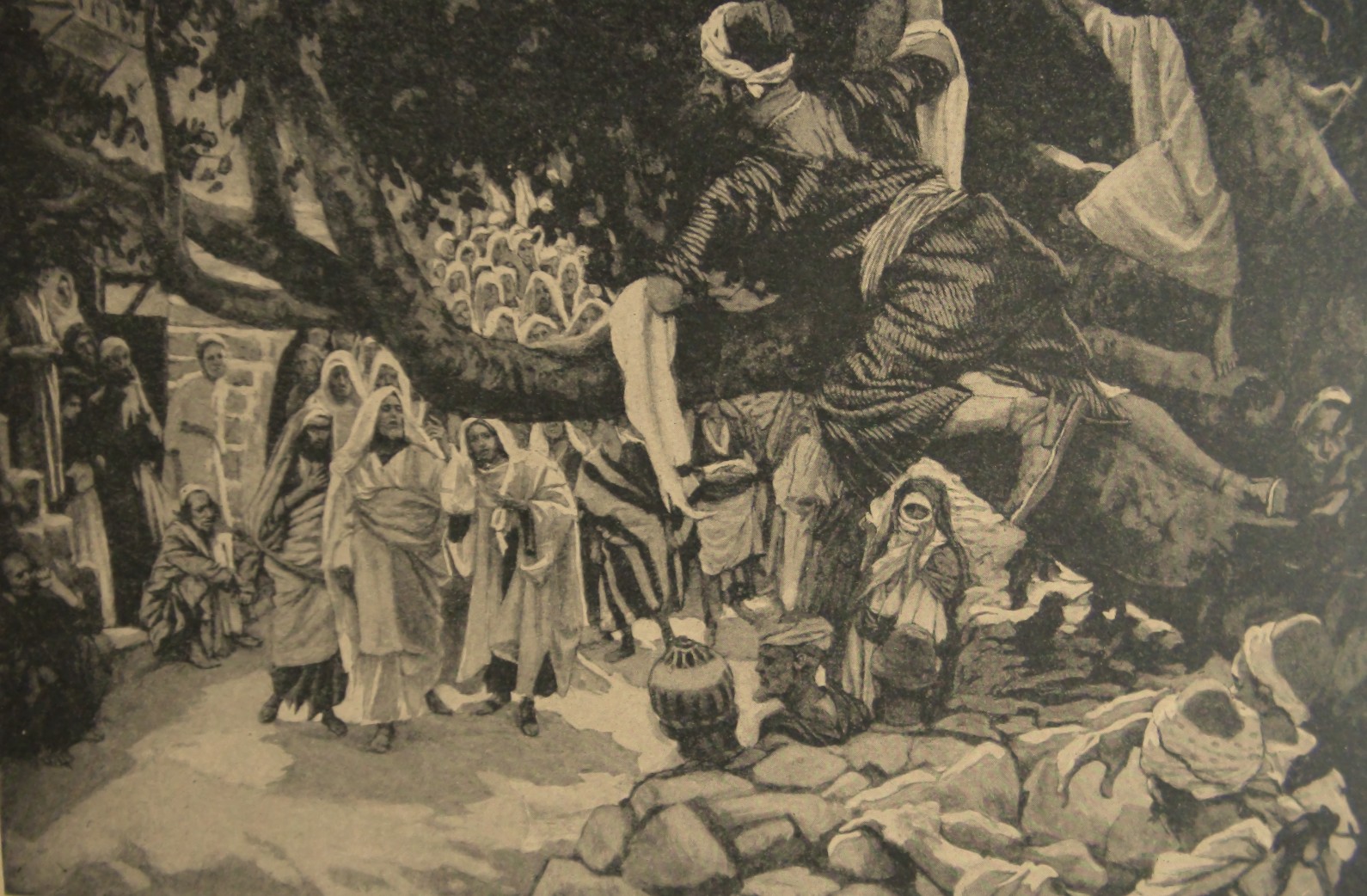
The parable of the talents follows the story of Zachaeus in Luke’s Gospel. Was Zachaeus one of those given ten talents, which he multiplies by his generous gifts to the poor?  There seems to be something of the child in him too. Climbing a tree is something a child would do, isn’t it? Was he on the way to become like a child, as Jesus taught?

I like this picture of Zachaeus by J. Tissot. (above)

In Jericho last year I took a picture of the sycamore tree they feature now in the town square. (above) Imagine Zachaeus up that tree.

23rd Sunday

One of the hardest things we have to do in life is to correct somebody, to tell someone they’re wrong and take steps to stop some harm being done. Our readings today are about correction. Correction is not just what people in authority or experts do; we all have to stand up for what’s right.

You need help doing this, and the Gospel of Matthew (18,15-20) we read today suggests that sometimes help may be sitting right next to you.

Awhile ago, I was coming back on a crowded train from Toronto to New York;  a long ride that I hoped to pass by napping and reading a book. But around Buffalo, two women got on and sat across from me. They were older women. One of them must have been hard of hearing; she talked so loudly that people all around her could hear her conversation.

They never stopped talking, about food, clothes, their families, their health, the different medicines they were taking.  But then, one  woman brought up her husband. She had had trouble with him. After the kids got married, he started to drink and he got nasty when he drank. It got so bad, she said, that she told him to get out of the house and get straightened out. She wasn’t going to leave the house; he had to get out.

Well, he got mad, she said, and went to live his brother for awhile, but in a couple of months he was back. He told her she was right. He stopped drinking. It was a hard thing to be so strong with him, she said, she loved him very much,  but she remembered the story in the bible where the father threw his son out of the house and after awhile he came back.

The other woman said she knew that story too and wondered where it was in the bible.

I was ready to chime in and tell them that story’s in St. Luke’s gospel, chapter 15, and actually the father didn’t throw the son our of the house. He left on his own. But something told me to keep my mouth shut.

Just then, another woman a few seats down the aisle turned to the women and said, “You must be angels sent by God. I’ve been praying for months, trying to figure out what to do with my son, and I think you’ve got the answer.”

Her son was on drugs, she said. “He’s a good kid, but he’s in the wrong crowd.” She knew that he was having a bad influence on his younger brothers and sisters, but she felt she had to leave him in the house. He just couldn’t manage on his own. Her husband was no help; he wanted to ignore the problem.

She talked to her minister in church and he told her she was being too easy on her son, but she wasn’t convinced.

Now, listening to these women, she felt God was telling her something. She had to be like that father in the gospel story that threw his son out of the house. She was going to look that story up in the bible.

Again, I was going to tell them the location of the story in St. Luke’s gospel and that the father doesn’t really throw the son out of the house, but again thought better of it. Maybe the version they had in their minds was the version God meant them to hear.

By the time the train reached Albany where two of the women got off, they were in solid agreement and were new friends. They had exchanged phone numbers and emails and promises to keep in touch, and they were thanking God for this time on the train as a time of special grace.

Sometimes we think the scriptures are about a world long gone. But read our gospel carefully. It’s not only about a world long gone. It’s also about those three women and all of us who sometimes face hard things to say and do and don’t know how to do it.

God sends help, often in the simplest ways–maybe even on a long train ride. This one ended up in New York City 5 hours late.