Tag Archives: Lent

Thursday, 2nd Week of Lent

Lent 1

The readings for the 2nd Week of Lent are mainly about the mercy of God. On Monday we were told in Luke’s Gospel: “Be merciful as your heavenly Father is merciful.” (Luke 6: 36)

The  man In Jesus’ parable of the Rich Man and Lazarus, our reading today, is far from merciful, absorbed as he is in himself and his own good. He’s living in a bubble of luxury, a gated world where he sees nothing else, not the poor man at his door nor his own inevitable death. He sees nothing else but the “good life,”  wealth and pleasure.

Scriptures, like Psalm 49, often point out the dangers of riches. “In his riches, man lacks wisdom; he is like the beasts that are destroyed.” The parable is obviously an example for the rich, but it’s also a warning for others besides.

Our first reading from Jeremiah warns all of us about trusting in human success and achievements. Even a small store of talents and gifts can make us as shortsighted as a great store of riches. The parable’s warning goes beyond the obviously rich. Small things we treasure, little things we make everything, can make us blind to the poor at our gate.

We don’t have to be a super billionaire to lack wisdom. “All you peoples, give heed, all who dwell in the world, men both low and high, rich and poor alike.” (Psalm 49)

Jesus’ parable also points to the treasure we should keep in mind. In a turn of circumstances, the poor like Lazarus will be rewarded in the next life and the merciful who cared for them will be in their company. Jesus gives us a sign in his resurrection that those who have been rejected will find acceptance in the heavenly kingdom.

A life beyond this is our destiny and our treasure. What we do and how we live here counts there. May God give us grace to believe in it.

Lord, I see only so far, I live for the day

my vision is all on what’s before me,

Give me eyes to see Lazarus, wherever he may be,

to see your kingdom in those in need.
Following Jesus Christ in Lent

On the 1st Sunday of  Lent we follow Jesus Christ from his baptism in the Jordan into the desert where he is tempted by Satan for forty days. Jesus, the New Adam, conquers Satan and leads us back to a promised Paradise.

On the 2nd Sunday of Lent we follow him up the mountain where he reveals the glory that awaits us. Lent is a time of revelation, the prayer that begins this season says. Jesus reveals his glory to us as well as to the disciples who accompanied him then.

Grant, almighty God, through the yearly observances of holy Lent, that we may grow in understanding of the riches hidden in Christ and by worthy conduct pursue their effects. Through our Lord Jesus Christ, your Son, who lives and reigns with you in the unity of the Holy Spirit, God, for ever and ever. (Collect, 1st Sunday of Lent)

Now is a time to  “grow in understanding”of the Paschal Mystery. We know so little of the mystery we celebrate. The riches are “hidden in Christ” and not immediately obvious. We must pursue them humbly, dig for the treasures hidden in the field, find Jesus Christ in the desert world we live in.

This is not just an intellectual effort either. By “worthy conduct”, good deeds, patient love for others, we uncover the “riches hidden in Christ”.

All our efforts mean little, though, unless the Almighty God grant it, “Through our Lord Jesus Christ, your Son, who lives and reigns with you in the unity of the Holy Spirit, God, for ever and ever. Amen.”

O God, who have commanded us to listen to your beloved Son, be pleased, we pray, to nourish us inwardly by your word, that, with spiritual sight made pure, we may rejoice to behold your glory. Through our Lord Jesus Christ, your Son, who lives and reigns with you in the unity of the Holy Spirit, God, for ever and ever. Amen. (Collect, 2nd Sunday of Lent)

The Transfiguration of Jesus is a strongly visual mystery. Jesus is revealed in  glory on the mountain. Yet, we are told to “listen” to God’s beloved Son. His words we hear within will give us the spiritual eyes we need to behold his glory. 

What about our eyes that long to see? The stories of Abraham who is told to search the starry skies and look at the land he has been given tell us the treasures of the natural world can nourish our  desire to see more, namely, the glory revealed in Jesus Christ, God’s Son. Now we listen, then we shall see.

Wednesday, 1st Week of Lent: The Sign of Jonah

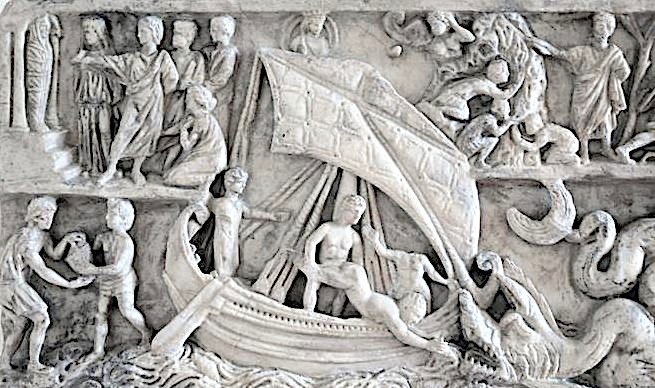
Jonah, Roman Catacombs


Luke 11:29-32

Jonah, starting out, doesn’t seem like much of a prophet, does he? He’s a frightened man fleeing the task God gives him–to preach repentance to the great city of Nineveh. He thinks it can’t be done. Not only does he think himself unable to preach repentance to that city but, as we see later in the story, he doesn’t think they deserve to be forgiven. He has a low estimation of God’s forgiveness.

He can’t stop the sailors who thought he cursed their ship from throwing him overboard. He would have been finished if the whale that swallowed him didn’t vomit him onto the shore at Nineveh.The people of Nineveh listened to Jonah and begged God for forgiveness. God calls Jonah to be his messenger of forgiveness.

In Jesus, a greater than Jonah calls us to take up his mission. Jesus announced his death and then rose from the belly of the earth. That’s his great word, his message of hope — God’s forgiveness. That message must be proclaimed to the whole world and the world must hear it.

Paintings and sculptures of the story of Jonah, like the above, often appear in the early Christian catacombs of Rome. There’s Jonah thrown to the whale. On the upper right panel, Moses strikes the rock and water flows, a sign of Baptism promising life. (Note the water flows over the whale) On the panel upper left, Jesus raises Lazarus from the grave.

The story of Jonah raises our hope and nourishes our prayers. God offers us a great mission and a great vision. As it was with Jonah, we may find it beyond our understanding and think our world unredeemable, but we are called to believe in the great mercy of God. but we are called to believe.

“Have mercy on me, O God, in your kindness” we pray in Psalm 51, our responsorial psalm today. Is that the prayer of one person, or is it the prayer of the whole world, yearning for forgiveness, like the people of Nineveh?

Lord,
I believe in the sign
that lifted you up and blesses us,
the sign of your Cross.
You bring resurrection and life to the world,.
Help us believe in what is beyond anything we know..
Amen.

For more: http://www.PassionistsPray.org

The Prayer of Jesus in the Garden

Mount Olives 3


The Feast of Jesus Praying in the Garden is another feast St. Paul of the Cross placed at the beginning of the lenten season in the Passionist Calendar. Lent is a season for prayer, fasting and almsgiving, but prayer is the first.

Jesus taught his disciples how to pray, the gospels say. In Matthew’s gospel he brings them up a mountain–a traditional place to draw close to God – and teaches them there the prayer we call the “Our Father” . (Matthew 6, 9-13)

In Luke’s gospel, Jesus teaches his disciples to pray “in a certain place”, on the plain, in the midst of daily life. (Luke 11, 2-4) He prayed daily through life; the prayer Jesus taught them is more basic than the prayer found in Matthew’s Gospel..

“When you pray, say: Father, hallowed be your name, your kingdom come. Give us each day our daily bread and forgive us our sins for we ourselves forgive everyone in debt to us, and do not subject us to the final test.” (Luke 11,2-4)

Mark, Matthew and Luke recall Jesus praying in the garden before his passion; his disciples do not join him, but fall asleep.  

They’re sleeping because the flesh is weak, Mark says.

They’re sleeping because they can’t keep their eyes open, Matthew says.

They’re sleeping because of grief, Luke says.

Stay awake and pray, Jesus tells them. Prayer brings you through times of testing and temptation. Some things can only be done by prayer, Jesus tells his disciples who wonder why they can’t drive out a certain spirit. (Mark 9: 29) On our part, however, we are like the disciples, our flesh is weak, we can keep our spiritual eyes open too long, we can be overwhelmed by grief.

Facing the weakness of the flesh as he faces death, Jesus doesn’t wave it away in stoic resignation or look to his own power. “Not my will, but your will be done,” he says. Facing the consequences of his mission, the limits of human power, the “form of a slave,” he depends on his Father for the strength he needs.

In the garden Jesus teaches his disciples how to face life’s trials. He kneels on the ground and humbly looks beyond himself to his Father, “Abba”, who hears him. He falls to the ground, trusting his Father’s strength and not his own. Troubled and distressed, for an hour’s time he simply pleads for help. . 

“He was in such agony and he prayed so fervently that his sweat became like drops of blood falling on the ground.” Luke says. Then, an angel comes to strengthen him. The cup of suffering isn’t taken away; he will drink from it, but it will not crush him. God will raise him up.

He teaches us pray as he did and promises to pray with us in our trials.

This feast calls us to pray with Christ. It also tells us to pray with the church. Lent is a time to enter into the church’s prayer, to follow the scriptures, to enter its feasts, to use its devotions.

.

Lent Online

Lent begins this Wednesday. If you are following this blog, I’ll be providing daily reflections on the lenten liturgy. For additional lenten material I invite you to scan PassionistsPray ..

The lenten liturgy leads up to Holy Week and the mysteries of the Passion and Resurrection of Jesus. You can find material on these mysteries and the Stations of the Cross at:

The Passion of Jesus:   http://passionofchrist.us

Commentary on the Passion Gospels: https://passionofchrist.us/commentary/

Stations of the Cross:   Video  https://www.youtube.com/watch?v=waaMOBJ5e1Q&list=PLLUFZUgOPMFxkmfgBNS4Kfm8XxEwoAd6f&index=11

Stations of the Cross for Children: https://passionofchrist.us/stations-of-the-cross-children/

Prayers :  https://passionofchrist.us/prayers/

Studies on the Passion of Jesus: https://passionofchrist.us/recent-studies/

For material for leading children into the lenten season see: https://ourchildrenpray.com

Scripture Readings for the lenten season: http://www.usccb.org

Finally, I will be leading a reflection group on the weekly lenten readings every Monday of Lent at Thomas Berry Place here in Jamaica, New York. Starts at 9:30 AM with 15 minutes silent reading of the week’s lenten scriptures, then shared reflections till 10:30 AM.

There’s a Mass at II AM for those who wish to participate in the monastery public chapel, All welcome.

The Passion of Jesus is a wise and tender book that reveals God to us. “Taste and see the goodness of the Lord” this Lent.

On to Jerusalem: Mark 9: 14-29

It takes time to believe. The disciples of Jesus needed time to believe in him and understand the meaning of his life, death and resurrection. So did the man in today’s gospel from Mark who asks help in his unbelief. So do we.

As Jesus came down from the mountain with Peter, James, John
and approached the other disciples,
they saw a large crowd around them and scribes arguing with them.
Immediately on seeing him,
the whole crowd was utterly amazed.
They ran up to him and greeted him. 
He asked them, “What are you arguing about with them?”
Someone from the crowd answered him,
“Teacher, I have brought to you my son possessed by a mute spirit.
Wherever it seizes him, it throws him down;
he foams at the mouth, grinds his teeth, and becomes rigid.
I asked your disciples to drive it out, but they were unable to do so.”
He said to them in reply,
“O faithless generation, how long will I be with you?
How long will I endure you? Bring him to me.” 
They brought the boy to him.
And when he saw him,
the spirit immediately threw the boy into convulsions.
As he fell to the ground, he began to roll around   
and foam at the mouth. 
Then he questioned his father,
“How long has this been happening to him?” 
He replied, “Since childhood.
It has often thrown him into fire and into water to kill him.
But if you can do anything, have compassion on us and help us.”
Jesus said to him,
“‘If you can!’ Everything is possible to one who has faith.”
Then the boy’s father cried out, “I do believe, help my unbelief!”
Jesus, on seeing a crowd rapidly gathering,
rebuked the unclean spirit and said to it,
“Mute and deaf spirit, I command you:
come out of him and never enter him again!”
Shouting and throwing the boy into convulsions, it came out.
He became like a corpse, which caused many to say, “He is dead!”
But Jesus took him by the hand, raised him, and he stood up.
When he entered the house, his disciples asked him in private,
“Why could we not drive the spirit out?”
He said to them, “This kind can only come out through prayer.” Mark 9:14-29

Where are we now?

Since the Christmas season we have been reading from Mark’s Gospel, which end when Lent begins. Through lent we follow Jesus from Matthew’s Gospel mostly, as he journeys on to Jerusalem where he will die and rise again.  

Do his disciples fully understand him? Peter certainly doesn’t. (Mark 8, 27-33) Despite miracles and his inspired teaching,  his own family and hometown turn away from him. (Mark 3,1-5;  6, 1-6) Pharisees and scribes from Jerusalem come to Galilee to dismiss and condemn him.( Mark 7,1-15)

Yet, Jesus goes on to Jerusalem, with his disciples and with all of us. The lenten season’s readings and feasts will take us, like his disciples, from Galilee to Jerusalem. Lent will call us, as Jesus does in today’s gospel, to prayer.

Will this lent and Easter turn more people to join him?  Maybe. The world we live in is a lot like Galilee and Jerusalem. Still, like the disciples who first followed him there, we’re going up to Jerusalem. There will always be transfigured moments to lead us on.

In today’s gospel listen to a merciful God. “O faithless generation, how long will I be with you?” Jesus says. Yet then he says “Bring him to me.” And he cures the young boy possessed from childhood. He helps the half-believing father.

Is he unique? Isn’t faith itself always half-believing, always marked with the unbelief that comes from who we are, finite human beings who only see so far?


2nd Week of Lent: Readings and Feasts

MARCH 6 Mon Lenten Weekday

Dn 9:4b-10/Lk 6:36-38 

7 Tue Lenten Weekday [Sts Perpetua and Felicity, Martyrs] Is 1:10, 16-20/Mt 23:1-12 

8 Wed Lenten Weekday [St John of God, Religious] Jer 18:18-20/Mt 20:17-28 

9 Thu Lenten Weekday [St Frances of Rome, Religious] Jer 17:5-10/Lk 16:19-31 

10 Fri Lenten Weekday Gn 37:3-4, 12-13a, 17b-28a/Mt 21:33-43, 45-46 

11 Sat Lenten Weekday Mi 7:14-15, 18-20/Lk 15:1-3, 11-32 

12 SUN 3rd SUNDAY OF LENT Ex 17:3-7/Rom 5:1-2, 5-8/Jn 4:5-42

Our readings for this week, beginning with the Old Testament reading from Isaiah, proclaim the mercy of God. The New Testament readings on Monday, Thursday and Saturday are from St. Luke– a gospel of mercy. Jesus proclaims God’s mercy, especially extended to the poor. The story of the Prodigal Son, Luke’s great parable of God’s mercy, is read on Saturday,

Matthew’s Gospel for Wednesday reminds us that temptations about power, so obvious in the story of Jesus’ temptations, also occur in his disciples, like James and John. Can we see it too in the elder brother from the Parable of the Prodigal Son?

The readings from the Old and New Testaments complement each other during Lent. Celebrations of the saints are fewer and often become optional memorials, as is the case of the saints this week. .

The mercy Jesus calls for is not just acceptable or normal;  it’s Godlike. Can any of us be as merciful as God?  But there’s no watering down the challenging, radical words we hear in our lenten readings.

Lent’s not meant to make us comfortable; it sets our sights on loving more, and it sets the bar higher than we like. Like the Olympic games, lent calls for our best, and more. A bigger prize than a gold medal is at stake.

What am I going to do for Lent?

table

Lent begins  Ash Wednesday. What am I going to do for Lent? The supper table is a good place to ask that question, because Lent is about renewing ourselves as we are here and now. The supper table is a sign of life here and now.

Those closest to us there. Doing something for Lent must mean doing something for them, first of all, the people across the table–or maybe those who have left our table because we have driven them away. A scripture reading early on in Lent says: “Don’t turn your back on your own.”  Have we turned our backs on those closest to us because we know them too well or we have hurt them in any way?

Besides the supper table, I guess we should also ask that question “What am I going to do for Lent?” in the place where I work, or where I go to school. Don’t turn your back on them either.

Lent is for renewing ourselves as we are, in real life and real time. We don’t have to leave this world or go to Mars to do that

The Ash Wednesday scriptures say: pray, fast and give alms. What am I going to do for Lent? How about praying each day? How about fasting from my own hard opinions of others? How about looking after someone else instead of myself, someone in need?

How about keeping this terrible situation in the Ukraine in mind? Not just looking at TV Broadcasts or online reports. How about praying for peace there? Looks like  economic sanctions are doing some good. Prayer does more good, if we believe what Jesus says.

Let’s not forget something else, though.  “What’s God going to do for us during Lent?” That’s important. Lent is a time of God’s grace, which is more than we can hope for, beyond what we deserve. The great sign of God’s limitless love is the Passion of his Son, a wondrous love beyond all others.

Following Jesus Christ in Lent

Lent 1

Lent is coming. Let’s join those disciples in our picture above following Jesus. One way to follow him is by reflecting on the lenten scriptural readings recommended for the Sundays and weekdays till Easter. They’re the basic book for lenten reading.

On the 1st Sunday of Lent, this coming Sunday, Luke’s gospel takes us to the Jordan River where Jesus is led into a deserted place by the Spirit and tempted for 40 days after his baptism. Our journey  begins  in a desert. Readings from Luke’s Gospel lead us through the Sundays of Lent this year.

The weekday gospels for the first three weeks of lent are mostly from Matthew, the early church’s favorite gospel for catechesis during Lent. Matthew brings us to Galilee  where Jesus speaks “the words of eternal life” in his Sermon on the Mount.  (Matthew 5-7) Be faithful to prayer and you will grow in wisdom, Jesus says.  ( Tuesday and Thursday, 1st week of Lent)  Love your neighbor, even your enemies and “the least,” whom we easily overlook. ( Monday, Friday, Saturday, 1st week of Lent)

Peter’s confession at Caesaria Phillipi is the highpoint of the first part of Matthew’s gospel. “You are the Christ, the Son of the living God,” Peter says to Jesus. “You have the words of everlasting life.” Lent invites us to join him in that same confession.

Yet, can we possibly love and believe that way, so lofty and challenging? We’re rather weak disciples.  Jesus doesn’t call perfect disciples, the reading for Saturday after Ash Wednesday reminds us. He called  Matthew the tax collector and people like him–not very good keepers of the law. Outsiders and sinners like them tell us we belong in the lenten season. (Luke 5, 27-32)

Matthew’s gospel takes us up the Mount of the Beatitudes. Like most sacred writers, Matthew likes mountains; you see ahead  more clearly from them. On the 2nd Sunday of Lent, we go up to the Mount of the Transfiguration to glimpse the  glory found ahead.

By the 4th week of Lent,  we arrive  in the Holy City, Jerusalem, to the temple mount and  then the Mount of Calvary. Starting with the 4th week most of the weekday lenten gospels will be from the Gospel of John. I’ll say something about them before we get there.

You can follow the lenten readings online here.

I’ll mention some lenten devotions, like the Stations of the Cross, in the next few days.

Tuesday, 3rd week of Lent

Peter’s question about forgiveness in today’s gospel ( “How many times must I forgive my brother?”) isn’t just his question. He’s asking the question for all of us.

Measure your forgiveness by God’s forgiveness, Jesus says to Peter. It’s beyond measure, and he gives Peter and all of us a story of two servants. Both are involved in a money operation gone wrong. As we know money brings out the worst in people.

There’s a big difference in the money owed. The first servant owes ten thousand talents, a huge sum, and in a unexpected display of mercy, his master forgives the entire debt.

After being forgiven so much, however, that servant sends off to debtors prison another servant who owes him a few denarii, a small sum. The ten thousand talents his master has forgiven him would be worth about 10 million denarii. Big difference!

The story isn’t our only teacher, however.  God’s unmeasurable forgiveness finds its greatest expression in the passion and death of Jesus: “Father, forgive them for they know not what they do,” he cries out from the cross. He pleads, not for one, or a few, but for the whole world. Jesus reveals the mercy of God beyond measure.

We’re called to measure our forgiveness of others against his.

Lord, let me hear your call for forgiveness from the cross,

and let me make your call mine.