Jesus enjoined them, “Watch out, guard against the leaven of the Pharisees and the leaven of Herod. … Do you not yet understand or comprehend? Are your hearts hardened?… Do you have eyes and not see, ears and not hear? Do you still not understand?”
(Mark 8:14-21)
Harsh words of Jesus to his disciples. They occur, not early in Mark’s Gospel, but as they prepare to go up to Jerusalem, after many miracles Jesus has done and many times he has taught. Yet they do not understand.
Is this still true for his disciples today? Mark’s Gospel reminds us how much, like them, we don’t know.
How should we guard against the leaven of the Pharisees and the leaven of Herod? I suppose that means the corruption that can take place in religion and in politics. We live in an imperfect world.
If Mark is writing in Rome –and I think he is– he would have to be careful about criticizing the government, especially in the wake of Nero’s persecution. Mark writes more of the scribes and pharisees who oppose Jesus. He speaks less about Herod; he has to be discreet.
So every time I hear about Herod and the Herodians in Mark’s Gospel I hear him talking about Nero and Rome’s rulers. His description of John the Baptist’s death and the absurd circumstances that brought it on– Herodias’ vindictiveness, Herod’s care for his reputation, the cowardly compliance of his court– are not limited to that event from the time of Jesus. Mark is alluding to Nero’s cruel attack on the Christians of Rome who, like John, were innocent.
When he tells the story of the passion of Jesus Mark is also telling the Christians of Rome their story. Jesus was there with them. Jesus is there with them.
Let’s not stop at the early Christians of Rome, however. He’s also talking to us in our world.
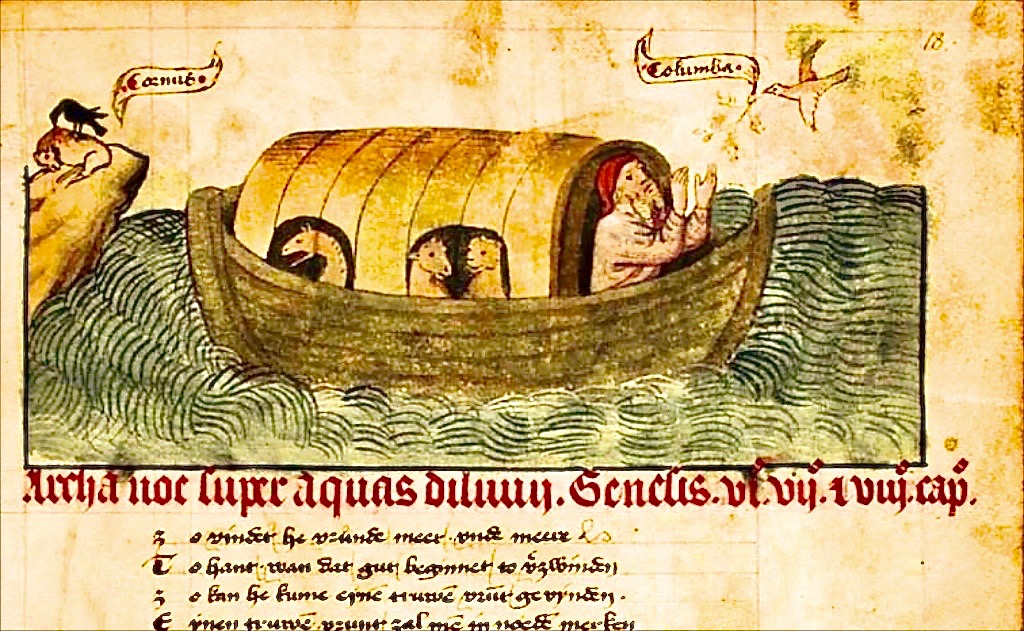
For almost two weeks at Mass we’ve been reading about the creation of the world and the origin and development of the human family, beginning with Adam and Eve, from the first 11 chapters of Genesis. An important source for understanding where we come from and our relationship with. God and creation, The medieval illustration above has a raven picking on a dead carcass, but Noah greets the dove holding an olive branch. How do we look at our world in flood times like now, as dead or as living?
In today’s reading God renews with Noah and his descendants the covenant made with humanity and the earth. Once again, after the fall, as human beings go into different lands and take up various trades, they’re blessed by God. The renewal of the covenant is an act of mercy, the responsorial psalm for today reminds us.
“The LORD looked down from his holy height, from heaven he beheld the earth, To hear the groaning of the prisoners, to release those doomed to die.” (Psalm 102)
God’s blessings will continue through time. His abiding mercy is signified in the God’s promise God there will not be another flood to devastate the earth. The rainbow signifies hope and mercy.
“I will establish my covenant with you, that never again shall all bodily creatures be destroyed by the waters of a flood; there shall not be another flood to devastate the earth.” (Genesis 9,12)
God’s blessings continues through time. God’s mercy will abide, but the human family still enjoys freedom. Made in the likeness of God, we’re free, and what we do with our freedom has consequences, not only for ourselves, but for creation itself.
The abuse of human freedom leads to dire consequences for humanity and creation itself. “When my people did not hear my voice, when Israel would not obey, I left them in their stubbornness of heart to follow their own designs.” (Psalm 81) God does not micro manage history.
Today some see God’s promise “never again shall all bodily creatures be destroyed” as repudiating the threat of climate change, but that’s not the promise made in Genesis. Human “stubbornness” can have disastrous consequences for humanity and the created world.
For humanity to flourish, it needs a good relationship with creation. Human flourishing doesn’t happen without a relationship with creation, not a dominating relationship, or a selfish relationship, but one of love and care. Creation rises and falls with us.
Good to be aware of the question of water as it’s discussed in the United Nations. Here’s something from Passionists International:
And regarding ocean biodiversity, we recommend viewing the film, “BluePeril”, which raises grave concerns regarding current efforts to increase deep sea mining of precious minerals in the rush to a transition to green energy, creating “blue peril”.
https://dsm-campaign.org/blue-peril/The International Seabed Authority has been in existence for over 40 years, and has a mandate to organize, regulate and control all mineral-related activities in the international seabed for the benefit of humankind. To date, ISA has entered into 17 contracts for exploration which involves scraping of the ocean floor. We know however, that such mining risks destroying the breeding grounds of marine life. One such project in the territorial waters of Papua New Guinea will be the world’s first deep-seabed mining project aiming to extract copper, gold and silver. Many countries are calling for a pause, moratorium or complete ban on deep sea mining. Due to the imminent risks, French President Emmanuel Macron has called for a ban, citing the need to “protect the blue heart of our planet that sustains us all…to put sustainability and intergenerational equity first.”
The focus will continue with the UN Water Conference in March (22-24), New York… (Scroll down for further information: Upcoming Commission Meetings.)
These conferences are attempting to address what is referred to as the triple planetary crisis – climate change, biodiversity loss, and pollution. All intersect, and all contribute to the success or failure of each and every one of the Sustainable Development Goals. We are all aware of the urgency to decrease global warming, and this requires countries to live up to our commitments to limit greenhouse gases/carbon emissions. While even fifty years ago we were
urged to reduce, re-use, recycle, unheeded, we are facing a fierce urgency of now. We have reached unsustainable levels of production and consumption, and “our unlimited extraction of resources from the Earth is having a devastating impact on the natural world, propelling climate change, destroying nature , and raising pollution levels.” See more re: triple planetary crisis: https://www.unep.org/news-and-stories/speech/triple-planetary-crisis-forging-new- relationship-between-people-and-earth
Pope Francis’ Laudato Si has stirred the hearts and consciousness of all of us to respond to this moral, ethical, and spiritual challenge to love and care for all of creation, and ensure the well- being of all the world’s inhabitants. It is our Call to Action. And we are invited to join with people of other faiths and Indigenous traditions in responding! See UN Environmental Program and World Parliament of World’s Religions’ joint project and rich resource, Faith for Earth: A Call to Action
God was pleased with the sacrifice of Abel, rather than that of Cain. St. Ambrose explains why:
“Jesus told us to pray urgently and often, so that our prayers should not be long and tedious but short, earnest and frequent. Long elaborate prayers overflow with pointless phrases, and long gaps between prayers eventually stretch out into complete neglect.
Next he advises that when you ask forgiveness for yourself then you must take special care to grant it also to others. In that way your action can add its voice to yours as you pray. The apostle also teaches that when you pray you must be free from anger and from disagreement with anyone, so that your prayer is not disturbed or broken into.
The apostle teaches us to pray anywhere, and the Saviour says ‘Go into your room’ – but you must understand that this “room” is not the room with four walls that confines your body when you are in it, but the secret space within you in which your thoughts are enclosed and where your sensations arrive. That is your prayer-room, always with you wherever you are, always secret wherever you are, with your only witness being God.
Above all, you must pray for the whole people: that is, for the whole body, for every part of your mother the Church, whose distinguishing feature is mutual love. If you ask for something for yourself then you will be praying for yourself only – and you must remember that more grace comes to one who prays for others than to any ordinary sinner. If each person prays for all people, then all people are effectively praying for each.
In conclusion, if you ask for something for yourself alone, you will be the only one asking for it; but if you ask for benefits for all, all in their turn will be asking for them for you. For you are in fact one of the “all.” Thus it is a great reward, as each person’s prayers acquire the weight of the prayers of everyone. There is nothing presumptuous about thinking like this: on the contrary, it is a sign of greater humility and more abundant fruitfulness.”
Monday Acts 14, 5-18
John 14, 21-26
Tuesday Acts 14, 19-28
John 14, 27-31
Wednesday Acts 15, 1-6
John 15, 1-8
Thursday Acts 15, 7-21
John 15, 9-11
Friday Acts 15, 22-31
John 15, 12-17
Saturday Acts 16,1-10
John 15, 18-21
Through the Easter season until the Feast of Pentecost our first reading at Mass on ordinary days is from Luke’s Acts of the Apostles. The lesson we learn from Acts is that the Risen Jesus creates and guides his church through time through the ministry of his followers.
From chapter 13 onward Luke concentrates on the missionary activity of Paul the Apostle and those associated with him. A sharpened Jewish reaction to Paul’s preaching develops at this time, as well as a greater acceptance of his message by the gentiles.
Paul’s experience is that “It is necessary for us to undergo many hardships to enter the Kingdom of God.” (Tuesday) The church must take the same path its Lord took.
At the same time, church order– how the church functions– has to be looked after. “They appointed presbyters for them in each Church and, with prayer and fasting, commended them to the Lord in whom they had put their faith.” (Tuesday)
“No little dissension and debate” goes on in the church of any age. (Wednesday) We need to go back to Jerusalem to get our bearings. The church is always bigger than some of its members may think. (Thursday and Friday) No matter what, the Spirit guides the church. (Saturday)
At the Last Supper–the gospel from John is read this week– Jesus promises his disciples peace. (Tuesday) He is the vine, we are the branches. (Wednesday) “Remain in my love,” he says. We are his friends (Friday) and if his friends then we have to follow the path he did. (Saturday)


 The Victor's Place