Tag Archives: Lazarus

The Passover Meal

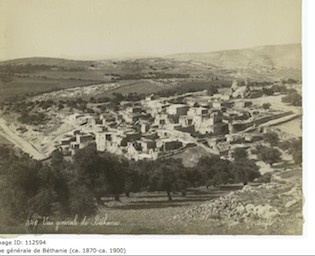
During these days of Holy Week I’ve been thinking of the Passionist house of St. Martha in Bethany where I stayed about a week a few years ago. Looking eastward from the roof of the house on a clear day you can see down to the Judean desert miles away. The ancient road Galilean pilgrims took to Jerusalem for the feasts began there in Jericho and passed by this site. The Passionist house stands over parts of the ancient village of Bethany; 1st century ruins stretch out on its eastern side. From the roof you could see the traditional tomb of Lazarus if the modern Israeli security wall didn’t block your view.

It’s a place that stirs your imagination.

Most likely Jesus lived here with his friends during Jewish feasts when he came from Galilee. It was the obvious place for Galilean pilgrims to camp in those times when the city would be so crowded. The Mount of Olives just west of Bethany was sometimes called the “Mount of the Galileans.” Here Jesus would likely be among friends, like Martha, Mary and Lazarus. A safe place. From here he walked to Jerusalem, a few miles away, over the Mount of Olives to teach and pray in the temple. Likely, followers from Galilee would accompany him back and forth, and they were armed.

Would this explain why the temple leaders reached out to an insider like Judas as a way of capturing Jesus, who seemed so secure? Perhaps his disciples thought so too; they’re so complacently confident that nothing will happen to him. They’ll take care of that.

“Where do you want us to prepare the Passover supper for you?” his disciples ask (Matthew 26,27) Surely, Jesus could have chosen to eat the Passover there in Bethany, which Jewish law saw as part of Jerusalem in times of feasts when the city’s population multiplied. It would have been a meal among his own, like that he enjoyed after raising Lazarus from the dead.And it would have been safer.

Instead, he chose to eat the Passover close by the temple. The traditional site of the Last Supper places the site just south of the temple. They would have eaten it there, as the lambs were being slaughtered for sacrifice. It certainly wasn’t a place chosen for security.

The Tomb of Lazarus

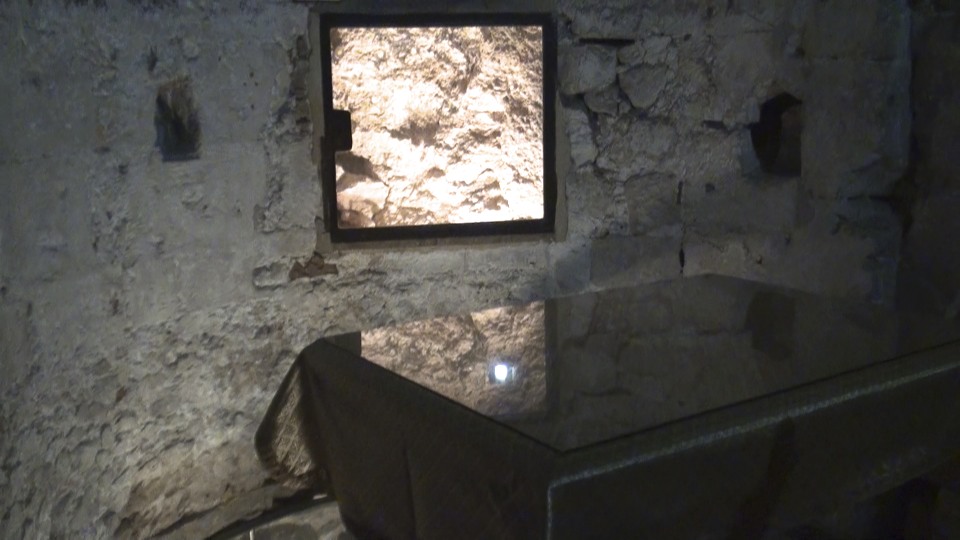
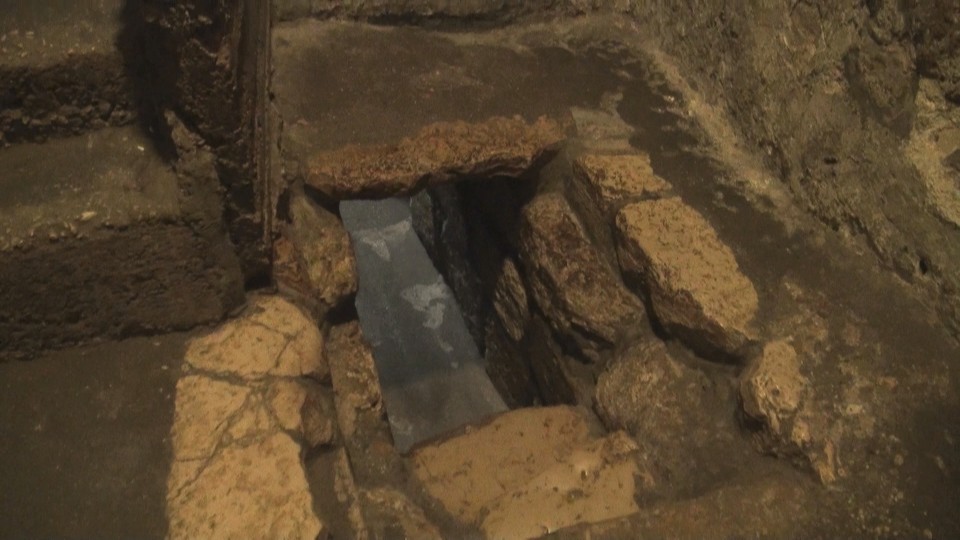
I visited the tomb of Lazarus in November 2010 while in the Holy Land. It’s only a few hundred yards from the Passionist house, St Martha, in Bethany, where I was staying, but because of the Israeli security wall you now have to drive about 13 miles around the wall to get there.

Some sisters from the nearby Comboni convent drove me there on their way to go food shopping one day. As I approached the tomb a group of about 30 pilgrims from one of the slavic countries were entering the tomb, so I stayed outside till they left. During the 2nd World War over 40 million people were killed by Hitler and Stalin in what’s been called “The Bloodlands,” parts of Eastern Europe that were fought over so viciously. Were these people going down to the tomb from that part of the world, bringing memories of “The Bloodlands,” I wondered?

They started to sing in harmony their beautiful eastern chants and the haunting, glorious music came up from the dark rock cavern below. Lazarus was being celebrated again and his tomb rang with their joyful song.

“Lazarus, come out!”

And not only were they celebrating the raising of Lazarus but our hope of resurrection too.

The dark tomb was still ringing with their singing when I went in. Joyful song from a tomb. Lazarus represents us all. That’s the powerful message from our gospel today which prepares us for the life-giving death of Jesus.


Meal at Bethany

John 12, 1-11

John’s Gospel read today calls us to a meal honoring Jesus in Bethany following the Resurrection of Lazarus. It’s the last meal before the Passover supper. The gift of life that Jesus gives his friend leads to a sentence of death.

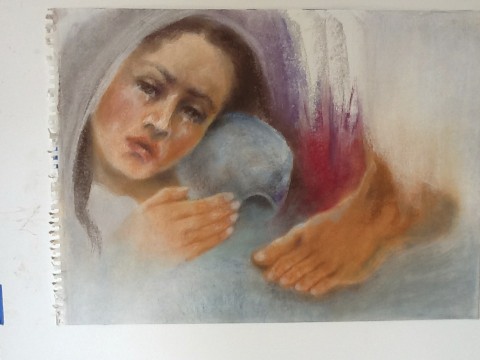
Faithful Martha serves the meal; Lazarus newly alive, is at the table. But the one drawing most of our attention is Mary, their sister who, sensing what’s coming, kneels before Jesus to anoint his feet with precious oil and dry them with her hair. “And the house was filled with the fragrance of the oil.”

The precious oil is an effusive sign of her love and gratitude; it also anoints Jesus for his burial. Only in passing does the Gospel mention that evil is in play here. Judas, “the one who would betray him,” complains that the anointing is a waste, but his voice is silenced. Believers are honoring the one they love.

How fitting that Holy Week begins with this Gospel when, like Mary, we kneel and pour out the precious oil of our love upon him who pours out his precious life for us.

The Second Tomb

Right down the street from where I’m staying these days–in Bethany–is the traditional tomb of Lazarus. Jesus raised Lazarus from the dead, you remember, and stories of that famous incident and other events from Bethany figure large in the New Testament.

I went over to the Franciscan bookstore near the Joppa Gate this morning and got a small book on Bethany which goes into the history of this tomb and what archeologists have found as they dig and dig. Actually, they have stopped digging–for the present.

Surely, like the tomb of Jesus, the tomb of Lazarus would be remembered. Egeria, the 4th century nun, who was to all these places, says that there were so many people at Lazarus’ tomb  when she was there that they packed the whole church and all the fields around. For Christian pilgrims Lazarus played a vital part in the story of Jesus.

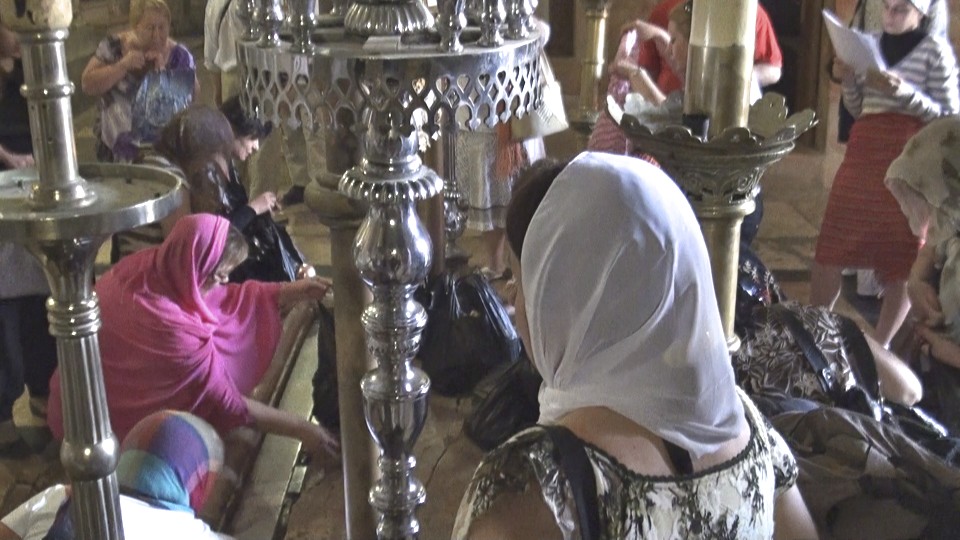
Right now, the Franciscans, the Greek Orthodox and the Muslims (who venerate Lazarus, by the way) are all around his tomb together. It looks like the same war over turf that goes on at the Church of the Holy Sepulcher.

Raising Lazarus from the dead was the final sign God gave before raising Jesus from the dead, John’s gospel says. It’s a miracle telling us we shall share in his resurrection.

Political reasons weren’t the only thing that brought Jesus to his death, it was his claim to be the way, the truth and life. The miracle brought people from Jerusalem to see a man who came from the dead and the one who raised him. The authorities reckoned that Lazarus would have to be taken care of too.

The believers were here in Bethany; not many in the temple, according to John’s gospel. Like Martha, carrying her pots and pans, they believed he was the Messiah, the Son of the Living God, who  brings life to the whole world. That’s why Bethany, and Lazarus, are important.

I spent today at the Church of the Holy Sepulcher, watching the crowds pile into the dark church and sat for some time in “Adam’s Cave” next to Calvary on a bench looking at the exposed rock where the crucifixion took place.  A stuffy guide came in with two Englishmen and said, “Look at that fellow over there, he’s sitting on the tomb of Baldwin 1, one of the first Crusader rulers of Jerusalem and doesn’t even know it.” I went back and looked up Jerome Murphy O’Connor who says the Greeks removed that tomb in 1809.

So much for experts.

Morning Masses during the Mission

The Mass texts for March 30th, 31st, April 1st and 2nd  can be found at http://www.usccb.org/nab/  , the site of the US Catholic Bishops. It’s a good site to bookmark for the future because, besides the readings, it offers daily reflections and podcasts.

For Monday March 30th, I’ll be using the 5th Sunday readings for the RCIA (the raising of Lazarus) instead of the regular daily readings.

John 11:1-43
Here’s a reflection on raising Lazarus:
The blind man sees, Lazarus lives. John’s Gospel links these two figures closely because of the gifts they receive from the Word of God, Jesus Christ. “In him was life, and that life was the light of all people.” John 1:4

Light touched the blind man, as the Word of God enlightened his spirit along with the gift of physical sight, and he believed in Jesus.

And Life came to the tomb of Lazarus, as Jesus, “the resurrection and the life,” raised him from the dead.

More is known about Lazarus than the nameless blind man. Most likely from an influential family, he and his sisters, Martha and Mary, were friends of Jesus, whom they welcomed to their home in the village of Bethany, a little under two miles from Jerusalem. Jesus often stayed with them when visiting the Holy City.

Jesus was not there, however, when Lazarus died some days before the Passover. Threatened by Jerusalem’s authorities, he had left the area, traveling down the ancient road to Jericho, then to the safety of Transjordan where John had baptised.

Once he heard the news of Lazarus’ death he returned up the same road to be with his friends.

John’s account describes a typical Jewish burial. Wrapped in linen strips, Lazarus’ body was buried the same day he died; his tomb a cave, sealed with a stone, outside the village. His sisters, Martha and Mary then began the customary 30 days of mourning at home, receiving the condolences of their friends and neighbors.

By the time Jesus arrived, Lazarus was dead four days, the point the rabbis claimed no trace of the soul remained in the body. Decomposition had set in.

Hearing that Jesus was coming up the road, the two sisters left their home to express their grief. “And Jesus wept.”

Then, deeply moved, he went to the tomb and ordered the stone removed. Looking up to heaven, Jesus prayed to his Father and in a loud voice cried, “Lazarus, come out.” The dead man came out, his hands and feet bound with linen bandages, his face wrapped in a cloth. Jesus said, “Loose him; let him go.”

The raising of Lazarus, which John’s gospel places immediately before Jesus’ passion and death, made the Jerusalem authorities finally decide to put Christ to death. It is an irony like others the evangelist makes. Jesus, bringing life, is put to death and placed in a tomb.

His death and resurrection are life-giving, the church’s faith proclaims. Dying and rising from the dead, he brings hope of eternal life to all who, like Lazarus, must die. That hope is realized in the sacrament of Baptism:

“Are you not aware that we who have been baptised into Christ Jesus were baptised into his death? Through baptism into his death we were buried with him, so that, just as Christ was raised from the dead by the glory of the Father, we too might live a new life. If we have been united with him through likeness to his death, so shall we be through a like resurrection.” (Romans 6:3-5)

Lazarus was only a sign of what the Savior of the world, the Resurrection and the Life, would do for all humanity.

Lord,
like the traveler
lifting the fallen one
on the Jericho road,
healing all his wounds,
you went to Lazarus’ tomb,
and would not let him die
but loosed the bonds of death,
so great was your love for him.

Savior,
we believe
you weep at every death,
and pray at every tomb,
for all the dead
whose faith is known to you alone.

Like Lazarus,
call us your friends,
stay in our company,
share what we have,
come to our aid when we call.
and grant us eternal life.