Tag Archives: Laudato Si

Praise be to You, My Lord.

DSC00154


“LAUDATO SI’, mi’ Signore” – “Praise be to you, my Lord”. In the words of this beautiful canticle, Saint Francis of Assisi reminds us that our common home is like a sister with whom we share our life and a beautiful mother who opens her arms to embrace us. “Praise be to you, my Lord, through our Sister, Mother Earth, who sustains and governs us, and who produces various fruit with coloured flowers and herbs”.

This sister now cries out to us because of the harm we have inflicted on her by our irresponsible use and abuse of the goods with which God has endowed her. We have come to see ourselves as her lords and masters, entitled to plunder her at will. The violence present in our hearts, wounded by sin, is also reflected in the symptoms of sickness evident in the soil, in the water, in the air and in all forms of life. This is why the earth herself, burdened and laid waste, is among the most abandoned and maltreated of our poor; she “groans in travail” (Rom 8:22). We have forgotten that we ourselves are dust of the earth (cf. Gen 2:7); our very bodies are made up of her elements, we breathe her air and we receive life and refreshment from her waters. Pope Francis, Laudato Si, 1-2

“Dissolved in Flames?”

In the coming “day of God…the heavens will be dissolved in flames and the elements melted by fire.” (2 Peter 3, 12-15) That’s a strong picture of the last days in the 2nd Letter of Peter we read today at Mass. Commentators say it’s the only place in the New Testament that predicts the world ending in fire.

Some years ago, after the Newshour in the evening, I would sometimes turn to the next channel on television to watch Harold Camping, a crusty old evangelist who was predicting the world ending in fire. The world was going to be burnt to a crisp and unless you explicitly professed faith in Jesus Christ you were going to go up in flames too.

Harold even figured out when it was going to happen, 6 PM, May 21, 2011. and if you wrote in he would send you his calculations. People called in with questions, some humorous. “Should I pay my income tax this year?” Some were sad. “My little boy can’t speak yet and profess his belief in Jesus. What about him?” Harold skirted that question.

May 21 came and nothing happened. I thought I was the only one listening to Harold until I noticed advertisements in the buses weeks before for “D Day May 21.” The day after May 21 I mentioned it to some people and one of them said she called her daughter who was driving over the Brooklyn Bridge that day to get off the bridge as soon as she could.

Harold said on a later broadcast he was recalculating the date, but some time later he died.

Harold isn’t the only one predicting an end for our planet. One of our greatest scientists, Stephen Hawkins, said before he died that we should start a colony in outer space soon because the earth is headed for destruction.

There’s a lot of pessimism in our world today. There was pessimism when the 2nd Letter of Peter was written. The apostles Peter and Paul had been viciously put to death. The City of Rome was almost completely destroyed by fire in the 60s. Jerusalem and the Jewish temple were destroyed by fire in the 70s. Christians were being persecuted and killed. I’m sure a lot of them were saying “This is the end.”

In times of pessimism we need to reaffirm God’s love for humanity and creation itself. That’s why Pope Francis’ encyclical Laudato Si is so important. Care for the earth and respect it, he says. God made our world out of love and promises to renew it.

Care for creation in practical ways, the pope says, but keep creation in mind in our prayers, especially the prayer of the Eucharist.

“In the Eucharist all that has been created finds its greatest exaltation.” Jesus became human; he was made flesh and his humanity comes from the earth. In the Eucharist, he takes bread and wine, which come from the earth, to give life to the world. Through “a fragment of matter” he communes with us.

“ Joined to the incarnate Son, present in the Eucharist, the whole cosmos gives thanks to God. Indeed the Eucharist is itself an act of cosmic love: Yes, cosmic! Because even when it is celebrated on the humble altar of a country church, the Eucharist is always in some way celebrated on the altar of the world”.[166]

“Creation is projected towards divinization, towards the holy wedding feast, towards unification with the Creator himself”.[LS 167]

God won’t destroy creation. He loves it and finds it good.

Feast of Corpus Christi

For this week’s homily, please play the video below:

Change and Automation


17. Theological and philosophical reflections on the situation of humanity and the world can sound tiresome and abstract, unless they are grounded in a fresh analysis of our present situation, which is in many ways unprecedented in the history of humanity. So, before considering how faith brings new incentives and requirements with regard to the world of which we are a part, I will briefly turn to what is happening to our common home.

18. The continued acceleration of changes affecting humanity and the planet is coupled today with a more intensified pace of life and work which might be called “rapidification”. Although change is part of the working of complex systems, the speed with which human activity has developed contrasts with the naturally slow pace of biological evolution. Moreover, the goals of this rapid and constant change are not necessarily geared to the common good or to integral and sustainable human development. Change is something desirable, yet it becomes a source of anxiety when it causes harm to the world and to the quality of life of much of humanity.

19. Following a period of irrational confidence in progress and human abilities, some sectors of society are now adopting a more critical approach. We see increasing sensitivity to the environment and the need to protect nature, along with a growing concern, both genuine and distressing, for what is happening to our planet.
Pope Francis, Laudato SI, 17-19

Avoiding an “irrational confidence in progress and human abilities”, we need to make “a fresh analysis of our present situation,” the pope says. He speaks of the “rapidification” of life– a fast changing world that cares little for nature or sustainable human development.

Like automation, smart cars, or whatever else puts people out of work and removes them from involvement in society or having a hand in the progress of our created world?

Crimes Against the Natural World


“Patriarch Bartholomew has spoken in particular of the need for each of us to repent of the ways we have harmed the planet, for “inasmuch as we all generate small ecological damage”, we are called to acknowledge “our contribution, smaller or greater, to the disfigurement and destruction of creation” He has repeatedly stated this firmly and persuasively, challenging us to acknowledge our sins against creation:

“’For human beings… to destroy the biological diversity of God’s creation; for human beings to degrade the integrity of the earth by causing changes in its climate, by stripping the earth of its natural forests or destroying its wetlands; for human beings to contaminate the earth’s waters, its land, its air, and its life – these are sins” For “to commit a crime against the natural world is a sin against ourselves and a sin against God.’

“At the same time, Bartholomew has drawn attention to the ethical and spiritual roots of environmental problems, which require that we look for solutions not only in technology but in a change of humanity; otherwise we would be dealing merely with symptoms. He asks us to replace consumption with sacrifice, greed with generosity, wastefulness with a spirit of sharing, an asceticism which “entails learning to give, and not simply to give up. It is a way of loving, of moving gradually away from what I want to what God’s world needs. It is liberation from fear, greed and compulsion” As Christians, we are also called “to accept the world as a sacrament of communion, as a way of sharing with God and our neighbours on a global scale. It is our humble conviction that the divine and the human meet in the slightest detail in the seamless garment of God’s creation, in the last speck of dust of our planet”.

Pope Francis ,Laudato SI, 8-9

Laudato Si and Thomas Berry

fullsizerender

This weekend we had a program at our monastery in Jamaica, New York, entitled Pope Francis’ Encyclical Laudato Si and the Wisdom of Thomas Berry, Passionist. The main presenters were Mary Evelyn Tucker and John Grim, senior lecturers and research scholars at Yale University.

The program began Friday evening with the award-winning film “Journey of the Universe” produced by Tucker and Grim along with Brian Swimme, which brilliantly portrays the story of our universe as science today explains it. On Saturday Mary Evelyn and John lectured on the pope’s encyclical, the influence of Thomas Berry and the contribution of native peoples to the critical question of the environment. I was among the commentators responding to their presentations:

I was one of Fr. Thomas Berry’s first students. It was at Holy Cross Preparatory Seminary in Dunkirk, NY in 1950. It’s usually not noted in biographical material about him, but Tom taught history to seminarians that year and I was in his class.

I remember the first day he came into class with a stack of booklets in his hands. “We have to know what’s going on today in the world,” he said, “and so we’re going to study The Communist Manifesto.”

Now remember, this was 1950. Senator Joe McCarthy had begun a witch-hunt to root out Communist sympathizers and I think The Communist Manifesto was on the church’s list of forbidden books. We studied it.

Yet, Tom never mentioned Joe Mc Carthy or the threats of a Communist takeover in Europe or what was happening then in China. No, he was interested in where the Communist Manifesto came from. Beyond Karl Marx and Lenin, he traced it back to the Jewish prophets and their demands for justice for the poor and human rights. The long view of history was what interested him.

After the Communist Manifesto, we studied St. Augustine’s City of God. Two loves are building two cities, Augustine said. Again, Tom didn’t dwell much on the historical events used by Augustine to illustrate his theory of history. It was the overall dynamic of the two loves in conflict over time that interested him.

From Augustine, we studied Christopher Dawson and his book The Making of Europe. Dawson, one of the 20th century’s “meta-historians,” wasn’t interested only in Europe; he was interested in the whole panorama of civilizations that came before it. That was Tom’s interest too.

As far as I remember, Tom didn’t speak of the universe and its evolution, his focus in later years, yet you could see him heading that way. He had a mind for the long view of things.

Pope Francis in Laudato Si also has a mind for the long view of things, it seems. The pope doesn’t quote from The Communist Manifesto, but he insists, more strongly than the manifesto, on the rights of the poor, to which he joins a strong insistence on the rights of the earth.

Can we also hear echoes of Augustine’s City of God in Laudato Si? I think so. The pope speaks of two loves in conflict. There’s the love that builds the city of man. How describe it today? How about blind consumerism; we love things too much. We love our vision of material progress too much. We love our technology too much. We love our control over the earth too much. We love ourselves too much. The result is “global indifference” to an environment falling apart. (Laudato Si, 9,14)

Opposing that love is a love the pope sees in Francis of Assisi, “who was particularly concerned for God’s creation, for the poor and the outcast…he would call all creatures, no matter how small, by the name of ‘brother’ or ‘sister’… If we approach nature and the environment without this openness to awe and wonder, if we no longer speak the language of fraternity and beauty in our relationship with the world, our attitude will be that of masters, consumers, ruthless exploiters, unable to set limits on their immediate needs.” (LS, 13)

Berry, like the pope in Laudato Si, accepted science’s view of our environment, yet also like the pope he distanced himself from a major trait of the era of the Enlightenment which unfortunately causes us in the western world “to see ourselves as lords and masters of our environment, entitled to plunder her at will.” (LS, 2)

Science teaches us a lot about our environment and its perilous condition today, but knowledge is one thing and love is another. Two loves are at work. Love doesn’t always follow what we know, especially if our hearts are fixed on something else. Love is hard to change.

I heard the preachers and teachers and ordinary folk in the workshops that followed our workshop presentations bemoan the poor reception the pope’s encyclical has received so far. Why isn’t the environment a critical issue in our parishes, in the media and in the political world? Why aren’t we undergoing what the pope calls “an ecological conversion?”

There are many reasons, I suppose, but one thing seems sure. It’s not going to happen overnight through some quick fix. We need to get ready for the long haul. And what does that mean? We need wise teachers and leaders to guide us, like Thomas Berry and Pope Francis.

“The present time is not a time for desperation, but for hopeful activity.” Thomas Berry, CP

Victor Hoagland.CP


Feast of Corpus Christi

To listen to today’s homily, please select the audio file below:

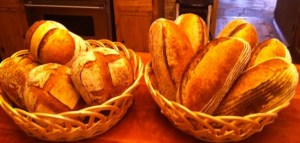
A man I know built himself an oven and bakes bread “the old way,” he told me. He goes about the process meticulously: the flour’s carefully chosen, the right amount of water is used, the fire that bakes the bread is just the right temperature. It takes time, but what a feast results!

Bread

I mentioned to him how so many homilies on the Eucharist from the days when they baked bread “the old way” see profound spiritual mysteries in this same process. The flour represents creation itself; the water and the fire represent the work of the Holy Spirit whom we invoke in this sacrament. “The Sacraments are a privileged way in which nature is taken up by God to become a means of mediating supernatural life.”(Laudato Si 235.) Simple created realities like water, oil, bread and wine speak for all creation.

In our prayer over the bread at Mass we say: “Blessed are you, Lord God of all creation, for through your goodness we received the bread we offer you, fruit of the earth and work of human hands, it will become for us the bread of life.”

The bread we offer, the wine we offer are signs of creation and the human efforts involved in creation. They’re signs of everything that the “God of all creation” gives us and of everything that comes from our hands. “The word bread stands for everything,” Augustine said in one of his commentaries on the Lord’s Prayer. (Epistle to Proba) No wonder Jesus chose these two precious signs to give himself to us.

The bread and wine stand for everything. Think what that means. Scientists say that our universe came into existence about 15 billion years ago. The bread and wine stand for the 15 billion years our universe has been in existence. About 3.5 billion years ago life began on our planet. The bread and wine represent that 3.5 billion years of life on our planet. When they’re brought to the altar the whole universe is brought here. About 200,000 years ago human life emerged on our planet. 200,000 years of human life are represented in the bread and wine. Our lives are part of the human story represented in the bread and wine .

We believe that when Jesus sat down with his disciples at the Last Supper and took bread and wine into his hands he took all creation, all life, all human life into his hands.. “This is my body.” “This is my blood,” he said. He is God in human flesh giving himself to us and to everything that God made. In love poured out, he renews the covenant God makes with us and with creation.

Pope Francis in his letter “Laudato Si.” emphasizes the cosmic dimension of the Eucharist. Our created world is there with the dignity and purpose bestowed on it. As he takes bread and wine into his hands, Jesus takes the whole universe to himself. “ Joined to the incarnate Son, present in the Eucharist, the whole cosmos gives thanks to God. Indeed the Eucharist is itself an act of cosmic love: Yes, cosmic! Because even when it is celebrated on the humble altar of a country church, the Eucha¬rist is always in some way celebrated on the altar of the world. The Eucharist joins heaven and earth; it embraces and penetrates all creation. The world which came forth from God’s hands returns to him in blessed and undivided adoration: in the bread of the Eucharist creation is projected towards divinization, towards the holy wedding feast, towards the unification with the Creator himself.” (LS, 236)

We celebrate this great mystery on the “humble altar” of our church. The created universe as it was, as it is and as it will be is before us. A marvelous sacrament, so simple in appearance and so tremendous in reality.

Ecological Conversion

IMG_0943
Today, September 1st, Pope Francis asks Catholics and all people to pray for the care of creation, the subject of his recent encyclical “Laudato Si.” We may need to pray, if recent surveys are right that claim that American Catholics aren’t much interested in the pope’s recent encyclical. That might be true of Catholics elsewhere as well.

There’s an ecological crisis, the pope says in his letter, and we have to do something about it. Some may deny the crisis exists; some may claim it’s exaggerated; some may just throw up their hands thinking it’s too big to deal with. Some may think it can be easily fixed by the eventual play of “market forces.”

For the pope and many today the ecological crisis is real, it endangers the world and it has to be dealt with now. To meet it Francis recently urged Christians to “first rediscover in our own rich spiritual patrimony the deepest motivations for our concern for the care of creation.”

That’s important advice. The first step is not to immerse ourselves in conclusions of science, although the pope in his encyclical obviously respects scientific conclusions. The ecological crisis is not going to be taken care of with a few quick moves, like changing a couple of light bulbs at home. The first step, the pope says, is to undergo an “ecological conversion” guided by our spiritual patrimony.

Caring for creation isn’t going to be an easy task. People of faith are needed who, in the pope’s words, understand that “living our vocation to be protectors of God’s handiwork is essential to a life of virtue; it is not an optional or a secondary aspect of our Christian experience” (Laudato Si, 217).

In his encyclical the pope looks to the scriptures, from Genesis to the books of the New Testament, to provide wisdom for our steps. He looks to the sacraments, especially the Eucharist, as signs that creation itself figures in God’s plan.

An interesting feature in “Laudato Si” is the way Francis turns to the Eastern Church for guidance to ecological conversion, almost as if he recognizes the weakness of western theology and spirituality. A prayer suggested by the Vatican for today’s prayer service is inspired by the prayers of the Eastern Church:

We praise and bless you, O Lord,
for you are the King of all ages,
and through Christ your Son you have made all that is.
In the beginning of the beginning,
you breathed upon the waters of creation,
and filled the earth with life through your vibrant Spirit.
The heavens declare your glory, O Lord,
and the stars of the sky bring light to our darkness.
You spoke, and the earth burst forth in life,
you saw that it was good.
You called forth creation, and enlivened every creature on land and sea.
You made human beings in your image,
and set us over the whole world in all of its wonders.
You gave us share in your dominion,
and called us “to till and to keep” this garden, the work of your hands.
As day gives way to evening, we praise you for your manifold gifts.
May our adoration this night give glory to your name,
so that we may serve you with faithfulness and love.
May our daily care for your creation show reverence for your name,
and reveal your saving power in every creature under heaven.
We make this prayer in the name of Christ your Son,
in the unity of the Holy Spirit, One God forever and ever. Amen.

The Daughters of Jesus


To listen to today’s homily, please select the audio file below:

In this Sunday’s gospel, the evangelist Mark runs two stories together. A synagogue official, Jairus is his name, goes to Jesus pleading that he come and cure his little daughter who’ s dying. Jairus is obviously an important figure in that area; people know him and immediately a crowd gathers to follow the synagogue official and Jesus to the house.

That story is interrupted by the story of a woman– we don’t know her name– who has had hemorrhages for twelve years and spent all her money on doctors. Obviously she’s poor, broke and stressed out. She pushes through the crowd on the way to Jairus’ house and touches Jesus cloak and is cured. Jesus recognizes her and calls her. “In fear and trembling” she approaches him. “Daughter,” Jesus says to her, “ your faith has saved you. Go in peace and be cured of your affliction.” To Jesus the woman is his “daughter,” like the daughter of Jairus, someone who is dear to him.

Then the gospel returns to the first story. Jesus reaches Jairus’ house, the little girl is dead. They’re all mourning loudly. He raises the little girl up to life and tells them to give her something to eat.

It’s easy to say which of those two stories would make the 6 o’clock news tonight or the Daily News headlines tomorrow. Daughter of Synagogue Official Saved from Death.

You wonder why Mark’s Gospel runs those stories together the way it does? The unknown woman’s story seems to interrupt the far more dramatic story about the synagogue official’s little girl who dies and is brought back to life. Yet, Mark’s gospel puts the two stories together, seemingly to indicate that both them must be told and are somehow interconnected.

I’m thinking of these stories in the light of Pope Francis’ new encyclical, Laudato Si, on the environment, which was published last week. That encyclical has a lot of interconnected stories too. You can concentrate on one of its dramatic highlights, like it’s urgent call to do something about climate change and either agree or disagree with the pope and pass over all the rest. But the pope’s encyclical is many sided. There’s a great deal in it. It’s about more than climate change or carbon credits or the impact it may have on our American political scene.

The pope is asking us to examine the way we look at things, the way we look at life, the way we look at nature, our common home. He wants us to examine ourselves in the light of our faith, but also in the view of the realities of life today. The encyclical is addressed primarily to Catholics, but he’s asking all people to look at what it means to live together on this planet now.

Encyclicals are long letters, densely constructed, and this one is too, 184 pages. But if you take your time and go through it slowly, and that’s hard because so many of us like our news in sound bites, you will find it’s stimulating and challenging. I’m sure we are going to be exposed to the “stories” in this encyclical in the months and years to come. I don’t think it’s going to go away.

The encyclical is on the internet. You can get it on the Vatican website, and I’m sure you’ll find it in print very shortly.

The pope’s language is strong, but remember the pope’s a preacher, and they say a preacher is supposed to “Comfort the afflicted and afflict the comfortable.”

It’s not just governments, or corporations and communities and systems he’s challenging. It’s all of us. We “have grown up in a milieu of extreme consumerism that makes it difficult to see the world as it is, particularly the world of the poor.” He’s asking us to see the world as it’s interconnected.

For the pope, the environment is not just nature, but nature and human society together. He’s calling, not just for awareness, but an awareness that translates into new habits. (209) He’s asking for an “ecological conversion. It’s not enough to think about these things; we need to change our ways.

And changing our ways and our lives is always hard. We get used to the way we live, the ways we think and the way we are.

On final thing to remember about this encyclical: the pope wants us to look at things with an eye on the poor, the poor that are close by and the global poor who live in places we never see or hear about. In his letter, the pope sometimes refers to poor as the “excluded,” they don’t enter into our world or our planning or our thinking. But they should.

And maybe that’s why this Sunday’s gospel is so pertinent. The two stories in it are about two worlds. Jairus the synagogue official is someone people know. He has a name, and Jesus goes to his house and raises his daughter to life. The poor woman who comes up to Jesus in the crowd has no name. She lives in fear and trembling. But Jesus calls her “daughter,” she’s his daughter too, and she will not be turned away.

Putting Stormy Times in Place

The scriptures are meant for stormy times, and they put stormy times in their place.

Last Sunday’s gospel was about the storm at sea from Mark’s gospel. Night’s coming, the wind rises, the waves sweep over the boat. Looks like the end, and Jesus is asleep.

I was thinking about the storm created by Pope Francis’ encyclical “Laudato Si.” Take a look at Twitter, #popefrancis, and you will see what I mean. What is he getting us into?

Today we began to read at Mass about the call of Abraham from the Book of Genesis. Brother Angelo read it slowly, as he usually does, dwelling on phrases you could miss.

“The LORD said to Abram:
‘Go forth from the land of your kinsfolk
and from your father’s house to a land that I will show you.’”

“…a land I will show you,” God says. Not a land you will show me.

“You will be a blessing…all the communities of the earth will find blessings in you.”
Not your land and it’s not about you, but it’s a blessing for all nations.

“Abraham was seventy-five years old when he left Haran.”
Seventy-five? How old is Pope Francis? How old are we?

“Abraham took his wife, Sarai, his brother’s son Lot, all the possessions they had and the persons they acquired in Haran.”
Too many people, too complicated to go anywhere with such baggage.

So Abraham built an altar near the Terebinth at Mamre.
The early Christian commentators say the terebinth tree at Mamre is a symbol of the cross.

“Then Abraham journeyed on in stages to the Negeb.”
“Are we there yet?” Not there yet, only “in stages.”