Tag Archives: John’s gospel

The Sacred Heart: A Heart Says it All

IMG_0291

Faith says great things in simple ways. Sometimes a few words say it all, like the few words of the Creed. Sometimes signs like bread and wine point far beyond themselves to an infinitely generous God.

How is it possible to sum up the love of Jesus Christ for us? Today’s Feast of the Sacred Heart expresses divine love, which cannot be measured, through the human heart. Pope Francis offered an important recent reflection on the Sacred Heart in his Encyclical Letter, Dilexit nos,

The Feast of the Sacred Heart is always celebrated on Friday, the day Jesus showed the depth of his love, the day he faced rejection and gave himself for us. On that day a soldier pierced his heart as he hung on the cross, and blood and water poured out. “Immediately blood and water poured out.”

See these signs with eyes of faith, John’s gospel says. They reveal God’s love for us and for our world. His pierced heart says it all. The heart can never be separate from the Person whose heart it is: Jesus Christ. He can never be separate from the Father and the Holy Spirit, so his heart represents the love of the Trinity for the world.

Consider

Consider who hangs on the cross for you, his death gives life to the dead, his passing heaven and earth mourn,  even the hard stones split. Consider how great he is, who he is. He slept on the cross that the church be formed from his side and scripture might be fulfilled:

“They shall look on him who they have pierced,  One of the soldiers pierced his side with a spear, blood and water flowed out paying the price of our salvation. He gave his blood that the sacraments might give grace, living water, eternal life.

Bride of Christ, arise and like the dove, like the sparrow finding a home, drink from the wells of your Savior. He is the spring flowing in the midst of Paradise. from him four rivers flow to every heart, watering the whole world and making it fruitful.

Run with longing, cry out from your inmost heart: Beauty of God most high, Shining everlasting light, Life that gives life to all life, Light that illumines every light, Water eternal and unseen, clear and sweet, flowing from a spring hidden from all, A spring whose depths can’t be plumbed, whose height can’t be measured, whose shores can’t be charted, whose purity can’t be muddied. From him flows the river that makes glad the city of God. 

So with songs of thanksgiving, we sing hymns of praise. With you is the fountain of life and in your light we shall see light.  Adapted from St. Bonaventure.

Almighty God and Father,  we glory in the Sacred Heart of Jesus, your beloved Son,  as we call to mind the great things his love has done for us.Fill us with the grace that flows in abundance  from the Heart of Jesus, the source of heaven’s gifts. Who lives and reigns with you in the unity of the Holy Spirit,  one God, for ever and ever.Amen.

Wednesday, 5th Week of Lent

Lent 1


Readings
Those listening to Jesus in the temple area claim to be “descendants of Abraham.” (John 8,31-42) They’re children of Abraham. They have a splendid temple to worship in and ancient traditions to live by, and so they ask: “ Why should we listen to this man? We have Abraham.”

But “If you were the children of Abraham you would be doing the works of Abraham,” Jesus says. Abraham was a nomad who found God’s promises revealed from place to place. He discovered God’s plan in time. So must we.

John’s gospel was written well after the temple and Jerusalem itself were destroyed by the Romans in 70 AD. Jews and Jewish Christians at this time, “descendants of Abraham”, were in a time of radical transition. Many may have longed for the restoration of ancient structures now gone and the surety they found in them.

Jesus reminds them, and us, that Abraham, “our father in faith,” ventured on paths unknown.

Does their time sound like ours ? We’re called to have Abraham’s faith, a mystic faith. In our first reading today from the Book of Daniel three children thrown into the fiery furnace in Babylon, their land of exile, sing in the flames. They have Abraham’s faith.

Is God telling us to do that today? Sing in the flames and God will lead us on to the beautiful unknown.

Two centuries ago, St. Paul of the Cross urged those who sought his advice to hold on to the Unchanging One we meet “in spirit and truth.” God will be our guide..

“Jesus will teach you. I don’t want you to indulge in vain imagery over this. Freely take flight and rest in the Supreme Good, in God’s consuming fire. Rest in God’s divine perfections, especially in the Infinite Goodness which made itself so small within our humanity.” (Letter 18)

O God, you are my God,
For you I long.
My body pines for you,
Like a dry, weary land without water. (Ps 63)

You guide our steps into the unknown. Lead us on.

Monday, 5th Week of Lent

Lent 1


Readings


On the Feast of Tabernacles, according to John’s Gospel. Jesus claims to be the light of the world and living water, two symbols of this feast. His enemies fiercely dispute his claims. “As I hear, I judge, and my judgment is just…” Jesus says. (John 5:30)

In our reading about Susanna, adultery is not the only issue to be judged. Gender injustice is also on the table. Jewish religious law said if a woman were caught in the act of adultery and two men witnessed it, she could be stoned to death or strangled. The system obviously led to abuse; two witnesses paid by a vengeful husband might give false testimony and have her stoned to death. The story of Suzannah tells us two men could also plot a rape. The woman becomes a victim and the man avoids blame.

Two old men, judges with lots of power, think they can do anything they want. Abuse of power, combined with lust, is still behind many of our sexual crimes today. It’s found in the workplace, in politics, in the celebrity and sports world, and also unfortunately in the world of religion. 

Suzannah refuses to give in to their advances, and she finds a champion in Daniel who faces up to the powerful men. Her story calls for standing up for truth and fighting against abuse of power wherever we find it.  

Lord,
let me judge others fairly with your eyes, your heart and your mind.
Help me work for a world that is right and just.
Give me the grace to know myself.

Thursday, 4th Week of Lent

Lent 1

Readings

In the final weeks of Lent the readings from John’s Gospel describe Jesus’ various visits to Jerusalem to celebrate different Jewish feasts. In John’s gospel today, Jesus is in Jerusalem celebrating the Jewish feast of Pentecost, which took place 7 weeks after Passover. (John 5, 31-47)  Our Pentecost comes from the Jewish feast.

The Jewish feast of Pentecost goes by different names. It’s called Shavuot, meaning weeks, which originally celebrated the beginning of the barley harvest, but also recalls Moses handing on the law to the Jews as he comes down from Sinai. This year the Jewish feast begins at sundown, June 11. The Christian feast of Pentecost falls on Sunday, June 19th, this year. 

Our first reading today recalls the descent of Moses from Sinai to an unbelieving people.”I see how stiff-necked this people is. Let me alone, then, that my wrath may blaze up against them to consume them.Then I will make of you a great nation,” God says to him. (Exodus 34:7-14)

But Moses pleas for his people, lest Egypt be convinced the God of Israel is cruel. Moses also recalls God’s covenant made to Abraham. Jesus appears as the new Moses on this feast, pleading for forgiveness for his people and promising to open the graves of their dead. 

The miracles and his works of healing testify to him, Jesus says. The scriptures, long searched by the Jews as the way to eternal life also “testify on my behalf,” Jesus says. Above all, his heavenly Father, who through an interior call draws to his Son those who are humble, speaks for him.

Faith in Jesus still comes in these ways. The Jewish scriptures still point him out. On their feast of Shavuot, Jews study the Torah, the law of Moses. One Jewish custom is to stay up all night and read the Torah.

Our heavenly Father draws us to his Son in lent. The voice of the Father says once more: “listen to him.” We listen to him in the scriptures.

We’re reminded by scholars that in these passages from John’s Gospel, “the Jews” who condemned Jesus are not the Jewish people but a powerful group that turned against him at that time. We approach the mystery of God together with our Jewish brothers and sisters..

Prayer

O God
I come to you
who have given so much to me. You know “my inmost being” and “all my thoughts from afar.” I want to listen to you
and be changed by what I hear.

Help us all to be changed by you. Amen.

Wednesday, 4th Week of Lent

Lent 1


READINGS
In today’s reading from John’s gospel, the cure of the paralyzed man at the pool of Bethesda sparks criticism of Jesus by Jerusalem’s leaders who accuse him of working on the Sabbath. The proscription of work on the Sabbath was questioned before by Jewish leaders. After all, God maintained creation on the Sabbath, babies were born, people died, God passed judgment on that day.

But the leaders now make a greater charge– Jesus claimed to be God’s Son, saying he continued his Father’s work; he had power over life and death; he will judge the living and the dead – divine powers.  Jesus claimed to be God’s unique Son, true God, true man.

“Who do you say I am?” is a question Jesus raised then and he asks us now. That’s a question our readings from John’s gospel asks through the remainder of this week and into Holy Week.

 John’s gospel, read from now on till after Easter at Mass, reminds us that God gives the gift of faith. The man waiting for 38 years at the pool of Bethesda, the man born blind, Nicodemus in the dark, Lazarus in the tomb are signs of the helplessness of humanity that waits for the life-giving Word of God. God alone makes the weak strong and those who have nothing live, and the blind see.

God gives his gifts abundantly. Waters from the temple flow through the world, yesterday’s reading from Ezechiel says. The number of believers is not to be small. Let’s not think it will be small. “Go to all nations,” Jesus says.

Wednesday of the 4th week of Lent was an important day for the early church in Rome which met today at the church of St. Paul Outside the Walls with its catechumens preparing for baptism at Easter. A cross was traced on their foreheads. They were given the Apostles’ Creed and told to memorize it and reflect on it as a summary of faith. They were also given the Our Father to be prayed as their basic prayer.

Today’s a good day to pray our Creed and reflect on the Our Father. Why don’t we trace the cross on our forehead and pray the Our Father slowly today?

Lord Jesus,
I believe you are God’s Son,
true God from true God,
I believe you have come to save us.

For Morning and Evening Prayers today.

Tuesday, 4th Week of Lent

Lent 1


READINGS
Jesus healed a paralyzed man at the pool at Bethesda, John’s gospel says, on a Sabbath day, on a feast. (John 5,1-18)

The paralyzed man is so different than the official in our previous story who came from Capernaum to Cana looking for a cure for his son. The official was obviously an important man who knew how to get things done. He came to get Jesus to heal his son. He’s resourceful.

The paralytic at Bethesda, on the other hand, is utterly resourceless. For 38 years he’s come to a healing pool– archeologists identify its location near the present church of St. Anne in Jerusalem– and he can’t find a way into the water when it’s stirring. Paralyzed, too slow, he can’t even get anybody to help him. He doesn’t approach Jesus; Jesus approaches him, asking: “Do you want to be well?”

Instead of lowering him into the water, Jesus cures the paralyzed man directly and tells him to take up the mat he was lying on and walk. The man has no idea who cured him until Jesus tells him later in the temple area. He’s slow in more ways than one.

“God chose what is weak in the world to shame the strong; God chose what is low and despised in this world, things that are not, to reduce to nothing things that are, so that no one might boast in the presence of God,” St. Paul tells the Corinthians.

Here’s one of the weak, the lowly, the nobodies God chooses, and he wont be the last. The mystics saw weakness differently that most do. It’s a time God acts, St. Paul of the Cross says:

“Be of good heart, my good friend, for the time has come for you to be cured. Night will be as illumined as day. As his night, so is his day. A great difference takes place in the Presence of God; rejoice in this Divine Presence. Have nothing, my dear one; allow yourself to be deprived of all pleasure. Do not look your sufferings in the face, but accept them with resignation and satisfaction in the higher part of your soul as if they were jewels, and so they truly are. Ah! let your loving soul be freed from all that is created and pay no attention to suffering or to enjoyment, but give your attention to your beloved Good. (Letter 41)

Lord Jesus,
like the paralytic I wait for you,
not knowing when or how you will come.
But I wait, O Lord,
however long you may be.

Following Jesus Christ in Lent

On the 1st Sunday of  Lent we follow Jesus Christ from his baptism in the Jordan into the desert where he is tempted by Satan for forty days. Jesus, the New Adam, conquers Satan and leads us back to a promised Paradise.

On the 2nd Sunday of Lent we follow him up the mountain where he reveals the glory that awaits us. Lent is a time of revelation, the prayer that begins this season says. Jesus reveals his glory to us as well as to the disciples who accompanied him then.

Grant, almighty God, through the yearly observances of holy Lent, that we may grow in understanding of the riches hidden in Christ and by worthy conduct pursue their effects. Through our Lord Jesus Christ, your Son, who lives and reigns with you in the unity of the Holy Spirit, God, for ever and ever. (Collect, 1st Sunday of Lent)

Now is a time to  “grow in understanding”of the Paschal Mystery. We know so little of the mystery we celebrate. The riches are “hidden in Christ” and not immediately obvious. We must pursue them humbly, dig for the treasures hidden in the field, find Jesus Christ in the desert world we live in.

This is not just an intellectual effort either. By “worthy conduct”, good deeds, patient love for others, we uncover the “riches hidden in Christ”.

All our efforts mean little, though, unless the Almighty God grant it, “Through our Lord Jesus Christ, your Son, who lives and reigns with you in the unity of the Holy Spirit, God, for ever and ever. Amen.”

O God, who have commanded us to listen to your beloved Son, be pleased, we pray, to nourish us inwardly by your word, that, with spiritual sight made pure, we may rejoice to behold your glory. Through our Lord Jesus Christ, your Son, who lives and reigns with you in the unity of the Holy Spirit, God, for ever and ever. Amen. (Collect, 2nd Sunday of Lent)

The Transfiguration of Jesus is a strongly visual mystery. Jesus is revealed in  glory on the mountain. Yet, we are told to “listen” to God’s beloved Son. His words we hear within will give us the spiritual eyes we need to behold his glory. 

What about our eyes that long to see? The stories of Abraham who is told to search the starry skies and look at the land he has been given tell us the treasures of the natural world can nourish our  desire to see more, namely, the glory revealed in Jesus Christ, God’s Son. Now we listen, then we shall see.

Rembrandt and the Woman at the Well

Samaritan woman
Though he’s known best for his portrayal of the Dutch world of his time, Rembrandt was very interested in stories from the Bible, both from the Old and New Testament. Possibly one third of his work is devoted to biblical subjects, about 700 drawings among them.

What led him to paint and draw biblical events? It wasn’t mainly a patron’s commission, as was the case of his contemporaries– Rubens, for instance. Rembrandt seems genuinely attracted to the bible and felt compelled to draw from the biblical narrative, not because he could make money on it, but because it spoke to him and his situation in life.

“Rembrandt’s relation to the biblical narrative was so intense that he repeatedly felt impelled to depict what he read there. These sketches of Rembrandt have the quality of a diary. It is as though he made marginal notes to himself…The drawings are testimonies, self-revelations of Rembrandt the Christian.” (Rembrandt’s Drawings and Etchings for the Bible. p. 6)

It seems this interest in the bible came, in part, from his mother, a devout woman, who had a Catholic prayerbook that featured the Sunday gospels with illustrations on facing pages. As she prayed from this book, did she show them to her little boy growing up?

His portrayal of scriptural stories are so insightful. Just look at his portrayal of Jesus at the well with the Samaritan woman, which is found in John’s gospel. Jesus deferentially asks for a drink of water, bowing to the woman as he points to the well. And she stands in charge, her hands firmly atop her bucket. She’s a Samaritan and a woman, after all. He wont get the water until she says so. Jesus looks tired, bent over by the weariness of a day’s long journey.

Certainly, this is no quick study of a gospel story. Obviously, Rembrandt has thought about the Word who made our universe and humbled himself to redeem us. Perhaps he’s also thinking of the way Catholics and Protestants at the time were clashing among themselves, their picture of Jesus a strong, vigorous warrior. But here he stands humbly outside a little Dutch village that the artist’s contemporaries might recognize. Some of them may be pictured looking on at the two.
Artists have a powerful role in relating truth and beauty.
And what about Rembrandt’s mother? A 19th century French Sulpician priest, Felix Dupanloup, who had a lot to do with early American Catholic catechetical theory said to parents:
“Till you have brought your children to pray as they should, you have done nothing.”
Looks like she did her job.

The Bread of Life

DSC00076

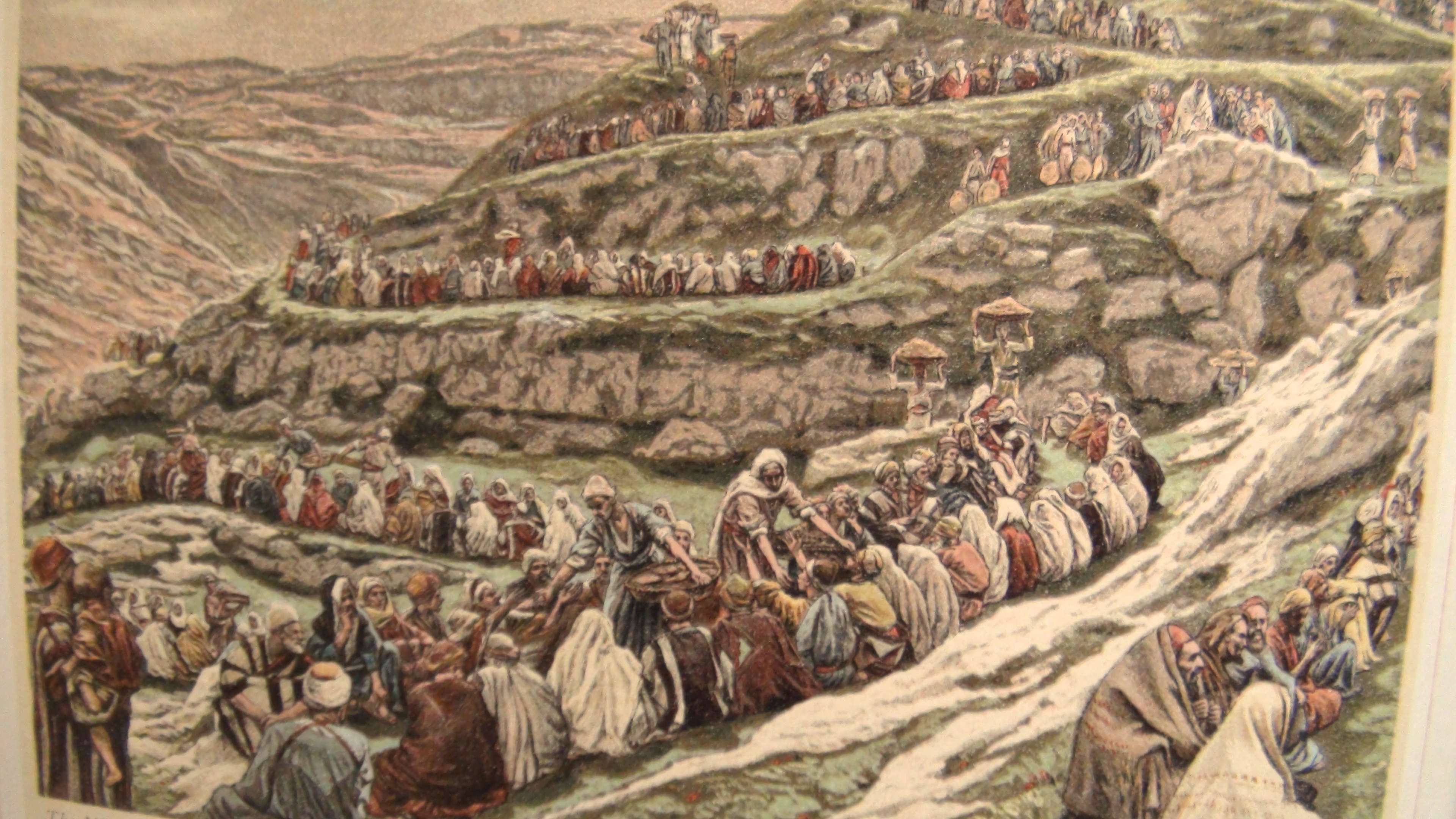
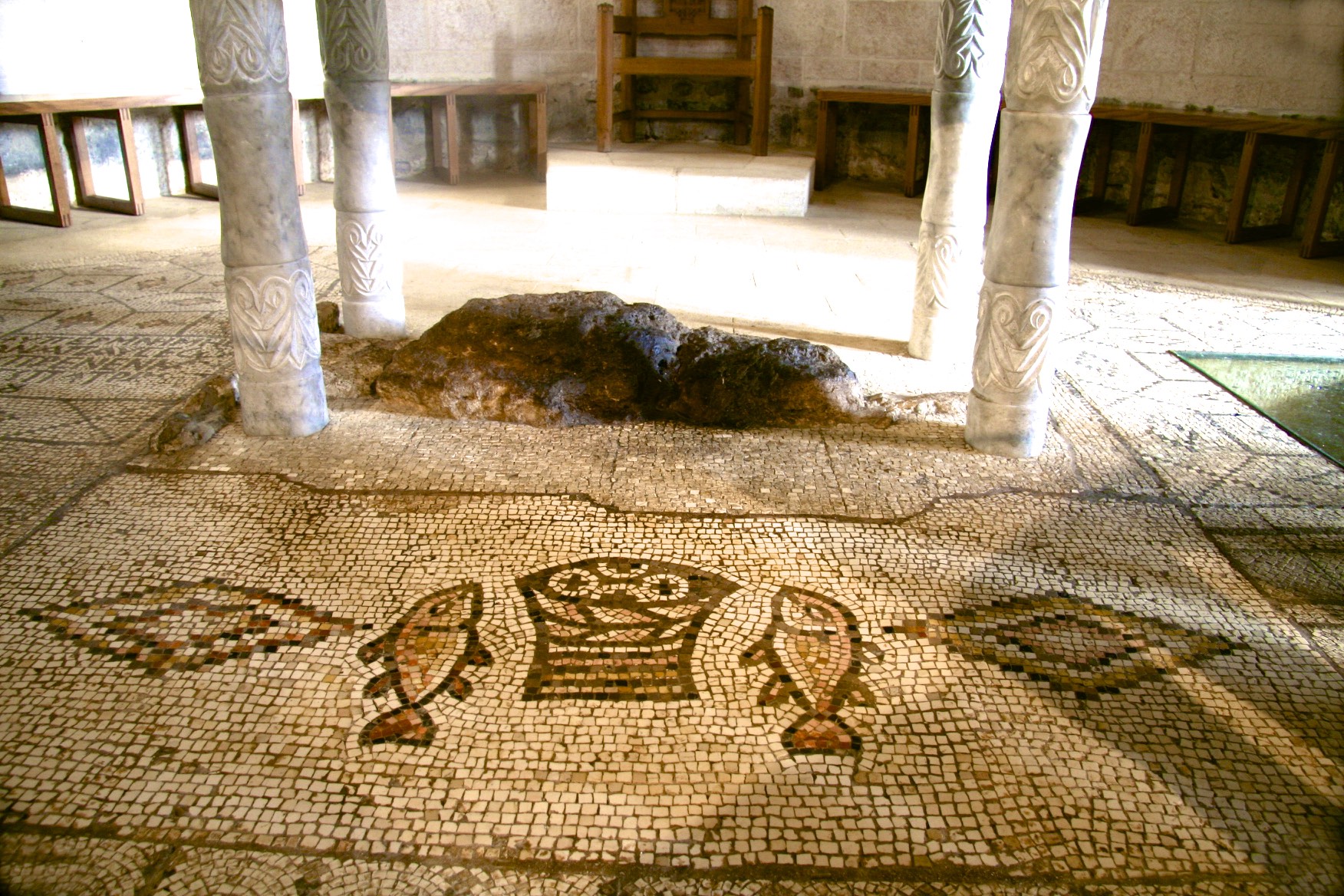
All four gospels say that Jesus fed a great crowd near the Sea of Galilee by multiplying a few loaves of bread and some fish. It’s an important miracle.

John’s account (John 6), read at Mass on weekdays from the Friday of the 2nd week of Easter until Saturday of the 3rd week of Easter, indicates the miracle takes place during the feast of Passover. Like the Passover feast, the miracle and the teaching that follows occur over a number of days.

The Passover feast commemorated the Manna God sent from heaven to sustain the Jews on their journey to the promised land. Jesus claims to be the “true bread,” the “living bread” that comes down from heaven.

Jesus is a commanding presence during the miracle and the days that follow in John’s account. “Where can we buy enough food for them to eat?” he asks Philip as crowds come to him. He then directs the crowd to sit down, feeds them with the bread and fish, and says what should be done with the fragments left over. Unlike the other gospel accounts that give the disciples a active role in the miracle John’s account gives them a small role. Philip and the other disciples are tested during the miracle and the teaching that follows it.

As they embark on the Sea of Galilee to return to Capernaum after the miracle, a sudden storm occurs and Jesus’ rebukes the wind and the sea, the forces of nature, so that the disciples reach the other shore. All four gospels have some version of Jesus’s power over the sea and therefore the natural world. He has divine power.

The crowds to whom Jesus speaks at Capernaum after the miracle are also tested as well as his disciples. They want to make him king after a plentiful meal and only look for a steady hand out instead of “the true bread come down from heaven.” Their faith is limited and imperfect after the miracle. They miss the meaning of the sign.

The disciples also are tested; some walk with him no more.

The miracle of the loaves and the fish remind us that Jesus is Lord and we are people of limited faith. We only see so far. The Risen Lord leads us to the other shore. He is the Bread of Life. “Master, to whom shall we go? You have the words of everlasting life,” Peter says to Jesus at the end of John’s account. And so do we.

Weekday Readings: Third Week of Easter


Monday Acts 6,8-15; John 6,22-29
Tuesday Acts 7,58-8,1; John 6,30=35
Wednesday Acts 8,1-8; John 6,35-40
Thursday Acts 8,26-40; John 6,44-51
Friday Acts 9,1-20; John 6,52-59
Saturday Acts 9,31-42; John 6,60-69

The Mass readings this week continue from the Acts of the Apostles with the story of the Greek-speaking deacon Stephen. His fiery preaching against temple worship and “stiff-necked” Jewish opposition to Jesus results in his death and a persecution that drives Hellenist Christians out of Jerusalem. (Monday and Tuesday) But Stephen’s death, like the death of Jesus, brings new life. The church grows. “The death of Christians is the seed of Christianity.” (Tertullian )

Philip the Deacon, one of those displaced, preaches to the Samaritans north of Jerusalem. Then, led by the Spirit, he converts the Ethiopian eunuch returning home after his pilgrimage to Jerusalem. (Wednesday and Thursday} Following Philip’s activity, Paul, the persecutor, is converted by Jesus himself. (Friday)

Before Paul’s ministry begins, Peter leaves Jerusalem to bless the new Christian communities near the coast; at Joppa he’s told by God to meet the Roman centurion in Caesarea Maritima. The mission to the gentile world begins with that meeting. (Saturday)

Stephen, Philip, Peter and Paul serve God’s mysterious plan. It’s not human planning. The Holy Spirit is at work.

The gospel readings this week are from St.John’s gospel– segments of Jesus’ long discourse on the Bread of Life to the crowd at Capernaum after the miracle of the loaves. (John 6) In the Eucharist we meet the Risen Christ.  He not only feeds us personally, but a growing church is fed.