Tag Archives: Jesus Christ

Looking Out The Window: Llght and Darkness

FullSizeRender

Light and darkness are important in the Genesis story; they’re also important in our morning and evening prayers. Daily prayer is deeply influenced by the Genesis story .

“God saw light and said it was good.” the Book of Genesis says. God creates light, then sunlight, first. Then, holding this bright lamp, God goes about creating the world day by day out of darkness.  Each day ends in darkness, but God goes to work the next day, light in hand, and new things come to be. Like us, God works day by day.

“Send forth your light and your truth, let these be my guide.” The morning psalms each day repeatedly ask for light to continue God’s work.

“Your word is a lamp for my steps, a light for my path.” The evening psalms prepare us for the darkness of night, when we rest. But God’s work goes on. Night for us is a time for trust and leaving the world in God’s hands. “Truly I have set my soul in silence and peace, As a child in its mother’s arms. even so my soul.” (Psalm 131, Tues.3)

Before television and radio and the complex scientific weather reports we get now, I think we looked out the window more to see the dawn, the dusk, the light and darkness. Should we stop looking out the window?

I don’t think so. Maybe we should look out the window more each morning and evening and try to see the light and darkness as the Book of Genesis suggests. We learn from them. God works day by day. So, “What am I going to do today?” Whatever we do, we should do it thankfully, by the light of God’s grace.

And don’t forget how the days of Genesis end. God rests and says it’s good. Something of God’s rest and appreciation, praise and thanksgiving, should be in us as we go through our days of creation.

In the New Testament, Jesus Christ, the Word of God, is called “the true light that enlightens everyone who comes into this world.”

The everyday sun promises the Sun that enlightens everyone.

Priests and a Priestly People

Are priests a class apart, separate from the rest of humanity? The Letter to the Hebrews, our weekday reading at Mass, offers an extended reflection on the priesthood of Jesus in the light of Jewish tradition of priesthood found in the temple of Jerusalem. The Letter to the Hebrews was probably written to the Roman church where many Jewish Christians were lamenting the fall of Jerusalem and its temple in the year 70. Can it throw light on the meaning of priesthood today?.

Jesus is our new high priest, but he did not separate himself from the rest of humanity. He became fully human to bring humanity to God in sacrifice and praise. Here’s how St.Fulgensius of Ruspe explains it:

“When we speak of Christ’s priesthood, what else do we mean than the incarnation? Through this mystery, the Son of God, though himself ever remaining God, became a priest. To him along with the Father, we offer our sacrifice. Yet, through him the sacrifice we now offer is holy, living and pleasing to God. Indeed, if Christ had not sacrificed himself for us, we could not offer any sacrifice. For it is in him that our human nature becomes a redemptive offering.

When we offer our prayers through him, our priest, we confess that Christ truly possesses the flesh of our race. Clearly the Apostle refers to this when he says: Every high priest is taken from among us. He is appointed to act on our behalf in our relationship to God; he is to offer gifts and sacrifices to God.”

A priest embraces the mystery of the Incarnation, the saint says. Like Jesus, priests are called to embrace humanity in its weakness. Following him, they must embrace their own times and place, without isolating themselves from the world they live in.  Otherwise, how can they bring it to God?

All who are baptized also share in the priesthood of Christ. Every Sunday, we gather as a priestly people. The priestly call belongs to us all. “Let us give thanks to the Lord, our God,” we say at Mass. We’re a priestly people.

Keeping Heroes in Mind

We’re reading the Letter to the Hebrews at length these days in our liturgy at Mass. Why was this written? When and to whom was it written? Interpreters of the Letter to the Hebrews ask these questions to understand this writing better.

Obviously Hebrews is written to Jewish-Christians, some think in Rome which had a substantial Jewish-Christian population in the 1st century. It was written after a time of persecution, perhaps when the Emperor Claudius banished Jewish Christians from the city in 49 AD because they were causing riots in Rome’s synagogues in disputes over Jesus Christ. Or maybe a later persecution.

Did that  cause the followers of Jesus there to tamper down their efforts and embrace their faith less fully? Perhaps. The writer of Hebrews warns his hearers against “drawing back” and “losing confidence” in the faith they profess. Were they losing their enthusiasm? That sounds like something that happens to us too.

Keep before you the heroes of faith, beginning with Jesus, the author of Hebrews says as he draws up for them a lengthy list of inspiring believers.

“For, after just a brief moment, he who is to come shall come; he shall not delay. But my just one shall live by faith, and if he draws back I take no pleasure in him.”

 To that list of Old Testament heroes we can add the saints of the New Testament and saints of our times. They can inspire us too.

Mary, the Mother of God

Virgin and Child

The Feast of Mary, the Mother of God (January 1) is celebrated by the Roman Catholic Church as the Christmas celebrations end and a new year begins. This feast begins a month named for the Roman god Janus, the two faced god who looks ahead and looks back. Mary connects us to the world ahead as well as the world of the past, and so we pray to her “that we may be made worthy of the promises of Christ.”

Christian churches of the east have a similar feast at this time honoring the Virgin Mary as the Mother of God. .

“Marvelous is the mystery proclaimed today
Our nature is made new as God becomes man;
He remains what he was and becomes what he was not,
Yet each nature stays distinct and undivided.” Canticle, Morning Prayer

Mary’s Son who came “in the fullness of time” blesses all time:
“The LORD bless you and keep you!
The LORD let his face shine upon you,
and be gracious to you!
The LORD look upon you kindly and give you peace!” (Numbers 6, 22-27)

On this feast of Mary, the Mother of God, I think of a PBS special “What Darwin Never Knew” produced awhile ago on Nova. I don’t remember or understand a lot of the program’s scientific material, but its description of DNAs and embryos caught my attention.

According to scientists, embryos from different living beings–humans, animals, birds, fish– appear remarkably alike at an early stage of development, as if they were from the same source. Then, something triggers a different development in each species. Humans sprout arms and legs and begin human development. The other species develop in their own way.

A few years ago, I visited an exhibit called “Deep Time” at the Smithsonian Museum in Washington which described the development of the earth through 4.5 billion years. One section described our development as human beings from 4.5 billion years ago. Our human species developed over time in an evolving world.

In Mary’s womb, the Word became flesh, connected with the world of the past and the world of the future. Early theologians, like St. Irenaeus, say the Word became truly human, and therefore went through the same process of development as we do. They also say the Word had to assume all that he would redeem. Can we say that in his early embryonic journey in Mary’s womb the Word assumed the creation he would renew? The embryonic journey is a sacred journey that needs to be cared for and recognized.

“Blessed is the fruit of your womb,” Elizabeth says to Mary before Jesus’ birth. (Luke 1,42) At that moment, the Word of God gave the promise of redemption to another infant– Elizabeth’s son John. Was that promise also communicated to the rest of creation in Mary’s womb, by the Word made flesh, who dwelt among us– Jesus Christ, maker and Savior of all?

Nazareth: Where Jesus Was Raised


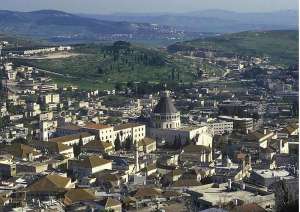
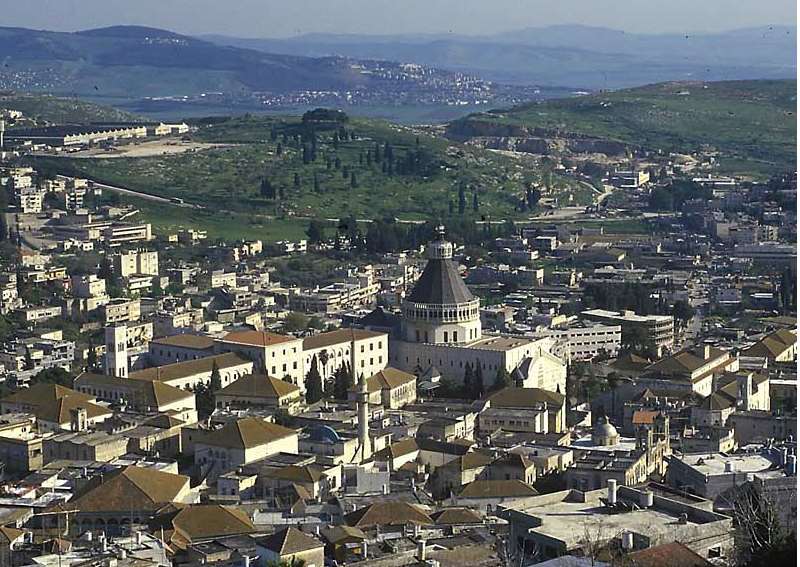
What was Nazareth like? We might think it was a quiet little town far from anywhere else in Jesus’ time; the gospels indicate his early years were spent in such a place.  Recent historical studies tell a different story. The town was not as isolated as once believed.  Just four miles away was the thriving Greco-Roman city of Sepphoris, recently uncovered by archeologists, and nearby were roads to Tiberias, Jerusalem, the sea coast and the rest of the world.

 Galilee’s economy was booming then, thanks to the rich soil of the Esdraelon plains, the fishing villages along the Sea of Galilee, the stability of Roman rule and Herod Antipas, a skillful administrator and builder who was firmly in charge then.  His new regional capital, Tiberias–a model of Greco-Roman city planning– dominated the shores of the Sea of Galilee. A new port, Caesaria Maritima linked Galilee to the rest of the Roman world. 

Could Nazareth, 15 miles east of the Sea of Galilee and 20 miles west of the Mediterranean Sea, situated in a thriving province, be shut off from this world?

How did Jesus get there?

Some historians say Joseph and Mary were not from Nazareth in Galilee, but from Judea.  Matthew’s gospel, in contrast to Luke’s, indicates that Joseph was a Judean associated with Bethlehem, David’s city. Mary’s family may have been associated with the temple in Jerusalem. The Church of St. Ann there claims to mark Mary’s birthplace in that city. 

Another tradition, however, says Mary was born in Sepphoris, near Nazareth. After Jesus’ birth in Bethlehem, the gospels indicate his family moved north to the small town of Nazareth to escape the clutches of Herod the Great, who ordered the slaughter of infants. When Herod died, he was succeeded by his son Archelaeus, who was just as unstable as his father. Herod Antipas, another of Herod’s sons yet slightly less dangerous than Archelaeus, inherited power in Galilee after his father’s death in 6 BC and ruled till about 36 AD, in the lifetime of Jesus. He began building the city of Sepphoris in 3 BC. Workers from nearby Nazareth would likely have been recruited to build that city.

Jesus and his followers rejected

Whatever its history, Nazareth will always be a mystery. Instead of supporting Jesus, the Nazareans turned their backs to him, the gospels say. They drove him out of their synagogue when he announced his mission and said he was mad. (Mt 13,54-58)  After his resurrection, there is no evidence Jesus appeared there; his followers in Nazareth were few. “No prophet is without honor except in his native place,” Jesus said. (Mt 13,54)

A Christian Minority through the Centuries

Followers of Jesus in the town where he was raised continued to be few, it seems. By the time Matthew’s Gospel was written, around the year 90, after the destruction of Jerusalem and the temple in 70 AD,  scribes and temple officials as well as the pharisees from that city had moved to the Galilean cities of Tiberias and Sepphoris, near Nazareth, and began a powerful new movement in Judaism.

Did they drive the followers of Jesus out of the Galilean synagogues just as his contemporaries drove him out of Nazareth?  Matthew’s gospel offers numerous warnings that the disciples would be handed over to the courts and scourged in the synagogues. (cf. Mt 10, 17)

“Slender evidence suggests that a Jewish Christian community survived in Nazareth during the C2 and C3 AD, “ writes Jerome Murphy-O”Connor. (The Holy Land, 423) The nun Egeria, one of the few early Christian visitors to Nazareth, found a cave considered part of Mary’s house in the 4th century,  but she did not stay long in the town.  In 570 AD a pilgrim from Piacenza found Nazareth a hostile place:  “there is no love lost in the town between Christians and Jews.” Two Christian churches were built at that time, but after the Muslim conquest of Palestine in the 7th century the number of Christians in Nazareth declined further and their churches were destroyed.

When the Crusaders conquered the town in the 11th century, they rebuilt the Byzantine shrines and added their own buildings; some remains are visible today. But after the defeat of the Christians in the 12th century, Nazareth once more became a Muslim stronghold and Christians a minority.

Through the ages, the Christian presence in Galilee remained small, dependent mostly on Christian pilgrims to the Holy Land. After the crusades, it was considered dangerous for Christians to enter Nazareth.  In 1620 the Franciscans bought a site in the  town where the house of Mary was said to be and they continued to nourish a Christian presence in the town. Through their efforts the large Basilica of the Annunciation, built over the early Byzantine and Crusader churches and archeological remains from the ancient town, was dedicated in 1968. The Greek Orthodox church also continued its ministry in this revered spot.

Nazareth itself remained poor and undeveloped from the time of Jesus until recently, when it became the provincial capital of Galilee and its population soared. From less than 1,000 inhabitants in Jesus’ time, the number has grown today to 70,000, mostly Muslim.

The large basilica of the Annunciation, with its extensive collection of art from all over the world honoring this mystery, is a gathering place for Catholic pilgrims. Here faith attempts to interpret this mysterious town “where our feeble senses fail.”

19th Century Nazareth

An English vicar left this quaint description  as he approached Nazareth towards the end of the 19th century. Unlike its neighbor, Cana, the town then was experiencing a modest revival:

“Our horses began to climb the steep ascent of 1,000 feet that brings one to the plateau in a fold of which, three miles back among its own hills, lies Nazareth.

“At last, all at once, a small valley opened below, set round with hills, and a pleasant little town appeared to the west. Its straggling houses of white soft limestone, and mostly new, rose row over row up the steep slope. A fine large building,with slender cypresses around it, stood nearest to us; a minaret looked down from the rear.

“Fig trees, single and in clumps, were growing here and there in the valley, which was covered with crops of grain, lentils and beans. Above the town, the hills were steep and high, with thick pasture, sheets of rock, fig trees now and then in an enclosed spot.   Such was Nazareth , the home of our Lord. (p 513)

“The town is only a quarter of a mile long, so that it is a small place, at best; the population made up of about 2,000 Mohammedans, 1,000 Roman Catholics, 2,500 Greek Catholics and 100 Protestants – not quite 6000 in all; but its growth to this size is only recent, for thirty years ago Nazareth was a poor village.”  (p 516)

The Catholic shrines of Nazareth were not among the English vicar’s favorite places to visit, but he does recognize one of the town’s enduring holy places:

“The water of Nazareth is mainly derived from rain-cisterns, for there  is only one spring, and in autumn the supply is precarious. A momentous interest, however, gathers around this single fountain, for it has been in use for immemorial ages, and, no doubt, often saw the Virgin and her Divine Child among those who frequented it morning and evening, as the mothers of the town, many with children at their side, do now.” (p.515)

“The Virgin’s Spring bursts out of the ground inside the Greek Church of the Annunciation, which is modern, though a church stood on the same site at least as early as 700 AD.They say that it was on this spot that the Angel Gabriel appeared to the Virgin; and if there is nothing to prove the legend there is nothing to contradict it.  Indeed, the association of the visit with the outflow of living water from the rock has a certain congruity that is pleasing. “ (p.516)

The Word Made Flesh

Nazareth, where Jesus lived most of his time on earth, offers few traces of the town he knew. Those were hidden years when the Son of God “humbled himself” by living inconspicuously, immersed in the steady, ordinary rhythms of a small 1st century Jewish town.  Jesus “became flesh” in Nazareth,  “one like us in all things but sin.”

Instead of Nazareth of the past, then, we may find him just as well in Nazareth of the present–or in any town or city or anyplace today, for that matter.

Jesus did not come only for the world then, he comes also for the world now, to dwell among us. Nazareth may help us understand the mystery of his Incarnation in our town and place.

The Humanity of God

You can’t say it more beautifully than St. Bernard does in this sermon.

“The kindness and love of God our savior have appeared.  Thanks be to God, we receive such abundant kindness in this pilgrimage, this exile, this distress through him.

” Before his humanity appeared, God’s kindness lay concealed. Yes, it was already there, because the mercy of the Lord is eternal, but how could we know it was so great? It was promised but not yet experienced, and so many did not believe in it.  At various times and in various different ways, God spoke through the prophets, saying I know the plans I have in mind for you: plans for peace, not disaster.

“Now at last let us believe our own eyes, because all God’s promises are to be trusted. So  even our troubled eyes can see, He has set up his tabernacle in the sun. Peace is no longer promised, but given; no longer delayed, but present; no longer predicted, but here.

“Behold, God has sent down to earth a message of mercy, at his passion our ransom was poured out on us. A small child was given to us, but all the fulness of the Godhead dwells in him.

“After the fulness of time had come, there came too the fulness of the Godhead. He came in the flesh to reveal himself to our earthly minds; his kindness would be known when his humanity appeared. Where the humanity of God appears, his kindness can no longer be hidden. Could he better reveal his kindness than by assuming my flesh? My flesh, that is, not Adam’s, as it was before the fall.

“What greater proof could God give of his mercy than by taking upon himself that very thing which needed mercy? Could there be a better loving-kindness than for our sake the Word of God became perishable like the grass? Lord, what is man, that you make much of him or pay him any heed?

“Let us know  how much God cares for us from this. Let us know from this what God thinks of us, what he feels about us. Do not ask about your own sufferings; but about what God suffered. Learn from what he became for you what he wishes you to become. Know his kindness from his humanity.

“The more he humbled himself in his humanity, the greater has he shown his kindness. The more he humbles himself on my account, the more I love him. The kindness and humanity of God our Saviour appeared says St Paul. The humanity of God shows the greatness of his kindness.

The One who added humanity to the name of God gave proof of God’s kindness.”

The World Waits for Mary’s Reply

The world waited for Mary's reply, St. Bernard says:
The price of our salvation is offered to you. We shall be set free at once if you consent. In the eternal Word of God we all came to be, and behold, we die. In your brief response we are to be remade in order to be recalled to life.
Tearful Adam with his sorrowing family begs this of you, O loving Virgin, in their exile from Paradise. Abraham begs it, David begs it. All the other holy patriarchs, your ancestors, ask it of you, as they dwell in the country of the shadow of death. This is what the whole earth waits for, prostrate at your feet. It is right in doing so, for on your word depends comfort for the wretched, ransom for the captive, freedom for the condemned, indeed, salvation for all the sons of Adam, the whole of your race.
Answer quickly, O Virgin. Reply in haste to the angel, or rather through the angel to the Lord. Answer with a word, receive the Word of God. Speak your own word, conceive the divine Word. Breathe a passing word, embrace the eternal Word…
And Mary says, ‘I am the handmaid of the Lord. Be it done to me according to your word.'”

Friday, 3rd Week of Advent


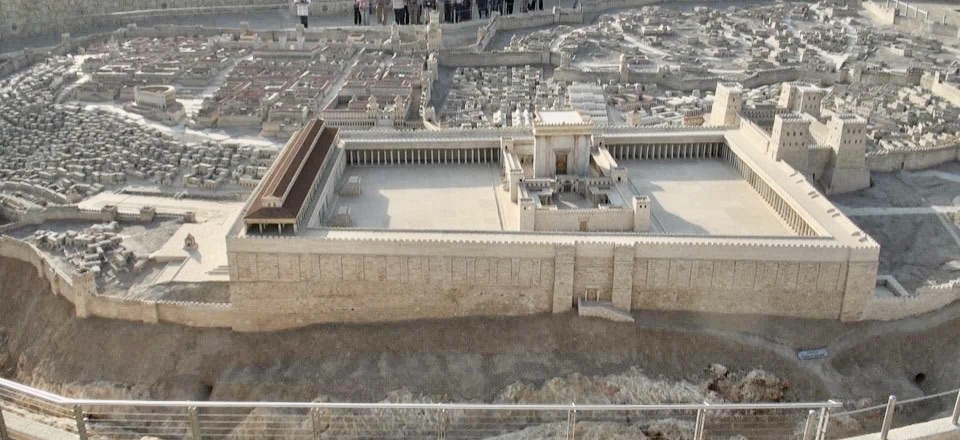
Prophets like Isaiah promised that all nations would come to Jerusalem, to the house of the Lord. And so the temple in Jerusalem provided a Court of the Gentiles, an extensive place surrounding the Holy of Holies (above) where foreigners as well as Jews could come to hear the word of God,

Them I will bring to my holy mountain
and make joyful in my house of prayer;
Their burnt offerings and sacrifices
will be acceptable on my altar,
For my house shall be called
a house of prayer for all peoples.
Thus says the Lord GOD,
who gathers the dispersed of Israel:
Others will I gather to him
besides those already gathered. (Isaiah 56)

It’s significant that Jesus in a symbolic act when he arrives in Jerusalem at the end of his public life cleanses the temple as a sign that that time had come. The Gentiles are called; he calls them to himself. In John’s gospel, read today, Jesus speaks from the temple, most likely from the Court of the Gentiles. He’s the One whom John the Baptist has pointed out and his mission will be confirmed by his Father who will glorify him in his Kingdom.

The Advent and Christmas seasons are not only celebrations for believers, confined to a church or the homes of believers. They take place in the “Court of the Gentiles”, they bring light to the world beyond Christianity. We may not realize it, but the world listens and sees, however dimly that may be. The light of our celebrations shine in a dark world that needs hope.

In the Advent and Christmas seasons, Jesus speaks in the “Court of the Gentiles”.

Readings here.

Pierre Toussaint

Toussaint
Pierre Toussaint

“Slaves, be obedient to your human masters with fear and trembling, in sincerity of heart, as to Christ, not only when being watched, as currying favor, but as slaves of Christ, doing the will of God from the heart.” (Ephesians 6:1-9)

St. Paul wrote those words as a prisoner in Rome. He wasn’t justifying slavery nor was he justifying his own unjust imprisonment. Slave or free, male or female, whatever our condition, whether it’s from an unjust structure of society like slavery or imprisonment, or from some natural cause, we are children of God.

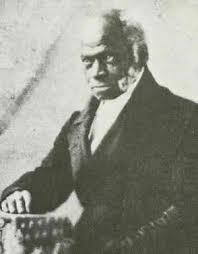
I think that’s how Pierre Toussaint lived, a Haitian slave brought to New York City late in 18th century. He died in 1853. Toussaint had a profound love of Jesus Christ. When he  died, a New York newspaper recognized him as “ a man of the warmest and most active benevolence.” His goodness was legendary.

Toussaint came to New York City with his French owners, the Berard family, shortly before the Haitian revolution in 1789. He lived in the city almost 66 years. A successful hair-dresser, confidante to some of New York’s most prestigious Protestant families, extraordinarily generous and faithful to the poor, a devout parishioner of St. Peter’s Catholic church on Barley Street, at Mass each morning at 6 AM. He was acclaimed one of New York’s finest citizens at his death.

St. Peter's Church
St. Peter’s Church

His first biographer was Hannah Farnham Sawyer Lee, a Protestant who wrote about him shortly after his death. It’s a lovely biography, based on memories she and others had of him. She admired his character, his good deeds, his genuine love for people, black or white:

“He never felt degraded by being a black man, or even a slave…he was to serve God and his fellow men, and so fulfill the duties of the situation in which he was placed…. He was deeply impressed with the character of Christ; he heard a sermon from Dr. Channing, which he often quoted. “My friends,” said Channing, “Jesus can give you nothing so precious as himself, as his own mind. May this mind be in you.”

Those last words come from Paul’s Letter to the Philippians: “Have this mind in you which was in Christ Jesus, Who, though he was in the form of God, did not regard equality with God something to be grasped. Rather, he emptied himself, taking the form of a slave, coming in human likeness; and found human in appearance, he humbled himself, becoming obedient to death, even death on a cross.…Philippians 2, 6-9

Toussaint made the mind of Jesus his own. His body now lies in the crypt under the main altar of New York’s St. Patrick’s Cathedral and his cause for canonization has begun.

Some question why Toussaint wasn’t more aggressive in the struggle against slavery. He could have easily won his own freedom well before 1807, when Madame Berard  emancipated him before her death. Why didn’t he? Why wasn’t he active in the abolitionist movement against slavery then?

IMG_1851
African American Museum

For one thing, Toussaint feared violence would erupt in the United States, like the violence destroying Haiti then.

But he was influenced most of all by the teachings of the gospel and the example of Jesus Christ who insisted on loving God and your neighbor.  Loving and serving others is his great commandment, more important than the color of your skin, or your status in life or even fighting for a cause.

images

‘What will we do if the whites continue to discriminate and mistreat us?’ someone once asked Doctor Martin Luther King ‘We will continue to love them to the point that they can’t do anything else but love in return, ’’ he said.

Toussaint understood that. Doctor Martin Luther King did too. 

A fellow Passionist, Bishop Norbert Dorsey, CP who died in 2013, wrote his doctoral thesis at the Gregorian University in Rome on Pierre Toussaint. It’s available in digital form, thanks principally to Lynn Ballas, who so competently and generously edited and formatted the bishop’s work. It’s available at 

A Mother’s Plans for James and John

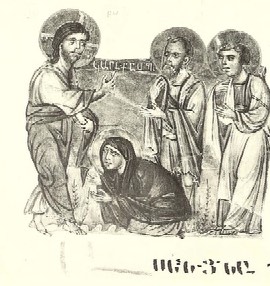
On today’s feast of St. James, the apostle,  Matthew’s gospel describes Salome, the mother of James and John, asking Jesus to give her sons privileged places in his kingdom. “Command that these two sons of mine sit, one at your right and the other at your left, in your kingdom.”

I’m not sure Salome would have fallen at Jesus’ feet as she’s pictured in the illustration above. They were related, after all, and she was a senior relative of his. She probably reminded Jesus that James and John were his cousins, and remember, I know your mother. Family ties always help people get ahead.

Jesus doesn’t dismiss her altogether, but he reminds her that his followers are to serve and not be served. It’s a service that will cost them, even their lives. Following him doesn’t mean that they and their family would gain. Like the Son of Man James and John will  have to give their lives “for many.”

They’re called by God to reach out, and reaching out can be hard, sometimes painful. It means going beyond those we call our own, our families and friends. It means reaching out to those we don’t know, even to those we don’t like. It means going beyond what we’re used to.

Later stories say that James and John went to places far beyond the Sea of Galilee where they fished with their father Zebedee and were cared for by a mother who had their interests at heart. Our church is a missionary church. It reaches out to the whole world. That’s what  Jesus last words in Matthew’s gospel says to do:  “Go out to the whole world, baptizing and teaching.”

That’s still his word today. Go out to the whole world, even if the world is changing and the future is uncertain. “I am with you all days,” Jesus says.

James, brother of John, is also known as  James the Greater, to distinguish him from James the Less, the other disciple mentioned in the New Testament. James was the first of the apostles to die for Christ; he was beheaded in Jerusalem by King Herod Agrippa in 42 AD.

Later Traditions About James

Some 4th century Christian writers say that one of the apostles went to Spain and a 6th century source identifies the apostle as James, who preached briefly in Spain and converted only a few before returning to Jerusalem and his death.

Modern scholars are divided about the truth of the tradition. Relics said to be of St. James were discovered in Compostela in Galicia in northwestern Spain in the 9th century, a major event in Spanish history. His shrine at Compostella became a major pilgrimage center for the people of Spain and Europe, rivaling even Rome and Jerusalem in its popularity.

From the 9th century onward, James was patron of the Spanish peoples and a rallying cry in their fight to free their land from the Moors. At four battles – Clavijo (9th c.), Simancas (10th c.), Coimbra (11th c.) and Las Navas de Tolosa (1212) – legends say he appeared as a warrior astride a great white horse with a sword in his hand. Throughout the Middle Ages, soldiers and knights  came as pilgrims to Compostela to seek the saint’s protection.

In 1492, when Spain was finally free of Moorish domination, King Ferdinand and Queen Isabella came to Compostela to give thanks to St.James in the name of the Spanish people.

How old are the relics of St.James? Pilgrims from Galicia were frequent visitors to the Holy Land as early as the 4th century and may have brought the relics back to their native land. Colorful legends from medieval times, however, brought the story back further to the time of the apostle himself, saying that disciples of James fled with his body after he was beheaded and, escaping by boat, drifted to the coast of Spain where, after many adventures they buried him. These legends about James appear frequently in medieval art and in numerous churches built in his honor in France, England, and later in the Spanish colonies of the New World. Cities such as Santiago, Chile, Santiago, Cuba,San Diego, California, are named after him. The feast of St.James is July 25.