Tag Archives: Jesus Christ

Don’t Look Down on Yourself?

July 30th is the feast of St. Peter Chrysologus, a bishop of Ravenna in Italy, who died around 450 AD. The prayer for his feast describes him as “an outstanding preacher of your Incarnate Word.”  You can see why in this excerpt from one of his sermons:

“Why do you look down on yourself who are so precious to God? Why think so little of yourself when you are so honored by him? Why do you ask how you were created, and don’t want to know why you were made?

“This entire visible universe is yours to dwell in.  It was for you that the light dispelled the overshadowing gloom; for you the night was regulated and the day was measured: for you the heavens were brightened with the brilliance of the sun, the moon and the stars. The earth was adorned with flowers, trees and fruit; lovely living things were created in the air, the fields, and the seas for you, lest you lose the joy of God’s creation in sad loneliness.

“And the Creator is still devising things that can add to your glory. He has made you in his image that you might make the invisible Creator present on earth; he has made you his legate, so that the vast empire of the world might have the Lord’s representative.

“Then in his mercy God assumed what he made in you; he wanted now to be truly manifest in men and women, to be revealed in them as in an image. Now he would be in reality what he was in symbol.”

Seed on Tough Ground: Matthew 13:1-9

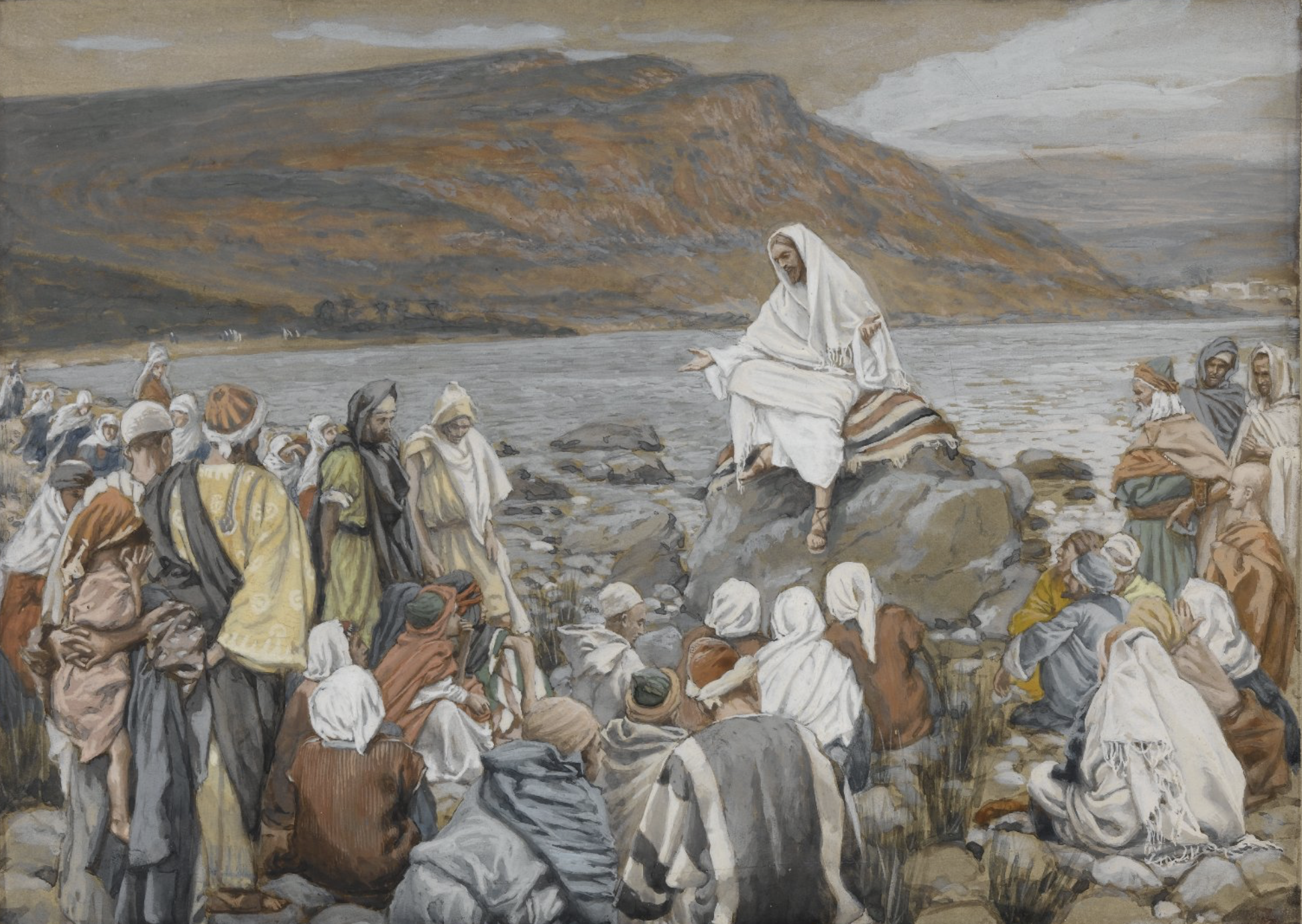
Teaching by the Sea. James Tissot

“A sower went out to sow. some seed fell on the path, and birds came and ate it up. Some fell on rocky ground, where it had little soil. It sprang up at once because the soil was not deep, and when the sun rose it was scorched, and it withered for lack of roots.Some seed fell among thorns, and the thorns grew up and choked it.” ( Matthew 13:1-9)

Jesus tells the crowd at the lakeside the parable of the sower after the Pharisees, the towns where he taught and worked wonders and his own family from Nazareth oppose him. (Matthew 11-12) Previously, Jesus sent his own disciples out to proclaim his life-giving message but he tells them:   “Do not go into pagan territory or enter a Samaritan town. Go rather to the lost sheep of the house of Israel. As you go, make this proclamation: ‘The Kingdom of heaven is at hand.’” (Matthew 10:

When they proclaimed his message to the lost sheep of Israel the seed fell on tough ground. They found the same opposition that Jesus did, more than they expected. .

Our reading today is an example of how an evangelist like Matthew used what Jesus experienced as an example for the church of his time. Matthew’s gospel was written around 90 AD with an eye on the religious conditions then in Galilee. The area had changed since the time of Jesus. After the Romans destroyed Jerusalem in 70 AD, many Jews influenced by the Pharisees moved into Galilee seeking to rebuild Judaism. They strongly opposed the followers of Jesus of Nazareth.

Matthew’s gospel reflects the increasing tension between Christians and Jews in his day. The parable Jesus originally taught throws light on this new situation. The ground is hard, rocky, with little soil. Still, the seed must be sown, however it’s received. Don’t give up on the tough ground, don’t judge it hopeless, Matthew’s gospel insists: Some seed falls on good ground.

A lesson for us today? Seems so. The soil was unwelcoming then, Matthew’s gospel says. Our soil seems unwelcoming now… Still!

A Harvest Nearby: Matthew 9:38

In our readings this 14th week of the year from Matthew’s Gospel, Jesus calls for laborers for a harvest: “The harvest is abundant but the laborers are few; so ask the master of the harvest to send out laborers for his harvest.” He gathers twelve disciples following that call. When we think of laborers in the vineyard we think of priests and religious. They are certainly needed for the harvest in our own church.

But they’re not the only laborers needed for God’s great harvest. What about laborers for places where priests or religious will never be? And what about the harvest itself, where does that happen?

I’m sure at one time or another you have overheard people at a restaurant or on a bus or at some gathering discussing religion. “What do you think of the pope?” “Do you think there’s life after death?” “Do you think Jesus is really God?” Often the questions go unanswered or wrongly answered because there’s no laborer there to speak the truth.

The harvest is waiting in a lot of places..

Jesus spoke about the laborers for the harvest as he moved from town to town in Galilee and saw  “troubled and abandoned” crowds, Matthew’s gospel says. We need to ask for laborers among crowds like those of today. Maybe we need to recognize there’s a harvest not far from where we are, “troubled and abandoned,” at a table nearby.

Resurrection Thinking

Some  years ago  Anglican Bishop N. T. Wright, a highly regarded New Testament scholar, addressed the Catholic Bishops of Italy on the resurrection of Jesus Christ.  His thoughts on the  resurrection were particularly interesting. The theme of the Italian bishops’ conference was “Jesus, our Contemporary.”

He began  with this challenging picture of the Risen Christ.

“ On the one hand, it is precisely because Jesus is risen from the dead that he is alive in a new, unique way; that he is able to be with us as a living presence, which we know in prayer and silence, in reading scripture and in the sacraments, and (not least) in the service of the poor.

“Jesus is truly our contemporary. But at the same time in his resurrection Jesus stands over against us. He is different. He is the first fruits; we are the harvest that still awaits. He has gone on ahead while we wait behind.

“What is more, the meaning of his resurrection cannot be reduced to anything so comfortable as simple regarding him as ‘contemporary’ in the sense of a friend beside us, a smiling and comforting presence. Because he is raised from the dead, he is Lord of the world, sovereign over the whole cosmos, the one before whom we bow the knee, believing that in the end every creature will come to do so as well.

“It’s not enough that Jesus intervenes at the moment of our death. He is the Lord of creation.”

According to Wright our belief in Jesus as Lord of creation has been undermined by the thinking of the Enlightenment, which placed God (if God exists) beyond our world. We are the lords of creation. This life and all in it is in our hands to shape and control as we think best.

Our belief in the Risen Christ is influenced by this thinking, Wright believes. The only role we give to the Risen Lord is to save us from death and bring us to heaven. But he is Lord of Creation, present here and now. We must live in him today and continue his work, not in a heavy-handed way, but humbly as Jesus called for in his teaching on the beatitudes.

“This is how Jesus wants to run the world: by calling people to be peacemakers, gentle, lowly, hungry for justice. When God wants to change the world, he doesn’t send in the tanks; he sends in the meek, the pure in heart, those who weep for the world’s sorrows and ache for its wrongs. And by the time the power-brokers notice what’s going on, Jesus’ followers have set up schools and hospitals, they have fed the hungry and cared for the orphans and the widows. That’s what the early church was known for, and it’s why they turned the world upside down. In the early centuries the main thing that emperors knew about bishops was that they were always taking the side of the poor. Wouldn’t it be good if it were the same today.”
Advent: Monday, 2nd Week

Today’s readings from the Old and New Testament complement one another, as the readings all through Advent do. Isaiah 35:1-10 speaks to Jewish exiles in Babylon, calling them to take a “holy way” through the wilderness to Jerusalem’s “holy mountain. Yet not just exiles in Babylon are called, God calls all nations to take the journey. All people, even the frailest, the weakest, are called to take it: the blind, the deaf, the lame, the fearful will take it, for God will strengthen them. The lame will leap “like a stag” and the “tongue of the mute will sing.”

The paralyzed man brought to Jesus in the gospel and sent away singing and dancing, (Luke 5:17-26), is a symbol of a paralyzed world that Jesus invites to take this journey, and humanity’s hopes are fulfilled as well as the hopes of prophets and peoples of the Old Testament are fulfilled. Our hopes as well. God wishes to heal our paralyzed world. Isaiah’s vision isn’t small.

Our vision shouldn’t be small either. When we hear ourselves saying “They’re not going anywhere.” “They’ll never change.” “The world’s never going to change.” we need to listen to ourselves. We’re living in a cynical world. We shouldn’t let our hope become too small.

Let’s not forget those in the gospel who lowered the paralyzed man from the roof down to where Jesus was. They were people of hope, willing to chance it with someone who looked like he would never move his limbs again. We need more of their kind today.

“They will see the glory of the LORD, the splendor of our God. Strengthen the hands that are feeble, make firm the knees that are weak, Say to those whose hearts are frightened: Be strong, fear not! Here is your God, he comes to save you.Then will the eyes of the blind be opened, the ears of the deaf be cleared; Then will the lame leap like a stag,then the tongue of the mute will sing… A highway will be there, called the holy way;
No one unclean may pass over it,
 nor fools go astray on it.
 No lion will be there,
  nor beast of prey go up to be met upon it.   It is for those with a journey to make,
 and on it the redeemed will walk.”

Hanukkah and Christmas

Hanukkah, an eight day Jewish celebration, which can occur in late November to late December, and Christmas, the Christian celebration on December 25th, are celebrated close together in time. Are they connected beyond that?

The quick answer usually given is no, but think about it a little. Hanukkah celebrates the rededication of the temple in Jerusalem after its desecration by Antiochus Epiphanes IV in 167 BC. After conquering Judea, the Syrian leader plundered the temple, ended Jewish services and erected an altar to Zeus in it.

Leading a Jewish revolt, Judas Maccabeus reconquered the city, cleansed the temple and initiated an eight day celebration in memory of the event. Eight lights lit successively call people to God’s holy place.

Christmas celebrates the birth of Jesus Christ approximately 167 years later.

Both of these feasts are about the Presence of God. For the Jews God was in the temple as Creator and Savior. For Christians God reveals his presence in Jesus Christ, who proclaimed himself God’s Son, “the light of the world” as he celebrated the Jewish feasts in the temple. (John 7-10)

All the gospels report that Jesus cleansed the temple  and spoke of himself replacing it. Luke’s gospel  begins in the temple with the promise to Zechariah of the birth of John the Baptist and ends as the Child Jesus enters his “Father’s house.” (Luke 1-2) Our readings today link the restoration of the temple by Judas Maccabeus and the Jesus cleansing the temple: 1 Mc 4:36-37, 52-59/Lk 19:45-48

Far from being separate, Hanukkah and Christmas are connected in their celebration of God’s presence. Hanukkah reminds us of the temple, the place of God’s provisional presence. The Christmas mystery reminds us of the abiding presence of God with us in Jesus Christ, Emmanuel, the Light that never fails, who gives life to all nations.

The Gift of the Old: 1 and 2 Maccabees

This week our first readings at Mass are from the First and Second Books of Maccabees commemorating the Jewish revolt against Antiochus Epiphanes, successor to Alexander the Great. The revolt led to the rededication of the temple by Judas Maccabeus after its profanation by foreign invaders.  The Jewish Feast of Hannukah recalls the event. (Thursday) The revolt took place over a hundred years before the time of Jesus.

The Maccabean revolt is one reason why the times of Jesus were so politically sensitive. On his journey to Jerusalem, some “thought that the kingdom of God would appear there immediately.” (Luke 19,11)  A number of his disciple probably thought that would happen by an armed uprising against the Romans, like the revolt  against Antiochus Epiphanes.

Our readings this week, however, are not battle accounts from the uprising but rather stories of two elderly faithful Jews: Eleazar, a scribe who refused to assimilate to the culture of the conquerors, and a mother who inspired her seven sons to resist the invaders. (Tuesday and Wednesday)

All Eleazar had to do was pretend to eat the meat of sacrifice, but the ninety-year old chose to die rather than give bad example to the young.
“I will prove myself worthy of my old age, and I will leave to the young a noble example of how to die willingly and generously for the revered and holy laws.” (2 Maccabees 6. 30-31)

The Jewish mother, seized with her seven son and witness to their torture and death,  urged them to keep their faith and persevere:
“I do not know how you came into existence in my womb; it was not I who gave you the breath of life, nor was it I who set in order the elements of which each of you is composed. Therefore, since it is the Creator of the universe who shapes each man’s beginning, as he brings about the origin of everything, he, in his mercy, will give you back both breath and life, because you now disregard yourselves for the sake of his law.” (2 Maccabees 7,1, 21-31)

Pope Francis often speaks of the wisdom and influence of the elderly.  We rely on them. Maybe now more than ever.

Abraham, The Unwavering Nomad

We reading the story of Abraham in our lectionary this week. He is called “Our father in faith” in our 1st Eucharistic Prayer. That’s because Abraham believed when God called him to leave his own land and go to a land he did not know. He believed in God’s call.

A pastoral nomad who settled down and then moving on. Abraham moved on to a permanent home. That’s us too. Abraham trusted in God rather than in himself. As an old man, he believed God who said he would have a child. His wife Sarah was old too.

The great patriarch was tested. Faith grows through testing. Abraham’s greatest test came when God asked him to sacrifice his only son Isaac.

My favorite reflection on Abraham is Jessica Power’s beautiful poem:

“I love Abraham, that old weather-beaten
unwavering nomad; when God called to him
no tender hand wedged time into his stay.
His faith erupted him into a way
far-off and strange. How many miles are there
from Ur to Haran? Where does Canaan lie,
or slow mysterious Egypt sit and wait?
How could he think his ancient thigh would bear
nations, or how consent that Isaac die,
with never an outcry nor an anguished prayer?

I think, alas, how I manipulate
dates and decisions, pull apart the dark
dally with doubts here and with counsel there,
take out old maps and stare.
Was there a call after all, my fears remark.
I cry out: Abraham, old nomad you,
are you my father? Come to me in pity.
Mine is a far and lonely journey, too.

The Bread of Life

DSC00076

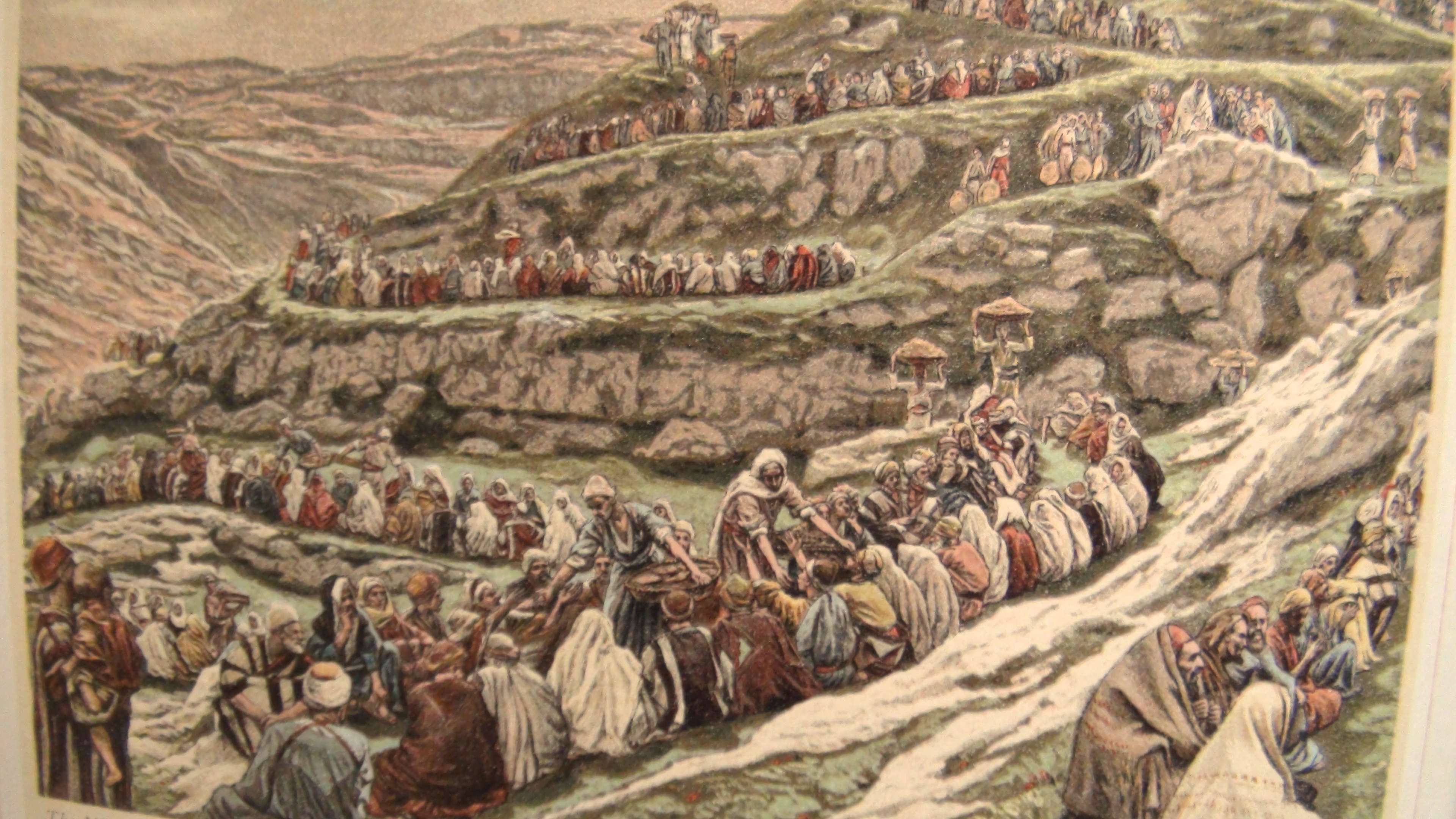
All four gospels say that Jesus fed a great crowd near the Sea of Galilee by multiplying a few loaves of bread and some fish. It’s an important miracle.

John’s account (John 6), read at Mass on weekdays from the Friday of the 2nd week of Easter until Saturday of the 3rd week of Easter, indicates the miracle takes place during the feast of Passover. Like the Passover feast, the miracle and the teaching that follows occur over a number of days.

The Passover feast commemorated the Manna God sent from heaven to sustain the Jews on their journey to the promised land. Jesus claims to be the “true bread,” the “living bread” that comes down from heaven.

Jesus is a commanding presence during the miracle and the days that follow in John’s account. “Where can we buy enough food for them to eat?” he asks Philip as crowds come to him. He then directs the crowd to sit down, feeds them with the bread and fish, and says what should be done with the fragments left over. Unlike the other gospel accounts that give the disciples a active role in the miracle John’s account gives them a small role. Philip and the other disciples are tested during the miracle and the teaching that follows it.

As they embark on the Sea of Galilee to return to Capernaum after the miracle, a sudden storm occurs and Jesus’ rebukes the wind and the sea, the forces of nature, so that the disciples reach the other shore. All four gospels have some version of Jesus’s power over the sea and therefore the natural world. He has divine power.

The crowds to whom Jesus speaks at Capernaum after the miracle are also tested as well as his disciples. They want to make him king after a plentiful meal and only look for a steady hand out instead of “the true bread come down from heaven.” Their faith is limited and imperfect after the miracle. They miss the meaning of the sign.

The disciples also are tested; some walk with him no more.

The miracle of the loaves and the fish remind us that Jesus is Lord and we are people of limited faith. We only see so far. The Risen Lord leads us to the other shore. He is the Bread of Life. “Master, to whom shall we go? You have the words of everlasting life,” Peter says to Jesus at the end of John’s account. And so do we.

2nd Week of Lent: Readings and Feasts

MARCH 6 Mon Lenten Weekday

Dn 9:4b-10/Lk 6:36-38 

7 Tue Lenten Weekday [Sts Perpetua and Felicity, Martyrs] Is 1:10, 16-20/Mt 23:1-12 

8 Wed Lenten Weekday [St John of God, Religious] Jer 18:18-20/Mt 20:17-28 

9 Thu Lenten Weekday [St Frances of Rome, Religious] Jer 17:5-10/Lk 16:19-31 

10 Fri Lenten Weekday Gn 37:3-4, 12-13a, 17b-28a/Mt 21:33-43, 45-46 

11 Sat Lenten Weekday Mi 7:14-15, 18-20/Lk 15:1-3, 11-32 

12 SUN 3rd SUNDAY OF LENT Ex 17:3-7/Rom 5:1-2, 5-8/Jn 4:5-42

Our readings for this week, beginning with the Old Testament reading from Isaiah, proclaim the mercy of God. The New Testament readings on Monday, Thursday and Saturday are from St. Luke– a gospel of mercy. Jesus proclaims God’s mercy, especially extended to the poor. The story of the Prodigal Son, Luke’s great parable of God’s mercy, is read on Saturday,

Matthew’s Gospel for Wednesday reminds us that temptations about power, so obvious in the story of Jesus’ temptations, also occur in his disciples, like James and John. Can we see it too in the elder brother from the Parable of the Prodigal Son?

The readings from the Old and New Testaments complement each other during Lent. Celebrations of the saints are fewer and often become optional memorials, as is the case of the saints this week. .

The mercy Jesus calls for is not just acceptable or normal;  it’s Godlike. Can any of us be as merciful as God?  But there’s no watering down the challenging, radical words we hear in our lenten readings.

Lent’s not meant to make us comfortable; it sets our sights on loving more, and it sets the bar higher than we like. Like the Olympic games, lent calls for our best, and more. A bigger prize than a gold medal is at stake.