Tag Archives: Jesus Christ

Praying in Jesus Christ

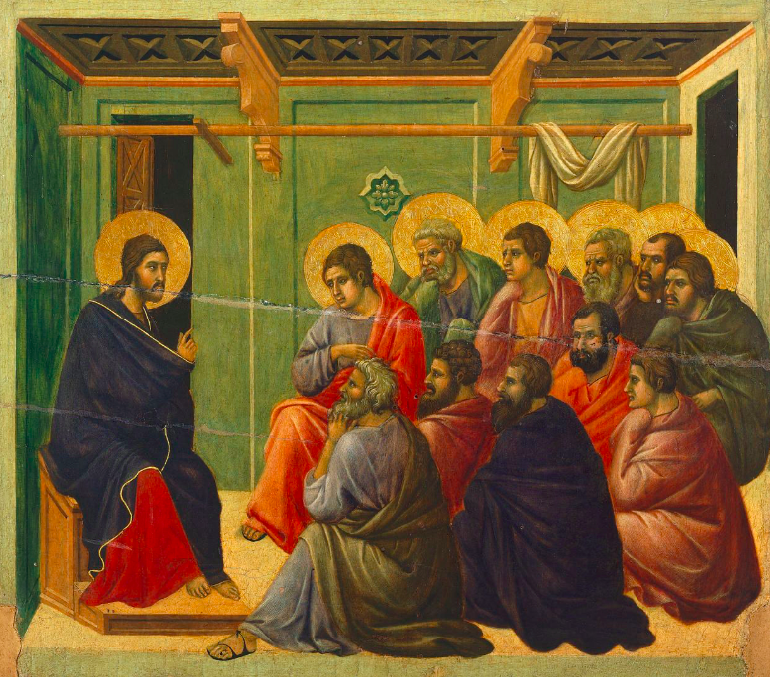
Farewell Discourse of Jesus. Duccio

“I pray for them,” Jesus says in John’s gospel as he looks at his disciples in the supper room and also at us who are his own today. We’re so conscious how poorly we pray. We need to remember Jesus is praying for us and in us. 

Is it possible to speak to God, we ask ourselves? We’re so easily distracted, so weak in faith, so bound to life as it is. How can we approach God in prayer?

“Let the Son who lives in our hearts, be also on our lips,” St. Cyprian says in his commentary on the Our Father. Jesus joins our weak and stumbling prayers to his own. He prays in and for us and assures us we will be welcomed and heard.

“I pray for them,” Jesus said in the supper room. He prayed for his disciples there in the supper room. When they left they entered the Garden of Gethsemani where they fell asleep, forgetful of everything. A stone’s throw away, Jesus prayed. His prayer was not only for himself but for them as well.

“I pray for them,’ Jesus says in our liturgical prayers. We speak to God the Father “through Jesus Christ, your Son, who lives and reigns with you and the Holy Spirit, One God, forever and ever. Amen.”

Whenever we pray, whether with others in public prayer or praying alone, he enters our prayer. “Let us pray with confidence to the Father in the words our Savior gave us,” we say as we begin the Our Father at Mass.

Our confidence in prayer comes, not from our own wisdom, or holiness or faith, but from Jesus who says “I pray for them.”

Saints Philip and James: May 3

Saints Philip and James. Duccio

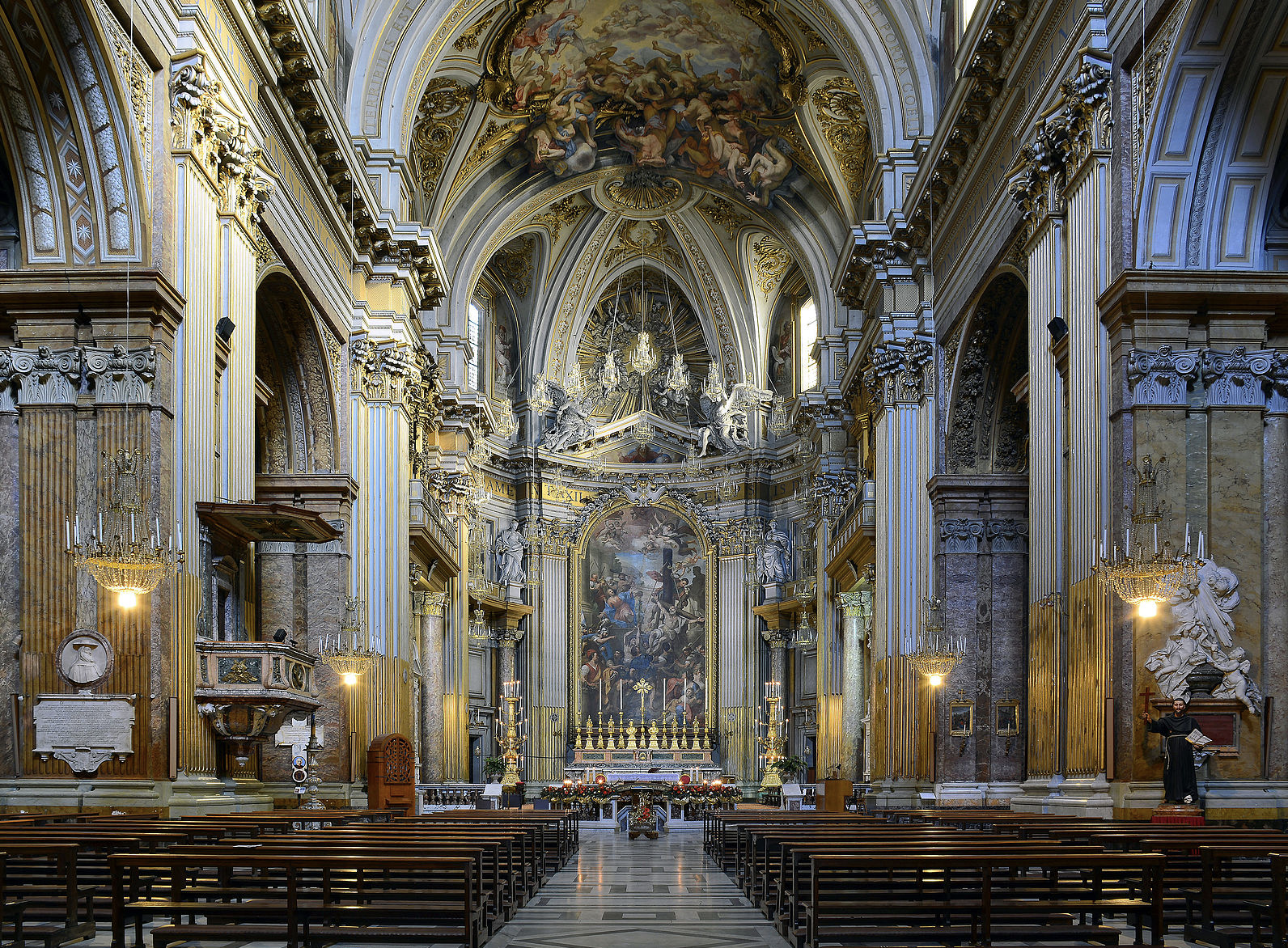
We celebrate a feast of the apostles each month. Why? Every family wants to find out how it began. Our church began with the apostles. Today, May 3rd, we remember two apostles together, Philip and James.They’re celebrated together because their relics were placed side by side in the Church of the Twelve Apostles when it was built in Rome in the 6th century.

Philip was called by Jesus to follow him the day after he called Andrew and Peter. (John 1:43-45) James, who is also called James the Less to distinguish him from James, the brother of John, was the son of Alpheus and a cousin of Jesus. He  later became head of the church in Jerusalem. His mother Mary, stood with Mary the mother of Jesus and Mary Magdalen beneath the cross of Jesus. (John 19: 25)  He was martyred in Jerusalem in the year 62.

On a feast of an apostle you expect to hear one or more heroic act or wise saying, but in today’s reading from St. John’s gospel  we hear an apostle’s clumsy question instead. During his Farewell Discourse, Jesus says, “I am the way and the truth and the life. No one comes to the Father except through me. If you know me, then you will also know my Father.”

“Master, show us the Father, and that will be enough for us.” Philip says to Jesus, who responds:

“Have I been with you for so long a time and you still do not know me, Philip? Whoever has seen me has seen the Father. How can you say, ‘Show us the Father’? Do you not believe that I am in the Father and the Father is in me? The words that I speak to you I do not speak on my own.”

Can we hear exasperation in Jesus’ words to Philip ? Better, perhaps, they point out how slow  Jesus’ apostles were to understand him; how uncertain, fearful–even ready to betray him. Philip isn’t the only one who can’t fathom Jesus and his message.

 James, son of Alpheus, came from conservative Nazareth. He knew Jesus as the son of Joseph, the carpenter and probably played with Jesus as a child. He lead the Jerusalem church, while apostles like Peter and John embarked on missions to distant lands. James favored keeping the Jewish tradition as the Spirit’s means of spreading the gospel. James and his allies would certainly be early critics of Paul’s mission to the gentiles. He alienated Jerusalem’s leaders less than Stephen or Paul, but eventually he was put to death in the year 62, as the Jewish wars approached and Jerusalem was destroyed by the Romans. Jewish Christians fled the city for the safety of another place.

Called by Jesus, all of his disciples were human. Their humanness and slowness makes us realize where our power comes from. “Not to us, O Lord, not to us be the glory!” The church’s one foundation is Jesus Christ.

But before we dismiss an apostle like Philip, let’s remember he pointed Jesus out to Nathaniel at the Jordan River and he brought Greek visitors to Jesus as he was entering Jerusalem to die on a cross. ( John 12: 20-23) He never stopped pointing to the One whom he tried to understand. It’s an apostle’s gift.

The apostles make us realize the patience of Jesus, which is the patience of God. They  reveal the different gifts and weaknesses found in the followers of Jesus.

Church of the. Twelve Apostles, Rome. Wiki commons

Cyril of Jerusalem: The Power of the Cross

St. Cyril of Jerusalem (313-386) was bishop of Jerusalem when that city was a popular center of Christian pilgrimage.  Ordinary Christians, as well as scholars like St. Jerome and St. Paula, came to the Holy Land at the time to visit the places where Jesus was born, died and rose again. “The whole world is going to an empty tomb,” St. John Chrysostom remarked. 

The church in Jerusalem influenced the liturgical, catechetical and devotional life of Christian churches throughout the world.. Visiting Christians, hearing Cyril’s sermons and masterful catechesis brought devotional and liturgical practices,, like the Stations of the Cross,  to their own churches back home. 

Cyril preached and celebrated the liturgy in the Church of the Holy Sepulcher, built by the Emperor Constantine  and his mother, Helena, over the tomb of Jesus and the place where  he died. The church still stands in Jerusalem today. 

St, Cyril and the church of Jerusalem are remembered, appropriately on March 18, usually during Lent.  

Here’s an excerpt from one of Cyril’s catechetical sermons, preached in the Church of the Holy Sepulcher, where the relic of the cross and the tomb of Jesus were honored. Siloam, the pool where the blind man was cured, Bethany where Lazarus was raised, the precious relic of the cross were not far away, they were nearly, easily seen and visited.

“The Catholic Church glories in every deed of Christ. Her supreme glory, however, is the cross. Well aware of this, Paul says: God forbid that I glory in anything but the cross of our Lord Jesus Christ!

“At Siloam, there was a sense of wonder, and rightly so: a man born blind recovered his sight. But of what importance is this, when there are so many blind people in the world? Lazarus rose from the dead, but even this affected only Lazarus: what of those countless numbers who have died because of their sins? Those miraculous loaves fed five thousand people; yet this is a small number compared to those all over the world who were starved by ignorance. After eighteen years a woman was freed from the bondage of Satan; but are we not all shackled by the chains of our own sins?

For us all, however, the cross is the crown of victory. It has brought light to those blinded by ignorance. It has released those enslaved by sin. Indeed, it has redeemed the whole of mankind!”

The relic of the cross, rescued from the refuse of Calvary, honored by Cyril in the Jerusalem church. was not just a grim reminder of the suffering of Jesus; Encased in gold, it was bathed in the glorious memory  of Jesus’ resurrection celebrated close by in his empty tomb.

Church of the Holy Sepulcher, Jerusalem

For Morning and Evening Prayers today, 4th week.

2nd Sunday of Lent: Transfiguration of Jesus

For this week’s homily please watch the video below.

The glorious transfiguration of Jesus before his disciples on the mountain came after he predicted his suffering and death. He told them then that they must follow him.
” If anyone wishes to come after me he must renounce self, take up his cross and follow me.”

They found those words hard to hear, as we do. Peter, reacting for the others, protested “Heaven forbid! No, Lord, this shall never happen to you.” Most likely he was also thinking: “Nor should it happen to me, either.”

In answer to their fears, Jesus took Peter, James and John up a high mountain and was transfigured before them. They saw his face shining like the sun and his garments brilliant white. Moses and Elijah. were at his side. A voice from heaven confirmed that “He is my chosen Son.”

Luke notes in his gospel that the disciples Jesus took up the mountain with him were at first unaware of the vision. They were asleep and had to be awakened, but even awake they can hardly take it in. They were filled with awe.

How hard it is to realize the promise made in the mystery of the Transfiguration, a promise we hear in Paul’s Letter to the Philippians.

Our citizenship is in heaven,
and from it we also await a savior, the Lord Jesus Christ.
He will change our lowly body
to conform with his glorified body
by the power that enables him also
to bring all things into subjection to himself.

The glorious promises of God are as hard to understand as the mystery of the Cross.

Thursday, 1st Week of Lent

Lent 1

Matthew 7,7-12

Does God answer prayers? A question often asked. Some say God–if there is a God-doesn’t pay attention to us at all. We’re on our own. No one’s listening and no one cares.

Jesus certainly believed his Father listens and cares. He trusted God and asked God for things. He taught us to pray as he did. His prayer in the Garden of Gethsemane reveals a trust that’s unfailing. Over and over he asks that his life be spared. “Father, let this cup pass from me.” He knocked and the door opened; the answer came, yet not as he willed, but as His Father willed. “An angel came to strengthen him,” to accept that answer.

His experience is a model for us. Yes, God gives good gifts to his children, but according to his will. He knows what we need. He gave his only Son the gift of new life, yet he had to first pass through death.

St. Paul of the Cross recognized the mystery surrounding petitionary prayer. Ultimately our prayer is answered, but often enough in mysterious ways that’s hard to understand. Our faith is tested when we pray for things.

“I thank the Father of Mercies that you are improved in health, and you say well that the Lord seems to be playing games. That’s what Scripture says: “God plays on the earth,” and “My delights are to be with the children of men.” How fortunate is the soul that silently in faith allows the games of love the Sovereign Good plays and abandons itself to his good pleasure, whether in health or sickness, in life or in death!”
(Letter 920)

The first reading today from the Book of Esther is an example of someone who comes late to praying. We might call Esther a non-practicing Jew, who prays when things get worse. Is Lent a time for non-practicing Christians to consider praying again? Faith grows through prayer.

“God of Abraham, God of Isaac, and God of Jacob, blessed are you. 
Help me, who am alone and have no help but you,
for I am taking my life in my hand.
As a child I used to hear from the books of my forefathers
that you, O LORD, always free those who are pleasing to you.
Now help me, who am alone and have no one but you,
O LORD, my God. And now, come to help me, an orphan.” (Esther 12:14-16)

Lord,
I ask, I seek, I knock.
Let me never tire of prayer.
“In the day I called you answered me.”                                                                                 So attentive, so quickly you turn when I call.                                                                   Hear me
and let it be done
according to your will.

For more: http://www.PassiionistPray.org

The World Here and the World Beyond

Two worlds are described in the readings at Mass these weekdays. The Gospel of Mark tells of the world around Capernaum by the Sea of Galilee, where Jesus called his first disciples, encountered a demon in the synagogue, cured Peter’s mother in law, the paralyzed man and the leper– where he was fiercely opposed. (Mark 1,14-2,12) He became involved in a world like ours..

The world described in the Letter to the Hebrews is a world beyond this one, the world of the Risen Lord where he sits at the right hand of God the Father Almighty..

The Letter to the Hebrews describes him further as a High Priest entering a heavenly sanctuary to intercede for us, a merciful High Priest. He is the same Jesus who entered Capernaum and cured Peter’s mother in law, the paralyzed man and the leper. He’s knows our humanity with its yearning, its weakness and hardness; he carries the wounds of suffering and death.

It’s hard to keep these two worlds in mind, but our readings, like our creed, tell us to do it. The worlds are not sealed off, they’re joined. They have a common goal:  “Our Father, thy will done, thy kingdom come.” The Risen Jesus is present in both of these worlds as Savior and Redeemer. Through him, God’s kingdom will come.

Unfortunately, we may think only of the world we see now, unsure or confused about a world beyond this one.  We may see the world beyond as an escape from this life, an isolated world in the clouds.

Both worlds are important to keep in mind. Together they help us see life in the full. A gift of God, greater than we can imagine.

Image of the Invisible God: 1 John 3:22-4:6

There’s always a temptation to make God distant and abstract. After all, God dwells “in light inaccessible,” the scriptures say. God is beyond the eyes of our mind and body.But God reveals himself in Jesus Christ, the “image of the invisible God.” The first followers of Jesus saw him with their own eyes and proclaimed that “the grace and kindness of our God has appeared” in him.

The First Letter of John, written as that first generation of  eyewitnesses to the gospel was passing on, tells a new generation (certainly us too) to believe in Jesus Christ. As eyewitnesses pass on and years go by, we’re tempted to forget or minimize his place in our world and in our lives.

John’s letter warns about the dangers of docetism and gnosticism, two heresies supporting that temptation. A note in the New American Bible describes what these strange sounding heresies are all about:

“The specific heresy described in this letter cannot be identified exactly, but it is a form of docetism or gnosticism; the former doctrine denied the humanity of Christ to insure that his divinity was untainted, and the latter viewed the appearance of Christ as a mere stepping-stone to higher knowledge of God.”

He came “through water and Blood,” John writes. He urges us not to forget the humanity of Jesus Christ, the humble way he became flesh and shared our experience. God comes to us that way too. He was baptized in the waters of the Jordan uniting all nations  journeying to God’s Kingdom. He died and shed his blood for us. Don’t forget the mystery of his death and resurrection.

“God gave us eternal life, and this life is in his Son.”

Love for one another is an essential part of loving God:

Beloved, we love God because
he first loved us. 
If anyone says, “I love God,”
but hates his brother, he is a liar;
for whoever does not love a brother whom he has seen 
cannot love God whom he has not seen. 
This is the commandment we have from him:
Whoever loves God must also love his brother.

The Epiphany and Severa

Today, as we remember the mysterious visitors from afar who came seeking the new-born King of the Jews, I remember wandering years ago through the catacombs of Rome where early Roman Christians buried their dead. On the burial places of their loved ones they scratched the name of the deceased, little symbols and prayers, sometimes a picture from the bible.


In the catacombs of Priscilla is a 3rd century grave belongs to a Roman woman named Severa. Her simple profile appears with an inscription that reads, “Severa, may you live with God.” Severa points to the figures of the three Magi coming with their gifts to the little Child sitting on Mary’s lap. Over the Child is a star and the figure of a man, probably Balaam, the prophet who predicted a star would announce a new king in Judea. (Numbers 24,15-19)

What did this mean to Severa, you wonder? She lived in Rome, so many miles from where the Child was born, yet she believed in promise he made to those strangers who once brought him gifts. His gift to Severa was greater than gold, frankincense and myrrh. The Child promised her eternal life. She would live with God.

The theme of the three kings is common in early Christian art.

Severa’s faith, contained in the Apostles’ Creed, is the same as ours today. God made this world and guides it to its destiny. Jesus Christ is God’s Son, born of Mary, he suffered under Pontius Pilate, was crucified, died and was buried. On the third day he rose from the dead.

Severa believed in his promise: the resurrection of the body and life everlasting. She knew, too, the story of Herod, the powerful king, who threatened the life of the new born Child. Powerful emperors ruling then were like the ruthless king, but Severa knew the Child was more powerful than them all. He would bring her to another world, God’s world.

“Severa, may we live with you in God.”


Letter to the Galatians

Our first readings this week at Mass are from the Letter to the Galatians, who were non-Jews St. Paul converted probably on his second missionary journey through Asia Minor. When Paul left, some Jewish Christians arrived and were enticing the new converts to adopt Jewish practices, especially that of circumcision. They also called Paul’s authority into question, saying he wasn’t among the original witnesses to Jesus’ life and resurrection.

Paul responds in this emotional letter written in 54 or 55 AD in which he voices amazement that the Galatians are listening to the newcomers and losing sight of the faith they’ve learned. Paul gives an account of his own call; he defends his authority to preach the gospel and his communion with the other apostles.

But the theme of his letter is belief in Jesus Christ, who was crucified. “Stupid Galatians! Who has bewitched you, before whose eyes Jesus Christ was publicly portrayed as crucified?” ( Gal 3,1) Don’t lose sight of what’s most important, what’s central to your faith–Jesus Christ!

Of course, the Galatians are not the only ones who lose sight of what’s most important ; we do too. That’s especially true in times like ours today.

Some of Paul’s most beautiful expressions of his own faith are found in this letter.  He describes his own conversion as a “revelation of Jesus Christ,” a grace by which God “revealed his Son to me.” It wasn’t a book he read or a blinding light.  Jesus revealed himself to him and that revelation continued. “I have been crucified with Christ,yet I live, no longer I, but Christ lives in me; insofar as I now live in the flesh, I live by faith in the Son of God who has loved me and given himself up for me.” (Gal 2,19-20)

Do  we need to remember too the Lord’s revelation of himself to us today?

Living in Christ means living in his Spirit, Paul continues. The Galatians are enticed by practices of the Jewish law; Paul reminds them of the law Jesus taught. “The whole law is fulfilled in one statement,’ You shall love your neighbor as yourself.’” (Gal 5,14) Bearing one another’s burdens is the way you fulfill the law of Christ, by sharing good things with one another you fulfill his law. Don’t tire of doing good, keep doing it, Paul says to his children in faith. (Gal 6,2;6:9)

Paul doesn’t give the Galatians a book he wrote once about Jesus, he speaks to them from his own faith in Jesus which is living and constantly growing. He’s likely just read the verse from the Old Testament about the curse one bears who hangs on the tree. The Son of God took on that cursed condition of hanging on a tree! What greater love can there be? Paul’s thinking too of the promise Abraham embraced who lived long before the mosaic law existed. That was the promise Abraham saw in faith and that’s the revelation the gentiles see in the Crucified Christ.

The Letter to the Galatians is about forgotten essentials that are replaced by something else. Paul recalls the essentials. “I live by faith in the Son of God who has loved me and given himself up for me.”

Keep before your eyes Jesus crucified.

Rejected By His Own: Luke 10: 13-16

“And as for you, Capernaum, ‘Will you be exalted to heaven?

You will go down to the netherworld.” Luke 10,13-16

The mystery of unbelief is hard to understand. Why was he rejected by the people of Capernaum who received him so enthusiastically when he began his ministry there? They saw him expel a demon in their synagogue. They marveled at his teaching. He cured Peter’s mother in law and made a paralyzed man walk. People came to the town from everywhere with their sick to have him cure them. They flocked around the door of the house where he stay. 

I’m sure some of Luke’s gentile readers (He wrote with them in mind) also wondered what happened in the land where Jesus was born and taught and died and rose again. Why was Jesus rejected in  Capernaum, Nazareth, Bethsaida– centers of Jesus’ life and ministry?

 “He came to his own and his own received him not,’ John’s gospel says. The mystery of unbelief was there from the beginning. Paul writes extensively about this mystery in the 9th chapter of this Letter to the Romans. Hope in the mystery of God’s mercy, Paul writes, Israel will have its day of belief.

The rejection of Jesus by his own people was a mystery  Christians could not understand then. We cannot understand it nows  as we see people abandoning Christianity and its churches. We wonder about the future of Christianity, especially among the young.

The mystery of unbelief is a mystery which calls us, not to believe less, but to believe more strongly. Believe in him with all your strength, preach him as well as you know how, Luke’s gospel says. Believing in a world of unbelief is one of the ways we enter into the mystery of the cross and resurrection.