Tag Archives: Jesus Christ

In Christ

What does that mean when we say we are “in Jesus Christ,”  when we pray “through Jesus Christ,” when we say we are “the body of Christ?”  Here’s Blessed Isaac of Stella from today’s Office of Readings:

“What Jesus, the Son of God, is by generation, his members are by adoption, according to the text: As children you have received the Spirit of adoption, enabling you to cry, Abba, Father.

“Through his Spirit, Jesus gave us the power to become children of God, so that all those he has chosen might be taught by the firstborn among many brothers and sisters to say: Our Father, who are in heaven. Again he says elsewhere: I ascend to my Father and to your Father.

“By the Spirit, from the womb of the Virgin, was born our head, the Son of Man; and by the same Spirit, in the waters of baptism, we are reborn as his body and as children of God. And just as he was born without any sin, so we are reborn in the forgiveness of all our sins. As on the cross he bore the sum total of the whole body’s sins in his own physical body, so he gave his members the grace of rebirth in order that no sin might be imputed to his mystical body. It is written: Blessed is the one to whom the Lord imputes no guilt for sin.

“The ‘blessed one’ of this text is undoubtedly Christ. Insofar as God is his head, Christ forgives sins. Insofar as the head of the body is one, there is no sin to forgive; and insofar as the body that belongs to this head consists of many members, there is sin indeed, but it is forgiven and no guilt is imputed.

“ In himself he is just: it is he who justifies himself. He alone is both Saviour and saved. In his own body on the cross he bore what he had washed from his body by the waters of baptism. Bringing salvation through wood and through water, he is the Lamb of God who takes away the sins of the world which he took upon himself. Himself a priest, he offers himself as sacrifice to God, and he himself is God. Thus, through his own self, the Son is reconciled to himself as God, as well as to the Father and to the Holy Spirit.”

An Upward Movement

Well, the world didn’t end yesterday. But a lot of  Catholics went to confesssion, just in case, I hear. The media is searching for Harold Camping but haven’t found him yet.

Instead of Harold’s gloomy, scary message, Jesus promises in the scriptures read at Mass today that he is the way, the truth and the life and that he has a home for us beyond this one. Good news for all.

In today’s Office of Readings there’s a wonderful sermon of St. Maximus of Turin proclaiming that all creation rises through the Resurrection of Jesus; “each element raising itself to something higher.” An antidote to the individualistic interpretation of the mystery of the redemption we hear so often.

“Christ is risen! He has burst open the gates of hell and let the dead go free; he has renewed the earth through the members of his Church now born again in baptism, and has made it blossom afresh with people brought back to life. His Holy Spirit has unlocked the doors of heaven, which stand wide open to receive those who rise up from the earth. Because of Christ’s resurrection the thief ascends to paradise, the bodies of the blessed enter the holy city, and the dead are restored to the company of the living. There is an upward movement in the whole of creation, each element raising itself to something higher. We see hell restoring its victims to the upper regions, earth sending its buried dead to heaven, and heaven presenting the new arrivals to the Lord. In one and the same movement, our Saviour’s passion raises human beings from the depths, lifts them up from the earth, and sets them in the heights.”

That’s a message poor Harold didn’t understand.

Harold Camping’s Judgment Day

Harold Camping is predicting judgment day today around 6 PM. Signs are up in the buses and on billboards in our area.

I watch his program every once in awhile because he’s an unlikely prophet. He’s an old man with a face like shoe leather and a gravely slow voice who always thanks those who call in to his program “for sharing.” But really there’s not much sharing. It’s mostly Harold shuffling through the bible he has on his lap and droning out his commentaries on bible verses. His big news is the end of the world coming today.

He’s dead against the Christian churches of any denomination. Satan’s got into the churches, he says. He’s arrived at today’s judgment day by an absurd set of calculations. But unfortunately he’s got an big audience out there who have lost confidence in institutions like churches and governments and are afraid.

Harold preys on their fears. He announces a God who only will save a few. Get ready, Harold says. He’s coming today in earthquakes. And while you’re getting ready, send some money in to Family Radio so that they can announce the news to the world.

It would be laughable, if you did not listen to the callers on Harold’s show. Last night a couple were asking about their three year old baby. “Will our baby be saved?” Their baby can’t speak yet for herself and can’t pray so they have her close by as they read their bible and pray fearfully for salvation. But how can they help their baby be saved?

“Let not your hearts be troubled,” Jesus said in our readings at Mass yesterday. “In my  Father’s house there are many mansions.”

Harold’s God isn’t mine.

Our Union with Jesus Christ

We should not forget our union with Jesus Christ, Pope St. Clement tells us in his Letter to  the Corinthians. Though we celebrate our independence, our uniqueness, our power to choose, as we do particularly today, these are not isolated from the gift of communion.  Jesus does not take these away these gifts or suppress them; he redeems them and gives them new power.  He calls us to communion.

We are made for communion, Clement says. The various parts of our body unite to bring us life; soldiers in an army come together for common causes. Above all, Christ becomes our eyes, our face, our hearts, our understanding. Yet, instead of becoming the sole focus of our lives, Jesus directs us to the service of our neighbor:

“In Christ Jesus let our whole body be preserved intact. Let every one of us be subject to his neighbour, according to the special gift bestowed upon him.”

A beautiful letter from today’s Office of Readings:

“My dear friends, this is the way in which we find our Saviour Jesus Christ, the High Priest of all our offerings, the defender and helper of our infirmity.

“By him we look up to the heights of heaven. In his face, exalted and without blemish, we see ourselves reflected. By him the eyes of our hearts are opened. By him our foolish and darkened understanding blossoms up anew towards his marvellous light. By him the Lord has willed that we should taste of immortal knowledge. He is the radiant light of God’s glory. He is now as far above the angels as the title which he has inherited is higher than their own name.

“Let us then, men and brethren, with all energy act the part of soldiers, in accordance with his holy commandments.

“Think of the soldiers who serve under our generals, and with what order, obedience, and submissiveness they perform the things which are commanded them. Not all are prefects, nor commanders of a thousand, nor of a hundred, nor of fifty, nor the like, but each one in his own rank performs the things commanded by the king and the generals. The great cannot subsist without the small, nor the small without the great. There is a kind of mixture in all things, and thence arises mutual advantage.

“ Let us take our body for an example. The head is nothing without the feet, and the feet are nothing without the head. The very smallest members of our body are necessary and useful to the whole body. All work harmoniously together and they are under one common rule for the preservation of the whole body.

“In Christ Jesus let our whole body be preserved intact. Let every one of us be subject to his neighbour, according to the special gift bestowed upon him.

“Let the strong not despise the weak, and let the weak show respect to the strong. Let the rich man provide for the wants of the poor; and let the poor man bless God, because he has given him one by whom his need may be supplied. Let the wise man display his wisdom, not by mere words, but through good deeds. Let the humble not bear testimony to himself, but leave witness to be borne to him by another. Let him that is pure in the flesh not grow proud of it, and boast, knowing that it was another who bestowed on him the gift of continence.

“ Let us consider, then, brethren, of what matter we were made. Let us consider how we came into this world, as it were out of a sepulchre, and from utter darkness: who and what manner of beings we were. He who made us and fashioned us, having prepared his bountiful gifts for us before we were born, introduced us into his world.

‘ Since, therefore, we receive all these things from him, we ought for everything to give him thanks; to whom be glory for ever and ever. Amen”

The Resurrection Stories

The resurrection narratives in the gospels speak to the churches for which they are written which explains partially why they differ one from the other.

Matthew’s Gospel

Matthew’s resurrection account, for example, obviously speaks to a Jewish Christian church confronted by a resurgent Judaism under Pharisaic leadership. The story of the Jewish guards at the tomb, an important part of Matthew’s resurrection narrative, was surely part of an attack on the reality of Jesus’ resurrection. His messianic origins, his parents and the leaders he had chosen to follow him were also being questioned.

Matthew insists that Jesus really died, he tasted death in all its harsh reality. “My God, my God, why have you forsaken me?” he cries out after a long silence on Calvary. He was buried, then he rose again.

An earthquake announces his resurrection and an angel clothed like lightening sits triumphantly on the stone rolled away from an empty tomb. Death has been conquered. Jesus appears to his disciples, however, not here at the tomb, but on a mountain in Galilee, according to Matthew’s gospel.  From there, he sends his disciples into the whole world to preach the gospel, baptizing in the name of the Father and of the Son and of the Holy Spirit.

The Christians of Galilee about 90 AD, when Matthew’s gospel was written, were struggling with Pharisaic Judaism for dominance in that part of Palestine; they may well have been losing the battle. In the centuries that followed, there is evidence that Christianity hardly survived in the land where Jesus began his ministry.

According to Matthew, the Risen Christ comes to urge his followers to a global mission. He does not dwell in the past;he is present where his followers are, leading them on.  At his command they are to leave Galilee which, instead of a place where the Christian movement ends, becomes a place of hope and new beginnings. Matthew doesn’t forget that the Risen Christ emerged from the tomb in Jerusalem, but he is intent on presenting him bringing new life and direction to his struggling church. Jesus constantly calls it to a wider mission.

Luke’s Gospel

The focus of the resurrection narrative of Luke is the story of the two disciples on the road to Emmaus. Like Matthew, Luke begins with the women at the tomb, but he also directs us beyond the tomb to a road where two downcast disciples sunk in disappointment are abandoning their hopes for God’s kingdom. He appears gradually to the two disciples. Slow to understand and to recognize Jesus, they see him finally in the breaking of the bread. They remember afterwards his words on the road.

Luke’s account of the Risen Jesus with the two disciples who have lost hope and are trying to find their way is a key to understanding the journey of the church the evangelist outlines in his gospel and in the Acts of the Apostles. It will be a journey from Jerusalem to the ends of the earth, Rome. But it is not a triumphant journey; it’s the road taken by the two disciples. Luke’s narrative is a wonderful corrective to a triumphalist view of the church and a perfectionist view of our personal journey of faith.

John’s Gospel

The Gospel of John, with its lengthy series of resurrection stories, begins in Jerusalem with Jesus appearing to Mary Magdalene as she goes to the tomb in the darkness of Sunday morning and finds it empty. In John’s church the eye-witnesses to what Jesus said and did are long gone. John  emphasizes the incredulity of the original eye-witnesses. Mary, first of all , is convinced that the body of Jesus has been stolen. She and Peter are not at all ready to believe. Like the Emmaus disciples who do not see him at first, Mary does not recognize the mysterious stranger.She thinks he is a gardener and only recognizes him after he calls her name. The Emmaus disciples find him “in the breaking of the bread,” Mary recognizes him as he speaks her name.

Their stories remind us that the eucharist and the word of God help us recognize the Risen Lord. “My sheep hear my voice, Jesus says.

Mark’s gospel describes Mary in his resurrection account as the one from whom Jesus cast out seven devils and that’s the way John’s gospel presents her. She is not a romantic interest as some modern sensationalists would like her to be. She is a symbol of every individual whom the Risen Lord comes to save; she represents the weakest of humanity that Jesus will bring to the Father.

As he rises from death Jesus has been changed, John’s gospel indicates. The lack of recognition of him by his disciples tells us that. Yet he is the same. “Life is changed, not ended,” we say in our prayers. He has a mission beyond this world to prepare a place for us. So Mary is not to cling to him. He will come again to take her and all of us to himself.

Like Mary Magdalen, who represents the weakness of us all.  Thomas the apostle, on the other hand,  represents institutional doubt, the doubt of the church and all humanity before the mystery of the resurrection. Thomas is not unique.

The locked doors of the Upper Room are more than a defense against the Jewish leaders. The Risen Jesus must come to his church with his gift of peace and forgiveness to renew it in its mission.  He comes to be present and to show us the wounds in his hands and his side, which remain in his risen body. When we see them in him and in also others, we will recognize him.

In John’s gospel Jerusalem is where Jesus meets his followers first. He meets them as individuals, like Mary. He meets them together as they gather on the first day of the week and on the Lord’s Day. He meets them in sacraments and signs. He empowers them with the Holy Spirit, the Creator Spirit.

After recalling his appearances in Jerusalem, John recalls the appearances of Jesus in Galilee, continuing the tradition of the two places where the early church saw the Risen One appear.

The gospel accounts of the resurrection offer a wonderful picture of how the Risen Christ comes to us as individuals, as a church and as the world.
The Resurrection

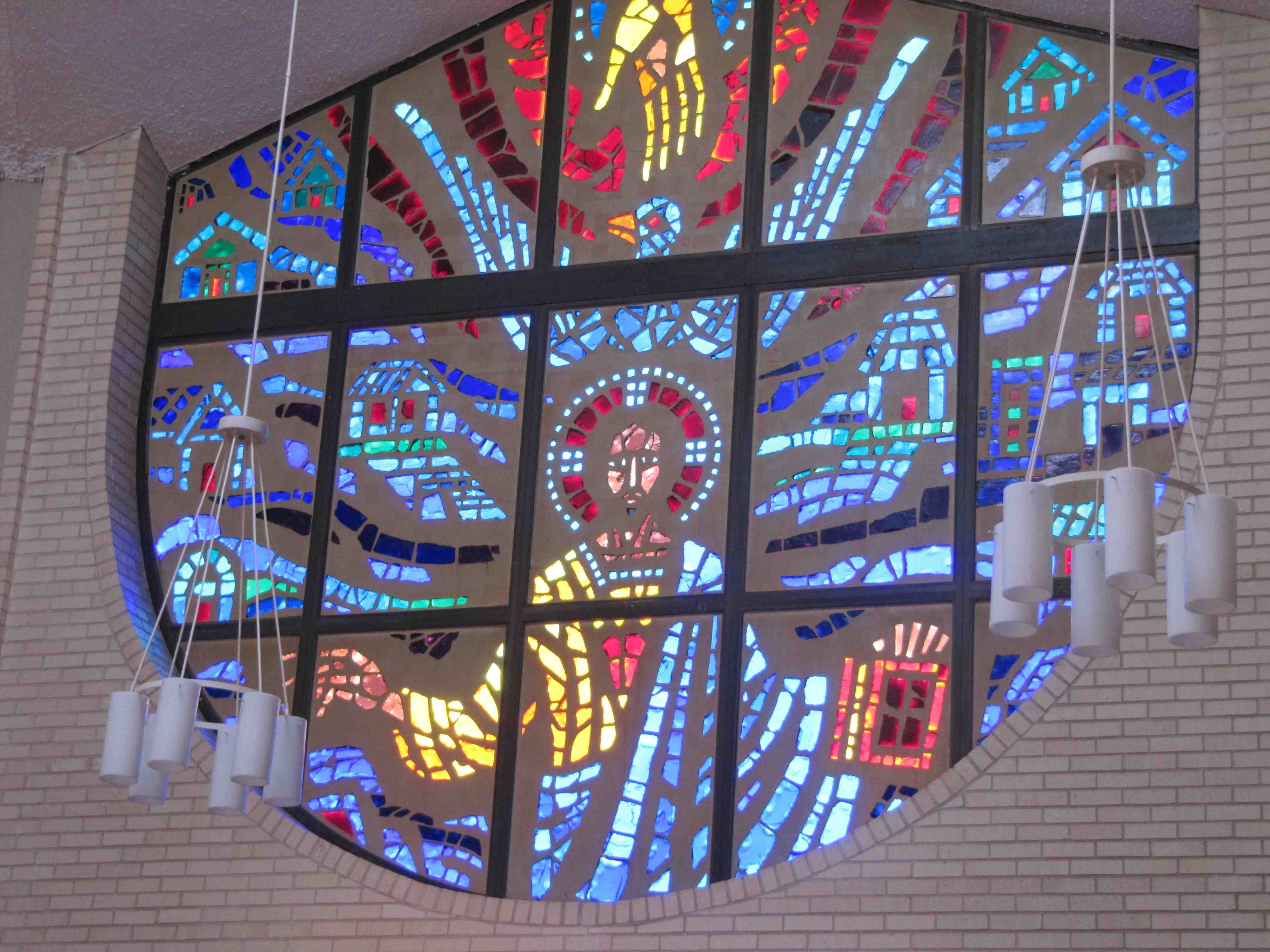
Matthew’s account of the resurrection pays a lot of attention to the soldiers who guard the tomb of Jesus. I think most illustrations of the resurrection in our churches and our books, like the above, follow his account.

There are the soldiers surrounding the tomb, who “became like dead men,”  fearful after an earthquake shook the tomb open and he appeared “like lightning, and his clothing white as snow.” (Mt 28, 2-4)

Matthew wants to assure us that his disciples didn’t steal Jesus’ body away after his death. That was a story circulating in his day and it circulates today.  But Jesus really died, Matthew claims, and the soldiers are his proof.

When Joseph of Arimathea asks to take the body for burial, Pilate first called the Roman centurion to certify that Jesus was dead, according to Mark’s gospel. ( Mk 15,44-45) The Romans certify his death.

 The Jewish leaders are worried his body would be stolen and ask Pilate for a guard to watch the tomb for three days. Pilate tells them to put their own guard at the tomb, a further assurance the body wont be taken. Often in illustrations the guards are pictured as Roman soldiers, but they are really the same kind of guard who came to seize Jesus in the garden and take him to the Jewish leaders. (Mt 27,64-66) 

When the guards go to them to report the body of Jesus is missing, they are told to say his disciples stole the body while they were asleep. (Mt 28.11-15)  The evangelist extends his resurrection account to make sure we know this.

Jesus really died, and he really rose again.

Holy Thursday

On Holy Thursday morning in my community, we would gather at prayer and one by one say, “My brothers, I ask pardon for all the scandal and bad example I have given and beg you to pray that I may make a worthy Easter communion.”

It was a simple request that originated from what Jesus called his disciples to do. After he washed their feet, he told his disciples to “wash one another’s feet.” Besides the forgiveness of God, we need the forgiveness of others.

God is the ultimate source of forgiveness. So, on that great night when this mystery is celebrated, Jesus “fully aware that the Father had put everything into his power and that he had come from God and was returning to God, he rose from supper and took off his outer garments. He took a towel and tied it around his waist. Then he poured water into a basin and began to wash the disciples’ feet and dry them with the towel around his waist.”

No one can wash away our sinfulness but God. Sin is so complex in us; we are so unaware of it. Only God knows it completely.

Yet,  Jesus calls us to join in forgiving.

“Do you realize what I have done for you? You call me ‘teacher’ and ‘master,’ and rightly so, for indeed I am. If I, therefore, the master and teacher, have washed your feet, you ought to wash one another’s feet. I have given you a model to follow, so that as I have done for you, you should also do.”

We need to join God in forgiving. Poor Peter, so unaware of himself. Yet Jesus washed his feet, so patiently. Shouldn’t I bear with those around me?  Shouldn’t I ask that they bear with me?

Tuesday Night: Matthew’s Passion

Notice in Matthew’s account of the Passion that Jesus gradually becomes silent. As the hours before his death go by, his words become fewer and fewer. He works no wonders, no cures. His power seems to slip away and he becomes more and more helpless.

In the garden, he prays a short troubled prayer, over and over: “Father, if it is possible, let this cup pass from me, yet not my will, but your will be done.”

He looks for the comfort of friends but finds none. They fall asleep and seem to not notice.  “Pray that you don’t enter temptation. The spirit is willing but the flesh is weak,” Jesus tells them.

When he’s brought before Caiaphas, the high priest, he doesn’t dispute the false witnesses that bring charges against him. Through his public ministry he’s quick to answer what’s false, but now he’s silent.  Only when Caiaphas directly asks him if he is the Messiah, the Son of God,  does Jesus answer: “ You have said so. I tell you from now on you will see the Son of Man seated at the right hand of the power and coming on the clouds of heaven.”

Similarly, when Jesus is brought before Pilate, he is mostly silent. “Are you the king of the Jews?” Pilate asks him. “You say so,” Jesus answers. Then, he says no more.

He’s silent when the crowd calls for Barrabas; he’s silent when the soldiers scourge him with whips and crown him with thorns. He’s silent when they mock him and lead him away to be crucified.

The only words he says in Matthew’s gospel, as well as in the gospel of Mark, are the final words from psalm 22, which the evangelists quote in Aramaic, as well as Greek:  “My God, my God why have you forsaken me.?”

It’s not that Jesus is unaware of what’s happening to him, or that he has steeled himself and turned away from it all. He’s not retreated into his divinity. “He humbled himself, accepting death, even death on a cross,” St. Paul, the Apostle says.

His silence is his humble acceptance of death and all it entails.

Yet, his trust in God never fails, even when God seems absent.

What kind of cross do we carry? We know it when words and human solutions fail and we can accomplish nothing on our own. Think of the silence that followed the earthquake in Japan. People could hardly take it in. It’s not just  physical pain, it’s more than that.

“My God, my God, why have you forsaken me?”

It was more than a question, Jesus was asking. It was a prayer. As he did in the garden, he threw himself into the hands of God, his Father, who knows all and receives us all. There he was safe and his soul found peace.

As he said to his disciples in the garden, he says to us, “Pray when the cross comes, put yourself in God’s presence our safety when the storm comes.”

Tuesday Night at the Mission

Last night at the mission we thought about death as Jesus faced it and accepted it in the Garden of Gethsemane. “Dying you destroyed our death; rising you restored our life,” we say at Mass. He accepted death and changed it forever. He will  be with us as our Savior at the moment of our death.

The two most important moments of our life are “now and at the hour of death.”

http://www.cptryon.org/prayer/season/agony.html

Tuesday evening our reflections will be on prayer. We need to pray, especially today. Is it possible to pray? How do we pray?

There are some reflections on prayer on Bread on the Waters, http://www.cptryon.org/prayer/index.html and some explanations of the common prayers we say as Christians.

You can learn to help your children pray at that site too.

The important days of Holy Week are coming up this week. Find out about them at this same site. It’s for adults and children.

Here’s a sample for introducing a child to Good Friday:

On Friday,

(We call it “Good”)

Jesus was nailed

to hard, hard wood.

Beneath his cross,

his mother stood

and cried for what they had done.

“Oh, if I could hold him,” she said,

“Hold my only Son!”

“Father, take me,” Jesus said,

“Take me in your hands.”

And God reached down

and took him,

and held his only Son.

“I am God who raises up,

your life has just begun.

I am God of the living,

no grave can hold my Son.”

Parish Mission: New Brunswick, NJ

This afternoon I begin a parish mission at St. Mary of Mount Virgin Church in New Brunswick, NJ, preaching at the Palm Sunday Masses  and conducting mission services till next Wednesday evening.

These days of Holy Week speak with “a well-trained tongue;”  We celebrate the death and resurrection of Jesus, remembering the days when Jesus was arrested, judged unjustly, scourged and crowned with thorns, led to a cross and was crucified.

“He suffered under Pontius Pilate, was crucified, died and was buried. On the third day he rose again,”

We take into our hands palm branches this Sunday, as those who welcomed Jesus into Jerusalem did long ago. We listen to the story of his passion and death; they witnessed what happened to him long ago. They heard his call to faith as we do now. They promised to follow him, but the next days came. How many followed him then?

These are precious days when God’s graces are given and God calls again. The graces are given through Jesus Christ and his life-giving Cross; the call is made through his bruises and wounds and through his empty tomb.

Let us follow him, like those whom he invited into the supper room and received him in bread and wine. Like Simon of Cyrene, let us carry someone’s cross. Like the women who met him on the way, let us have compassion on those who are hurting or are in trouble. Let our hearts be open to the needs of our neighbor and the misery and hopes of our world. Like the thief, who called from his nearby cross, let us ask him for forgiveness. Like Joseph of Arimithea let us tend his body, like Mary his mother, let us hold him in our arms.  Like Mary Magdalen let us see him risen from the death; like Peter and James and John let us be enflamed with new dreams for our world.

From Monday to Wednesday, at 7 PM I will conduct of service of preaching and Benediction, followed by confessions.

The Passionists provide an excellent commentary on the gospel accounts of the Passion of Jesus and the devotions that arise from this mystery at Bread on the Waters. The commentary is by Fr.Donald Senior, CP. and can be found here.