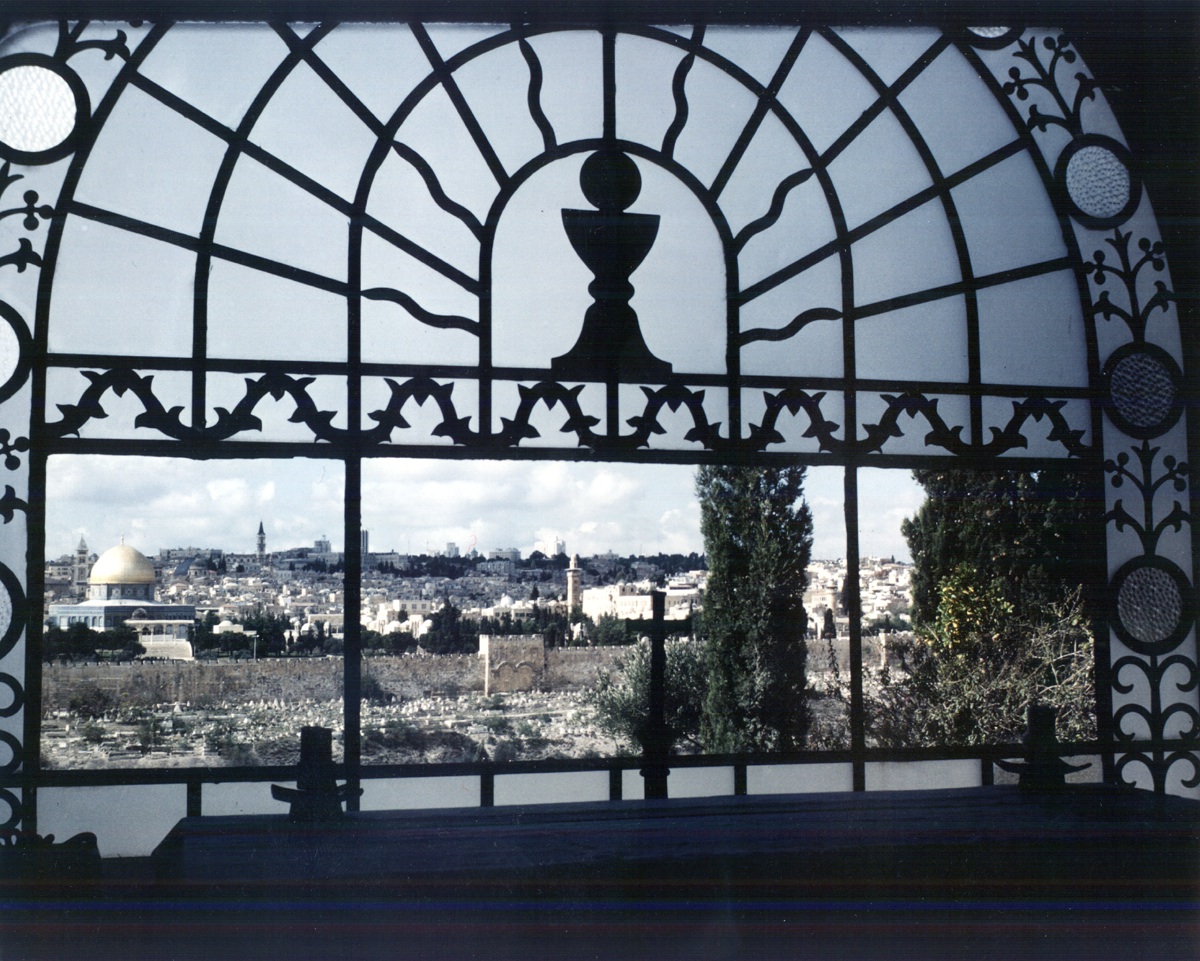
The temple in Jerusalem where Jesus often speaks these last few weeks of Lent has a significant place in Jewish prayers. For example, Psalm 24, from our morning prayer today.
The earth is the LORD’S and all it holds,
the world and those who live there.
For God founded it on the seas,
established it over the rivers.
Who may go up the mountain of the LORD?
Who can stand in his holy place?
“The clean of hand and pure of heart,
who are not devoted to idols,
who have not sworn falsely.
They will receive blessings from the LORD,
and justice from their saving God.
Such are the people that love the LORD,
that seek the face of the God of Jacob.”
Lift up your heads, O gates;
rise up, you ancient portals,
that the king of glory may enter.
Who is this king of glory?
The LORD, a mighty warrior,
the LORD, mighty in battle.
Lift up your heads, O gates;
rise up, you ancient portals,
that the king of glory may enter.
Who is this king of glory?
The LORD of hosts is the king of glory.
The temple was not considered a world apart from ours to the Jews but a place where God the Creator was present, who is always at work recreating the world. So this psalm begins by recalling that the earth is the Lord’s who founded it on the seas and established on the rivers. We know little about the temple’s ornamentation, but it would not be surprising to find it ornamented with symbols of the earth.
In our churches the great signs of the earth are bread and wine.
The temple was a place of blessing, where hearts and hands were blessed to take part in the Creator’s glorious work.
Yet, creation has a destiny beyond the form it has now, and that destiny is also signified in the temple. “This temple has two parts, one is the earth we inhabit, the other is not yet known to us mortals .” (St. John Fisher)
Given its importance, it’s understandable why Jesus spends so much time in the temple, according to John’s gospel. As the Word of God, he is the one “through whom all things were made.” He is the one who lifts up this world to a destiny “not yet known to us mortals.”
Tag Archives: Jerusalem
God’s Forgiveness
Time and place are tools that help us understand the gospels. On our lenten journey, we are in Jerusalem with Jesus. From the 4th week of Lent, John’s gospel, describing what Jesus did in the Holy City, is the preferred source for our Mass readings on Sundays and weekdays before Easter.
Unlike the synoptic gospels which present him making a single journey to Jerusalem, John’s gospel indicates that Jesus went often to the Holy City, as one would expect. He’s more than a dutiful Jew visiting the temple to celebrate the Jewish feasts, though. He’s more than a simple Galilean peasant from Nazareth caught in a random attempt by the city’s leaders to squelch a possible revolution. In John’s gospel, he is the Word made flesh, the Savior of the world, replacing the temple and its worship; he’s God’s presence on earth. “I am.”
Going to Jerusalem to celebrate the feasts was essential for Jesus’ mission. During the Feast of Tabernacles, the Feast of the Dedication of the Temple, and the Feast of Passover he makes startling claims before the Jewish people and their leaders. The false witnesses who testify later at his trial before the Jewish Sanhedrin are not far from the real claim he made; he came, not to destroy the temple, but to be its replacement.
Jesus’ meeting with the Samaritan woman (3rd Sunday A), which John describes at length, takes place as he returns from Jerusalem after driving out the buyers and sellers from the temple during the feast of Passover. He is the purified temple and all will be drawn to him. The Samaritan woman and her neighbors who welcome him stand for all the outsiders called to worship “in spirit and in truth.”
The temple was the place where sin was forgiven. Today’s reading about the woman caught in adultery (Monday, 5th week) takes us to the temple area and reminds us that Jesus, the Lamb of God, takes away the sin of the world. He is a sign of God’s mercy to the woman standing before him, and to all of us. His forgiveness is far beyond the forgiveness of the scribes and pharisees who would stone the woman to death, according to the Law of Moses.
God’s forgiveness goes far beyond their forgiveness–and far beyond ours too.
The Second Tomb
Right down the street from where I’m staying these days–in Bethany–is the traditional tomb of Lazarus. Jesus raised Lazarus from the dead, you remember, and stories of that famous incident and other events from Bethany figure large in the New Testament.
I went over to the Franciscan bookstore near the Joppa Gate this morning and got a small book on Bethany which goes into the history of this tomb and what archeologists have found as they dig and dig. Actually, they have stopped digging–for the present.
Surely, like the tomb of Jesus, the tomb of Lazarus would be remembered. Egeria, the 4th century nun, who was to all these places, says that there were so many people at Lazarus’ tomb when she was there that they packed the whole church and all the fields around. For Christian pilgrims Lazarus played a vital part in the story of Jesus.
Right now, the Franciscans, the Greek Orthodox and the Muslims (who venerate Lazarus, by the way) are all around his tomb together. It looks like the same war over turf that goes on at the Church of the Holy Sepulcher.
Raising Lazarus from the dead was the final sign God gave before raising Jesus from the dead, John’s gospel says. It’s a miracle telling us we shall share in his resurrection.
Political reasons weren’t the only thing that brought Jesus to his death, it was his claim to be the way, the truth and life. The miracle brought people from Jerusalem to see a man who came from the dead and the one who raised him. The authorities reckoned that Lazarus would have to be taken care of too.
The believers were here in Bethany; not many in the temple, according to John’s gospel. Like Martha, carrying her pots and pans, they believed he was the Messiah, the Son of the Living God, who brings life to the whole world. That’s why Bethany, and Lazarus, are important.
I spent today at the Church of the Holy Sepulcher, watching the crowds pile into the dark church and sat for some time in “Adam’s Cave” next to Calvary on a bench looking at the exposed rock where the crucifixion took place. A stuffy guide came in with two Englishmen and said, “Look at that fellow over there, he’s sitting on the tomb of Baldwin 1, one of the first Crusader rulers of Jerusalem and doesn’t even know it.” I went back and looked up Jerome Murphy O’Connor who says the Greeks removed that tomb in 1809.
So much for experts.
Bethany, November 15
I arrived at the Passionist house of St Martha in Bethany, late this morning. Here’s where I am in gospel terms: “When they drew near Jerusalem and came to Bethphage on the Mount of Olives, Jesus sent two of his disciples, saying to them, ‘Go into the village opposite you, and immediately you will find an ass tethered, and a colt with her. Untie them and bring them to me. And if anyone should say anything to you, reply, ‘ The master has need of them. Then he will send them at once.”
(Mark 21, 1-9)
The gospel continues that the disciples did this and a large crowd welcomed him, some spreading their cloaks on the road, others cutting branches to strew before him.
“The crowds preceding him and those following kept crying out and saying: ‘Hosanna to the Son of David, blessed is he who comes in the name of the Lord.’”
So here’s where Jesus started his Palm Sunday entrance into Jerusalem. He knew this place well, must have been a place where they believed in him. In Bethany he was accepted, at least as “Son of David.”
As I traveled here, courtesy of Catholic Travel, the streets to Bethphage were crowded with Muslims getting ready for their major feast of Eid-Ul_Adha, the Feast of Sacrifice, celebrated for the next several days at the conclusion of the Hajj. The sacrifice celebrated is the Sacrifice by Abraham of his first born son Ishmael. It’s a joyful feast that calls Muslims to a spiritual awakening. Cf. http://www.religioustolerance.org/isl_feast.htm
We know too little about Muslims and their spirituality. The website cited above quotes an western newspaper account some years ago warning of terrorist attacks at the conclusion of this feast. It’s like predicting Christian terror attacks after our easter celebrations. The feast actually calls for forgiveness of enemies and peace with your neighbor. Presents given out and food for everyone, especially the poor.
You could hear a special call to celebration in the muzzim’s call this evening to this Muslim neighborhood.
Our visitors from St. Marys all got off safe from the hotel early this morning; now they are winging their way home.
At The Tomb Of Jesus: November 14
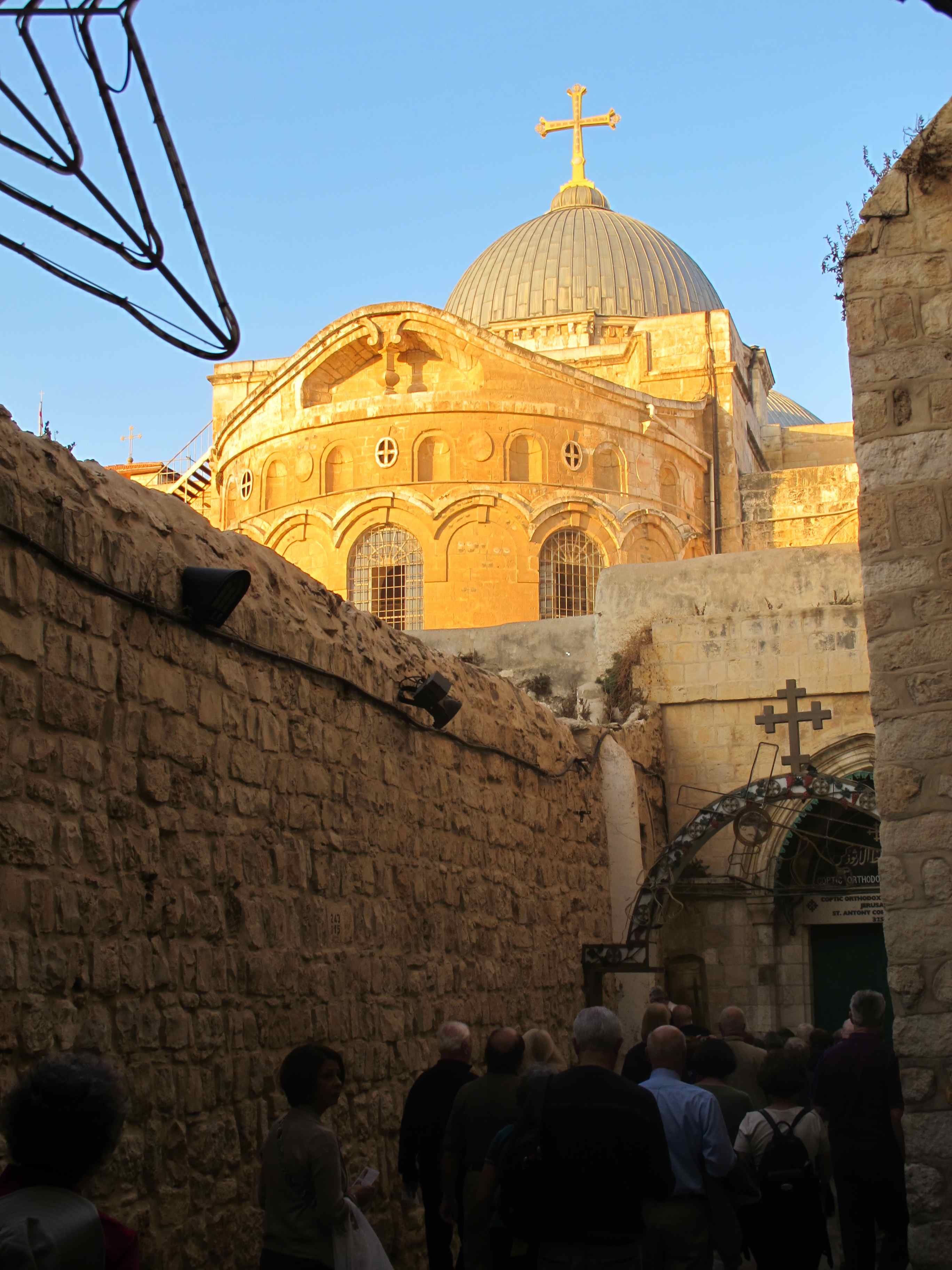
Early this morning, Sunday, like the women in the gospel we went to the tomb of Jesus at the Church of the Holy Sepulcher, entering the Old City by way of Herod’s Gate. Hardly any shops were open on the narrow streets before the Via Dolorosa except the bakeries where they were making fresh bread.
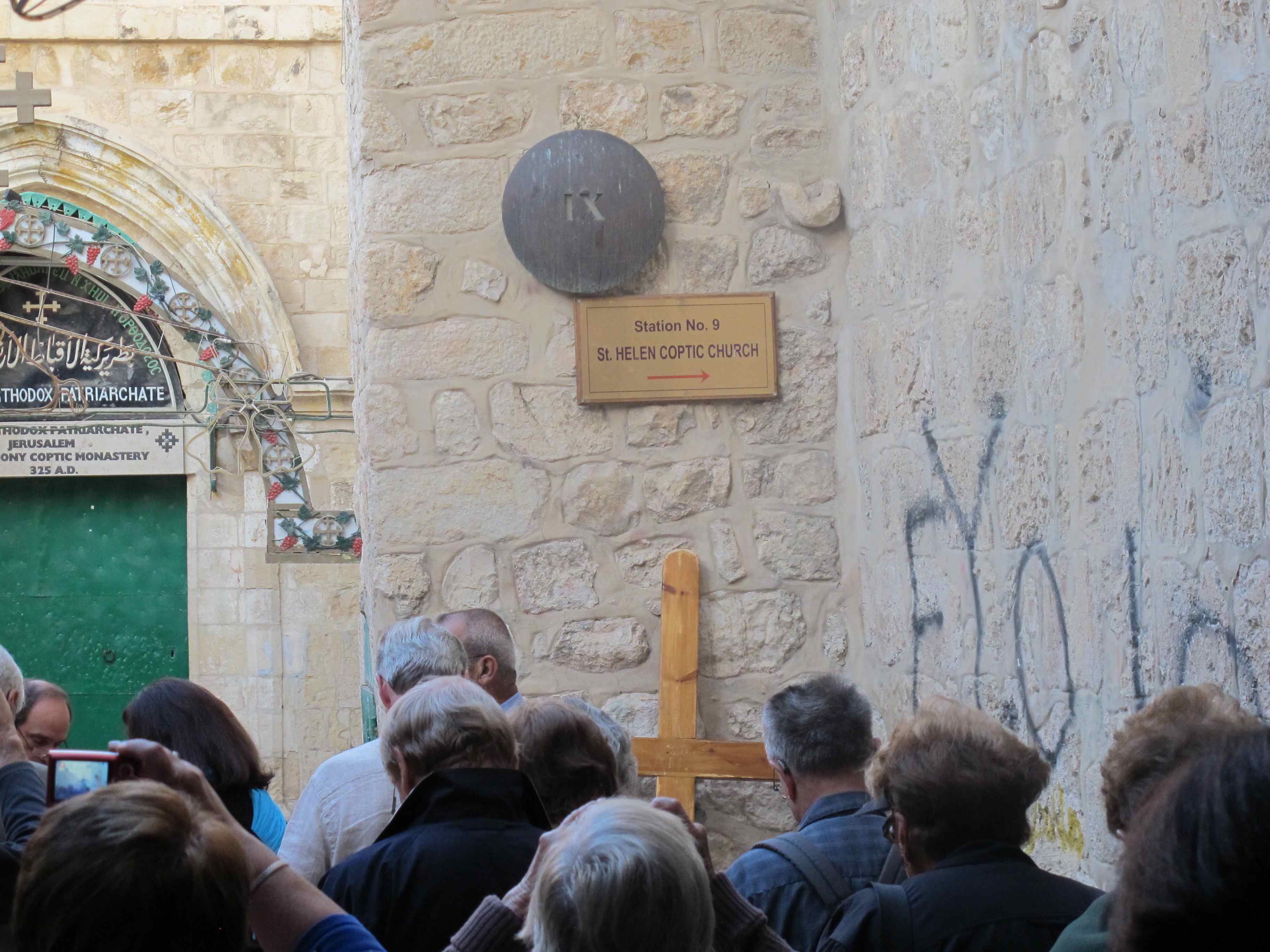
We walked the quiet dark street, the Via Dolorosa, the Street of Sorrow, up to the church and prayed the Way of the Cross marked out on different stations along the way.
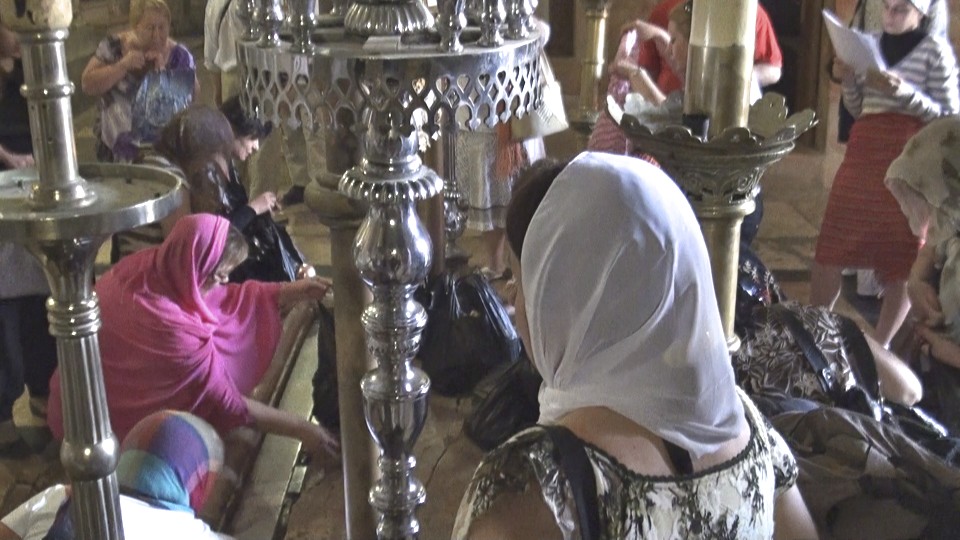
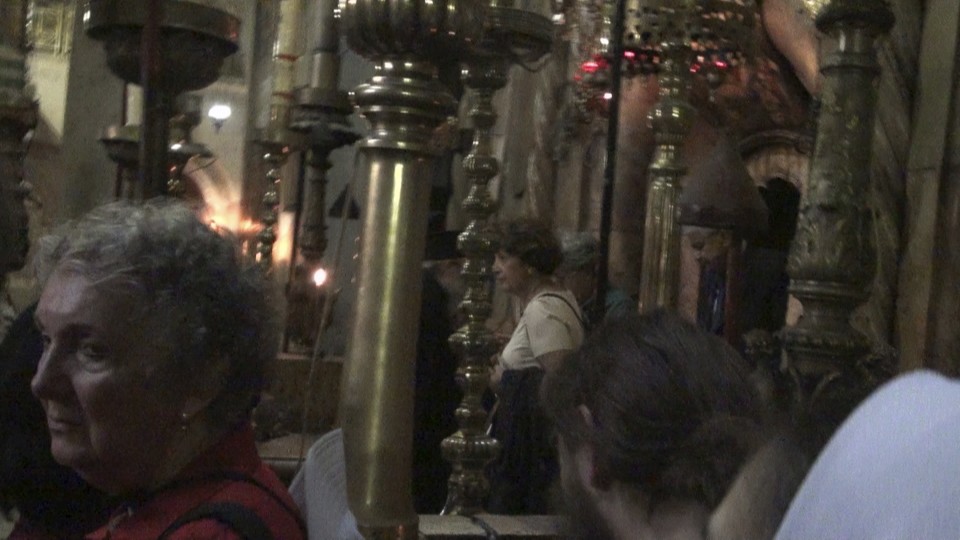
We entered the church through a side door to a small chapel where an Ethiopian liturgy was going on shrouded with clouds of incense and celebrated with ancient chanting. They are here with the Armenians, the Copts from Egypt, the Greek Orthodox, and Roman Catholics– all with their Sunday liturgies in progress in different parts of the church.
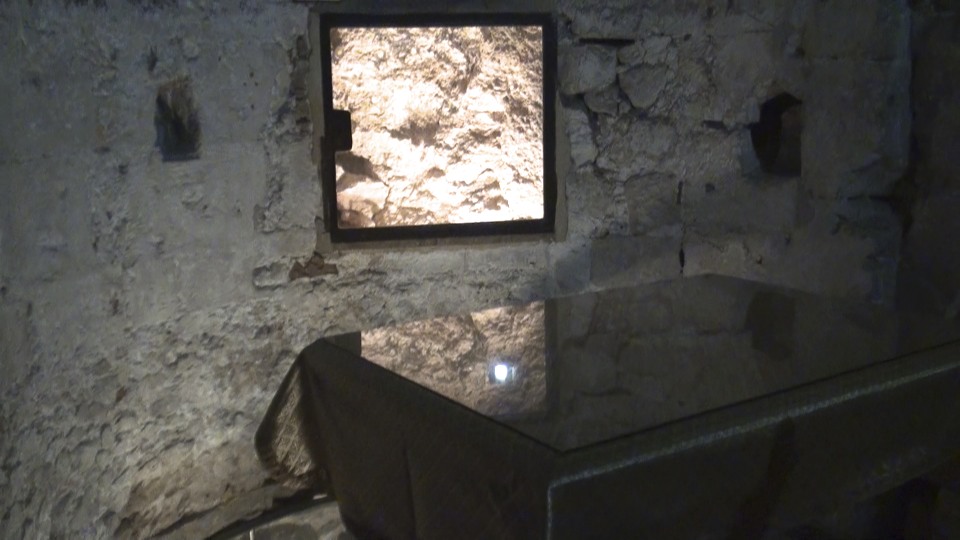
Since the lines were not yet long going into the tomb of Jesus, we got in line and entered the tomb in small groups of three or four.
Then we had Mass in the Roman Catholic Chapel, where we read the Easter gospel from Mark that tells of the women coming to the empty tomb on Easter morning.
From the church we went to the Jaffa Gate, boarded the bus, and headed for our hotel for breakfast.
Tomorrow most of us go home. I stay for a few days with the Passionists at Bethany.
Exploring Jerusalem: November 13
We went early this morning at 7:30 to the Western Wall, where many Jews were devoutly praying on the Sabbath. The Presence of God dwells beyond the wall, according to the Jews. Women and men pray separately at the wall. No pictures were allowed today.
The Temple Mount was closed today so we couldn’t visit it.
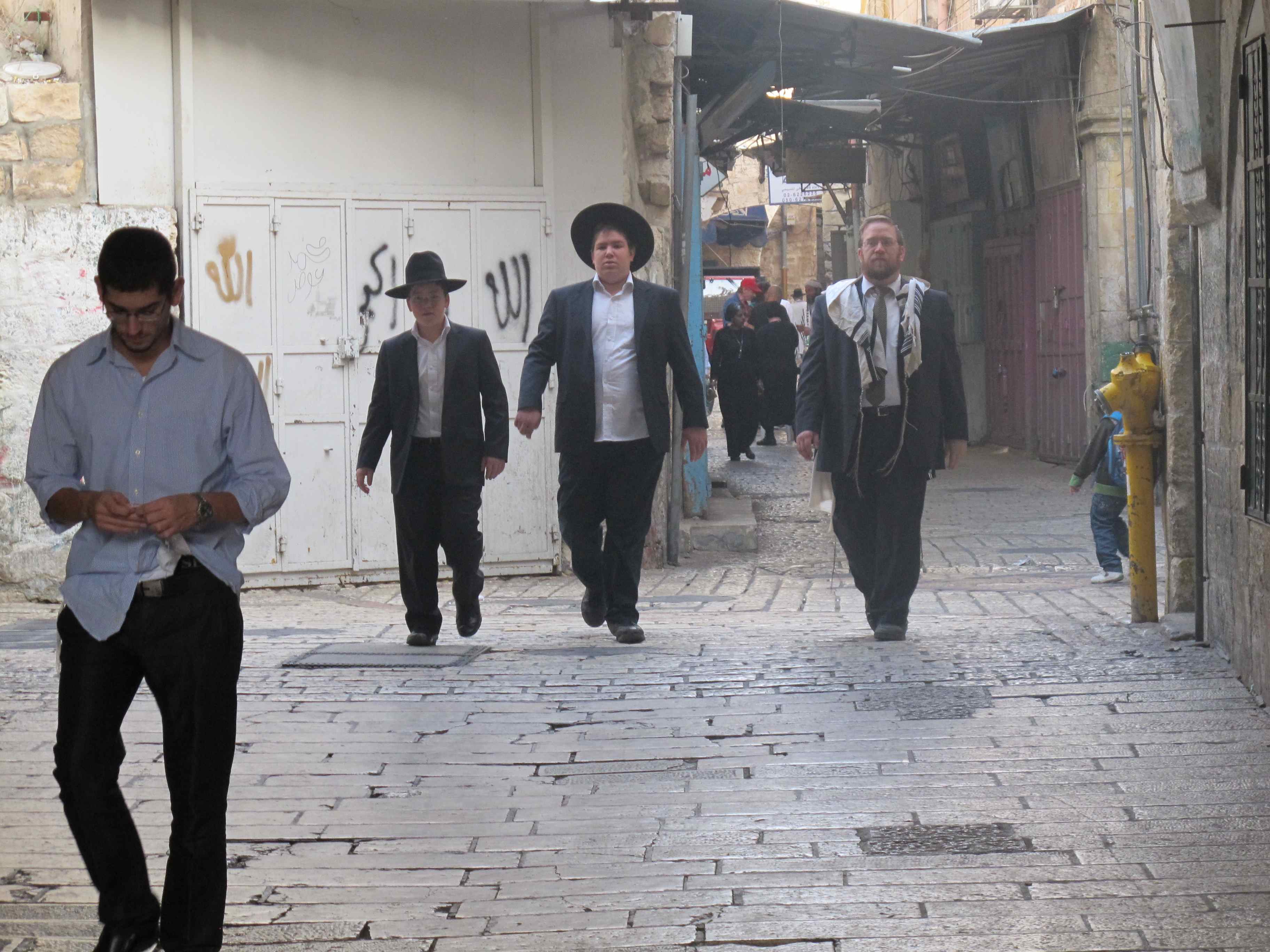
We walked then through the narrow streets of the Old City as the Muslim and Christian shops were opening. Joseph gave us some freshly baked Jerusalem bread to eat. By the time we reached the Via Dolorosa, the traditional path that Jesus took to his death, the streets were crowded with pilgrims, from Brazil, Russia, Korea, Singapore and Eastern Europe, as well as natives of Jerusalem.
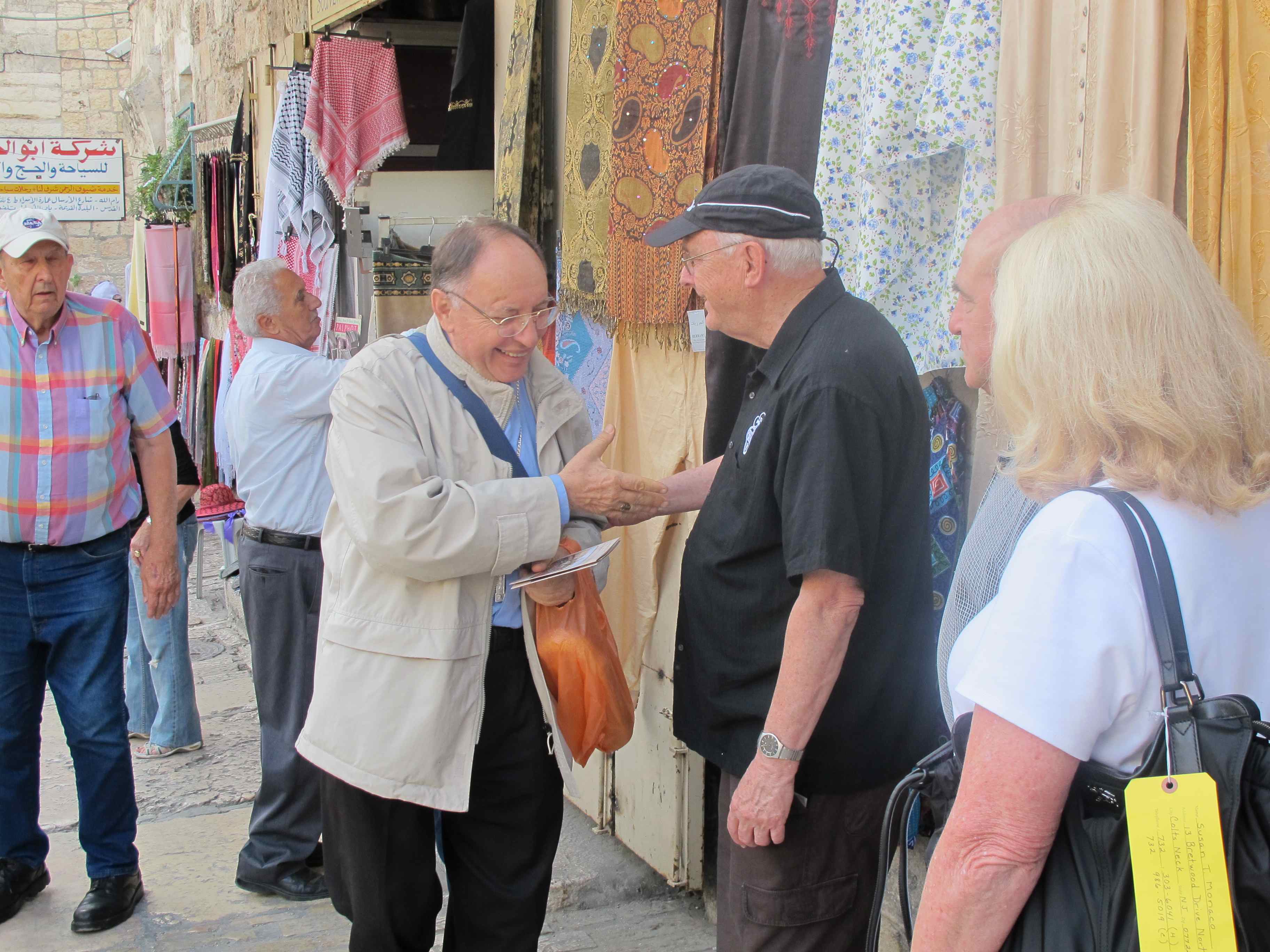
I met a bishop from Brazil who knew the Passionists there.
We walked the Via Dolorosa to the Convent of the Sisters of Sion, an order of nuns founded by a Jewish priest-convert, whose purpose is to work for better relations between Christians and Jews. Their convent is built on the site of the Fortress Antonia, where Roman soldiers were garrisoned at the time of Jesus. While excavating for the convent years ago, an early street and part of the soldiers’ barracks were uncovered.
In this place early pilgrims, entering the city from the Mount of Olives, commemorated the trial of Jesus by Pilate, his scourging and mockery by the soldiers–the beginning of his way to Calvary carrying his cross, as Joseph explained.
Afterwards, we entered the area of Bethesda, where Jesus cured the paralyzed man who had been waiting for 38 years to be cured but no one would help him into the healing pool when it bubbled up. (John 5,1-19) The ruins of the pool from the time of Jesus have been excavated, along with an ancient Byzantine church built over the ruins, but you have to follow the ground plan carefully to sort them out, because centuries overlay centuries.
The Crusaders’ church of St. Ann, built in the 12th century, is one of the most beautiful churches in Jerusalem. When we were there it was filled with the songs of the different pilgrim groups taking advantage of its wonderful acoustics.
We went from there by bus to the Church of St. Peter in Gallicantu on the eastern slopes of Mount Sion where we celebrated Mass. Some believe it was here that Jesus was brought before Caiaphas, the High Priest, and accused of blasphemy. In the area luxurious homes from the time of Jesus have been found, so it is likely that prominent Jewish leaders lived here.
Next to the church is a steep path down from Mount Sion to the Kidron Valley below, which dates to the time of Jesus, and it could have been the path he took after the Last Supper and the path those who seized him in the garden took to bring him to Caiaphas.
The Gallicantu church recalls the condemnation of Jesus by the Jewish leaders and also the denial of Peter. The weathervane of the rooster over the church is a reminder that a cock crowed after Peter denied Jesus three times.
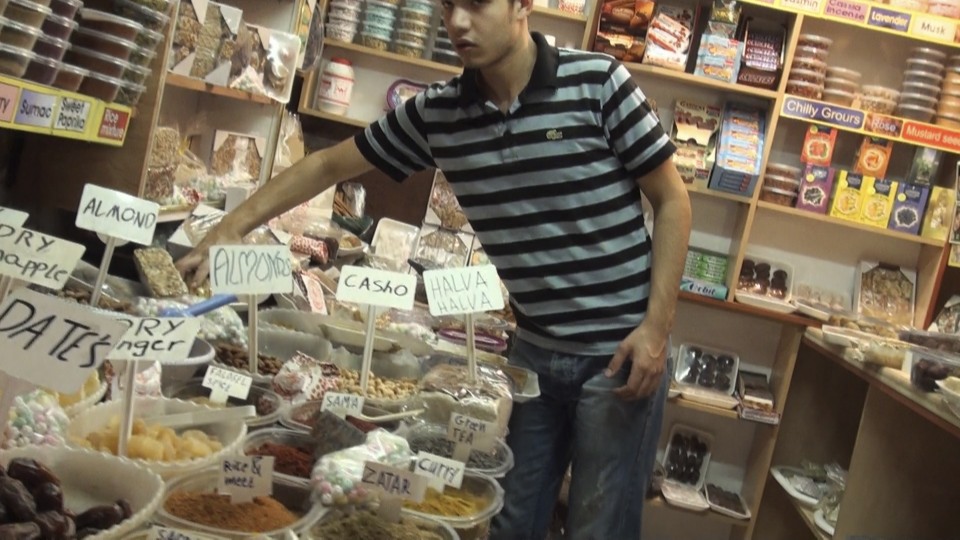
The afternoon was devoted to plundering the local stores.
In the evening we went to a Church of the Gethsemani for a holy hour. In the dark church–we were the only ones there–we read the gospel accounts of Jesus in the Garden from Matthew, Luke and John as we sat around the open rock before the altar. Each of the evangelists tell the same story but draws a different lesson. In Matthew’s account Jesus relies on his Father for everything, and so leads his followers to go to the Father for life. In Luke’s account, Jesus is strengthened from heaven for what he must do, and so are we when we pray. In John’s account, Jesus is already glorified, even in the midst of his sufferings. God’s sovereign power never fails, even in the midst of suffering.
Let’s Go To Bethlehem
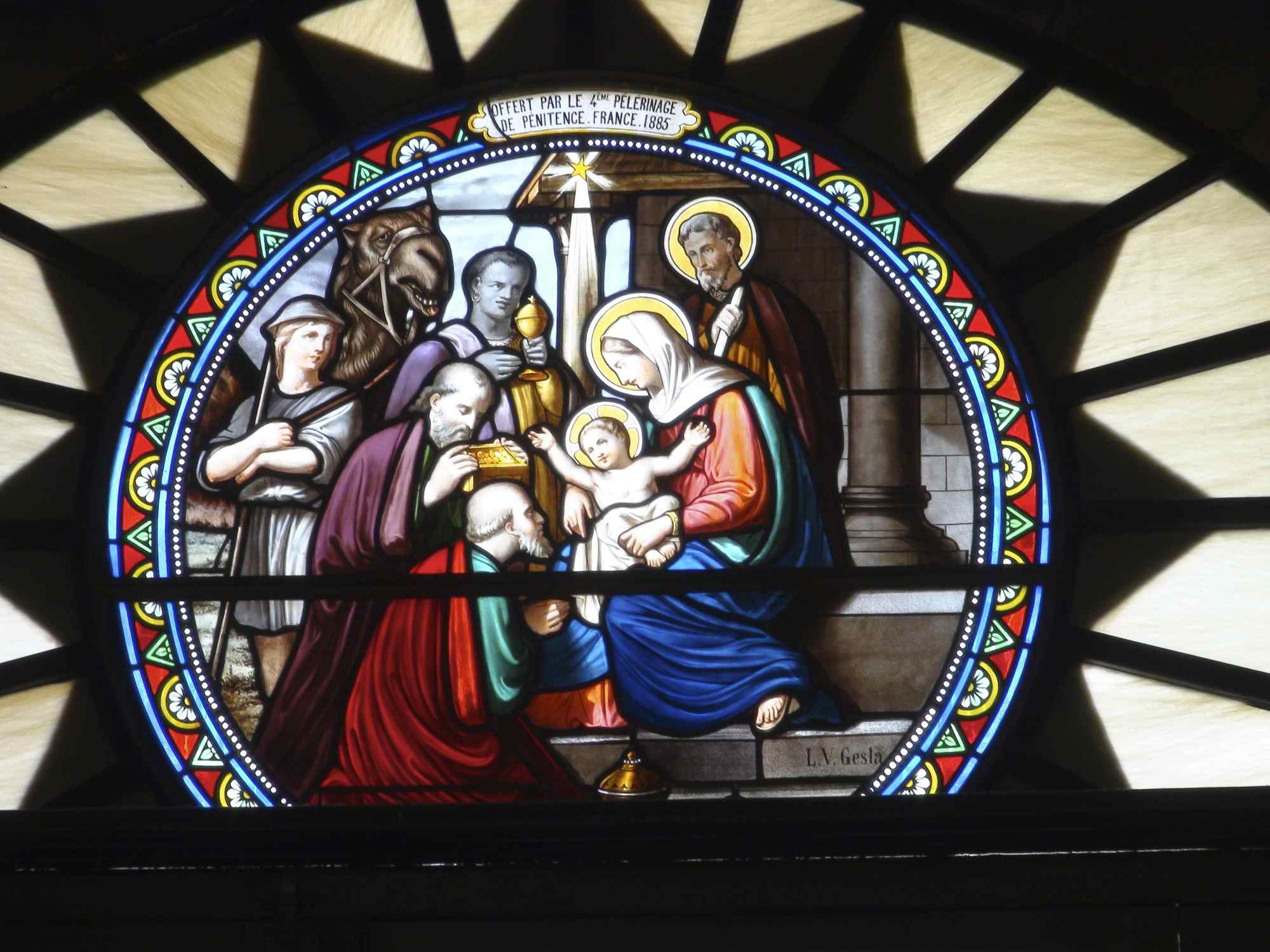
We started our visit to the Jerusalem area with a visit to Bethlehem where we had Mass at the beautiful little cave-chapel in the Franciscan site at Shepherds’ Field. We sang with the shepherds “Joy to the World” and read the Christmas story from Luke’s gospel.
There’s something about hearing that gospel there.
To get to the place we had to pass through the security wall and the Israeli checkpoint. When we left Bethlehem two young Israeli soldiers carrying guns boarded our bus at the checkpoint to take a look around.
Much building going on in the Bethlehem area. After Mass we headed for the ancient Church of the Nativity to visit the cave where tradition says Jesus was born. Long lines of people from many places waited to go down to the shrine. Here we are squeezed in with the Russians.
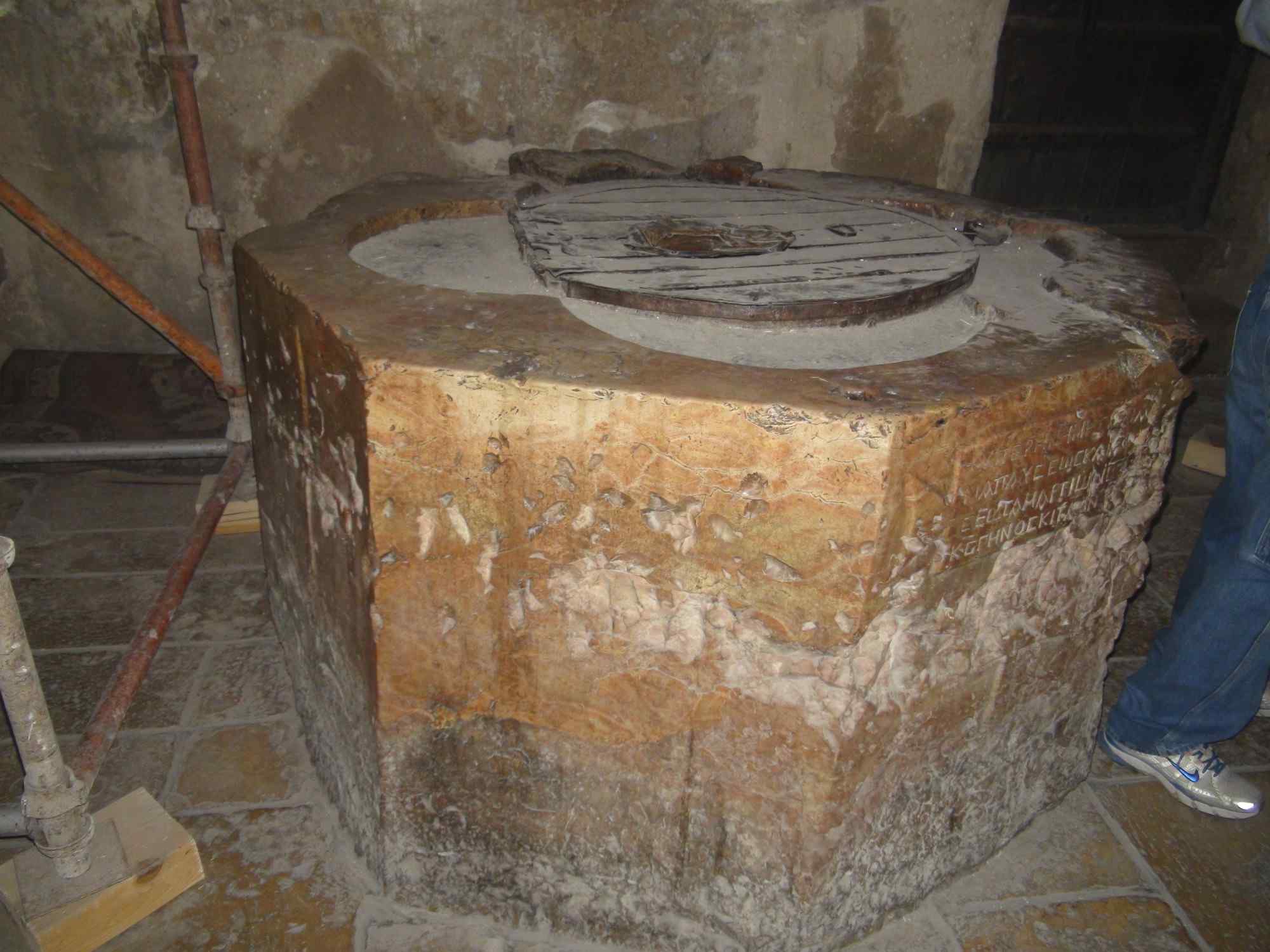
This is one of Christianity’s oldest churches. Renovations to the church are going on now, which I understand are being paid for by the Palestinian Authority. I found the baptismal fount which must go back at least to the 5th century. They’re probably going to do something with it.
After all these holy things there was nothing left to do but shop, which we did in a Bethlehem store that carried a profusion of religious gifts. Their stock on the Dow went up considerably after our visit.
If you ever wondered about the difference between men and women. The men were all outside the shop waiting; then the women came out with their treasures.
Then, a lunch at a new place near the state museum. Finally, a visit to the Holy Land map at the museum which features Jerusalem as it was shortly after the time of Jesus. We made our weary way to see the exhibit on the Dead Sea Scrolls at the museum and headed back to the hotel.
Holy Land Pilgrimage
Itinerary: November 5-16
Pilgrims in the Holy Land
Over the centuries, countless Christian pilgrims have gone to the Holy Land. Among the first were women like Helena, the mother of the Emperor Constantine, who is largely responsible for building Christian shrines over places like the Tomb of Jesus, Calvary and Bethlehem in the early 4th century AD.
A nun from Gaul, Egeria, visited the holy places later in the 4th century and left a wonderful account of her visit. Here’s what she did at every place:
“It was always our practice when we managed to reach one of the places we wanted to see to have first a prayer, then a reading from the scripture, then to say an appropriate psalm and another prayer. By God’s grace we always followed this practice whenever we were able to reach a place we wanted to see.”(9)
We are going to do that too. At most of the places, we will read from the scriptures associated with the place and celebrate Mass. Though our trip is primarily a pilgrimage, it’s also an opportunity to broaden our understanding of this part of the world and its place in our history.
On Egeria and other early women pilgrims: http://www.umilta.net/egeria.html
http://www.ccel.org/m/mcclure/etheria/etheria.htm
Where are we going?
Here’s an outline of the places we’re going to and the scriptural readings at Mass. I’ll provide some material beforehand and as we go along. We’ll have a professional guide with us who is certified by the State of Israel.
The guidebook I follow is The Holy Land: An Oxford Archaeological Guide, by Jerome Murphy-O’Connor, OP NY 2008
The Gospel of Matthew is an important gospel to have as a reference in Galilee. The Gospel of John is important for Jerusalem.
Nov. 5 Newark departure
Nov. 6 Tel Aviv to Tiberias on the Sea of Galilee, where we will be staying for four days.
The drive from the airport to Tiberias is about two hours. Israel and the occupied territories are about the size of New Jersey, so most of us should feel right at home. Our trips to different sites won’t be too long in Galilee– less traffic than the Garden State Parkway.
Nov. 7 Tiberias to Cana. (Mass) Is 62,1-5 Jn 2,1-12. John’s gospel also recalls a Jewish ruler came to Jesus at Cana asking him to cure his son. (Jn 4,46-54)
Then to Nazareth, now a city of 70,000 people, mostly Muslim, and the capital of Galilee. At the time of Jesus it was an insignificant village of about 500.
Nov. 8 Mt Carmel, where the prophet Elijah, who is closely connected to Jesus, defeated the priests of Baal and King Achaz and his Queen Jezebel. In the ancient world, mountains like Mt. Nebo and Mt. Tabor, were places to get your bearings. (Mass) Sirach 48,1-15 Mt. 16,13-20 From Mt. Carmel to a baptismal site on the River Jordan near the Sea of Galilee.
Nov. 9 Sea of Galilee sites where Jesus lived, taught, gathered disciples, left a memory. Mt. of Beatitudes, Primacy site along Sea of Galilee, (Mass) Jn 21,1-19 Acts 5, 27-32,40-41 Tabgha, Capernaum, Peter’s house. Synagogue.
Nov. 10 Tiberias to Mt. Tabor, where Jesus was transfigured. (Mass) 2 Pt 1,16-19 Mt 17,1-9) Jericho, Qumran, Jerusalem.
Nov. 11 Bethlehem (Mass: Shepherd’s Cave) Luke 2,1-2 Tit 2,11-14
Dead Sea Scrolls: Mystery Solved? Cf: National Geographic Special, Robert Cargill, 60 years ago.
http://video.nationalgeographic.com/video/index.html
Nov. 12 Jerusalem, Old City Western Wall, Temple Mount, St. Stephen’s Gate, Upper Room (Mass) Mk 14,12-16.22-26 Heb 9,11-15 Jesus is the new Temple.
Nov. 13 Mount of Olives. Peter in Gallicantu (Mass) Jn 18,15-27 Is 50,4-9a
Nov. 14 Via Dolorosa, Church of Holy Sepulcher (Mass)
Nov. 15 Return to Newark
The Political Situation
We are going to the Holy Land as negotiations between the Israeli and the Palestinians have reached a critical point. You may find these background stories from the website of the BBC helpful to understand the current situation:
Obstacles to Peace: Jerusalem
Obstacles to Peace: Borders and Settlements
Obstacles to Peace: Refugees
Obstacles to Peace: Water
http://www.bbc.co.uk/news/world-middle-east-1110179
There’s an important Synod on the Middle East involving Catholic and other religious figures that convened at Rome now to discuss the situation of Christians in that area. You can follow it at the Vatican Radio site: http://www.radiovaticana.org/en1/index.asp
Listening to One Teacher
Jesus spoke to the crowds and to his disciples, saying,
“The scribes and the Pharisees
have taken their seat on the chair of Moses.
Therefore, do and observe all things whatsoever they tell you,
but do not follow their example.
For they preach but they do not practice.
They tie up heavy burdens hard to carry
and lay them on people’s shoulders,
but they will not lift a finger to move them.
All their works are performed to be seen.
They widen their phylacteries and lengthen their tassels.
They love places of honor at banquets, seats of honor in synagogues,
greetings in marketplaces, and the salutation ‘Rabbi.’
As for you, do not be called ‘Rabbi.’
You have but one teacher, and you are all brothers.
Call no one on earth your father;
you have but one Father in heaven.
Do not be called ‘Master’;
you have but one master, the Christ.
The greatest among you must be your servant.
Whoever exalts himself will be humbled;
but whoever humbles himself will be exalted.”
This part of Matthew’s gospel is set in Jerusalem, far from the quiet hills of Galilee. As Jesus and his disciples come into the hostile city, they’re confronted by its leaders and therefore, in this passage. Jesus instructs his disciples how to deal with a world that’s pitted against them.
High-ranking priests and temple authorities controlled almost everything in that city then. Later the pharisees became the leading authorities in Judaism and, anticipating the future, the evangelist sees them as the main adversaries of Jesus and his disciples.
In unfriendly Jerusalem, where he would go to his death, Jesus tells his disciples to remember their teacher. His message is meant for us too.
We may not live in Jerusalem under a religious elite, but we live in a society that shapes us more than we know. Our elites are of another kind–who love honors and privileges too, and like being seen. We imagine ourselves free, yet we face steady pressure from so much around us to turn from the teachings of the gospel.
“Do and observe all things whatsoever they tell you, but do not follow their example,” Jesus says to his disciples in Jerusalem. They’re not to leave the challenging world they live in; they’re to be “the light of the world.” They’re to engage their time, but not follow its lead. They have their Teacher.
Neither should we to turn from our world. We’re to shed light on it too, and we will, if we listen to Jesus Christ. Lent is a time to turn to our one Teacher.
Sepphoris

Today’s gospel from Luke says that Mary and Joseph customarily took the Child up to Jerusalem for the yearly Passover feast. But was Jerusalem the only place they took him? Surely, they had friends and relatives in Cana and Capernaum, as well as in the Judean hill country, whom they visited from time to time? I don’t think they were a reclusive family hiding in the hills.
What about Sepphoris– Zippori the Israeli call it today– the capital of Galilee at the time, about five miles away from Nazareth, an easy walk for people then? According to one tradition, Mary’s family came from there. For the past decade, archeologists have been uncovering the ruins of this fascinating city.

Sepphoris was a flourishing place in Jesus’ day where, unlike Nazareth, gentiles and Jews lived together. Like other cities it was built on a hill surrounded by fertile valleys; looking east you could see the Mediteranean Sea. The city had a theater that sat 4,500 people, gleaming mansions with sparkling mosaics, streets lined with shops and public buildings. It was a center for tax-collecting and trade.

For sure, Galilee’s ruler, Herod Antipas, had his father’s taste for building. As in Jerusalem, building must have been going on there all the time. Did Joseph, a “builder” according to the gospel, work there? Did he bring his Son along with him? Did people from Nazareth bring their produce to the city to sell to the residents who smiled at the “simple” Nazarenes? Did Jesus see there how proud bureaucrats, like Pilate and Herod,”made their authority felt.” Did he watch the tough Roman legionnaires based there and recognize how futile a fight against them would be?
Sepphoris must have been one of the places, like Jerusalem, where Jesus learned about the world. The two wise teachers who mostly helped him understand what he saw were Mary and Joseph, “simple” people from Nazareth. But there must have been other family members and friends too who brought him up.
Angels didn’t.
The Feast of the Holy Family reminds us it’s not where you go to school, or where you live, or what things you have that’s important. It’s who brings you up?