Tag Archives: Holy Spirit

The Spirit Works in Green Time

FullSizeRender

Green is the liturgy’s color for ordinary time. Not white, the bright light of Eastertime, or red the color of blood and fire. or purple the color of penance. Green is earth’s color, color of slow growing trees and grasses, of ordinary time.

An unknown 4th century spiritual writer describes the ordinary ways the Holy Spirit works in us.

” ‘In varied and different ways’ invisible grace leads us. Ordinary time doesn’t mean that every day’s the same.  Sometimes we find ourselves sad at the state of things; sometimes we joyfully hold the whole world in our arms. Sometimes we feel helpless; sometimes we think there’s nothing we can’t do. Sometimes we’re brave; sometimes we escape into the supposed safety of ourselves looking for peace.

.. The soul becomes like any other human being.”

Which means, I guess, that we don’t feel spiritual at all.

Far from taking us away from the human condition, the Spirit leads us by human steps in human time. Ordinary time is the natural roller-coaster of life, all right, but the Spirit leads us on.

That’s why the psalms are such wonderful prayers. They’re the prayers of ordinary time. They take us from one human experience to another. If you don’t experience what a certain psalm describes, wait awhile–you will.

Green is the Season

Green is the season after Pentecost.
The Holy Ghost in an abstracted place
spreads out the languid summer of His peace,
unrolls His hot July.
O leaves of love, O chlorophyll of grace.
Native to all is this contemplative summer.
The soul that finds its way through Pentecost
knows this green solitude at once as homeland.
Only the heart, earth held and time engrossed,
dazed by this unforeknown and blossoming nowhere, toubles itself with adjectives like “lost”.

Jessica Powers, 1954


Green is the season after Pentecost.The Holy Ghost in an abstracted placespreads out the languid summer of His peace,unrolls His hot July.O leaves of love, O chlorophyll of grace.Native to all is this contemplative summer.The soul that finds its way through Pentecostknows this green solitude at once as homeland.Only the heart, earth held and time engrossed,dazed by this unforeknown and blossoming nowhere,
Like a Dove

DSC00804

The Holy Spirit descends on Jesus at his baptism in the form of a dove, the gospels say. Scholars like Luke Timothy Johnson in his commentary on St. Luke’s gospel seem puzzled by the description. What’s the explanation?  “Such is the nature of symbols–all are possible,” Johnson writes.

May I hazard an explanation? Doves are regular visitors at my window and at our bird-feeder outside. I notice how confident and unafraid they seem to be, so different from the nervous sparrows flitting from place to place. As far as I can see, the doves are without the usual signs of power, sharp talons and strong wings. What’s their secret?

St. Gregory of Nyssa seems to point to a fearless love in his Commentary on the Song of Songs:

“When love has entirely cast out fear, and fear has been transformed into love, then the unity brought by our Savior will be realized, for all will be united with one another through their union with the supreme Good. They will possess the perfection ascribed to the dove, according to our interpretation of the text “one alone is my dove, my perfect one.”

A fearless, humble love, unafraid of chaos, brings peace. Is that why Noah chose the dove to go into the world engulfed by the flood and not a lion or an eagle? Such is the nature of symbols–all explanations are possible. We could use that kind of fearlessness today, couldn’t we?

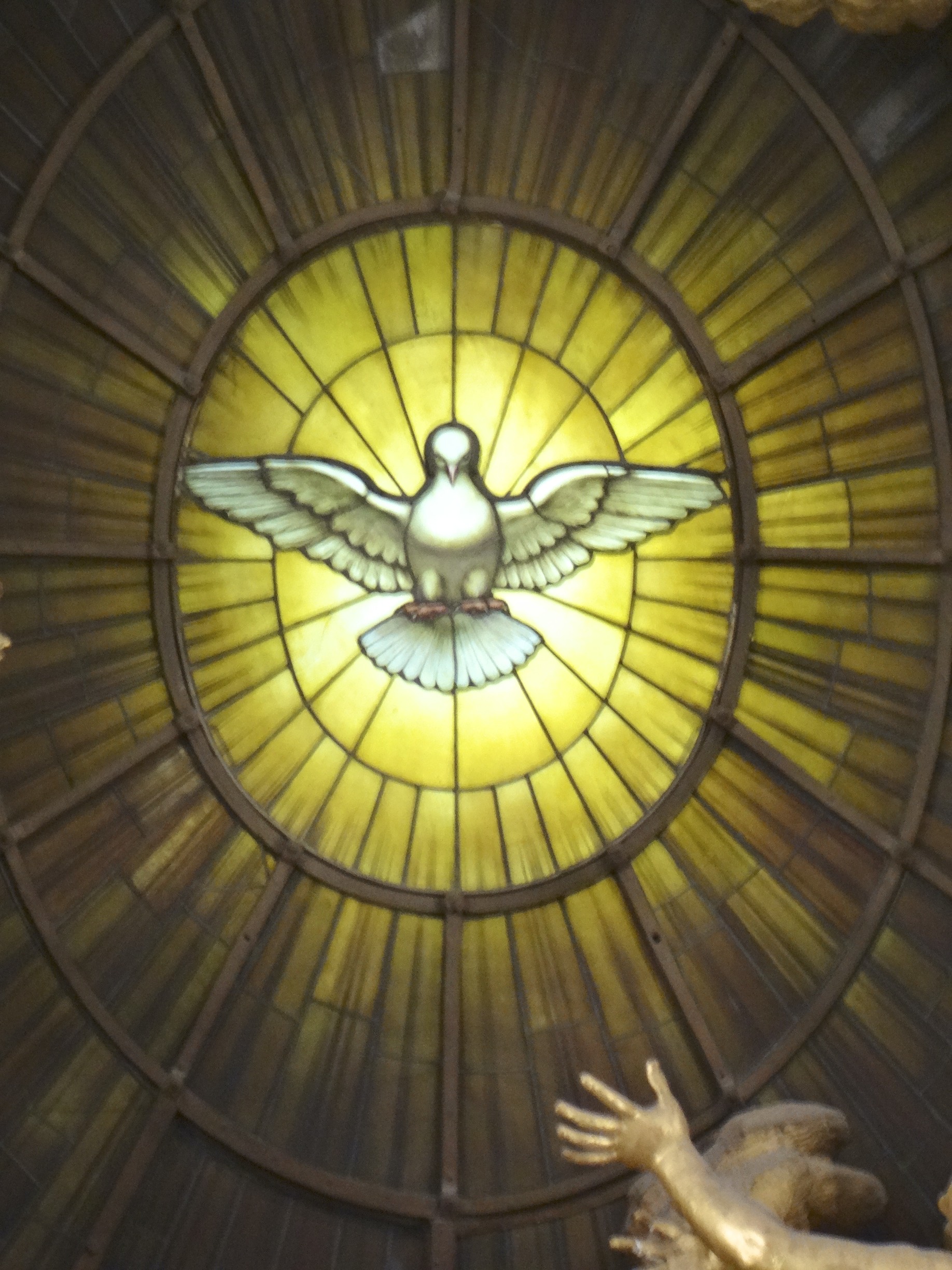
Behind the Chair of St. Peter in the Vatican Basilica in Rome, the artist Bernini created a beautiful alabaster window where a steady light pours into the dark church through the image of the Holy Spirit, in the hovering form of a dove. Light is also a favorite sign of the Holy Spirit.

Day by day, the light comes quietly through the window. Day by day, the Holy Spirit dispenses light for the moment, graces for the world that is now. As Jesus promised, the Holy Spirit dwells with us, his final gift.

The Feast of Pentecost is this Sunday.

Water and the Spirit

baptism jes

In the easter season the Risen Christ promises signs and sacraments. The Sacrament of the Eucharist is one of his great signs, but let’s not forget the Sacrament of Baptism, another gift we receive from the Risen Lord. He blesses us in water.

Water is a sign of death and of life, says Saint Basil the Great.

“Like a tomb, the water receives the body, symbolizing death; while the Spirit pours in the quickening power, renewing our souls from the deadness of sin into their original life. This then is what it is to be born again of water and of the Spirit, the water bringing the necessary death while the Spirit creates life within us…

“ Through the Holy Spirit comes our restoration to paradise, our ascension into the kingdom of heaven, our return to the status of adopted children our liberty to call God our Father, our being made partakers of the grace of Christ, our being called children of light, our sharing in eternal glory – in a word, our being brought into a state of all fullness of blessing both in this world and in the world to come, of all the good gifts that are in store for us. Through faith we behold the reflection of their grace as though they were already present, but we still have to wait for the full enjoyment of them. If such is the promise, what will the perfection be like? If these are the first fruits, what will be the complete fulfillment?”      Basil the Great, On the Holy Spirit


The Holy Spirit: Water Poured Out

IMG_0943
The Holy Spirit is “poured out on all flesh,” Peter tells the crowd at Pentecost who represent all peoples.  The Spirit is like water poured out, St. Cyril of Jerusalem tells his hearers:

“The water I shall give him will become in him a fountain of living water, welling up into eternal life. This is a new kind of water, a living, leaping water, welling up for those who are worthy. But why did Christ call the grace of the Spirit water? Because all things are dependent on water; plants and animals have their origin in water. Water comes down from heaven as rain, and although it is always the same in itself, it produces many different effects, one in the palm tree, another in the vine, and so on throughout the whole of creation. It does not come down, now as one thing, now as another, but while remaining essentially the same, it adapts itself to the needs of every creature that receives it.
 
 “In the same way the Holy Spirit, whose nature is always the same, simple and indivisible, apportions grace to each one as he wills. Like a dry tree which puts forth shoots when watered, the soul bears the fruit of holiness when repentance has made it worthy of receiving the Holy Spirit. Although the Spirit never changes, the effects of his action, by the will of God and in the name of Christ, are both many and marvellous.
 
 “The Spirit makes one person a teacher of divine truth, inspires another to prophesy, gives another the power of casting out devils, enables another to interpret holy Scripture. The Spirit strengthens one person’s self-control, shows another how to help the poor, teaches another to fast and lead a life of asceticism, makes another oblivious to the needs of the body, trains another for martyrdom. His action is different in different people, but the Spirit himself is always the same. In each person, Scripture says, the Spirit reveals his presence in a particular way for the common good.
 
“The Spirit comes gently and makes himself known by his fragrance. He is not felt as a burden, for he is light, very light. Rays of light and knowledge stream before him as he approaches. The Spirit comes with the tenderness of a true friend and protector to save, to heal, to teach, to counsel, to strengthen, to console. The Spirit comes to enlighten the mind first of the one who receives him, and then, through him, the minds of others as well.
 
 
“As light strikes the eyes of a person who comes out of darkness into the sunshine and enables him to see clearly things he could not discern before, so light floods the soul of someone counted worthy of receiving the Holy Spirit and enables him to see things beyond the range of human vision, things hitherto undreamed of.”  (Catechesis)

Paul’s Conversion: January 25th

Caravaggio, Conversion of Paul

Our yearly church calendar celebrates saints from every age and place because saints are examples of God’s grace present always and everywhere. Some saints are singled out for their importance. St. Paul the Apostle, whose dramatic conversion is celebrated on January 25th, is one of them. His martyrdom, along with Peter, is celebrated June 29th and we read extensively from his writings throughout the church year.

An account of Paul’s conversion ( Acts 22: 3-13) – one of three found in the Acts of the Apostles – is read first at his feast day Mass. Mark’s gospel for the feast recalls Jesu after his resurrection telling his disciples to “Go into the whole world and proclaim the gospel to every creature.” (Mark 16: 15-18)   St. Luke devotes much of the Acts to Paul’s  missionary journeys ending in Rome. The apostle fulfilled that command of Jesus.

Paul writes to the Corinthians: 

“I am the least of the apostles; in fact, since I persecuted the Church of God, I hardly deserve the name apostle; but by God’s grace that is what I am, and the grace that he gave me has not been fruitless. On the contrary, I have worked harder than any of the others: or rather, not I but the grace of God that is with me. (  1 Corthinians 15:9-10)

St. Paul is an example of how far we can rise, from the depths to the heights, and for that reason the church celebrates his conversion.  He never forgot that God’s grace raised him from the dust to become  a powerful force in his church and in the world. He never forgot he was a Pharisee who became one of Jesus’ most loyal disciples. His conversion gave him a boldness to go fearlessly to the ends of the earth 


“Saul, Saul, why do you persecute me?”  Jesus says to him from a blinding light. He never forgot the moment he was blinded by a light that made him see.

“Paul, more than anyone else, has shown us what we really are, and in what our nobility consists, and of what virtue a human being is capable. Each day he aimed ever higher; each day he rose up with greater ardour and faced with new eagerness the dangers that threatened him. He summed up his attitude in the words: I forget what is behind me and push on to what lies ahead. When he saw death imminent, he bade others share his joy: Rejoice and be glad with me! And when danger, injustice and abuse threatened, he said: I am content with weakness, mistreatment and persecution. These he called the weapons of righteousness, thus telling us that he derived immense profit from them… ” ( St. John Chrysostom)                                                                                             

O God, who taught the whole world through the preaching of the blessed Apostle Paul, draw us, we pray, nearer to you through the example of him whose conversion we celebrate today, and so make us witnesses to your truth in the world.Through our Lord Jesus Christ, your Son, who lives and reigns with you in the unity of the Holy Spirit, God, for ever and ever. Amen.

Pope John XXIII called for a Second Vatican Council on the Feast of the Conversion of Paul, January 25, 1959. He called for the church to be converted.

The Spring Rains Come

 April showers. Spring rains. A bowl of Easter Water stands near our altar during the Easter season.

Cyril of Jerusalem has a wonderful sermon on water that he preached to catechumens centuries ago. Here are a couple of lines:

“Water comes down from heaven as rain, and although it is always the same itself, it produces many different effects, one in the palm tree, another in the vine, and so on throughout the whole of creation. It does not come down, now as one thing, now as another, but while remaining essentially the same, it adapts itself to the needs of every creature that receives it.”

The saint goes on to say that just as water adapts itself to every creature, the Holy Spirit gives life to each one according to its needs and to benefit the common good. The Spirit’s coming is gentle, not felt as a burden, with tenderness, as a true friend, to save, heal, counsel, strengthen and console.

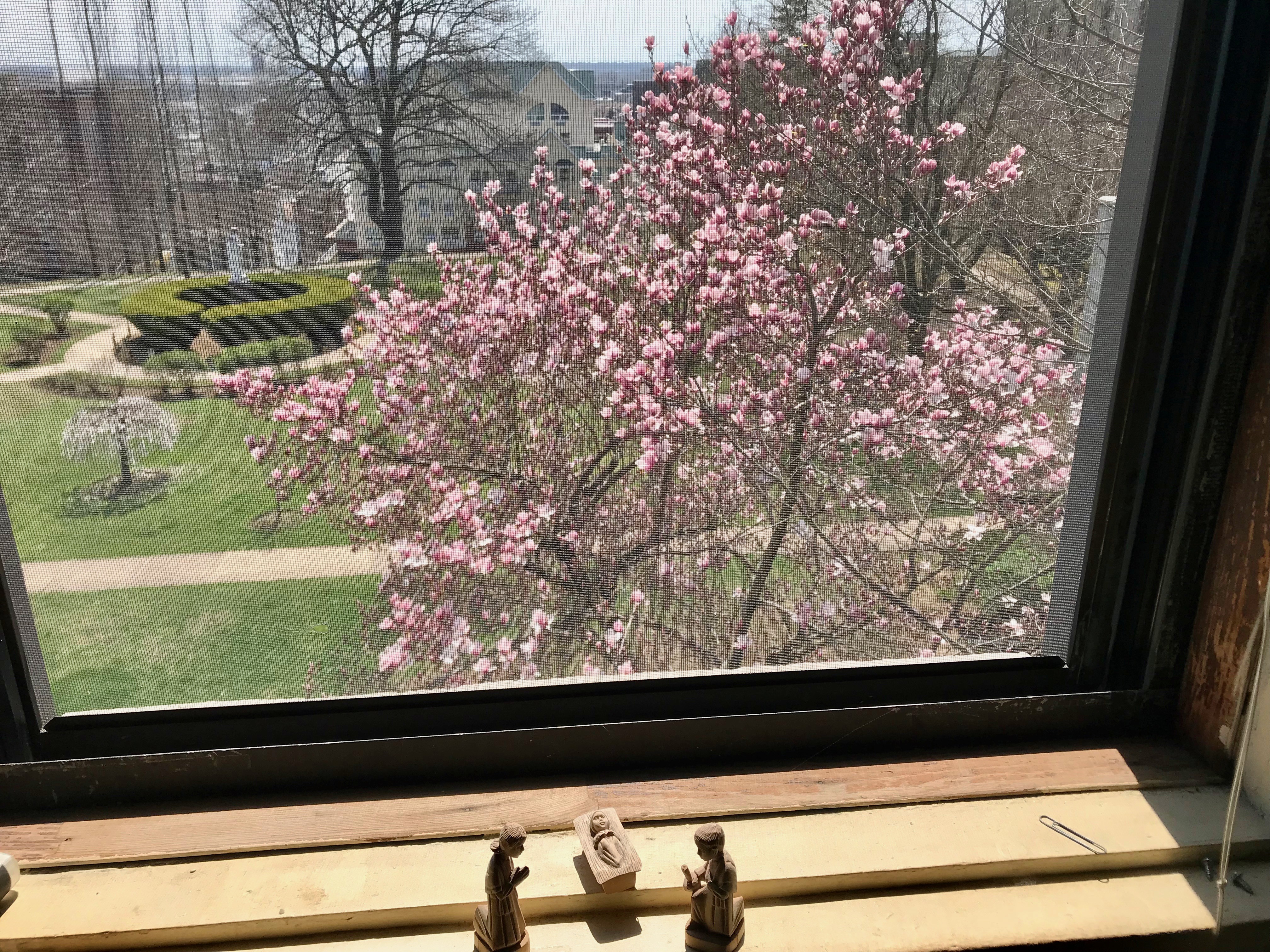
So back to spring rains. They have come this year.  The magnolia trees outside my room testify they’ve come, and the other trees and plants in our garden testify too. The rain falling on the earth does what it always does. Like the Spirit of God, water brings life.

Might we learn from the spring rains bringing life to all the varied plants, all shapes, all sizes, even some we might think useless or of no account?. Might we learn from the spring rains?

Send the spring rains, Lord, on our varied earth and human family.

Leaders Disagree

If there were a Catholic version of Jeopardy there might be some questions we could ask about the Feast of St. Barnabas today, June 11. Did he die on this day? No. Were his relics brought to some church on this day? No. We celebrate his feast today because he’s a key figure in the Post Pentecostal church. He tells us something about the leadership of that church, especially, and also about church leaders today.

Leaders can disagree. 

Barnabas and Paul were missionaries together, but a sharp disagreement occurred between them and they went their separate ways. (Acts 15, 36-41)  Will disagreement always occur among Christian leaders?

Today the US Catholic bishops meet in Baltimore to deal with the crisis of sex abuse in our church. They agree the issue has to be strongly addressed, but they seem divided about how to address it. There are strong personalities involved; men holding on to positions they’re committed to. 

We might like it to be different, but it was that way from the beginning. The Spirit leads the church, not human beings. “While they were worshiping the Lord and fasting, the Holy Spirit said, “Set apart for me Barnabas and Saul for the work to which I have called them.”Then, completing their fasting and prayer, they laid hands on them and sent them off.” (Acts 13, 1-3)

From the beginning the Spirit brought human beings to lead who are different and will disagree. 

Why? So that no one can boast?

The Spirit is our guide. Lord, send out your Spirit and renew the face of the earth.

How about political leaders? Another story, or the same?

My guess is it’s the same. Beware of the one who knows it all.

To Pray is to Hope

Prayer is more than looking for something, like a cure for sickness or getting a job., In prayer we search  for something we do not even understand. It’s a hope we have for something beyond anything we know, St.Augustine writes to Proba, a woman asking him about prayer.

“There is one thing I ask of the Lord. This I seek: to dwell in the house of the Lord for years to come. To gaze on the loveliness of the Lord…” The psalms express that hope..

We have an “instructed ignorance,” the saint says, and the Spirit of God helps us in our weakness.

“The Spirit pleads for the saints because he moves the saints to plead… to plead with sighs too deep for words by inspiring in them a desire for the great and as yet unknown reality that we look forward to with patience. How can words express what we desire when it remains unknown? If we were entirely ignorant of it we would not desire it; again, we would not desire it or seek it with sighs, if we were able to see it.”

The Wisdom of Ordinary Time

DSC00804
The readings in today’s Mass point to the wisdom of ordinary time. “Whoever is not against us is for us,” Jesus says to his disciples who complain there are others “who do not follow us” driving out demons. (Mark 9,38-40) Wisdom is not just in our tradition; it’s there everywhere in ordinary time.

I like the hand in the picture above of Bernini’s famous window in St.Peter’s. Who’s hand is it, anyway? A believer’s hand. Yes, for sure. But also the hand of all who walk this earth searching for truth.

“Wisdom breathes life into her children” (Sirach 4,11 ) Like much of the wisdom literature in the bible (Proverbs, Ecclesiastes, Wisdom, Psalms) the Book of Sirach, one of the readings at the beginning of ordinary time, draws much of its content from the culture of the middle east which influenced the Jews at home and in their exile in other lands.

As the gift of God breathed into ordinary time, the Holy Spirit “renews the face of the earth.” The Spirit’s wisdom is everywhere.

Pentecost

For this week’s homily please play the video file below: