Tag Archives: Herodias

Speaking the Truth:Mark 10:1-12

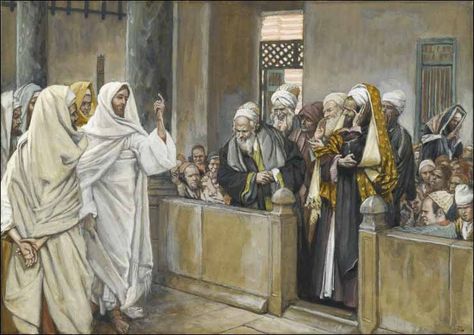
Christ Questioned. James Tissot

Often Mark’s Gospel offers little clues to help us interpret one passage in the light of another. For example, Jesus is sharply questioned by the Pharisees whether it’s lawful for a husband to divorce his wife. The questioning takes place as Jesus “came into the district of Judea and across the Jordan,” on his way up to Jerusalem where he will meet his death.

Mark’s not altogether accurate in his geography but “Judea across the Jordan” was where John the Baptist was put to death for questioning the validity of Herod’s marriage to Herodias, who divorced Herod’s brother Philip to marry him. Mark tells that gruesome story a few chapters before in great detail. (Mark 6, 14-29) The site of John’s death, east of the Dead Sea in what is now the country of Jordan, was lost for more than a thousand years after it was destroyed by the Romans at the end of the First Jewish Revolt in 71/72 A.D. It was definitively identified in 1968, when a German scholar discovered the remains of a Roman siege wall. Since then, the Hungarian architect and archaeologist Dr Győző Vörös has been excavating the site.

Perhaps the Pharisees thought that questioning Jesus here might have two outcomes. Either it might incite Herodias and Herod to do to Jesus what they did to John, or if Jesus didn’t answer the delicate question about divorce, the crowds gathered around him might see him less brave than the Baptist.

Jesus’ answer is brave, and it’s not an abstract one. Marriage is not to satisfy human ambition, like Herodias’ ambition. From the beginning God willed that man and woman be one flesh. The final lines of our gospel, spoken at this time and place, is also a strong judgment on the man and woman who engineered John’s death:

“Whoever divorces his wife and marries another commits adultery against her; and if she divorces her husband and marries another, she commits adultery.”

Evil Doesn’t Have Its Way

Beheading JohnToday we read a long narrative from Mark’s Gospel (Chapter 6) describing the death of John the Baptist at the hands of Herod Antipas. It’s been called a “Passion Account before the Passion of Jesus.”

Herod Antipas, ruler of Galilee, had his capitol in Tiberias a short distance from Capernaum where much of Jesus’ ministry took place. He certainly knew what Jesus was doing and what people were saying about him. Some said he was Elijah, or a prophet. But what caught Herod’s attention especially was talk that Jesus was John the Baptist raised from the dead.

Herod had arrested John and imprisoned him, probably in his fortress at Macherius near the Dead Sea. Then, influenced by his wife Herodias, who resented John’s criticism of their marriage– which violated Jewish law– Herod had John put to death.

The story told in great detail in Mark’s Gospel is an example of evil, oppressive power at its worst. Herodias’ daughter Salome dances at one of Herod’s bloated banquets and elicits his promise to do anything she asks for. “What shall I ask?” Salome asks her mother. “The head of John the Baptist,” is her answer.

Later in Mark’s gospel, Jesus identifies John the Baptist with Elijah. “I tell you that Elijah has come and they did to him whatever they pleased, as it is written of him.” (Mark 9, 13) Like Jesus, John suffers and is treated with contempt.

The story of John’s beheading by Herod prepares Mark’s readers for the story of the Passion of Jesus. Both stories were meant to help Mark’s first audience, Roman Christians, face the sudden, absurd persecution inflicted on them by the Emperor Nero in the mid 60s. Like Herod, Nero seemed supremely powerful. They could not see it yet, but evil would not have its way. The Son of Man would rise from the dead and be glorified. So would they.

That’s the lesson we should take from this story too. Evil doesn’t have its way.