Some homilies, scattered thoughts, images from the Passionists: : whatever the days bring. Follow me on Twitter @vhoagland.
Tag Archives: God
When we think of saints, we may think of Mary, the mother of Jesus, apostles like Peter and Paul, or extraordinary individuals like Mother Teresa. True friends of God.
Besides those saints – shining lights of faith– there are unnumbered others in God’s company, the Feast of All Saints says. In a vision of heaven, St. John saw “a great multitude, which no one could count, from every nation, race, people, and tongue.” {Revelations 7, 9-13} We hope to be with them one day.
Our hope rests on a promise Jesus made, the same apostle says:
“See what love the Father has bestowed on us that we may be called the children of God. Yet so we are…Beloved, we are God’s children now; what we shall be has not yet been revealed.” (1 John 3,1-3)
How shall we reach that place where we’ll be revealed as children of God? Jesus said to follow him and live as he taught. He offers the way in his Sermon on the Mount, our gospel reading for this feast says. He will be the way, the truth and the life.
We haven’t seen yet that life we hope for or what God intends us to be. Life does not end; it changes. This feast invites us to trust in God’s promise and hope for the day it’s revealed.
Extraordinary saints are not the only ones in heaven. There won’t be just a few either. Countless others are in God’s company: saints unnoticed here on earth, saints with little to show, saints who were sinners. People like us.
As we celebrate this feast, St. Bernard says:
“Rise again with Christ and seek the world above and set your mind on heaven. Long for those who are longing for us; hasten to those who are waiting for us, ask those who are looking for our coming to intercede for us. Desire their company and seek a share in their glory. There’s no harm in being ambitious for this. No danger in setting your heart on such glory. Remembering the saints inflames us with a yearning that Christ our life may appear to us as he appeared to them and that one day we may share in his glory.”
Who are the Romans Paul writes to in his letter to the church in Rome? Historians say Jews were the predominant group that first embraced Christianity in Rome, but there were not many Jewish converts at first. A substantial population of Jews at the time lived in Trastevere, across the Tiber River. Claudius had to expel some of them from the city around the year 47 because of violent disturbances in the Trastevere synagogues over Christ. It’s unlikely there was a large number of converts to Christianity from Judaism when Paul wrote his letter.
Many Jews in Rome, faithful to Judaism, would strongly question Paul’s argument that the law was a failure.
Not many Romans, Gentiles, embraced the gospel early on either. I doubt the majority of the Romans would agree with Paul that the Roman gods had failed. Rome was a powerful, successful empire in Paul’s day. I doubt many thought too much about its flaws.
The Christian community made up of Jews and Gentiles was not large, if my reading of Paul’s time is accurate. The Christians of Rome were fervent, but few.
In his letter, Paul pictures sin as a cosmic reality, but cosmic sin is not always easy to see. It was not easy to see in Paul’s day, nor is it easy to see in our day. We identify sin with personal sin, murder, theft, cheating, adultery. Paul is aware of personal sin, yet his focus is on cosmic sin. Harder to see who’s responsible for cosmic sin. Who’s responsible for the sin in wars, armament races, manipulation of world markets, plundering the environment?
The Letter to the Romans has a large place in the Sunday and weekday readings of our lectionary. It can be difficult to read, but we need Paul’s larger picture, which calls for a larger hope. Until the final coming of Jesus, we must live in the world pictured by the apostle.
We thank God for his grace of forgiveness and his promise of new life.
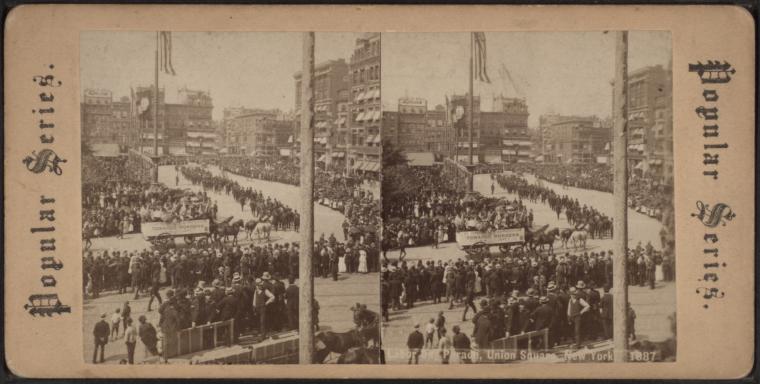
Labor Day Parade 1889, New York City, NYPublic Library
Labor Day is a holiday in my country, a day off. It’s also day to reflect on issues affecting work and workers. Labor Day can be traced back to when our world was agricultural rather than industrial. In many Christian societies, it was a day when people gave thanks for the crops they harvested and prayed for continued blessings. “Prosper the work of our hands, Lord, prosper the work of our hands.”
Labor Day can be traced to the rogation days in the Christian calendar, when people gathered in their church and went in procession through their fields thanking God for his gifts of the earth and asking God’s blessing for the future. Their procession was a walk of appreciation. As they walked through their fields people saw creation as good.
In a gospel suggested for today, Jesus tells us
“Do not worry and say, ‘What are we to eat?’ or ‘What are we to drink?’ or ‘What are we to wear?’ All these things the pagans seek. Your heavenly Father knows that you need them all. But seek first the kingdom [of God] and his righteousness, and all these things will be given you besides. Do not worry about tomorrow; tomorrow will take care of itself. Sufficient for a day is its own evil.” (Matthew 6:311-36)
Each day has its worries, but worrying about tomorrow stops us from appreciating today, Jesus tells us. Worrying about tomorrow can stop us from living today.
That’s not to say we should not reflect on society’s social ills. Labor Day is also a time to call out against poor labor conditions, abusive labor conditions, lack of opportunities for good, meaningful work. There’s the threat that comes now from Artificial Intelligence. How will that impact workers?
Still, Labor Day calls us to take an appreciative walk through our own wheat fields, through the place where we are, looking at the work we do, appreciating the work others do for us. It’s a holiday.
Ten years ago, Pope Francis called for A World Day of Prayer for the Care of Creation for September 1st. The day of prayer, coinciding with the publication of his letter Laudato si’ , began a Season of Creation, an ecumenical endeavor shared with other churches and communities that extends from September 1st to October 4th, the Feast of St. Francis of Assisi.
Our church calendar, besides feasts and seasons, has days of prayer when particular causes arise. In a recent letter, Pope Leo called the care of creation a particularly timely issue to pray for:
“…given the evidence in various parts of the world that our earth is being ravaged. On all sides, injustice, violations of international law and the rights of peoples, grave inequalities and the greed that fuels them are spawning deforestation, pollution and the loss of biodiversity. Extreme natural phenomena caused by climate changes provoked by human activity are growing in intensity and frequency (cf. Laudato Deum, 5), to say nothing of the medium and long-term effects of the human and ecological devastation being wrought by armed conflicts.
As yet, we seem incapable of recognizing that the destruction of nature does not affect everyone in the same way. When justice and peace are trampled underfoot, those who are most hurt are the poor, the marginalized and the excluded. The suffering of indigenous communities is emblematic in this regard.
That is not all. Nature itself is reduced at times to a bargaining chip, a commodity to be bartered for economic or political gain. As a result, God’s creation turns into a battleground for the control of vital resources. We see this in agricultural areas and forests peppered with landmines, “scorched earth” policies, [1] conflicts over water sources, and the unequal distribution of raw materials, which penalizes the poorer nations and undermines social stability itself…
Environmental justice – implicitly proclaimed by the prophets – can no longer be regarded as an abstract concept or a distant goal. It is an urgent need that involves much more than simply protecting the environment. For it is a matter of justice – social, economic and human. For believers it is also a duty born of faith, since the universe reflects the face of Jesus Christ, in whom all things were created and redeemed. In a world where the most vulnerable of our brothers and sisters are the first to suffer the devastating effects of climate change, deforestation and pollution, care for creation becomes an expression of our faith and humanity.
Now is the time to follow words with deeds.”
( For THE 10th WORLD DAY OF PRAYER FOR THE CARE OF CREATION 2025)
Recently, the Dicastery for Divine Worship provided a preliminary text for a Mass for the Care of Creation. A good resource for prayer during the Season of Creation.
MASS FOR THE CARE OF CREATION
Entrance Antiphon Ps 18: 2
The heavens declare the Glory of God,
and the firmament proclaims the work of his hands.
Collect
God our Father,
who in Christ, the firstborn of all creation,
called all things into being,
grant, we pray, that docile to the life-giving breath of your Spirit, we may lovingly care for
the work of your hands.
Through our Lord Jesus Christ, your Son,
who lives and reigns with you in the unity of the Holy Spirit,
God, for ever and ever.
Prayer over the Offerings
Receive, O Father,
these fruits of the earth and of our hands:
bring to completion in them the work of your creation,
so that, transformed by the Holy Spirit,
they may be for us the food and drink of eternal life.
Through Christ our Lord.
Communion Antiphon All the ends of the earth have seen the salvation of our God.
cf. Ps 97: 3
Prayer after Communion
May the sacrament of unity
which we have received, O Father,
increase communion with you and with our brothers and sisters,
so that, as we await the new heavens and the new earth,
we may learn to live in harmony with all creatures.
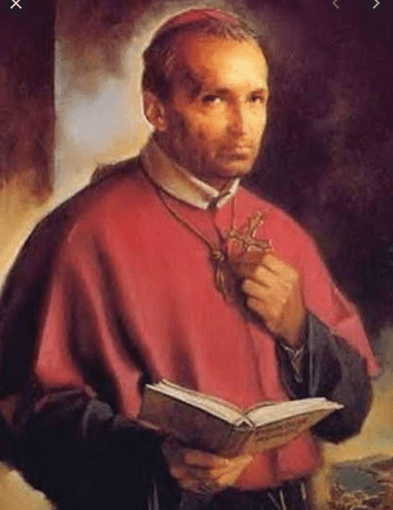
Alphonsus Liguori (1696-1787) was born near Naples, Italy, into a noble family. He began life as a lawyer but gave up law to become a priest and devote himself to bringing the gospel to the poor. His sermons and instructions were simple. “I never preached a sermon that the poorest old woman in the congregation didn’t understand,” he claimed. In 1732 he founded the Redemptorists, the Congregation of the Holy Redeemer.
A prolific writer, poet and musician, Alphonsus authored a series of devotional books on Mary and important works on moral theology. He advocated leniency and mercy towards people, steering a course between severity and laxity. In hearing confessions, he said he never denied anyone absolution. We can see why he’s an example for pastoral workers today.
In 1762, he became bishop of Sant Agata dei Goti, a small diocese near Naples, where he worked to reform the clergy and renew its people in their faith. In 1775 he resigned his bishopric because of his health, but continued writing religious and devotional tracts till his death in 1787. In 1816 he was canonized by Pope Gregory XVI. Pope Pius IX declared him a doctor of the church in 1871.
“Hasn’t God a claim on our love? From all eternity God has loved us. ‘ I first loved you. You had not yet appeared in the light of day, nor did the world yet exist, but already I loved you. From all eternity I have loved you.’
God gave us a soul endowed with memory, intellect and will; he gave us a body equipped with the senses; it was for us that he created heaven and earth and all things. The truth is the eternal Father went so far as to give us his only Son.
By giving us his Son, whom he did not spare precisely so that he might spare us, he bestowed on us at once every good: grace, love and heaven; for all these goods are certainly inferior to the Son. He who did not spare his own Son, but handed him over for all of us: how could he fail to give us along with his Son all good things?”
The prayer for his feast day points out it’s our turn to do what Alphonse’s did:
O God who constantly raise up in your church new examples of virtue, grant that we may follow so closely in the footsteps of the Bishop Saint Alphonsus in his zeal for souls as to attain the same rewards that are his in heaven.
Our lectionary leaves out a number of the stories about Jacob and his wife Rachel, her brother Laban and his sons, that are far from edifying. They are hardly honest. They strike deals and, by hook or by crook, try to get the best deal they can. They’re not people you want for neighbors or do business with.
Yet, God promises Jacob what he promised Abraham:
“I, the LORD, am the God of your forefather Abraham and the God of Isaac; the land on which you are lying I will give to you and your descendants. These shall be as plentiful as the dust of the earth, and through them you shall spread out east and west, north and south. In you and your descendants all the nations of the earth shall find blessing. Know that I am with you; I will protect you wherever you go, and bring you back to this land. I will never leave you until I have done what I promised you.” (Genesis 22,1 8-28)
Even with those sublime words ringing in his ears, Jacob never seems to abandon his wheeling and dealing. It’s as if the most important thing in the world is the extra sheep he’s going to wheedle out of his father in law.
The Old Testament certainly portrays real life. The early Christian scholar Marcion wanted to throw out the Old Testament altogether, because he claimed it wasn’t spiritual enough. God wouldn’t promise such great things to people like Abraham, Isaac and Jacob and their wives and relations and slaves.
I suppose that’s one reason for us to keep reading the Old Testament: God works in real life. “God is a Potter; he works in mud,” the Greek writer Nikos Kazantzakis entitled a chapter in one of his books.
Two things commentators note about the stories of Jacob. First, he doesn’t recognize the presence of God until afterwards. “When Jacob awoke from his sleep, he exclaimed, ‘Truly, the LORD is in this spot, although I did not know it!’” That’s an interesting discovery we all can make. God was there and we didn’t know he was there.–except afterwards.
Second, the commentator for the New American Bible says this about the story of Jacob wrestling in the dark at the river edge with the unknown figure: “The point of the tale seems to be that the ever-striving, ever-grasping Jacob must eventually strive with God to attain full possession of the blessing.”
God engages us and wrestles with us, “ever striving, ever grasping”, whether we like it or not, and we will have scars to prove it.
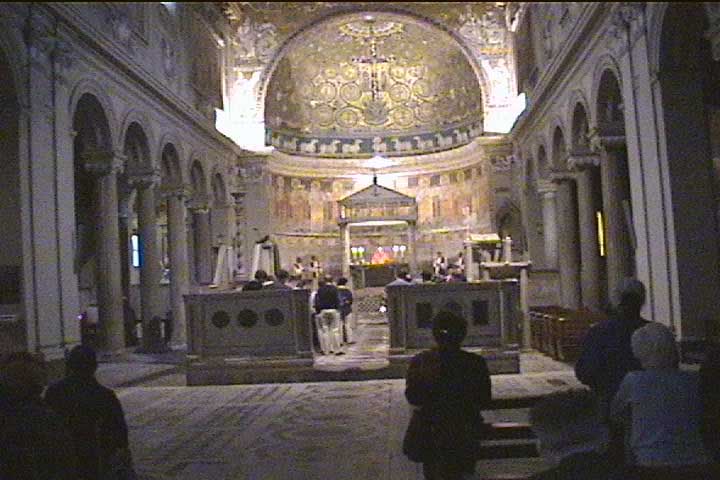
The Cross flowers at Easter time. There’s a flowering cross brimming with life in the great apse of the church of San Clemente in Rome. Its branches swirl with the gifts God gives. It brings life, not death. Humanity is there, signified in Mary and the disciple John. We are there in the doves resting on it. Creation itself is there, drawing new life from it. The hand of God makes it so.
The sacraments offered in this sacred place bring life-giving graces to us.
An early preacher Theodore the Studite praises the mystery of the cross:.
“How precious the gift of the cross, how splendid to contemplate! In the cross there is no mingling of good and evil, as in the tree of paradise: it is wholly beautiful to behold and good to taste. The fruit of this tree is not death but life, not darkness but light. This tree does not cast us out of paradise, but opens the way for our return.
“This was the tree on which Christ, like a king on a chariot, destroyed the devil, the Lord of death, and freed the human race from his tyranny. This was the tree upon which the Lord, like a brave warrior wounded in his hands, feet and side, healed the wounds of sin that the evil serpent had inflicted on our nature. A tree once caused our death, but now a tree brings life. Once deceived by a tree, we have now repelled the cunning serpent by a tree.
“What an astonishing transformation! That death should become life, that decay should become immortality, that shame should become glory! Well might the holy Apostle exclaim: Far be it from me to glory except in the cross of our Lord Jesus Christ, by which the world has been crucified to me, and I to the world!”
San Clemente, Rome
See Children’s Prayers here for a children’s version of the Easter Tree.
Lent is a time for us to face up to how very much our God loves us. This is who our God is. Because of this, Lent is also our time to face up to to the hurt that we give to Our Beloved One whenever we behave in unloving ways. We can begin by looking at the commandments that our Church teaches us and examining our conscience. In the Gospel for Wednesday of the Third Week of Lent our Lord warns us: “Whoever breaks the least of these commandments and teaches others to do so will be called the least in the Kingdom of Heaven.” Ouch! I look at the Ten and see how I fall short in fulfilling them, and at times provide a bad example for those around me. I am certainly one of “the least”. Sadly I am not alone. So many of us are in the same boat. And yet Our Lord still includes us in His Kingdom. The least, but still there. Like Fr Victor says, Our Lord has not given up on us!
How can we help God get us out of that hole? Perhaps we can begin by approaching our Creator with humility and trust. In the powerful Gospel for Saturday of this same week, we hear Jesus’ parable of the Pharisee and the tax collector. The attitude of the Pharisee immediately places him next to me as one “of the least!” He has been trying to be “good”, and he feels joy and comfort in the presence of God, especially in his House. This is good. So many of us Christians walk into Mass full of hope and gratitude. But oh! That cardinal sin of pride, the failure to love our neighbor as ourselves!
The tax collector seems to have the better attitude, full of shame, contrite, totally surrendering to the judgement of God. He knows that he certainly is one of the “least”. I’ve always said, “I want to be like him,” in all prayer, specially during the Sacrament of Reconciliation. Today, though, Fr Victor pointed out that this tax collector so far has failed to know how incredibly great is the Love God has for him. This is what our Lord Jesus came to teach. At least the tax collector has a glimmer of belief in the mercy of God. It’s a good beginning, and God exalts him for that.
Sometimes at Mass I feel like the Pharisee, satisfied with my efforts and full of gratitude for God’s Love and presence in my life. The Celebration of the Mass seems like such a joyful time and I wonder why so many fellow worshippers have such long faces! I should know better, because there are times when I walk into Church with that same unhappy mood! All I know is that I am still one of “the least” and I’m not proud of it. I wonder how far down the list I am? Does God keep lists? Who is the least of the least?
I was sitting at the Monastery Chapel thinking about these things and my eyes suddenly looked up to the crucifix up front, and I began to cry. My beloved God chose to become the Least of the least upon that Cross, taking on the pride of the Pharisee, the corruption of the tax collector, my unworthiness, the misery of of those with long faces at Church, and the viciousness and brutality of His time and mine.
Why would God do this? The answer to his mystery is beyond all comprehension. But I do know that the main reason is the incredible love that God has for me and every person on Earth, no matter how far down the list we are.
May the Passion of Jesus Christ be always in our hearts.
Commentators find it hard to establish the time and place the Epistle to the Hebrews was written. Most say it was written for early Jewish Christians trying to figure out their relationship to the religion of their ancestors.
I wonder if Jewish Christians in Rome would be especially among those for whom the letter was written. Rome is one of the places commentators say it might have originated..
The Jewish Christian community of Rome was a large community attached to Jerusalem and the temple, even Jews who had embraced a new faith. They would have been onlookers as Titus marched triumphantly into the Rome carting the spoils and slaves in chains from the Jewish wars and the destruction of the temple in 70. Afterwards, they would have watched the Colosseum bring built with the gold from the temple. Less than 5 years before some were singled out as renegade Jews and blamed by Nero for the great fired that had destroyed the city.
As we read the words from the Epistle to the Hebrews today I wonder if we hear words written especially for them.
“Let us hold unwaveringly to our confession that gives us hope, for he who made the promise is trustworthy.We must consider how to rouse one another to love and good works. We should not stay away from our assembly, as is the custom of some, but encourage one another, and this all the more as you see the day drawing near.” Hebrews 10:19-25
It would be a hard time then for Jewish Christians in Rome “to put your light on a lamp stand,” as we read in today’s gospel . It was a time for laying low, “staying away from our assembly.”
Faith has to be professed in season and out of season. It’s never to be hid under a bushel.
The Book of Revelation has an important place in the church’s evening prayer. A selection occurs every Sunday, Tuesday, Thursday and Friday evening through the four week cycle of the Liturgy of the Hours. It’s the last prayer of the evening.
The selections are not grim passages about battles fought against Babylon and the enemies of God, but rather invitations to share in the heavenly triumph of Christ. They bring us before God’s throne and the Lamb who was slain to offer praise with all the saints who have gone before us. From this world, which can be so small and constricted, so frightening and dangerous, where we can become so self-absorbed and unsure, we come into the welcoming presence of God, who calms the fear of darkness and death.
O Lord our God, you are worthy to receive glory and honor and power. For you have created all things; by your will they came to be and were made. Worthy are you, O Lord to receive the scroll and break open its seals. For you were slain; with your blood you purchased for God men of every race and tongue, of every people and nation. You made them a kingdom, and priests to serve our God, and they shall reign on earth. Worthy is the Lamb that was slain to receive power and riches, wisdom and strength, honor and glory and praise. Glory to the Father and to the Son, and to the Holy Spirit:as it was in the beginning, is now, and will be for ever. Amen. ( Tuesday Evening)
At the end of the day, we visit heaven; we go into the night listening to the songs sung there. Prayers from Revelation offer the promise of future life.






 The Victor's Place