Tag Archives: God

The Whole World Comes to a Manger

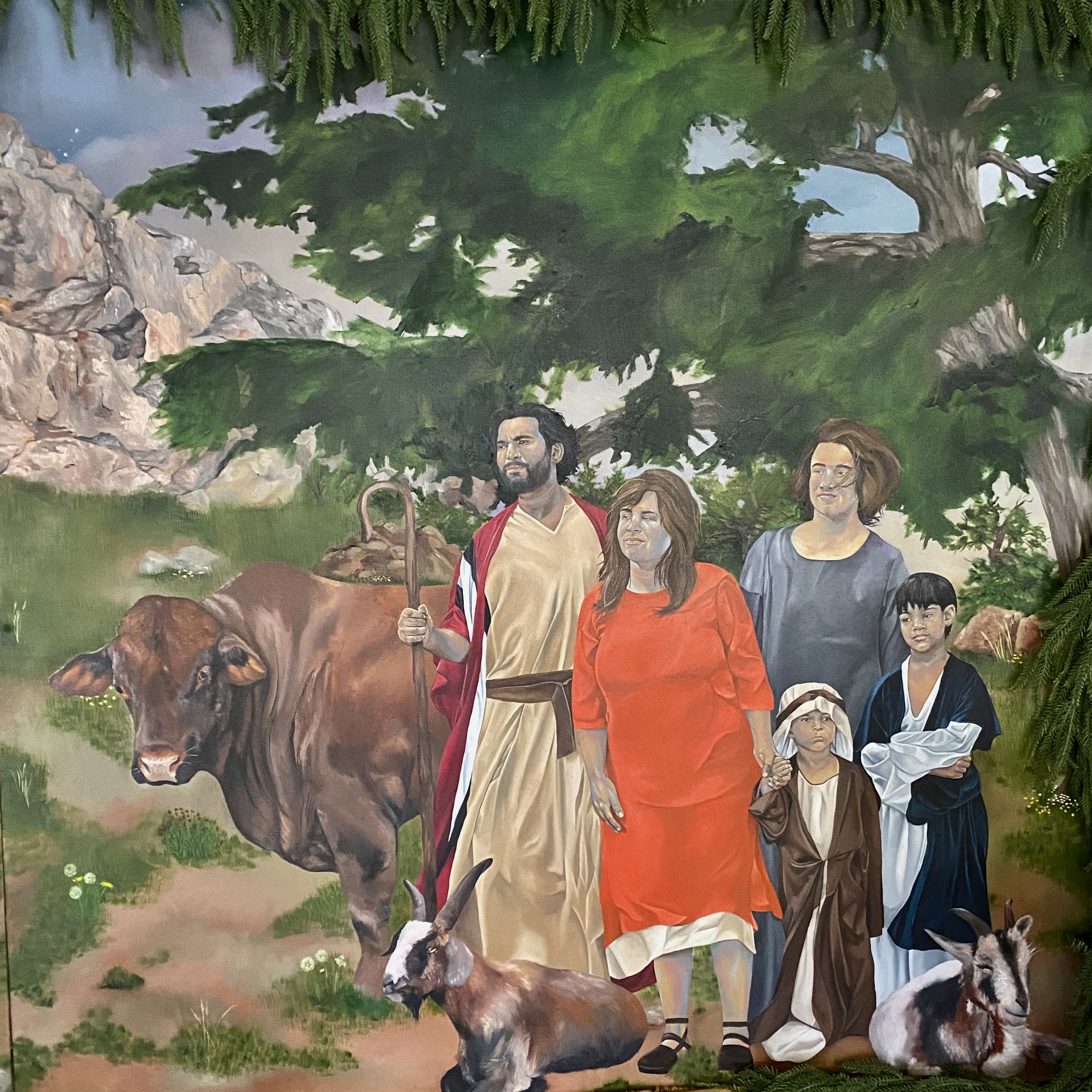
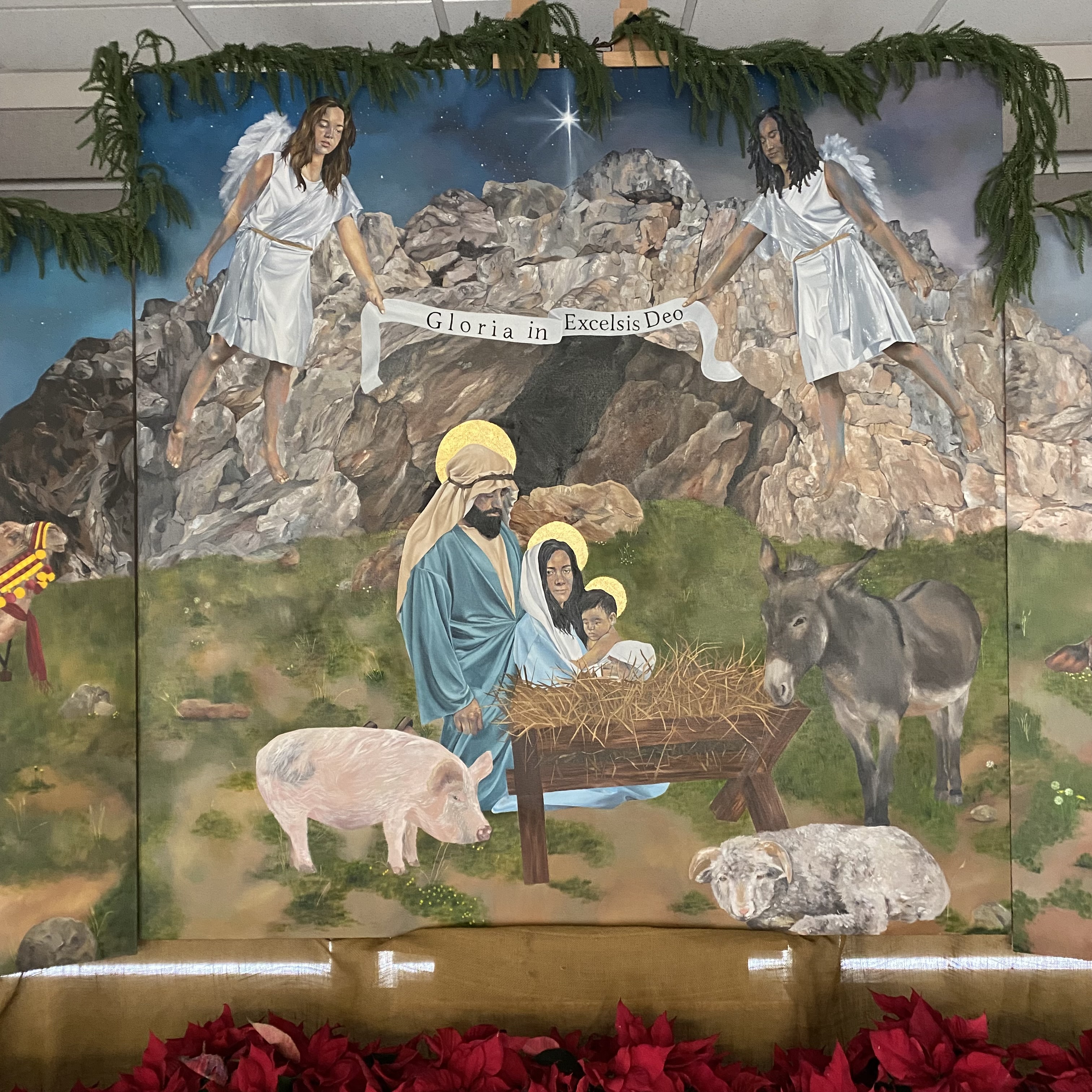
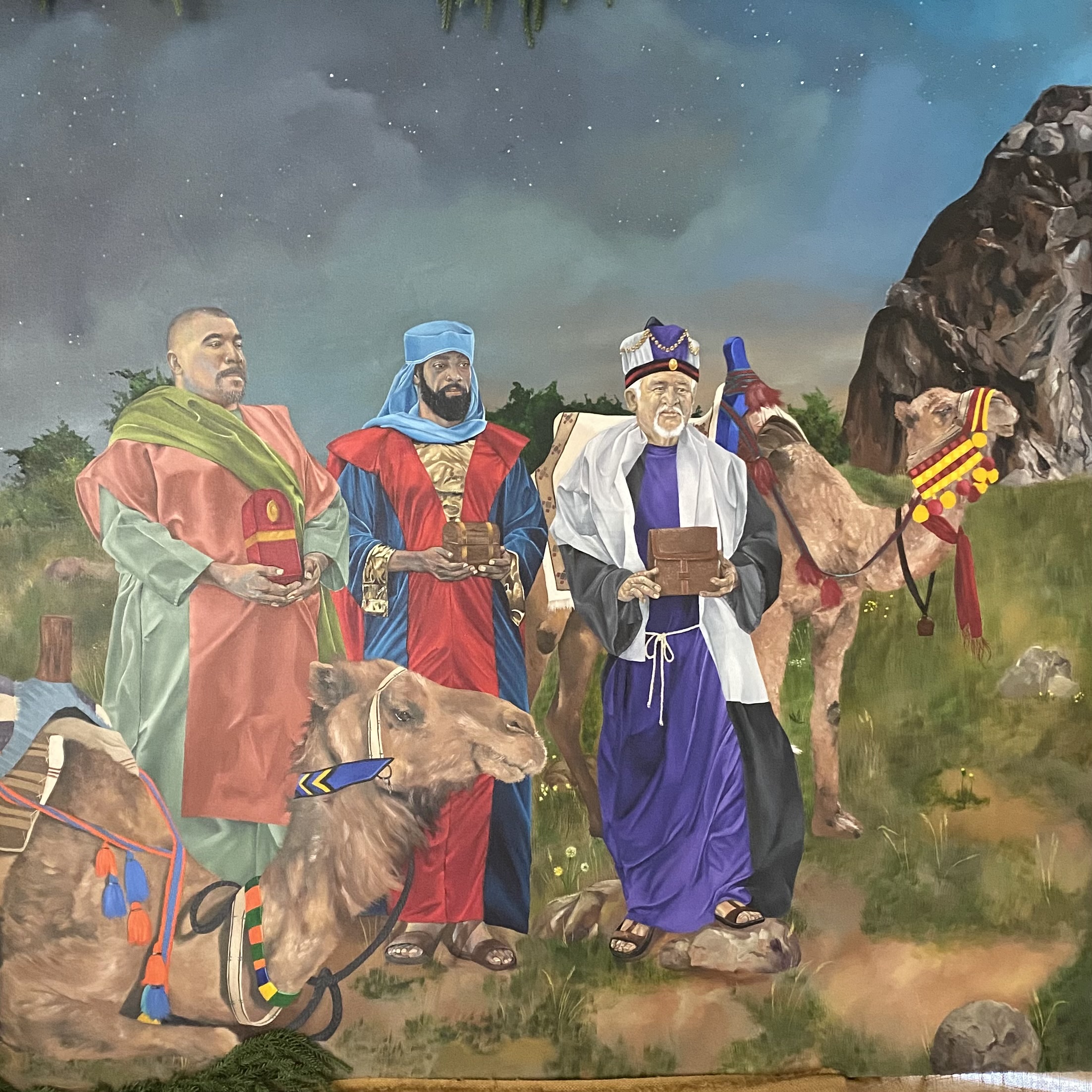
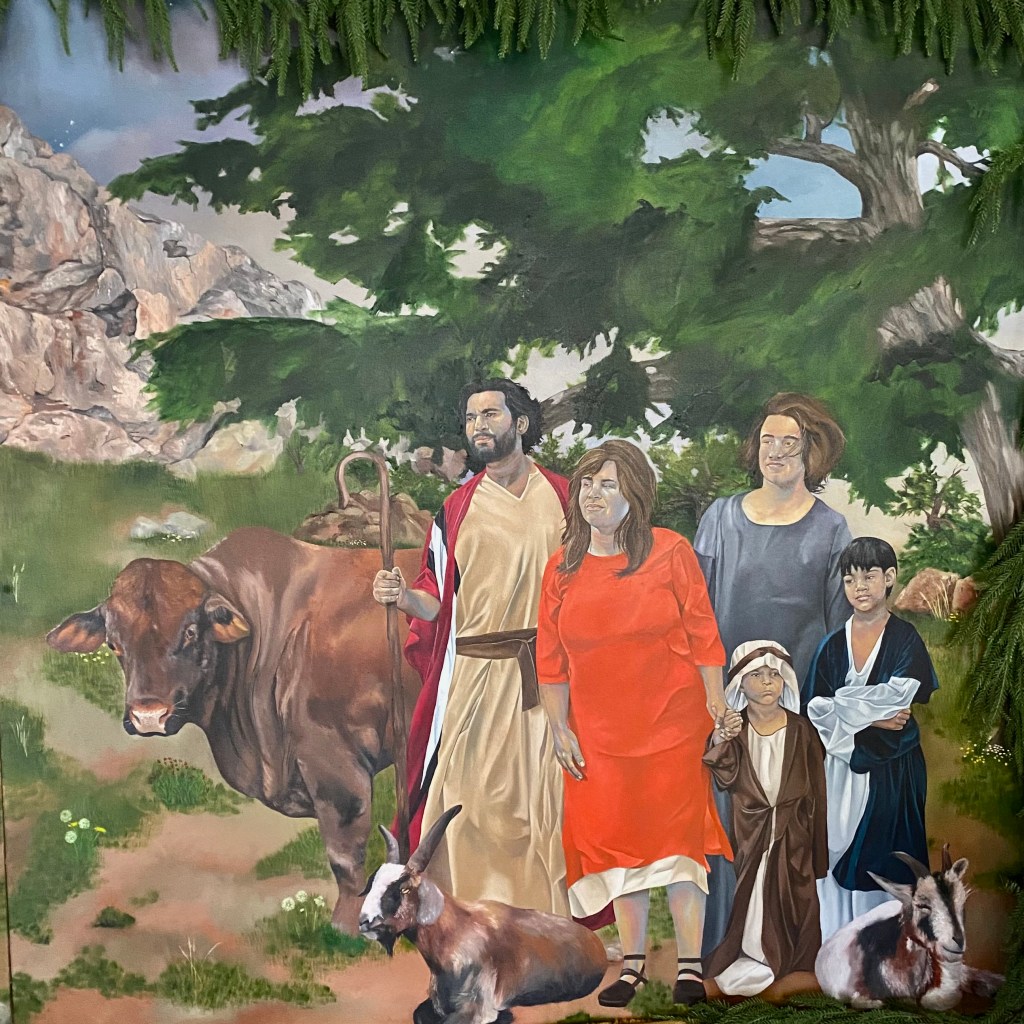
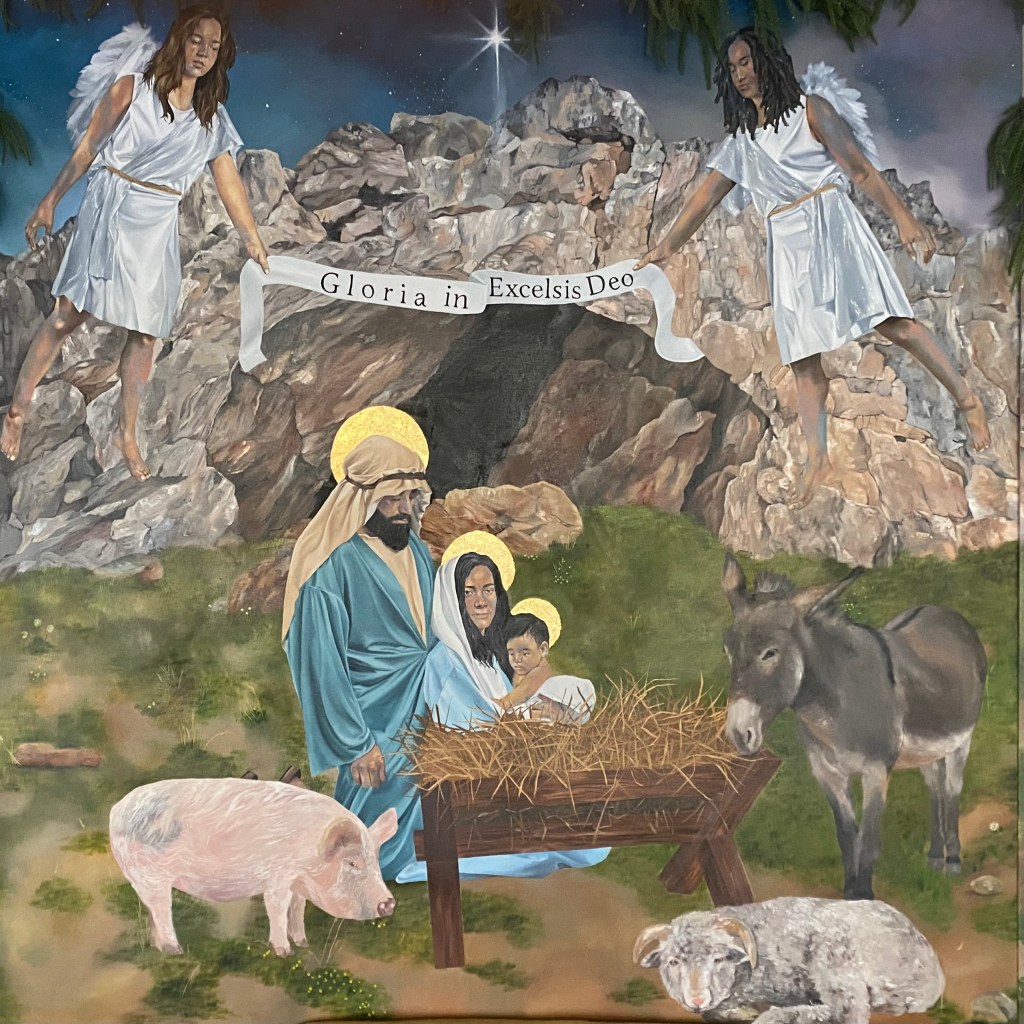
A large painting of the Christmas mystery in the gathering space of St.Mary’s Church in Colts Neck, New Jersey, is worth a visit before its taken down soon. The artist commissioned to make the work evidently wants to expand the way we look at this mystery in the three panels he created. 

In the right panel the shepherds coming to the Child are not the usual band of men followed by their sheep. There’s one shepherd and two women and two children and a water buffalo and two other animals who look like they may be wild mountain goats. No sheep. 

Who are the women? The shepherd’s wife and maybe his sister? The women look like they’ve been summoned quickly from their homes. Did the shepherd call them to come  see what the angels proclaimed in the fields? Don’t worry how you look, and bring the kids. Come and see.

Are the animals representatives of the animal world waiting , like the human world, for the angels’ message?

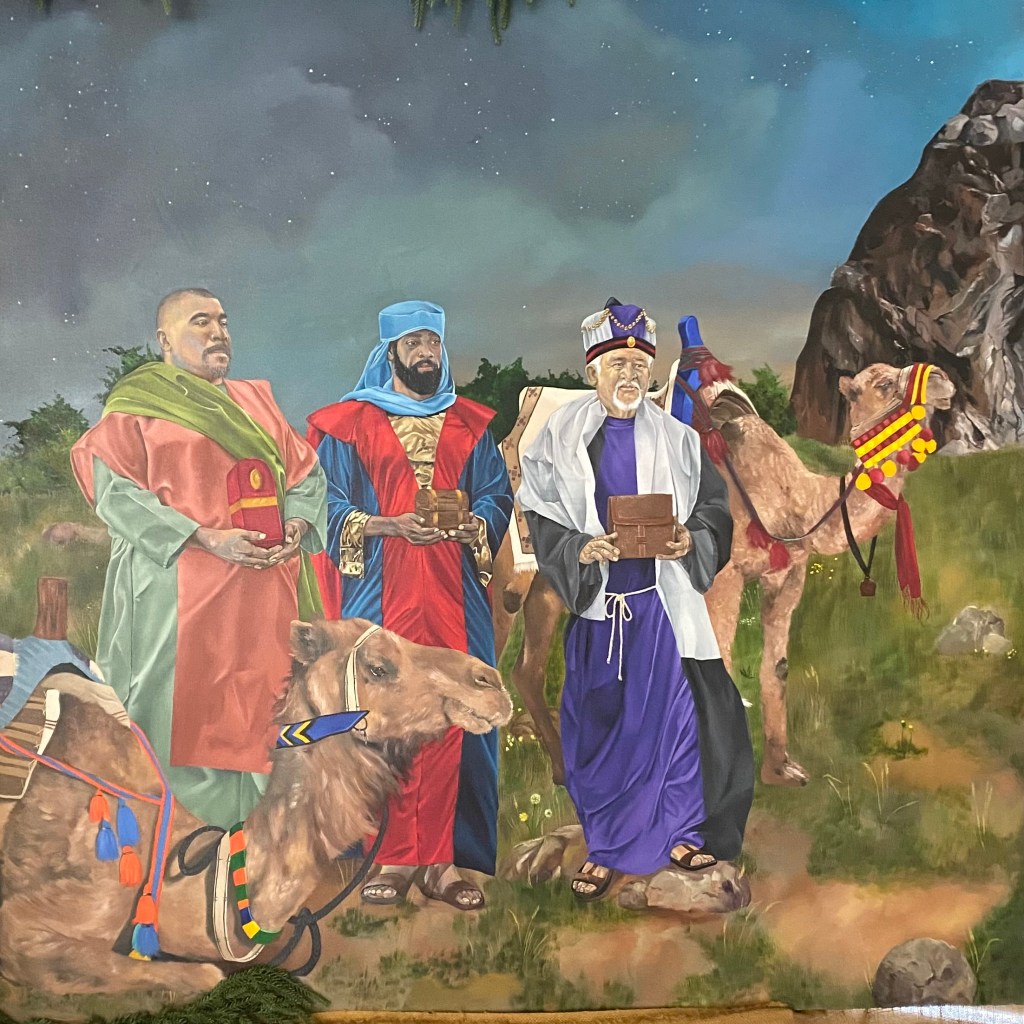
In the left panel, the Magi, elegantly dressed, hold their gifts for the Child as they come from a star-filled sky. Their camels finally rest from the long journey. The three represent the young and the old, and the different races called by the star. 

In the central panel, Mary seated holds in her arms the Child whom she wrapped in swaddling clothes and laid in a manger after she gave him birth.  Joseph stands protectingly over them. They’re dark skinned and dark haired, yet it’s hard to tell what race they belong to. 

Two angels above them announce “Glory to God” and a star shines brightly over the cave dug into the mountain. 

A donkey eats the straw from the manger, and a sheep lays on the ground beneath the manger. Right at Joseph’s feet there a large pig. Why is  he there, so close to the Child?  

In those days pigs were unclean animals. The Jews refused to eat them. On a journey to Joppa, Peter had a dream in which God commanded him to eat all kinds of food. There’s no fool that’s unclean, God said. All creation is  made clean through the saving power of his Son.

The whole world is welcome to the Manger. 

Artists remind us we can never exhaust the mysteries of life and the mysteries of God. There’s always more. 

Our Lady of Guadalupe, Pray for Immigrants

In our 2018 pastoral letter, “Open Wide Our Hearts,” we lamented the impact of immigration raids and mass deportations in which even those who are U.S. citizens have been caught up and deported, noting: “Today, many Hispanics are often assumed to be in this country illegally. These attitudes of cultural superiority, indifference, and racism need to be confronted; they are unworthy of any follower of Christ.”

We consistently reaffirm what the church has always taught: that every human person is created in the image and likeness of God, the imago Dei, and that the dignity of the human person does not depend on a particular legal status, nationality or occupation. We also recognize that promoting public order and upholding the rule of law are necessary endeavors, especially because these measures help guard against trafficking and other forms of exploitation.

Today, however, we see aggressive approaches to immigration enforcement that inflict harm on our sisters and brothers, sometimes restricting their ability to work, live and worship in arbitrary ways. Many citizens and lawful residents have reported being detained by methods that blur the line between legitimate enforcement and discriminatory profiling. This climate of fear makes our neighbors hesitant to go to work, to attend Mass or to visit loved ones.

In light of this, we must ask again: Who is my neighbor? The answer, as always, is found in Christ. He calls us to see with the eyes of mercy, to walk with those who suffer and to build a society rooted in justice and love. As disciples, we cannot remain indifferent. We are called to advocate for a just and meaningful immigration reform that respects human dignity, upholds due process and promotes the common good.

Let us follow the example of Our Lady of Guadalupe and stand in solidarity with those who live in fear, as a testament to God’s abiding peace. Let us be beacons of Christ’s light, filled with compassion and courage. Let us raise our voices in support of a meaningful reform of our immigration system, one that recognizes, as the U.S. bishops reaffirmed last month, that ensuring national security and safeguarding human dignity are not in conflict. Let us reject dehumanizing rhetoric and violence, whether directed at immigrants or at law enforcement. And let us never grow weary in the Gospel call to love without condition.

May the Lord, who is close to the brokenhearted, strengthen us in this mission. And may we, as one body of Christ, never forget who our neighbors are (Ps 34:19).

Bishop Robert Brennan of Brooklyn, NY

No Stone Will be Left: 34th Week

Enrique Simonet, Jesus over Jerusalem

We read Luke’s Gospel this week, the 34th week of the year. Luke  follows Mark’s Gospel closely in describing Jesus as he arrives in Jerusalem from Galilee, but he makes some simple, yet significant changes to Mark’s account. 

Mark’s account says that Jesus went back and forth to Bethany each day while teaching in the temple in Jerusalem. Luke’s account doesn’t mention Jesus’ stay in Bethany at all. Jesus comes to Jerusalem to enter the temple of God. 

The temple has great significance in Luke’s gospel.  Earlier in his gospel, Mary and Joseph bring Jesus there after his birth. His identity is validated there. For Jesus the temple is his Father’s house, where he belongs. It’s his home, where he teaches with authority, confronts his enemies and gives hope to those like the poor widow.

In Luke’s extension of his gospel, the Acts of the Apostles, the temple is also significant because the church is born there. For Luke, a disciple of Paul, we are also the temples of God and the Spirit of God dwells in us.

In Luke’s gospel, Jesus teaches about the end times in the temple area about the end ; in Mark’s gospel he teaches about it from the Mount of Olives. Though the temple stones be cast down, Jesus is the cornerstone, and so when “ powerful earthquakes, famines, and plagues from place to place; and awesome sights and mighty signs will come from the sky,” he remains our Rock.  

In this week’s readings, Luke adds some  important words to Mark’s fearful account of the end time. The end is coming soon. Mark seems to say. The end waits “until the times of the Gentiles are fulfilled,” Luke’s account says.(Luke 21:24)  The last times are delayed, not imminent. They will come at an indeterminate time, after the gentile world receives the gospel.

Yet, because Mark’s account was held by other followers of Jesus, Luke does not dismiss it.

Perhaps because the trees are shedding their leaves now in this part of the world, I notice another small change Luke makes to Mark’s gospel. “Learn a lesson from the fig tree. When its branch becomes tender and sprouts leaves, you know that summer is near. In the same way, when you see these things happening, know that he is near, at the gates” Jesus says in Mark. (Mark 13: 28-29)

Luke adds to the fig tree “and all the other trees.” (Luke 21:29-31) Why all the other trees? Was Luke adapting the message of Jesus to those forested regions in Asia Minor unlike Palestine, where creation in its many trees spoke of Word made flesh as well?

The gospel writers struggled with the great mysteries of the life, death and resurrection of Jesus and tried to adapt it to their times and place. We struggle with these mysteries too.

Pope Francis, in a letter on the study of history, said we need to read the fundamental texts of Christianity and understand them without “ideological filters or theoretical preconceptions” . “A study of history protects us from ‘ecclesiological monophysitism’, that is, from an overly angelic conception of the Church, a Church without spots and wrinkles…  A proper sense of history can help us develop a better sense of proportion and perspective in coming to understand reality as it is and not as we imagine it or would prefer reality to be.”

Like us, Luke and Mark struggled to understand.

The Kingdom among us: Luke 17: 20-25

Where is God?

God is everywhere.

That was one of the first question and answer I learned from my catechism many years ago. 

The Pharisees ask a question somewhat like that as Jesus approaches Jerusalem with his followers:

 “When is the kingdom of God coming?”

Jesus responds: “The coming of the Kingdom of God cannot be observed, and no one will announce, ‘Look, here it is,’ or, ‘There it is.’For behold, the Kingdom of God is among you.” (Luke 17:20-25)

The catechism of the scriptures, which we listen to now, says “The kingdom of God is among you.” The Greek word translated “among” can also be translated “within” so some translations have “The kingdom of God is within you.” But commentators say it’s better we look for the kingdom of God among us than simply within us. 

Yes, God who is everywhere is within us, holding us and all things in being. God makes a home in us, Jesus says, but we should not limit God’s presence to human beings or see God working only in us. God is among us, in others and in the universe we are part of. God is not present among us as an observer, God is building a kingdom that we may not observe. We can miss it, the parables of Jesus indicate.

Especially in times like our, the kingdom that’s coming is hard to see.  

It’s hard to see Jesus in the bread and wine, in his followers, in the wars and the destruction happening in our environment.

That’s what eyes of faith are for. Lord, that we may see.

When we think of saints, we may think of Mary, the mother of Jesus, apostles like Peter and Paul, or extraordinary individuals like Mother Teresa.  True friends of God.

Besides those saints – shining lights of faith– there are unnumbered others in God’s company, the Feast of All Saints says. In a vision of heaven, St. John saw  “a great multitude, which no one could count, from every nation, race, people, and tongue.” {Revelations 7, 9-13} We hope to be with them one day.

Our hope rests on a promise Jesus made, the same apostle says:

 “See what love the Father has bestowed on us that we may be called the children of God. Yet so we are…Beloved, we are God’s children now; what we shall be has not yet been revealed.” (1 John 3,1-3)

How shall we reach that place where we’ll be revealed as children of God?  Jesus said to follow him and live as he taught. He offers the way in his Sermon on the Mount, our gospel reading for this feast says. He will be the way, the truth and the life.

We haven’t seen yet that life we hope for or what God intends us to be. Life does not end; it changes. This feast invites us to trust in God’s promise and hope for the day it’s revealed. 

Extraordinary saints are not the only ones in heaven. There won’t be just a few either. Countless others are in God’s company: saints unnoticed here on earth, saints with little to show, saints who were sinners. People like us.

As we celebrate this feast, St. Bernard says:

“Rise again with Christ and seek the world above and set your mind on heaven. Long for those who are longing for us; hasten to those who are waiting for us, ask those who are looking for our coming to intercede for us. Desire their company and seek a share in their glory. There’s no harm in being ambitious for this. No danger in setting your heart on such glory. Remembering the saints inflames us with a yearning that Christ our life may appear to us as he appeared to them and that one day we may share in his glory.”

Who are the Romans Paul writes to?

Who are the Romans Paul writes to in his letter to the church in Rome? Historians say Jews were the predominant group that first embraced Christianity in Rome, but there were not many Jewish converts at first. A substantial population of Jews at the time lived in Trastevere, across the Tiber River. Claudius had to expel some of them from the city around the year 47 because of violent disturbances in the Trastevere synagogues over Christ. It’s unlikely there was a large number of converts to Christianity from Judaism when Paul wrote his letter. 

Many Jews in Rome, faithful to Judaism, would strongly question Paul’s argument that the law was a failure.

Not many Romans, Gentiles, embraced the gospel early on either. I doubt the majority of the Romans would agree with Paul that the Roman gods had failed. Rome was a powerful, successful empire in Paul’s day.  I doubt many thought too much about its flaws.

The Christian community made up of Jews and Gentiles was not large, if my reading of Paul’s time is accurate. The Christians of Rome were fervent, but few. 

In his letter, Paul pictures sin as a cosmic reality, but cosmic sin is not always easy to see. It was not easy to see in Paul’s day, nor is it easy to see in our day. We identify sin with personal sin, murder, theft, cheating, adultery. Paul is aware of personal sin, yet his focus is on cosmic sin. Harder to see who’s responsible for cosmic sin. Who’s responsible for the sin in wars, armament races, manipulation of world markets, plundering the environment? 

The Letter to the Romans has a large place in the Sunday and weekday readings of our lectionary. It can be difficult to read, but we need Paul’s larger picture, which calls for a larger hope. Until the final coming of Jesus, we must live in the world pictured by the apostle. 

We thank God for his grace of forgiveness and his promise of new life.

The Season of Creation: September 1-October 4

Ten years ago, Pope Francis called for A World Day of Prayer for the Care of Creation for September 1st. The day of prayer, coinciding with the publication of his letter Laudato si’ , began a Season of Creation, an ecumenical endeavor shared with other churches and communities that extends from September 1st to October 4th, the Feast of St. Francis of Assisi. 

Our church calendar, besides feasts and seasons, has days of prayer when particular causes  arise. In a recent letter, Pope Leo called the care of creation a particularly timely issue to pray for:

“…given the evidence in various parts of the world that our earth is being ravaged. On all sides, injustice, violations of international law and the rights of peoples, grave inequalities and the greed that fuels them are spawning deforestation, pollution and the loss of biodiversity. Extreme natural phenomena caused by climate changes provoked by human activity are growing in intensity and frequency (cf. Laudato Deum, 5), to say nothing of the medium and long-term effects of the human and ecological devastation being wrought by armed conflicts.

As yet, we seem incapable of recognizing that the destruction of nature does not affect everyone in the same way. When justice and peace are trampled underfoot, those who are most hurt are the poor, the marginalized and the excluded. The suffering of indigenous communities is emblematic in this regard.

That is not all. Nature itself is reduced at times to a bargaining chip, a commodity to be bartered for economic or political gain. As a result, God’s creation turns into a battleground for the control of vital resources. We see this in agricultural areas and forests peppered with landmines, “scorched earth” policies, [1] conflicts over water sources, and the unequal distribution of raw materials, which penalizes the poorer nations and undermines social stability itself…

Environmental justice – implicitly proclaimed by the prophets – can no longer be regarded as an abstract concept or a distant goal. It is an urgent need that involves much more than simply protecting the environment. For it is a matter of justice – social, economic and human. For believers it is also a duty born of faith, since the universe reflects the face of Jesus Christ, in whom all things were created and redeemed. In a world where the most vulnerable of our brothers and sisters are the first to suffer the devastating effects of climate change, deforestation and pollution, care for creation becomes an expression of our faith and humanity.

Now is the time to follow words with deeds.”

 ( For THE 10th WORLD DAY OF PRAYER
FOR THE CARE OF CREATION 2025)

Recently, the Dicastery for Divine Worship provided a preliminary text for a Mass for the Care of Creation. A good resource for prayer during the Season of Creation.

MASS FOR THE CARE OF CREATION

Entrance Antiphon Ps 18: 2

The heavens declare the Glory of God,

and the firmament proclaims the work of his hands.

Collect

God our Father,

who in Christ, the firstborn of all creation,

called all things into being,

grant, we pray, that docile to the life-giving breath of your Spirit, we may lovingly care for

the work of your hands.

Through our Lord Jesus Christ, your Son,

who lives and reigns with you in the unity of the Holy Spirit,

God, for ever and ever.

Prayer over the Offerings

Receive, O Father,

these fruits of the earth and of our hands:

bring to completion in them the work of your creation,

so that, transformed by the Holy Spirit,

they may be for us the food and drink of eternal life.

Through Christ our Lord.

Communion Antiphon All the ends of the earth have seen the salvation of our God.

cf. Ps 97: 3

Prayer after Communion

May the sacrament of unity

which we have received, O Father,

increase communion with you and with our brothers and sisters,

so that, as we await the new heavens and the new earth,

we may learn to live in harmony with all creatures.

Through Christ our Lord.

St. Alphonsus Liguori: August 1

Alphonsus Liguori (1696-1787) was born near Naples, Italy, into a noble family. He began life as a lawyer but gave up law to become a priest and devote himself to bringing the gospel to the poor. His sermons and instructions were simple. “I never preached a sermon that the poorest old woman in the congregation didn’t understand,” he claimed. In 1732 he founded the Redemptorists, the Congregation of the Holy Redeemer. 

A prolific writer, poet and musician, Alphonsus authored a series of devotional books on Mary and important works on moral theology.  He advocated leniency and mercy towards people, steering a course between severity and laxity.  In hearing confessions, he said he never denied anyone absolution. We can see why he’s an example for pastoral workers today.

 In 1762, he became bishop of Sant Agata dei Goti, a small diocese near Naples, where he worked to reform the clergy and renew its people in their faith. In 1775 he resigned his bishopric because of his health, but continued writing religious and devotional tracts till his death in 1787. In 1816 he was canonized by Pope Gregory XVI. Pope Pius IX declared him a doctor of the church in 1871.

“Hasn’t God a claim on our love? From all eternity God has loved us. ‘ I first loved you. You had not yet appeared in the light of day, nor did the world yet exist, but already I loved you. From all eternity I have loved you.’

God gave us a soul endowed with memory, intellect and will; he gave us a body equipped with the senses; it was for us that he created heaven and earth and all things. The truth is the eternal Father went so far as to give us his only Son. 

  By giving us his Son, whom he did not spare precisely so that he might spare us, he bestowed on us at once every good: grace, love and heaven; for all these goods are certainly inferior to the Son. He who did not spare his own Son, but handed him over for all of us: how could he fail to give us along with his Son all good things?”

The prayer for his feast day points out it’s our turn to do what Alphonse’s did:

O God who constantly raise up in your church new examples of virtue, grant that we may follow so closely in the footsteps of the Bishop Saint Alphonsus in his zeal for souls as to attain the same rewards that are his in heaven.

Jacob Wrestling with God

Jacob wrestling

( Genesis 23, 33-43)

Our lectionary leaves out a number of the stories about Jacob and his wife Rachel, her brother Laban and his sons, that are far from edifying. They are hardly honest. They strike deals and, by hook or by crook, try to get the best deal they can. They’re not people you want for neighbors or do business with.

Yet, God promises Jacob what he promised Abraham:

“I, the LORD, am the God of your forefather Abraham and the God of Isaac; the land on which you are lying I will give to you and your descendants. These shall be as plentiful as the dust of the earth, and through them you shall spread out east and west, north and south. In you and your descendants all the nations of the earth shall find blessing. Know that I am with you; I will protect you wherever you go, and bring you back to this land. I will never leave you until I have done what I promised you.” (Genesis 22,1 8-28)

Even with those sublime words ringing in his ears, Jacob never seems to abandon his wheeling and dealing. It’s as if the most important thing in the world is the extra sheep he’s going to wheedle out of his father in law.

The Old Testament certainly portrays real life. The early Christian scholar Marcion wanted to throw out the Old Testament altogether, because he claimed it wasn’t spiritual enough. God wouldn’t promise such great things to people like Abraham, Isaac and Jacob and their wives and relations and slaves.

I suppose that’s one reason for us to keep reading the Old Testament:  God works in real life. “God is a Potter; he works in mud,” the Greek writer Nikos Kazantzakis entitled a chapter in one of his books.

Two things commentators note about the stories of Jacob. First, he doesn’t recognize the presence of God until afterwards. “When Jacob awoke from his sleep, he exclaimed, ‘Truly, the LORD is in this spot, although I did not know it!’” That’s an interesting discovery we all can make. God was there and we didn’t know he was there.–except afterwards.

Second, the commentator for the New American Bible says this about the story of Jacob wrestling in the dark at the river edge with the unknown figure: “The point of the tale seems to be that the ever-striving, ever-grasping Jacob must eventually strive with God to attain full possession of the blessing.”

God engages us and wrestles with us, “ever striving, ever grasping”, whether we like it or not, and we will have scars to prove it.