We celebrated the feast of Christ the King last Sunday. It’s hard to think of Christ as king in a world where kings are few, at least in our western world. Royal families, where they exist, have mainly ceremonial roles.
Yet, Jesus Christ is king, and what’s more we share in his kingly role. (Catholic Catechism 1546) We’re all priests, prophets and kings by our baptism. “We’re a “chosen race, a royal priesthood, a people set apart,” (1 Peter 2,5)
How are we kings? The illustration of Adam, from the Book of Genesis, may tell us. Adam is given kingly powers by God in the garden, the symbol of the created world. He names the animals and is caretaker of God’s creation.
Psalms, like Psalm 8 (Saturday Morning, week 2), remind us that’s our role: When I see the heavens, the work of your hands, The moon and the stars that you arranged, What are we that you keep us in mind,, Mortal as we are that you care for us.
Yet you have made us little less than gods, With glory and honor you crown us, You have give us power over the works of your hand, Put all things under our feet.”
This week’s readings from Daniel and Luke’s Gospel (Friday) seem to predict a world torn apart and discarded when God’s kingdom comes. But that’s not so. Creation itself awaits the promise of resurrection. Jesus Christ is our Savior and we are part of his saving work.
We have been given kingly care over creation. Let’s not forget it. We’re not here just to save ourselves nor is our purpose in life to escape from this world. We’re to care for creation and make it ready for God’s kingdom.
At that time the disciples approached Jesus and said, “Who is the greatest in the kingdom of heaven?” He called a child over, placed it in their midst, and said, “Amen, I say to you, unless you turn and become like children, you will not enter the kingdom of heaven. Whoever humbles himself like this child is the greatest in the kingdom of heaven. And whoever receives one child such as this in my name receives me.
See that you do not despise one of these little ones, for I say to you that their angels in heaven always look upon the face of my heavenly Father.”
Matthew 18:1-5, 10
Guardian Angels Guide Us to the Father
God, the Father Almighty, maker of heaven and earth, of all things visible and invisible, placed Christ at the center of the angelic world. Every child made in the image of the Incarnate Son of God receives a guardian angel at conception to guide them in their journey home to the Father. As “their angels in heaven always look upon the face of my heavenly Father,” they intercede and light the way through Christ in the Spirit to the heart of the Father.
From its beginning until death, human life is surrounded by their watchful care and intercession. “Beside each believer stands an angel as protector and shepherd leading him to life.” Already here on earth the Christian life shares by faith in the blessed company of angels and men united in God.
Catechism of the Catholic Church 336
Prayer to My Guardian Angel
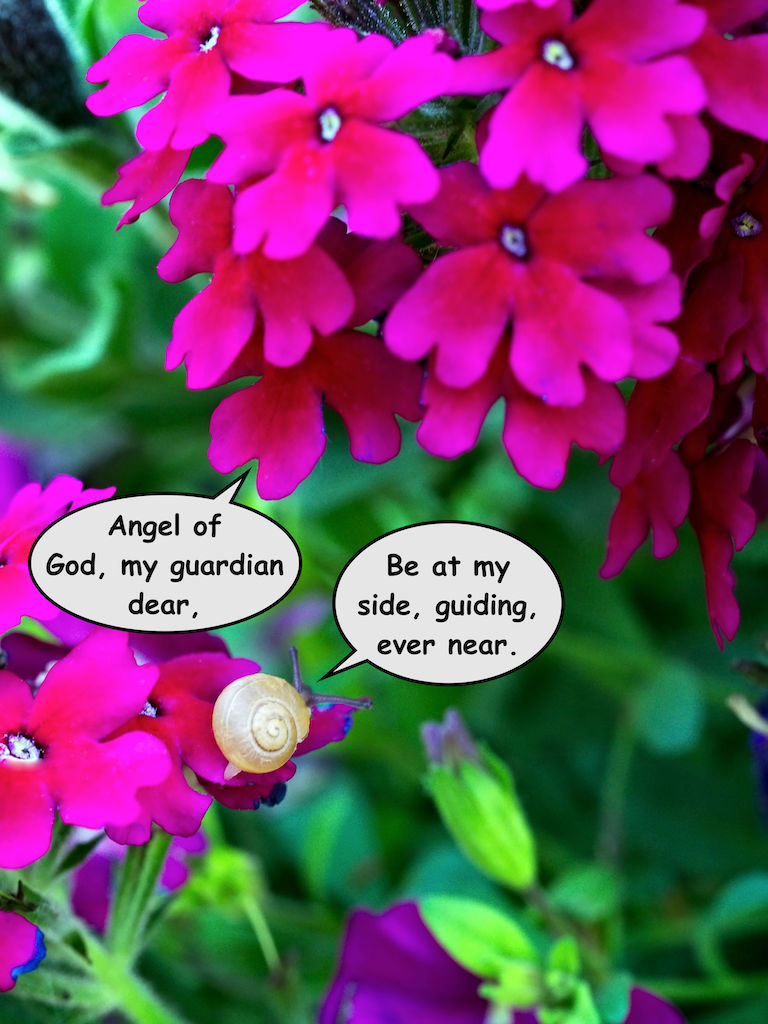
Angel of God, my guardian dear, to whom God’s love commits me here, ever this day be at my side, to light and guard, to rule and guide. Amen.
Angel of God, my guardian dear, Be at my side, guiding, ever near.
The Rosary of the Virgin Mary, which gradually took form in the second millennium under the guidance of the Spirit of God, is a prayer loved by countless Saints and encouraged by the Magisterium. Simple yet profound, it still remains, at the dawn of this third millennium, a prayer of great significance, destined to bring forth a harvest of holiness. It blends easily into the spiritual journey of the Christian life, which, after two thousand years, has lost none of the freshness of its beginnings and feels drawn by the Spirit of God to “set out into the deep” (duc in altum!) in order once more to proclaim, and even cry out, before the world that Jesus Christ is Lord and Saviour, “the way, and the truth and the life” (Jn 14:6), “the goal of human history and the point on which the desires of history and civilization turn.”
The Rosary, though clearly Marian in character, is at heart a Christocentric prayer. In the sobriety of its elements, it has all the depth of the Gospel message in its entirety, of which it can be said to be a compendium. It is an echo of the prayer of Mary, her perennial Magnificat for the work of the redemptive Incarnation which began in her virginal womb. With the Rosary, the Christian people sits at the school of Mary and is led to contemplate the beauty on the face of Christ and to experience the depths of his love. Through the Rosary the faithful receive abundant grace, as though from the very hands of the Mother of the Redeemer.”
The words of the Preacher, the son of David, king in Jerusalem. Vanity of vanities, says the Preacher, vanity of vanities! All is vanity. What does man gain by all the toil at which he toils under the sun? A generation goes, and a generation comes, but the earth remains forever. The sun rises, and the sun goes down, and hastens to the place where it rises. The wind blows to the south and goes around to the north; around and around goes the wind, and on its circuits the wind returns. All streams run to the sea, but the sea is not full; to the place where the streams flow, there they flow again. All things are full of weariness; a man cannot utter it; the eye is not satisfied with seeing, nor the ear filled with hearing. What has been is what will be, and what has been done is what will be done, and there is nothing new under the sun. Is there a thing of which it is said, “See, this is new”? It has been already in the ages before us. There is no remembrance of former things, nor will there be any remembrance of later things yet to be among those who come after.
Ecclesiastes 1:1-8 (ESV)
What is the Meaning of Life?
Qoheleth, the “Preacher,” writing in the name of Solomon, the son of David, wrestles with the absolute in the book of Ecclesiastes. The Hebrew word Qoheleth (from qahal, a root that means “assembly” or “congregation”) is Ekklesiastes in Greek, which names the book. Early traditions attribute the book’s authorship to Solomon, but philological evidence dates the book to no earlier than the mid-fifth century B.C., a half-millennium after Solomon’s reign. Thus, Qoheleth, a Hebrew sage, critiques the world through the eyes of King Solomon, the wisest, wealthiest, and most powerful man in the world. He investigates the patterns of nature and human striving, hoping to discover an ultimate purpose behind it all.
World of Vapor
Qoheleth begins by lamenting that all is “vanity” (in Hebrew hebel, “vapor, breath”), which he pronounces five times in a single utterance (1:2). Finding no ultimate profit in the drudgery of human toil, he rhetorically asks, “What does man gain by all the toil at which he toils under the sun?”
Ephemeral phenomena and superficial impressions shift and slide incessantly “under the sun,” where nothing is constant. The rising and setting of the sun, and the circuitous currents of wind go “round and round” ceaselessly in a futile loop. The sea, too, like human ambition and appetite, never finds fulfillment despite continuous filling: “All streams run to the sea, but the sea is not full” (1:7). Jaded by familiarity, Qoheleth deplores the predictable motions of the earth.
“All things are full of weariness,” he despairs, “a man cannot utter it.” “The eye is not satisfied with seeing, nor the ear filled with hearing” (1:8). Ever restless, human desire insatiably consumes the panorama of sight and sound—representative of all sensory and intellectual stimuli. All impressions eventually evaporate like steam (hebel).
Nothing New Under the Sun
What has been is what will be, and what has been done is what will be done, and there is nothing new under the sun. Is there a thing of which it is said, “See, this is new”? It has been already in the ages before us.
Ecclesiastes 1:9-10 (ESV)
Ecclesiastes affirms the truism that “history repeats itself.” As civilizations rise and fall, human nature remains the same. War and peace, joy and sorrow, strength and weakness, freedom and slavery, profit and loss—the same old human affairs cycle round and round, generation after generation, world without end. A keen observer of human nature and historical recurrence, Qoheleth bleakly concludes, “There is nothing new under the sun.”
Puff of the Past
There is no remembrance of former things, nor will there be any remembrance of later things yet to be among those who come after.
Ecclesiastes 1:11 (ESV)
As the sands of time fade away, so does human “remembrance of former things.” Stars and galaxies, fossils, and artifacts provide clues to the mystery of the 13.8 billion-year-old universe and human evolution. Yet billions of ancestors lie buried in the ground, forgotten by their descendants. Apart from cave paintings, oral traditions, scrolls, books, annals, chronicles, and even modern audiovisual media, which capture only fragments from limited perspectives, the past vanishes like vapor “under the sun.” Can fragmentary memories preserve an unbroken, unified recollection of the past? Can mortals achieve immortality in the minds of posterity?
The Value of Struggle
Ecclesiastes challenges the assembly of wisdom seekers to find ultimate purpose and profit “under the sun.” Like Job, Qoheleth embraces disputation and wrestling with elemental questions. Sometimes described as “unorthodox,” these books goad the pious to “struggle with God,” the meaning of Israel’s name (Genesis 32:28). Questions do not threaten religion but expand its horizons.
Without being an atheist, Qoheleth journeys to the edge of human striving to discover its peaks and valleys apart from God. His experiment confirms Paul’s observation that, on account of Adam’s departure from God’s will, “the creation was subjected to futility” (Romans 8:20; Genesis 3:17). The Greek word for futility,mataiotés (“vanity,” “emptiness”), translates the Hebrew word hebel (“vapor,” “breath”) in the Septuagint. Ecclesiastes allows every seeker of meaning to feel the emptiness of a life and vision that never rises above the sun.
I have seen all things that are done under the sun, and behold, all is vanity and a chase after wind.
Ecclesiastes 1:14 (NABRE)
All is vanity, a chase after wind. Series and cycles—these I examined. Under the sun, seasons whirl like vapor. What do humans gain by all their labor?
They left from there and began a journey through Galilee, but he did not wish anyone to know about it. He was teaching his disciples and telling them, “The Son of Man is to be handed over to men and they will kill him, and three days after his death he will rise.” But they did not understand the saying, and they were afraid to question him.
They came to Capernaum and, once inside the house, he began to ask them, “What were you arguing about on the way?” But they remained silent. They had been discussing among themselves on the way who was the greatest. Then he sat down, called the Twelve, and said to them, “If anyone wishes to be first, he shall be the last of all and the servant of all.” Taking a child he placed it in their midst, and putting his arms around it he said to them, “Whoever receives one child such as this in my name, receives me; and whoever receives me, receives not me but the One who sent me.”
Mark 9:30-37
Who is the Greatest?
Walking through Galilee, Jesus’ thoughts and that of his disciples diametrically clashed. A brooding Judas heard his master’s prediction of his betrayal and death. Did the omen disquiet the lone treasurer? Each man heard Jesus uniquely and darkly. The matter of his rising after three days sounded meaningless and opaque.
Filtering out ideas that conflicted with their image of an earthly Messianic kingdom, the Twelve heatedly argued about their relative positions of power. When questioned by Jesus, no one dared answer. Their squabble, in his presence, vanished as vain and arrogant chatter.
Sitting down to teach in the rabbinic manner, Jesus settled their debate: the greatest of all will be the least of all, like a little child. “If anyone wishes to be first, he shall be the last of all and the servant of all.” Jesus’ whole life from his birth in a manger, wrapped in swaddling clothes, to his burial in a tomb, wrapped in grave clothes, bespoke a complete stripping of earthly pride and power.
Jesus felt more at home among the lilies of the field than in the palaces of kings. Like the lowly child, the colorful, fragile flowers in the wild express the splendor of God, the true King of Israel.
Learn from the way the wild flowers grow. They do not work or spin. But I tell you that not even Solomon in all his splendor was clothed like one of them.
Matthew 6:28-29; cf. Luke 12:27
As the Cross loomed, the Twelve vied for power. Jesus bent down to the child and flower.



 The Victor's Place