Tag Archives: faith

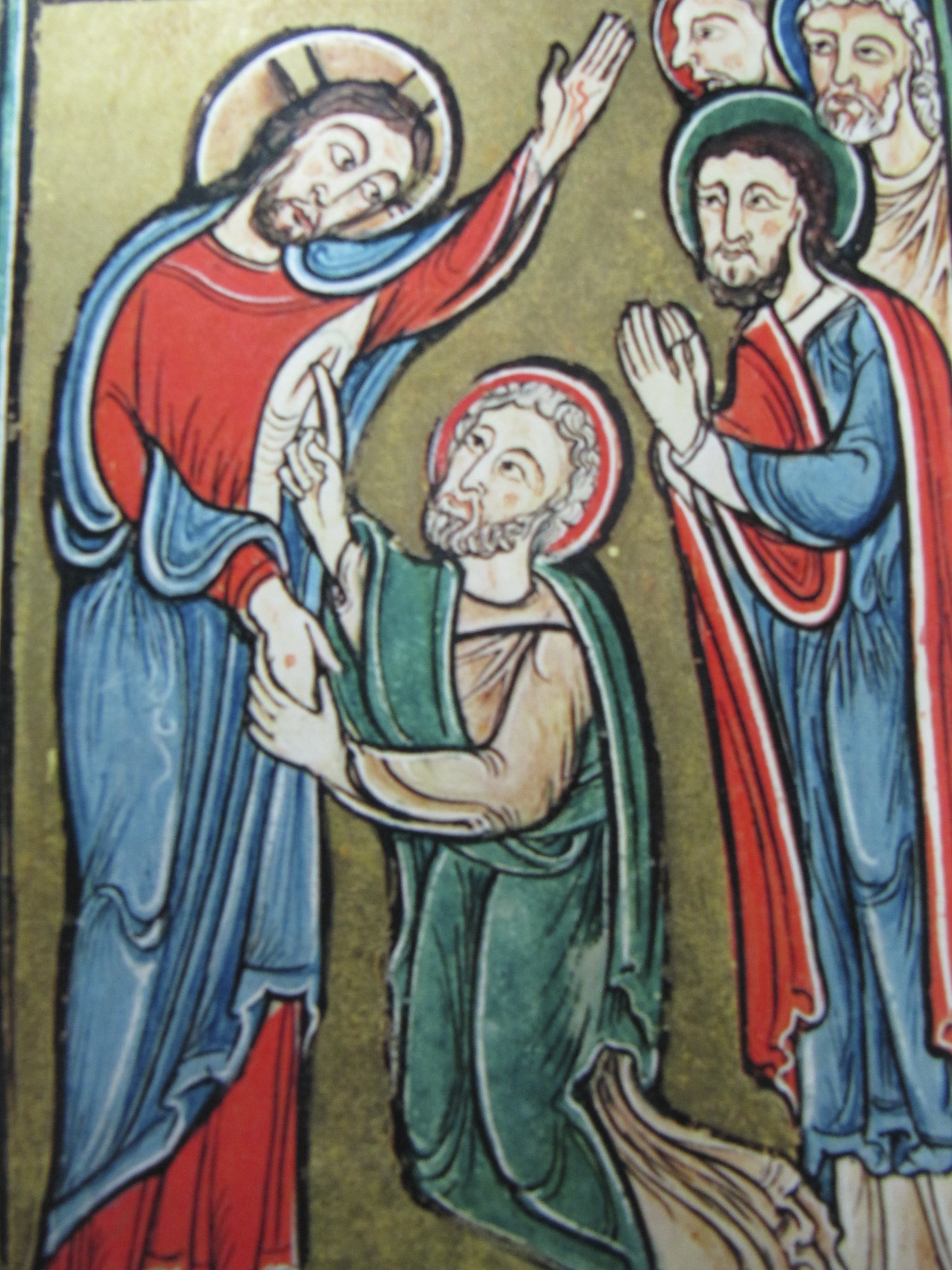
Ist Sunday of Easter: The Thomas in Us All

Audio of the homily below:

The yearly feast of Easter is a celebration, not of one day, but of fifty days, from Holy Saturday till the feast of Pentecost. We also celebrate Easter each Sunday of the year.

Why this extensive celebration? Because we’re so slow to realize what it means, and need reminding over and over.

Some things — like telling time or tying our shoes — we learn once, but the resurrection of Jesus is a mystery not learned at once. Never grasped completely, it unfolds as life unfolds, day by day.

That’s why Thomas, the apostle, whom we remember on the 2nd Sunday of Easter, is such an important figure. Far from being a lonely skeptic, an isolated dissenter, he represents the slowness of heart and mind, the recurrent skepticism, that affects us all.

Yet, Thomas is still a sign of hope. He reminds us that the Risen Jesus offers, even to the most unconvinced, the power to believe.

Lord Jesus,
the Thomas in us all
needs the wounds in your hands and side,
to call us to believe
you are our Lord and God.

Risen, present everywhere,
bless those who have not seen,
blind with doubts
and weakened faith.

Bless us, Lord,
from your wounded hands and side,
give us faith
to believe in you.

Spanish
El Tomás Dentro de Todos Nosotros
Juán 20, 19-31, Segundo Domingo de Pascua

La fiesta anual de Pascua florida es una celebración, no de un día, sino de cincuenta días, desde el Sábado Santo hasta la fiesta de Pentecostés. También celebramos el Domingo de Pascua cada domingo del año.

¿Por qué esta extensa celebración? Porque somos tan lentos en realizar lo que significa, y también necesitamos ser recordados una y otra vez.

Algunas cosas – como leer el reloj o amarrarnos los zapatos – las aprendemos una sola vez, pero la resurrección de Jesús es un misterio que no se aprende de una vez. Nunca comprendido completamente, se revela gradualmente mientras la vida se despliega día por día.

Por eso es que Tomás, el apóstol a quien recordamos el Segundo Domingo de Pascua, es una figura tan importante. Lejos de ser un escéptico solitario, un disidente aislado, él representa la lentitud de corazón y mente, el esceptisismo recurrente, que nos afecta a todos.

Sin embargo, Tomás sigue siendo un signo de esperanza. Él nos recuerda que el Jesús Resucitado nos ofrece hasta el menos convencido de nosotros, el poder de creer.

Señor Jesús, el Tomás en todos nosotros
necesita las heridas de tu costado y manos,
llamándonos a creer que eres nuestro Señor y Dios.
Resucitado, presente en todas partes,
bendice a los que no han visto,
ciegos con dudas y fé debilitada.
Bendícenos Señor; a través de tus heridas manos y costado,
danos fé para creer en Tí.

The Two Creations

In his homily on the readings for Mass on Monday, Pope Francis spoke of two creations, the first described in the Book of Genesis and the second described in the Gospel of Mark where Jesus goes among the people, and “as many of those who touched him were saved.”

Regarding the first creation, God gives us the responsibility to nurture creation, Pope Francis said.

“It’s our obligation as Christians. For us there is a responsibility to nurture the Earth, to nurture creation, to keep it and make it grow according to its laws. A Christian who does not protect creation, who does not let it grow, is a Christian who does not care about the work of God, that work that was born from the love of God for us. And this is the first response to the first creation: protect it and make it grow.”

We advance the second creation by advancing in faith, by touching Jesus in faith.

The popes daily homilies can be found here. Gems of spirituality.

An Unclean Spirit

Our gospel reading this Sunday is from the first chapter of the Gospel of Mark.  Jesus  has come from his baptism in the River Jordan; he’s gathered disciples and now he’s living at Peter’s house in Capernaum along the Sea of Galilee.He enters the synagogue in the town and amazes people with his teaching. They’ve never heard anyone like him.

But a man in the synagogue who has an unclean spirit challenges him.  I’m not sure what an unclean spirit is. Certainly the man reacts violently to Jesus. Listen to him shouting out:
“What have you to do with us, Jesus of Nazareth? Have you come to destroy us? I know who you are—the Holy One of God!”

In other words: “Keep away from us; you’re only going to bring us trouble.” The man just wants to be left alone. Even if Jesus is from God, the man just wants to be left alone. “Get away from us!” he says.

That strong reaction was not limited to the synagogue in Capernaum. It continued as Jesus made his way to Jerusalem. Mark’s gospel insists that others rejected Jesus, sometimes strongly, sometimes by simply ignoring him, and he calls their rejection diabolic.

However wise his teaching, compassionate his healing, loving his words, some rejected Jesus in his lifetime. In the end, his enemies killed him.

We believe the gospel repeats itself, and so it’s repeated today as we relive and experience it.  “If today you hear his voice, harden not your hearts.” Can we reject Jesus too?

Doesn’t he stand in our synagogue today, in signs and in faith?

Belief in Jesus Christ is at the heart of everything. “I believe in God, the Father Almighty…I believe in Jesus Christ…I believe in the Holy Spirit.” Believing means hearing Jesus, listening to him, offering ourselves to him, entering into friendship with him, hoping in his strength, waiting patiently to receive what he promises.

Belief is not something we do once; we believe day by day. We’re always dangerously close to losing sight of Jesus. “Leave us alone,” we say, “You want to destroy us.” How easily we prefer isolation to communion with the One God has sent.
Perhaps an unclean spirit is not rare at all. If it’s a spirit that’s cloudy and dark then, when it takes hold of you, you cannot see the Light at all.

Deliver us, Lord, from an unclean spirit.

Faith Like The Mustard Seed

27th Sunday of the Year C

Like the apostles, we would like a stronger faith. “Increase our faith,” they ask Jesus. Give us faith that understands everything immediately and sees everything clearly–right away! We can hear ourselves asking for faith like that too.

In response, Jesus offers the image of a mustard seed. Look at this tiny seed, he says. With faith like this, you can accomplish the most impossible things. What does he mean?
A mustard seed is so small that you hardly can see it in the palm of your hand, Yet once in the ground it grows into a full sized tree, through cold and heat, nights and days, all kinds of weather. But it takes time.

Faith is like that. It grows, but its growth takes place over time, day by day, through the common experiences that come our way. God dwells in the ground of daily life and it’s there we meet him most of all. That’s why the psalm for today’s Mass insists: “If today you hear his voice, harden not your hearts.”

Today in countless little things, in unassuming moments, God speaks to us. And even as the moments slip by, God’s plan unfolds. We need a daily faith, a patient faith, a faith like the mustard seed, to wait until it reaches its completion. “The vision still has its time, presses on to fulfillment, and will not disappoint. If it delays, wait for it, it will surely come, it will not be late.”

A daily faith that watches God’s plan unfold in the course of things.

First Holy Communion

In our parish children are receiving their First Holy Communion these Sundays of the Easter season. They will come into the church together, each one with her or his name printed on their clothes and we will greet each one of them by name at the altar. Their families and relatives will be here.

Later, we will call them to stand around the altar at the Eucharistic prayer and they will be the first to receive Communion. Afterwards, they’ll be joining their families to celebrate this important step in their life of faith.

We call them by name. In baptism, that’s the first thing we ask parents who bring their children to the baptized: “What’s his/her name?” and later we baptize them “in the name of the Father, and of the Son and of the Holy Spirit.”

God calls us by name. It’s my name and it stands for me. In baptism we are called by God, who takes us into his hands forever. We are baptized with water, with life, in the name of the Father, and of the Son and the Holy Spirit. We know God’s name: Father, Son and Holy Spirit.

Baptized as infants, we didn’t speak for ourselves; our parents spoke for us, and they were entrusted to bring us up in this belief: that we are God’s children, God who is Father, Son and Holy Spirit.

At first Holy Communion we speak for ourselves; no one holds us in their arms or speaks for us as they did in baptism. When we receive Jesus in the bread we say “Amen.” I believe he comes to me; I know who he is; He is my Lord and my God who loves me. He gave his life for me and he calls me to eternal life.

Our First Communion should be the beginning of many communions. Jesus wants us to know his name and to know us. That’s what the word “communion” means.

22nd Sunday

Don’t miss the way the Prophet Jeremiah talks to God in our first reading today and the way Peter the Apostle in our gospel gets the message of Jesus all wrong. They’re examples of what faith in God is really like. Without people like them, we might think faith is a ticket to a wonderful life and endless sweet dreams.

Jeremiah is fed up with God:

“You duped me, O Lord, and I let myself be duped;

you were too strong for me, and you triumphed.

All the day I am an object of laughter;

everyone mocks me.”

The lonely prophet lived in hard times when Babylonian armies were sacking Jerusalem and everyone was calling him a deceiver because of a message they didn’t want to hear– God was going to let his holy city be completely destroyed and his people led away in chains.

The message sours the prophet’s mouth and breaks his heart. He feels like a fool.  Yet listen to him:

“I say to myself, I will not mention him,

I will speak in his name no more.

But then it becomes like fire burning in my heart,

imprisoned in my bones;

I grow weary holding it in, I cannot endure it.”

He’s faithful to God no matter what.

Peter, a believer,  gets the message of Jesus wrong. He can’t accept the prediction of the Cross, but wants success instead.

Yet God works with this apostle whose faith is so imperfect and  prizes this prophet whose faith is so tried. Since our faith may be like theirs, let’s hope God will work with us.  “We believe; help our unbelief.”

Ever Old, Ever New

Our faith is “ever old and ever new.” It has a beauty ever old and ever new, a beauty found in the ancient scriptures we’ve received and in the creeds and traditions handed down to us; a beauty that shines out as it meets new times and circumstances and knowledge. The beauty of Jesus Christ.

Sometimes we hear about “an age of faith,” meaning an age gone by when faith was strong and real. That age is gone, it’s said; our times are unbelieving times when faith is weak and dying.

But is that true? Is faith just for another time, or is it also for our time? Can it be that  it only waits for fresh understanding and expression.

“For last year’s words belong to last year’s language

And next year’s words await another voice.” (T. S. Eliot)

“Jesus Christ is the same, yesterday, today and forever.” (Hebrews 13,8) Where are the voices that speak of him now? Are they ours?

We Go to God Through Questions

I’ve been talking to a number of people lately who have questions about their faith. I emailed this to one of them today:

Here are some sources you might find interesting as you look again at the faith you learned long ago.

Just a few months ago a new Catholic bible was published called the New American Bible Recent Edition. NABRE. The last printing was 20 years ago, but since so much new archeological material and textual discoveries have become available since then, they thought a new edition was due. Part of what we are experiencing today is an explosion of new knowledge in these fields and in other fields of human knowledge. I’m going to pick up that new bible soon myself. It has wonderful notes and introductions to the books and it’s also the translation we read in church.

I was in a Barnes and Noble store yesterday and looked at the section of bibles, but I could hardly locate the New American Bible among the other editions. With the decline of Catholic book stores it’s hard to get the books we might be looking for. The media don’t help either with some of their sensational productions on religion.

The pope’s two new books, “Jesus of Nazareth”. are also good to read. I’ve been reading his last one about the Passion and Resurrection of Jesus, and I find it stimulating. He’s using much of the latest scholarly materials and offering some wonderful insights. and he’s not afraid to take on tough questions.  We are all doing the same thing: learning and learning again.

I like a recent catechism published by the American bishops: The United States Catholic Catechism for Adults. You can get it at Amazon.com. It approaches the different aspects of faith simply and offers a person, whether a canonized saint or not, who exemplifies that aspect and tells their story. Faith is better seen when it’s lived by people.

Since you were impressed by your recent visit to the Holy Land you may be interested in some entries I did for our pilgrimage from St. Mary’s from October 16 to November 20, 2010. You can find them on Victor’s Place, my blog, at https://vhoagland.wordpress.com/

I think I told you what one of my theology teachers told me long ago. “We go to God through questions. You find one answer and ten more questions are there waiting to be answered.”

Questions are part of our search for God.

Window on the World

The window in my room faces west to a slice of Union City that includes the old monastery church and parking space, some city athletic fields, a crowded  block of houses along 21st Street and a few big oak trees that somehow have survived the urban sprawl.  It’s a wonderful window for taking in the world.

Earlier this morning, Jose reached into the van carrying some neighborhood people to work to bless them, anticipating the morning sun that blesses everything now. A  few minutes ago, a flock of pigeons momentarily touched down on the wires along the street, thenflew away. I can’t figure out their unpredictable ways.

I leave the tiny figures of Mary and Joseph and the Child on the window sill all year because they seem to complete the picture.  Keep your eyes fixed on examples of faith, St. Ambrose said yesterday in his commentary on the Visitation.  Mary saw it in Elizabeth and Elizabeth saw it in Mary. Joseph certainly had eyes of faith too.  The Child is so small.  Only eyes of faith can see him–and everything else as well.

Tuesday Night at the Mission

Praying from the Gospel of Matthew: Chapters 1-16

Matthew’s gospel gives important information about the origin and birth of Jesus Christ, so it’s an important gospel to read in Advent. We’re also going to read it most Sundays this coming year.

Matthew’s gospel is the Church’s first Catechism, the most popular gospel read in the early Church.

Where and when was it written?

It was written probably around 90 AD scholars suggest, and they offer three possible places: Antioch in Syria, Sepphoris near Nazareth and Tiberias on the Sea of Galilee. When the gospel was written, these cities had become centers for Jewish leaders who had fled from Jerusalem after the destruction of the city and its temple in 70 AD.  From these cities, they were trying to rebuild Judaism after the tragedy of 70 AD.

In their efforts to rebuild they came into conflict with the followers of Jesus Christ who saw him as the new hope for his people and for all the world. The Gospel of Matthew reflects the deep conflict between these two groups. The sharp critique of the scribes and pharisees in the 23rd chapter of Matthew is an example of the contentious spirit that must have existed on both sides.

Galilee and Judea

Matthew’s gospel focuses on two places of Jesus’ life and ministry: Galilee and Judea. He was raised in Nazareth of Galilee. Joseph tells the story of his origins there. After his baptism by John, Jesus spent some years in Capernaum, along the Sea of Galilee; he called others to follow him, and taught and performed great wonders in that region.  Matthew’s gospel recalls the origins and ministry of Jesus in Galilee in the first 16 chapters of his gospel. His sources are the tax-collectors and fishermen who followed Jesus during this period. Peter speaks for them all as he calls Jesus “the Messiah, Son of the Living God.” (Chapter 16)

In the remaining chapters, Matthew’s gospel recalls Jesus’ journey to Jerusalem, to Judea, where he will die and rise again. Afterwards, he sends his followers into the whole world to preach and baptize.

In Jesus’ time in Galilee, Herod Antipas (4 BC-39 AD), son of the infamous Herod the Great, who put the children of Bethlehem to death at the time of Jesus’ birth, ruled the region from his newly-built capital of Tiberias, only a few miles from Capernaum. His influence is important in the Gospel of Mattew even though he is mentioned only a few times in the New Testament. He ordered John the Baptist beheaded and later wondered if Jesus might be John come back from the dead. Jesus called him “that Fox.”

Later in Jerusalem, Herod came to celebrate the Passover and Pontius Pilate sent Jesus to him before passing the death sentence, but Jesus wouldn’t say a word to him. One interesting connection to Herod: Johanna, wife of Herod’s steward Cusa, was a follower of Jesus who stood with Mary and the other women at his cross.

Like his father, Herod the Great, Herod Antipas loved to build, and his splendid Greco-Roman city of Tiberias arose from 20 and 27 AD, while Jesus lived in Nazareth. It was a typical Roman city, with a Roman gate, stadium, spacious squares with marble statues, a grand palace with a golden roof and a large synagogue. To pay for it, and other big building projects in Galilee –Sepphoris, Caesaria Maritima– Herod sent his tax-collectors into the cities and towns of Galilee–places like Capernaum and Nazareth– to squeeze the fishermen and farmers for whatever they could get.

Herod was intent on exploiting the rich resources of Galilee and building up its economic potential, but for that  he needed money. Herod and his tax collectors weren’t popular among the people.

Highlights of the Gospel of Matthew

The highpoint of Matthew’s Gospel is found in chapter 16. At Caesaria Philippi  Jesus asks his disciples, “Who do people say that I am?” “Some say you are John the Baptist, some say you are Elijah,” they answer. “Who do you say that I am?” he asks them. Peter answers “You are the Christ, the Son of the living God.”

Peter’s strong confession would be fiercely disputed by the  Jewish authorities from Tiberias in the year 90, and others before them during the time of Jesus himself.

We recognized some of their objections. Jesus came from nearby, inconspicuous Nazareth where his own neighbors rejected him.   Did he really rise from the dead? Rumors were that his disciples stole his body from the tomb. Perhaps he resembled Elijah, or John the Baptist, or one of the prophets, but he could be a false prophet too.

The Jewish authorities would also question the credentials of the chief followers of Jesus– uneducated fishermen and unpopular tax-collectors. How could they be authentic teachers in Israel?

Modern scriptural studies, by pointing out the real life situations that influenced the creation of our gospels, help us  understand them better. Our gospels  didn’t drop down from heaven, they came from people struggling over the questions Jesus asked  Peter: “Who do people say that I am?” “Who do you say that I am?” The gospels were written to answer his critics then;  even now,  we can appreciate these old disputes.

For example, Matthew’s gospel speaks to questions about the origins of Jesus, born of a virgin and conceived through the power of the Holy Spirit.  Matthew’s gospel begins with a genealogy tracing Jesus back the David. He is a son of David. Joseph attests to his davidic origins, inspired by an angel. He testifies to Mary’s virginity. He guards the Child and Mary against the powers of darkness

Matthew’s Jesus speaks to the crowds from a mountain, like Moses, not just in a synagogue like the Pharisees. The gospel is filled with Old Testament references and miracles backing up his claims. Matthew’s gospel challenges the story that after his resurrection his body was stolen by his own disciples.

Matthew’s witnesses are ordinary people like Joseph, the just man, Peter, the fisherman, and Matthew, the tax-collector. “Flesh and blood” hasn’t revealed Jesus to them, but the Father in heaven. He has made them his star witnesses.
Did the Christians Lose in Galilee?

I think the followers of Jesus lost the battle with the new Jewish establishment in Galilee at the end of the 1st century, and many moved on to other places. Only some  remained in Galilee. The final words of Jesus to his eleven disciples in Matthew’s gospel seem to indicate a call to other places.

“The eleven disciples went to Galilee, to the mountain to which Jesus had ordered them.  When they saw him they worshipped, but they doubted. Then Jesus approached and said to them, “All power in heaven and on earth has been given to me. Go, therefore, and make disciples of all nations, baptizing them in the name of the Father, and of the Son, and of the Holy Spirit, teaching them to observe all that I have commanded you. And behold, I am with you always, until the end of the age.”  Mt 28, 16-20

Our church is ever on the move, but  we are empowered to go with it to wherever the Spirit leads.

Here are two biographies of leading characters in Matthew’s gospel: Joseph and Peter.

Joseph, the Foster Father of Jesus http://www.cptryon.org/holylives/nt/joseph/index.html

Peter: “You are the Christ, the Son of the Living God.” http://www.cptryon.org/holylives/nt/peter/index.html