St. Luke’s account of the Annunciation to Mary, read today at Mass, follows the announcement of the birth of John to Zechariah in yesterday’s advent readings. Mary responds to the angel so differently than the priest Zechariah. (Luke 1, 5-25,)
In the temple where great mysteries are celebrated, the priest won’t believe he and his wife can conceive a child. They’re too old. He doubts.
In Nazareth, an unlikely place for a great revelation, the angel approaches Mary with a message far more difficult to grasp. “ The Holy Spirit will come upon you and the power of the Most High will overshadow you. Therefore the child to be born will be called holy, the Son of God.”
Mary believes and does not doubt and by God’s power conceives a Son who will be born in Bethlehem. “Behold, the handmaid of the Lord, be it done to me according to your word,”
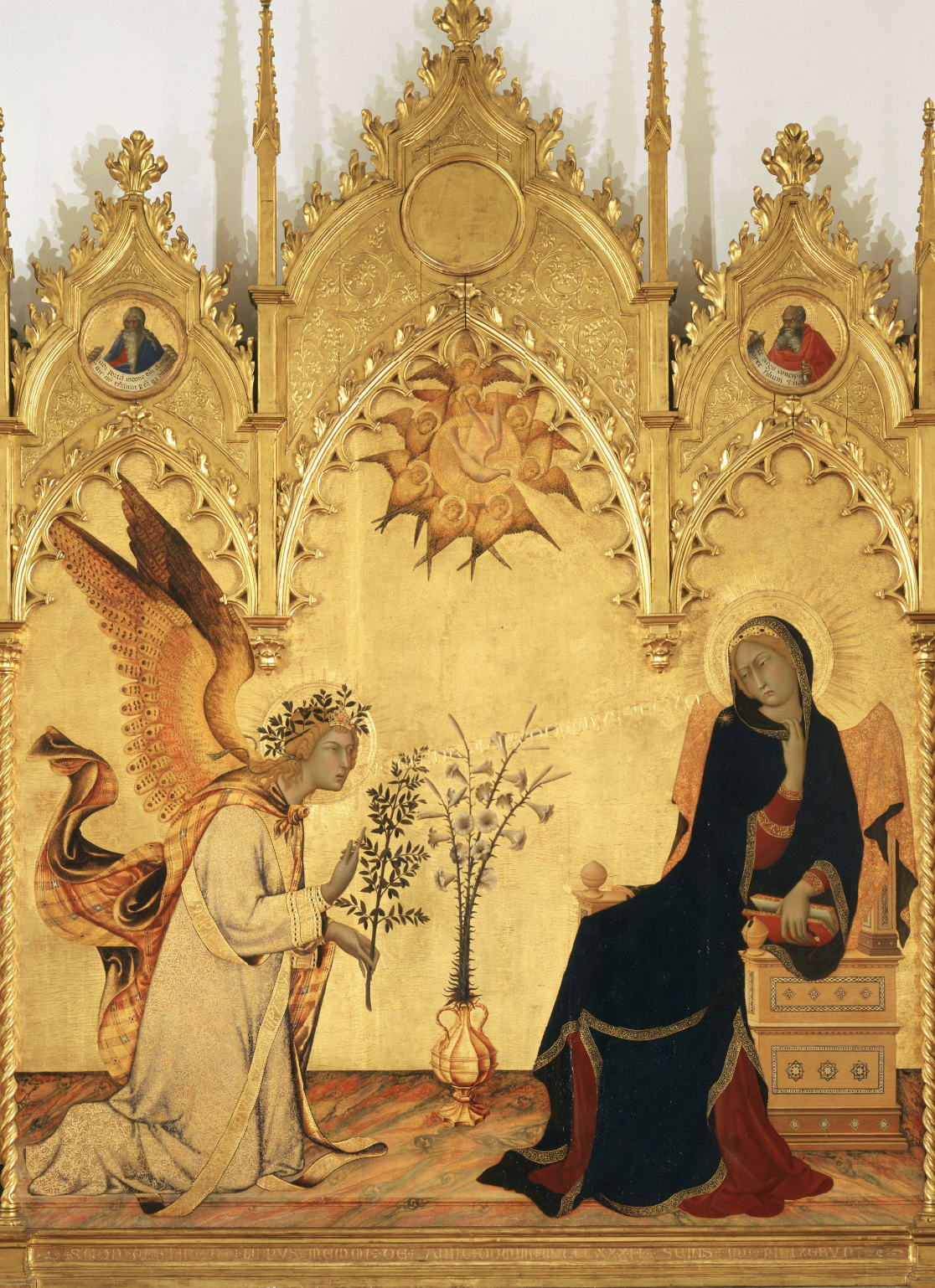
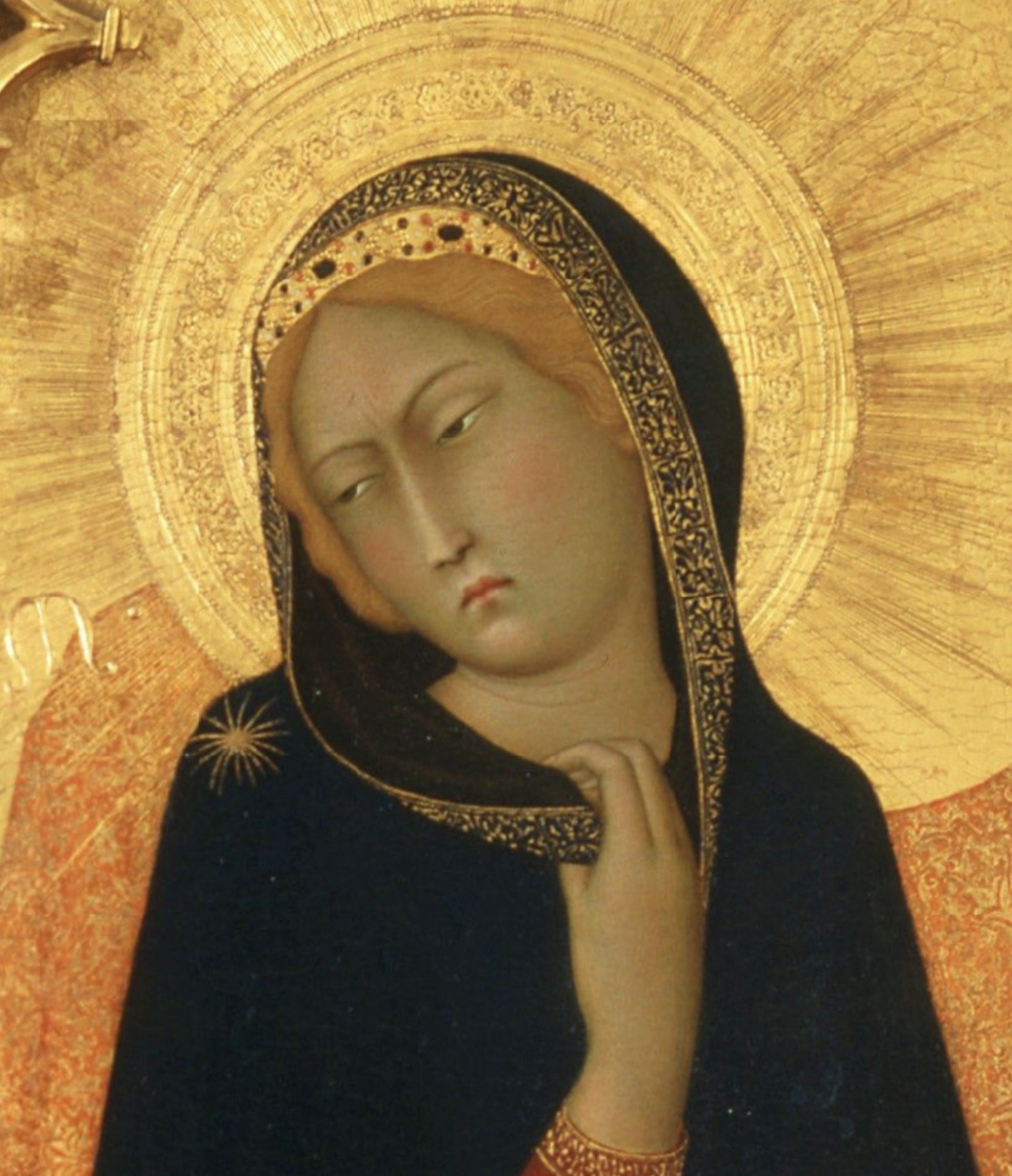
This is a golden moment, the 13th century painting above by Simone Martini and Lippo Memmi indicates. Mary is at home in prayer when the angel comes. Prayer enables her to believe and accept what is revealed. That’s true for all of us: prayer helps us discern and say yes to what God reveals.
“How can this be. I do not know man?” Mary says to the angel. Our painting seems to capture that moment in our gospel passage, but Mary will go on to respond in faith, “Be it done to me according to your word.” Mary is a woman of faith; we learn from her.
Today we pray:
O Flower of Jesse’s stem, you have been raised as a sign for all peoples; kings stand silent in your presence; the nations bow down in worship before you. Come, let nothing keep you from coming to our aid.
The Gospel of Luke is our principal guide through the final days of Advent till the feast of Christmas. These days are our “novena” preparing for the mystery of Christmas.
December 17th and December 18th we read Matthew’s genealogy of Jesus and his account of Jesus’ birth.
December 19 The angel’s announcement to Zechariah the priest about the birth of John the Baptist. (Luke 1: 5-26)
December 20. The angel announces to Mary that she will bring “the Son of God” into the world. (Luke 26-38)
December 21. Mary visits her cousin Elizabeth to share this Good News. ( Luke 1:39-45 )
December 22. The 4th Sunday of Advent. The gospel account of Mary’s visit to Elizabeth is repeated. ( Luke 1:46-56)
December 23. Elizabeth gives birth to John, who will announce the coming of Jesus: (Luke 1:57-66)
December 24. Zechariah praises God’s compassion towards those who “dwell in darkness and the shadow of death.” (Luke 1:67-79.)
December 25Christmas. The evening readings for Christmas are:
Isaiah 9: 1-6
Timothy 2:11-14
Luke 2:1-14, The story of the Birth of Jesus Christ
Old Testament readings add their voice to the gospel accounts. A number of stories, like the unpredictable births of Sampson and Samuel accompany the story of the birth of John the Baptist and Jesus. They remind us that “nothing is impossible with God.” The prayers in Advent speak too of the gentle rain that makes the earth fertile and the numerous “miracles” found in the ordinary course of nature. From the created world we can gain a sense of wonder for this great wonder of God.
Our readings are stories of belief and doubt. Isaiah offers King Ahaz, the consummate doubter and cold calculator on December 20. He was mentioned on Wednesday mornings at morning prayer each week of Advent. Ahaz stands in contrast to Mary, who believes and accepts the angel’s promise. She wonders “how can this be?” before this mystery of God, but she believes.
In our 2018 pastoral letter, “Open Wide Our Hearts,” we lamented the impact of immigration raids and mass deportations in which even those who are U.S. citizens have been caught up and deported, noting: “Today, many Hispanics are often assumed to be in this country illegally. These attitudes of cultural superiority, indifference, and racism need to be confronted; they are unworthy of any follower of Christ.”
We consistently reaffirm what the church has always taught: that every human person is created in the image and likeness of God, the imago Dei, and that the dignity of the human person does not depend on a particular legal status, nationality or occupation. We also recognize that promoting public order and upholding the rule of law are necessary endeavors, especially because these measures help guard against trafficking and other forms of exploitation.
Today, however, we see aggressive approaches to immigration enforcement that inflict harm on our sisters and brothers, sometimes restricting their ability to work, live and worship in arbitrary ways. Many citizens and lawful residents have reported being detained by methods that blur the line between legitimate enforcement and discriminatory profiling. This climate of fear makes our neighbors hesitant to go to work, to attend Mass or to visit loved ones.
In light of this, we must ask again: Who is my neighbor? The answer, as always, is found in Christ. He calls us to see with the eyes of mercy, to walk with those who suffer and to build a society rooted in justice and love. As disciples, we cannot remain indifferent. We are called to advocate for a just and meaningful immigration reform that respects human dignity, upholds due process and promotes the common good.
Let us follow the example of Our Lady of Guadalupe and stand in solidarity with those who live in fear, as a testament to God’s abiding peace. Let us be beacons of Christ’s light, filled with compassion and courage. Let us raise our voices in support of a meaningful reform of our immigration system, one that recognizes, as the U.S. bishops reaffirmed last month, that ensuring national security and safeguarding human dignity are not in conflict. Let us reject dehumanizing rhetoric and violence, whether directed at immigrants or at law enforcement. And let us never grow weary in the Gospel call to love without condition.
May the Lord, who is close to the brokenhearted, strengthen us in this mission. And may we, as one body of Christ, never forget who our neighbors are (Ps 34:19).
Why does Mary, the Mother of Jesus, have such a big place in our church? The words of the angel in Luke’s gospel, words we often repeat in prayer, are an answer: “Hail, full of grace, the Lord is with you.”
Mary is filled with God’s grace, gifted with unique spiritual gifts from her conception, because she was to be the mother of Jesus Christ, God’s only Son.
She would be the “resting place of the Trinity,” and would give birth to, nourish, guide and accompany Jesus in his life and mission in this world. To fulfill that unique role she needed a unique gift. She would be free from original sin that clouds human understanding and slows the way we believe God and his plan for us.
“How slow you are to believe” Jesus said to the two disciples on the way to Emmaus. Jesus made that complaint repeatedly as he preached the coming of God’s kingdom. “How slow you are to believe!” “What little faith you have!” “Do you still not understand!” Human slowness to believe didn’t end in gospel times. We have it too.
Mary was freed from that slowness to believe. “Be it done to me according to your word,” she immediately says to the angel. Yet, her acceptance of God’s will does not mean she understood everything that happened to her. “How can this be?” she asks the angel about the conception of the child. “The Holy Spirit will come upon you.” But the angel’s answer seems so incomplete, so mysterious.
Surely, Mary would have liked to know more, but the angel leaves, never to return. There’s no daily message, no new briefing or renewed assurance by heavenly messengers. The years go by in Nazareth as the Child grows in wisdom and age and grace, but they’re years of silence. Like the rest of us, Mary waits and wonders and keeps these things in her heart.
That’s why we welcome her as a believer walking with us. She is an assuring presence who calls us to believe as she did, without knowing all. She does not pretend to be an expert with all the answers. She has no special secrets she alone knows. “Do whatever he tells you,” is her likely advice as we ponder the mysteries of her Son.
The feast of the Immaculate Conception is celebrated 9 months before the feast of the Birth of Mary (September 8). The feast was extended to the universal Church by Pope Clement XI in 1708.
Pope Pius IX solemnly proclaimed the Dogma of the Immaculate Conception in 1854: “We declare, pronounce, and define that the doctrine which holds that the most Blessed Virgin Mary, in the first instance of her conception, by a singular grace and privilege granted by Almighty God, in view of the merits of Jesus Christ, the Savior of the human race, was preserved free from all stain of original sin” (Ineffabilis Deus, 1854)
We celebrated the feast of Christ the King last Sunday. It’s hard to think of Christ as king in a world where kings are few, at least in our western world. Royal families, where they exist, have mainly ceremonial roles.
Yet, Jesus Christ is king, and what’s more we share in his kingly role. (Catholic Catechism 1546) We’re all priests, prophets and kings by our baptism. “We’re a “chosen race, a royal priesthood, a people set apart,” (1 Peter 2,5)
How are we kings? The illustration of Adam, from the Book of Genesis, may tell us. Adam is given kingly powers by God in the garden, the symbol of the created world. He names the animals and is caretaker of God’s creation.
Psalms, like Psalm 8 (Saturday Morning, week 2), remind us that’s our role: When I see the heavens, the work of your hands, The moon and the stars that you arranged, What are we that you keep us in mind,, Mortal as we are that you care for us.
Yet you have made us little less than gods, With glory and honor you crown us, You have give us power over the works of your hand, Put all things under our feet.”
This week’s readings from Daniel and Luke’s Gospel (Friday) seem to predict a world torn apart and discarded when God’s kingdom comes. But that’s not so. Creation itself awaits the promise of resurrection. Jesus Christ is our Savior and we are part of his saving work.
We have been given kingly care over creation. Let’s not forget it. We’re not here just to save ourselves nor is our purpose in life to escape from this world. We’re to care for creation and make it ready for God’s kingdom.
We read Luke’s Gospel this week, the 34th week of the year. Luke follows Mark’s Gospel closely in describing Jesus as he arrives in Jerusalem from Galilee, but he makes some simple, yet significant changes to Mark’s account.
Mark’s account says that Jesus went back and forth to Bethany each day while teaching in the temple in Jerusalem. Luke’s account doesn’t mention Jesus’ stay in Bethany at all. Jesus comes to Jerusalem to enter the temple of God.
The temple has great significance in Luke’s gospel. Earlier in his gospel, Mary and Joseph bring Jesus there after his birth. His identity is validated there. For Jesus the temple is his Father’s house, where he belongs. It’s his home, where he teaches with authority, confronts his enemies and gives hope to those like the poor widow.
In Luke’s extension of his gospel, the Acts of the Apostles, the temple is also significant because the church is born there. For Luke, a disciple of Paul, we are also the temples of God and the Spirit of God dwells in us.
In Luke’s gospel, Jesus teaches about the end times in the temple area about the end ; in Mark’s gospel he teaches about it from the Mount of Olives. Though the temple stones be cast down, Jesus is the cornerstone, and so when “ powerful earthquakes, famines, and plagues from place to place; and awesome sights and mighty signs will come from the sky,” he remains our Rock.
In this week’s readings, Luke adds some important words to Mark’s fearful account of the end time. The end is coming soon. Mark seems to say. The end waits “until the times of the Gentiles are fulfilled,” Luke’s account says.(Luke 21:24) The last times are delayed, not imminent. They will come at an indeterminate time, after the gentile world receives the gospel.
Yet, because Mark’s account was held by other followers of Jesus, Luke does not dismiss it.
Perhaps because the trees are shedding their leaves now in this part of the world, I notice another small change Luke makes to Mark’s gospel. “Learn a lesson from the fig tree. When its branch becomes tender and sprouts leaves, you know that summer is near. In the same way, when you see these things happening, know that he is near, at the gates” Jesus says in Mark. (Mark 13: 28-29)
Luke adds to the fig tree “and all the other trees.” (Luke 21:29-31) Why all the other trees? Was Luke adapting the message of Jesus to those forested regions in Asia Minor unlike Palestine, where creation in its many trees spoke of Word made flesh as well?
The gospel writers struggled with the great mysteries of the life, death and resurrection of Jesus and tried to adapt it to their times and place. We struggle with these mysteries too.
Pope Francis, in a letter on the study of history, said we need to read the fundamental texts of Christianity and understand them without “ideological filters or theoretical preconceptions” . “A study of history protects us from ‘ecclesiological monophysitism’, that is, from an overly angelic conception of the Church, a Church without spots and wrinkles… A proper sense of history can help us develop a better sense of proportion and perspective in coming to understand reality as it is and not as we imagine it or would prefer reality to be.”
That was one of the first question and answer I learned from my catechism many years ago.
The Pharisees ask a question somewhat like that as Jesus approaches Jerusalem with his followers:
“When is the kingdom of God coming?”
Jesus responds: “The coming of the Kingdom of God cannot be observed, and no one will announce, ‘Look, here it is,’ or, ‘There it is.’For behold, the Kingdom of God is among you.” (Luke 17:20-25)
The catechism of the scriptures, which we listen to now, says “The kingdom of God is among you.” The Greek word translated “among” can also be translated “within” so some translations have “The kingdom of God is within you.” But commentators say it’s better we look for the kingdom of God among us than simply within us.
Yes, God who is everywhere is within us, holding us and all things in being. God makes a home in us, Jesus says, but we should not limit God’s presence to human beings or see God working only in us. God is among us, in others and in the universe we are part of. God is not present among us as an observer, God is building a kingdom that we may not observe. We can miss it, the parables of Jesus indicate.
Especially in times like our, the kingdom that’s coming is hard to see.
It’s hard to see Jesus in the bread and wine, in his followers, in the wars and the destruction happening in our environment.
That’s what eyes of faith are for. Lord, that we may see.
We’re celebrating the Dedication of the Lateran Basilica today. The Lateran Basilica was the parish church of Rome and the actual residence of the popes for many centuries. A magnificent baptistery was an essential part of Constantine’s church, dedicated in 325. As the reading from Ezekiel for the feast of its dedication indicates the church was a place of baptism for Rome’s Christians. Waters from this church – and all other churches, in fact– bless the world.
The Lateran Basilica has been an important destination for pilgrims to the Holy City since the 4th century. It was on the route early pilgrims took to pray at the shrines of martyrs buried on Rome’s outskirts, beginning with the place where Peter was buried, the Vatican Basilica. The pilgrim route ended in the church where the Apostle Paul was honored on the other side of Rome.
Pilgrimage to Rome’s shrines began shortly after Constantine brought freedom to the Christian church in 315. We know some of them. The popular shrine church of St. Lawerence, north of the Lateran Basilica, was part of the pilgrim route. Nearby Helena, the mother of Constantine, enshrined relics of the Cross from the hill of Calvary in the great hall of her residence.
Pilgrims came to Rome in great numbers to celebrate their faith and visit the Roman martyrs’ shrines. In the late 4th century, Pope Damasus placed about 40 inscriptions in Rome’s shrines, guiding pilgrims on their journey. St. Jerome was among the early pilgrims. He found faith and was drawn to being baptized on his journey.
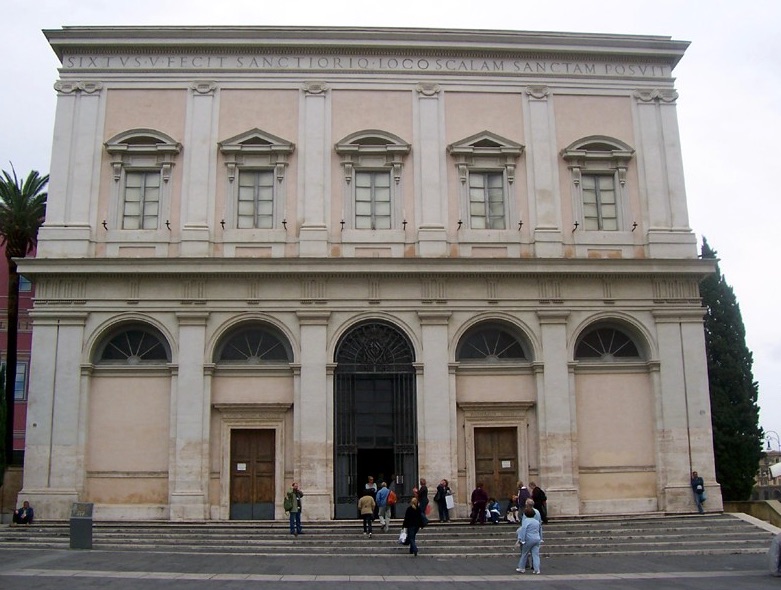
Early sources say that Constantine built a palace for the pope and a royal staircase leading to the papal quarters and his personal chapel at the Lateran site. The chapel was known as the Sancta Sanctorum, the Holy of Holies. An earthquake in the 1277 leveled the palace and chapel with its many relics.
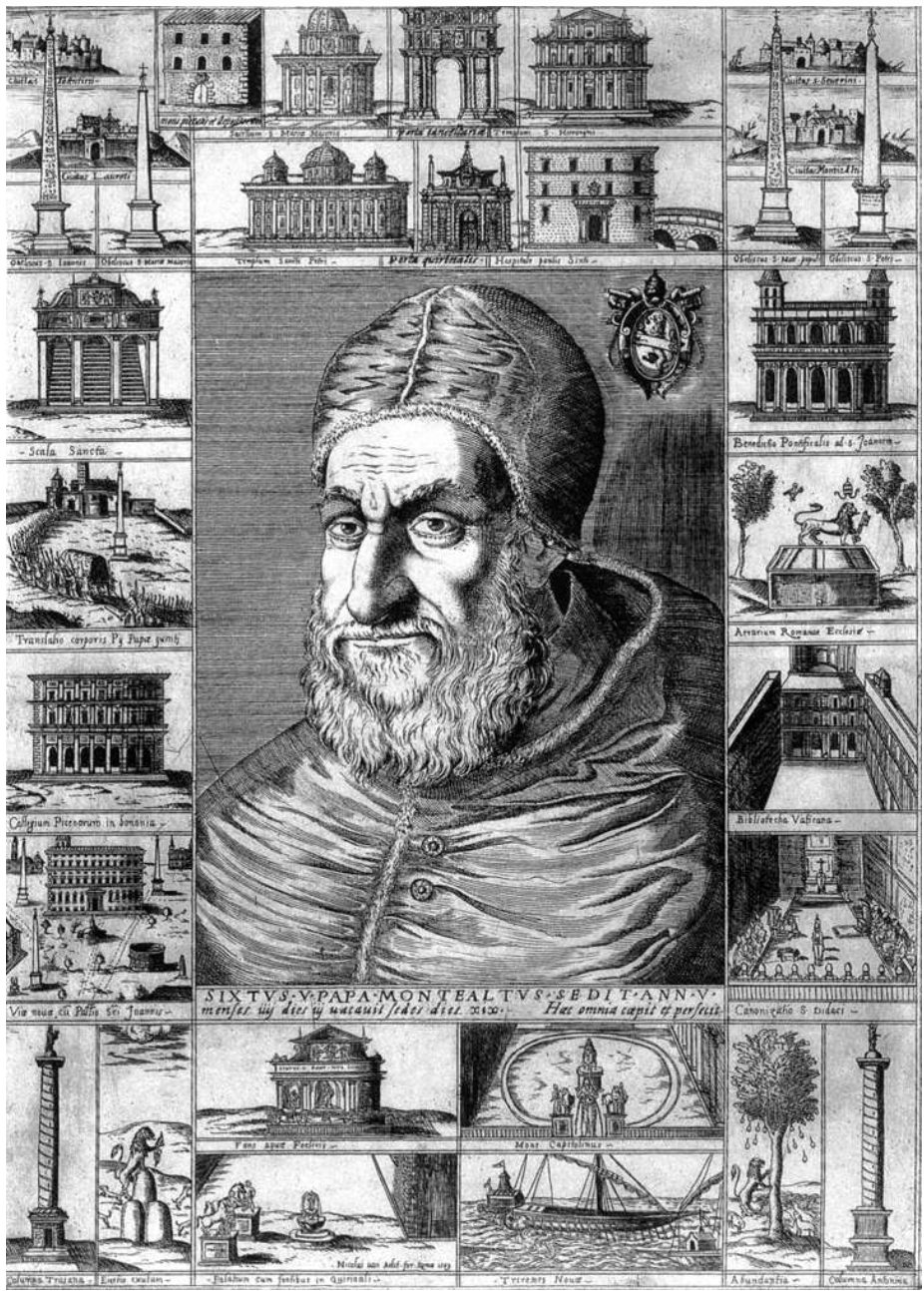
The chapel was rebuilt in magnificent style by Pope Nicholas III in the 13th century. Pope Sixtus V demolished most of the papal buildings in the 16th century but left the chapel alone in a free standing building, reached by a staircase of 28 steps. He claimed the stairs were from Pilate’s palace in Jerusalem on which Jesus walked to be judged. Historians and archeologists today say the stairs may be the stairs from the pope’s residence built by Constantine.
The site, known today as the Scala Sancta, the Holy Stairs, was restored in 2019. It is a UNESCO site. Pilgrims traditionally ascend the stairs on their knees. Pope Pius IX entrusted the shrine to the Passionists in 1853.
Two friends of mine ascended the stairs recently. Here they are.
When we think of saints, we may think of Mary, the mother of Jesus, apostles like Peter and Paul, or extraordinary individuals like Mother Teresa. True friends of God.
Besides those saints – shining lights of faith– there are unnumbered others in God’s company, the Feast of All Saints says. In a vision of heaven, St. John saw “a great multitude, which no one could count, from every nation, race, people, and tongue.” {Revelations 7, 9-13} We hope to be with them one day.
Our hope rests on a promise Jesus made, the same apostle says:
“See what love the Father has bestowed on us that we may be called the children of God. Yet so we are…Beloved, we are God’s children now; what we shall be has not yet been revealed.” (1 John 3,1-3)
How shall we reach that place where we’ll be revealed as children of God? Jesus said to follow him and live as he taught. He offers the way in his Sermon on the Mount, our gospel reading for this feast says. He will be the way, the truth and the life.
We haven’t seen yet that life we hope for or what God intends us to be. Life does not end; it changes. This feast invites us to trust in God’s promise and hope for the day it’s revealed.
Extraordinary saints are not the only ones in heaven. There won’t be just a few either. Countless others are in God’s company: saints unnoticed here on earth, saints with little to show, saints who were sinners. People like us.
As we celebrate this feast, St. Bernard says:
“Rise again with Christ and seek the world above and set your mind on heaven. Long for those who are longing for us; hasten to those who are waiting for us, ask those who are looking for our coming to intercede for us. Desire their company and seek a share in their glory. There’s no harm in being ambitious for this. No danger in setting your heart on such glory. Remembering the saints inflames us with a yearning that Christ our life may appear to us as he appeared to them and that one day we may share in his glory.”
Today we remember Pope St. John Paul II. We expect all the popes to be holy and saintly, but they’re not, statistics say. There have been 266 popes, but only 95 are remembered as saints, blessed or servants of God. Furthermore, 52 of the popes who are saints are from the first 5 centuries of the church, most of them were martyrs.
Only 2 popes have been canonized since the 16th century until the recent canonizations of Popes John XXIII, John Paul II and Paul VI. Why were these popes canonized? Each was a holy man who played a major role in the Second Vatican Council, a major event in the Catholic Church, which took place from 1962-65 and still inspires its life today.
What was Pope St. John Paul II’s role in that council? The first reading and responsorial psalm for his feast tell us:
Pope John Paul was a missionary who brought the message of Vatican II to the world: “How beautiful upon the mountains are the feet of him who brings glad tidings…” He had a prophet’s role, the first reading from Isaiah says. He fulfilled what Psalm 96 called for: “Proclaim God’s marvelous deeds to all the nations.”
John Paul II was a global pope. Inspired by the Second Vatican Council’s call for a church engaged in the world, he made 104 apostolic journeys to all parts of the globe. It was a world increasingly interconnected, with nations and religions in daily contact with one another. He visited mosques and synagogues and Buddhist temples, as well as his own faithful. He reached out to Protestants and separated Christian churches of the east. As the voice of the Catholic Church, he engaged the world, in the spirit of Vatican II.
John Paul II was a charismatic bishop who became pope as new communications were creating a world wide audience and new political movements, like that in his native Poland, caught the attention of people everywhere.
Within his own church, Pope John Paul canonized more saints, from different countries and backgrounds, than any pope before him had done. The Second Vatican Council taught that holiness could be found everywhere.
The three popes, John XXIII, Paul VI and John Paul II had different gifts, but all saw the Second Vatican Council as the path the church should follow. That’s the way they described the way ahead – a path, a way often unmarked, a winding road where the end is not clearly seen. Still, a path is God’s way, who leads the blind on their journey and strengthens the weak till they reach their home.




 The Victor's Place