Tag Archives: Environment

The Eucharist and the Environment

A recent major study warns about climate change and its affect on our environment, but commentators say the political establishment isn’t going to do anything about it. Too hard to deal with. What about the religious establishment?

Two years ago representative Catholics and Methodists came together to address the crisis and issued a document entitled “Heaven and Earth are Full of Your Glory: United Methodist and Roman Catholic” It looked on “the ecological crisis as a summons to an ecumenical response…The signs of the times call for an “ecological conversion” as we face “climate destabilization, the destruction of the ozone layer and the loss of biodiversity,” and hear creation’s groaning.( Romans 8,22)

The two churches have prayer traditions in which bread and wine represent the creation that Jesus Christ loved and came to save. How can we use these signs to raise our sense of the sacredness of creation?
The document says that looking at creation in an inadequate way also “leads to a diminished sense of the salvific work of Christ.” (12)

Good Night, Irene

Irene got our attention this weekend on the east coast of USA, from Miami to Washington to New York City and to Boston. The hurricane took over television, governments, businesses, transit systems, entertainments as nothing else has done since the terror attack on the World Trade Center ten years ago. For a couple of days, Irene turned our regular human preoccupations upside down.

Mayor Bloomberg and other government officials kept referring to “Mother Nature”   when they spoke of her. Respect her, they said, and for the most part we listened, though typically some of “Mother Nature’s” children ignored her threats.

Jim Keane, SJ, has a piece in the America Blog entitled “The Mountains Melt Like Wax,”where he asks what our expanding knowledge of creation means for our faith in the Incarnation of Jesus Christ and our understanding of our place as humans in this world. We’re not only learning more about weather systems like Irene, but we’re  also finding out much more about a “Mother Nature” who’s more complex, more powerful, older and more mysterious than we ever thought. She demands respect.

“If our notion of time keeps expanding, and our notion of space does the same, that particular moment of the Incarnation can seem more and more vanishingly discrete.” Sharing this mystery we humans have to wonder about our place in an expanding picture of the universe.

Keane points to Christian thinkers like  Roger Haight, SJ, Elizabeth Johnson, CSJ, William Lynch, SJ, Teilhard de Chardin, SJ and David Toolan, SJ. who faced this question.

I would add Thomas Berry, CP.

We like to see ourselves and our human world as the center of everything, and then Irene comes along. Jim Keane put it this way: “In other words, recognizing the immensity of space and the eternity of time might prove a valuable wakeup call for all of us:  it’s not just about you, pal.”

Besides expanding knowledge of our universe, how about Irene? Is she part of a wakeup call? If so, it’s not wise to sing “Good night, Irene.”

St. Gabriels, Toronto

I’m spending a few days in Toronto with our Canadian Passionists, who minister at St. Gabriel Church, a new church built in 2006 which reflects the eco-theology of Fr. Thomas Berry, a Passionist who died a few years ago. He believed we need to foster a life enhancing relationship with the earth and the whole cosmos.

The church is located in a booming area along Sheppard Avenue in North York where high-rise condos and a new subway line are recent additions to this growing prosperous Canadian city. It’s a showplace for human technology and building skills. What better place for a  reminder of things beyond the human?

The church and its surroundings are almost swallowed up by the great buildings around it; a modest sign along busy Sheppard Avenus beckons you into St. Gabriels.

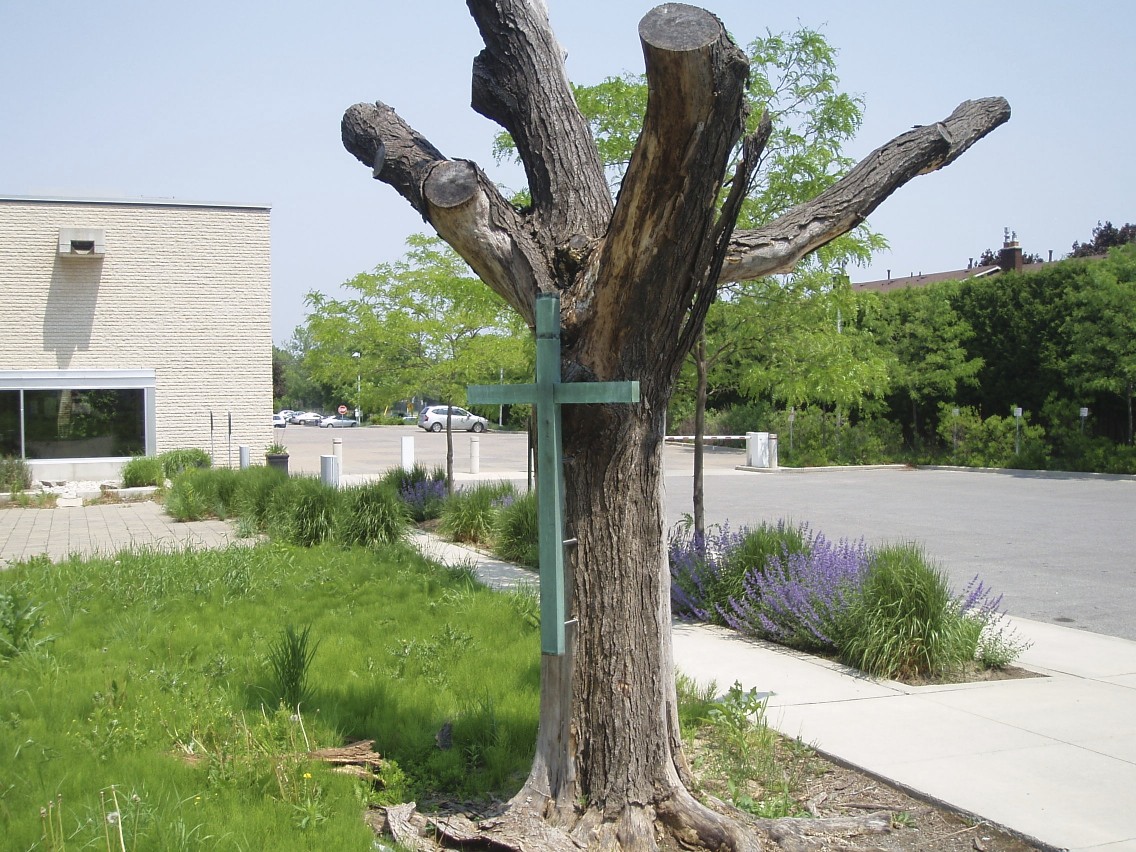
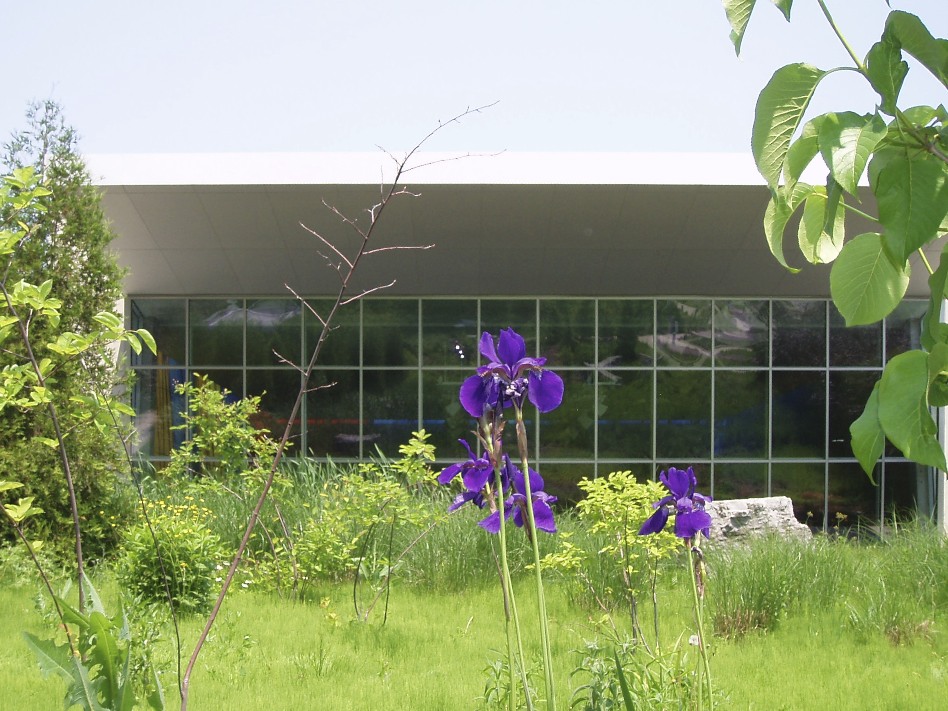
It’s not a church you would expect. No steeple skyward, no shrines of saints outside. A solitary statue of Christ stands on the roadway toward it. The entire south facade of the church is clear glass welcoming sunlight into the worship space within and a garden where the story of creation is retold from its beginning. Rocks, flowers, trees and grasses face the glass wall that dominates the new building,  A large tree trunk cut from a land development nearby stands at the edge of the outdoor garden, signed with a green cross. It signifies the Passion of the Earth, which the human community, recklessly exploiting the earth’s resources, has inflicted on the natural world.

Looming beyond the garden are the tall buildings of our modern human world.

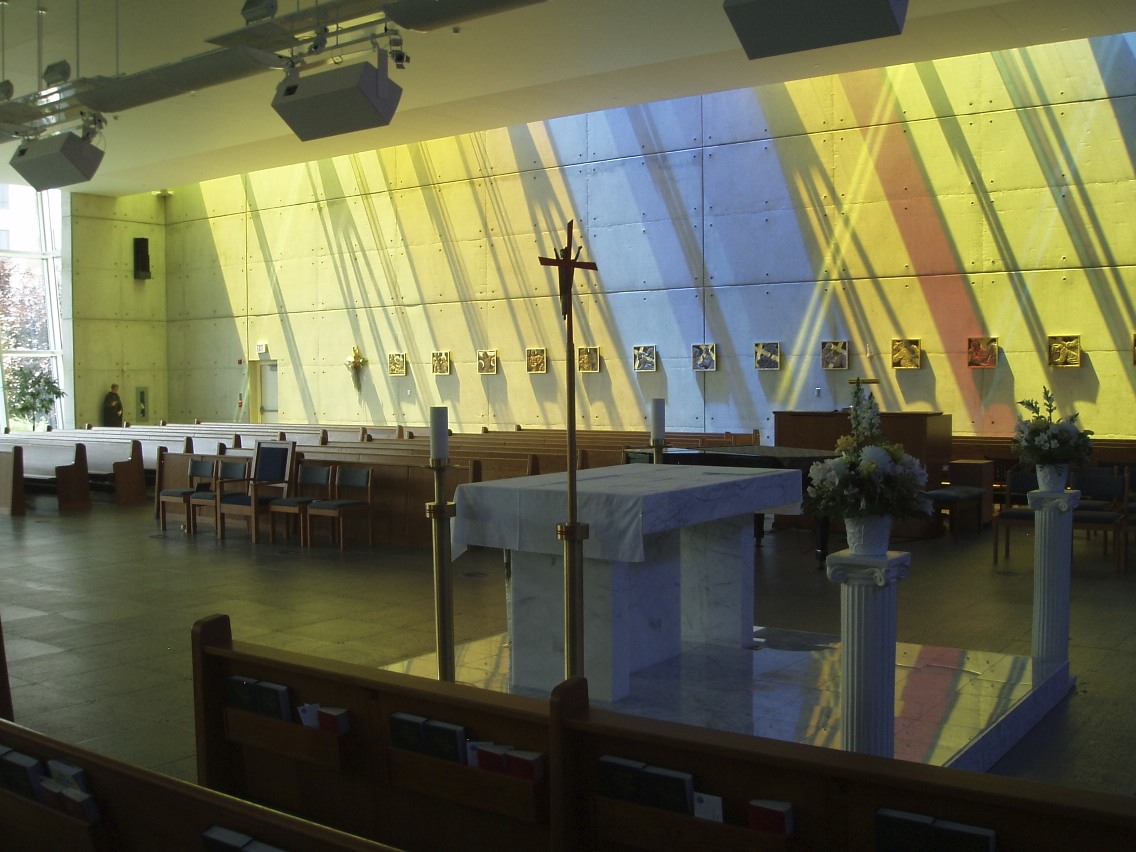
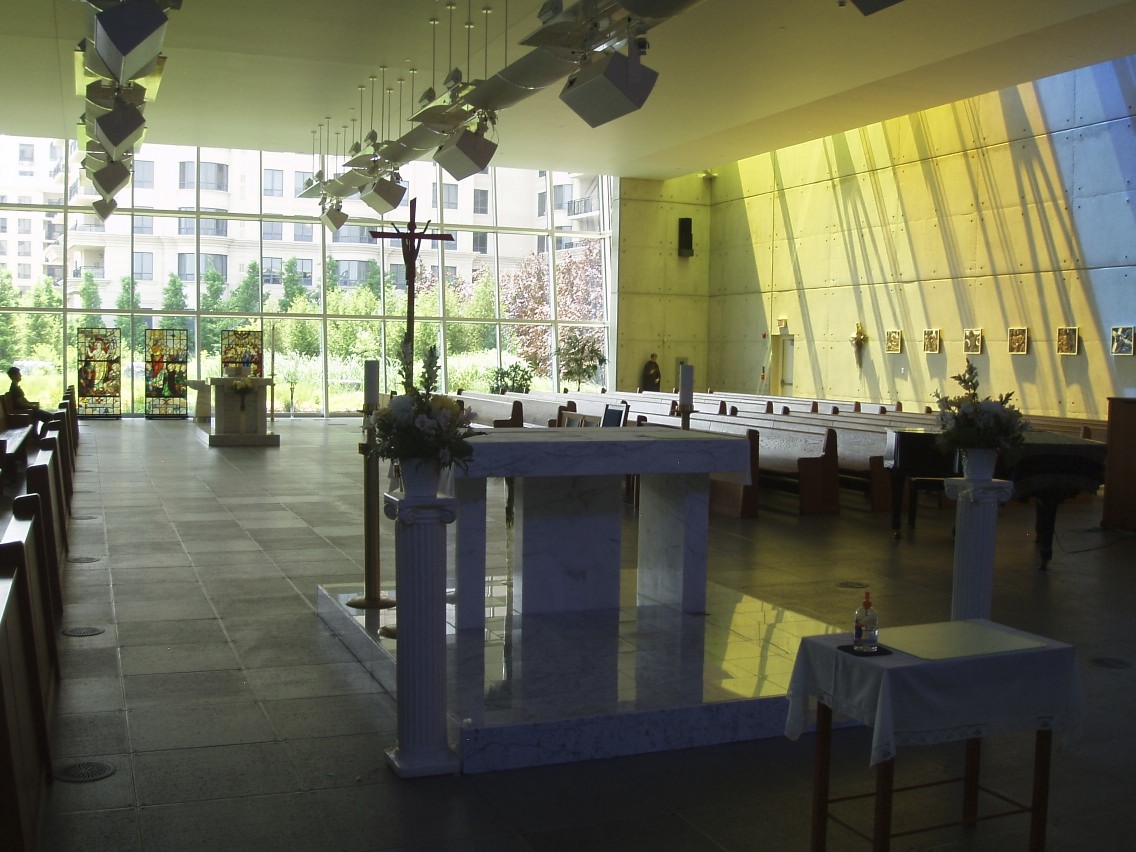
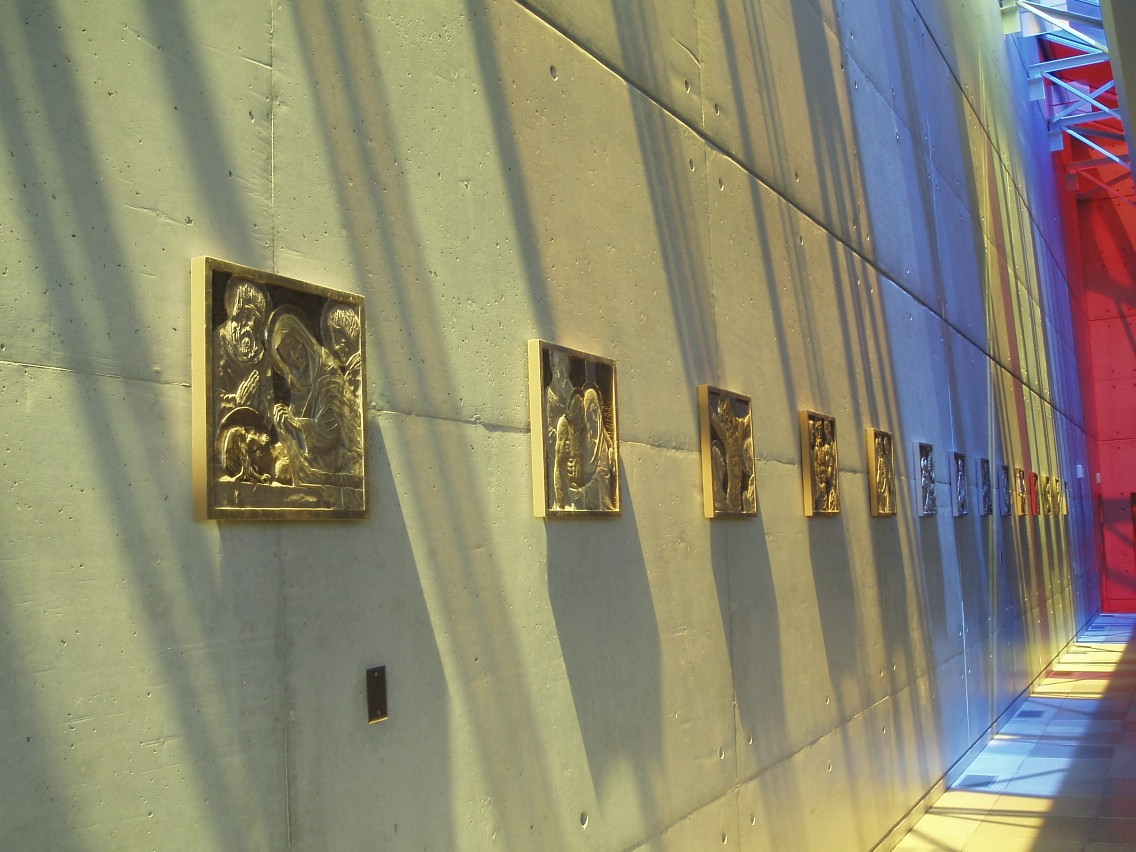
Sunlight through its expansive southern window and upper windows plays through the interior space of the church by day and over the seasons. This is not a church cut off from the world outside but in harmony with it.

The church pews, salvaged from an earlier church, are arranged antiphonally facing the baptismal fount near the southern glass wall, the ambo where the gospel is proclaimed, and the altar where the Eucharist is celebrated. A chapel where the Blessed Sacrament is reserved is situated in the northern part of the worship space. The Word who made the universe; the Savior sent to redeem us is present here in this church.

The baptismal fount, also from the earlier church, has water flowing from it; a rainspout on the outside southern wall delivers rainwater to a simple river bed below. The two remind us of our dependence on water as well as light.

The church seats 750 people; the present parish membership comes from all the continents and many nations. A parallel narthex provides a meeting place for these “living stones” who form the church today.

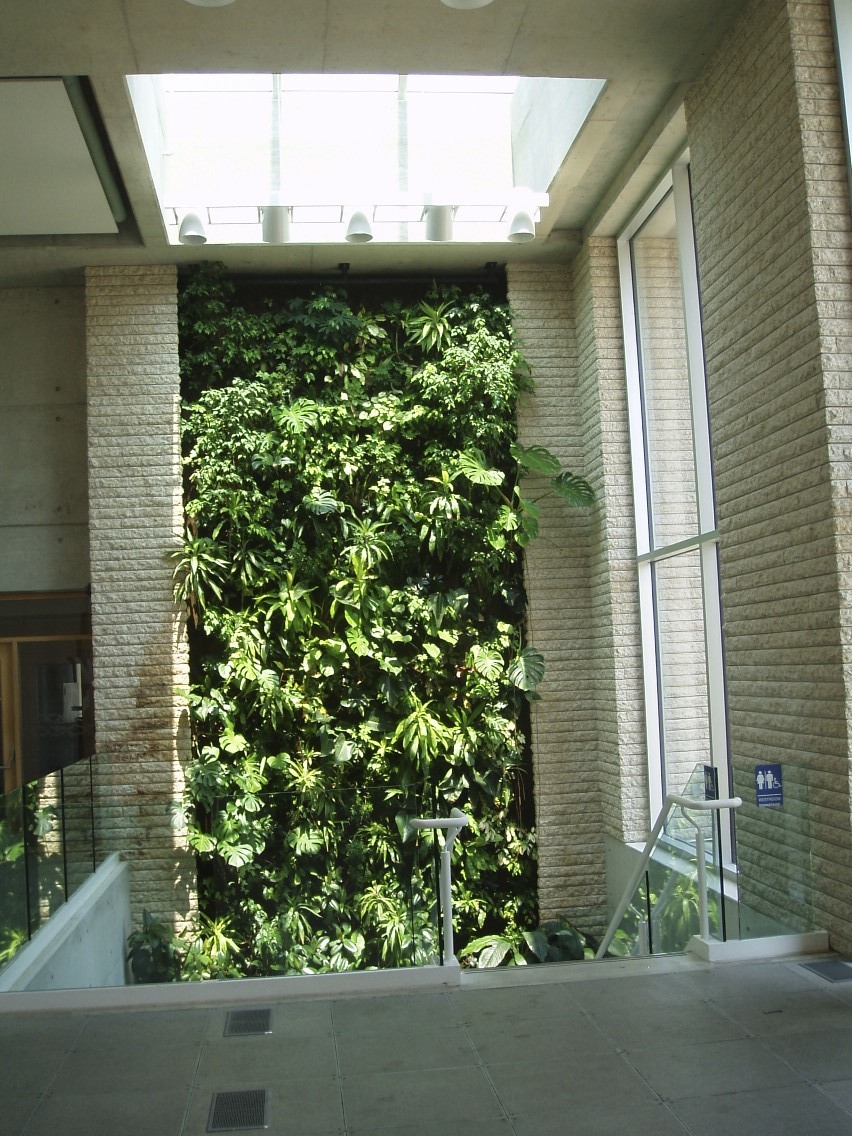
The church was built to be energy efficient. Most of its parking area is located beneath the church. Parishioners ascending from the underground parking face a large bank of plants, which serve to purify the air as well as remind them of the importance of the rain forests for the earth.

”Imaginative and creative,” Aloysius Cardinal Ambrozic, Archbishop of Toronto, Canada, called the new Passionist church of St. Gabriel, when he dedicated it on Sunday, November 19, 2006. The Jesuit magazine AMERICA featured the church in a recent issue on church architecture.

The parish website is http://stgabrielsparish.ca/

A Youtube video is here: http://www.youtube.com/watch?v=GasOYiK1l68

4th Sunday of Advent

The readings for the 4th Sunday of Advent would have us look at small, insignificant things– a little town in Judea, Bethlehem, and a visit of two women, Mary and her cousin Elizabeth.

Faith sees meaning here. A mystery, a great mystery,  hidden in this place and in these people.

Bethlehem, some say, means “House of Bread,” and with eyes of faith, we believe that the Bread of Life, Jesus Christ, was born in that humble town. The women, visiting together, were holy women who brought Jesus Christ, the Son of God, into the world and were among the first to recognize him.

With eyes of faith we look back and see.

But eyes of faith are not just for looking back; they help us see life today and discover God’s presence and call now.

Along with our scriptures, the signs and prayers of the Mass  help us see. Like our readings they point to great meaning in small things.

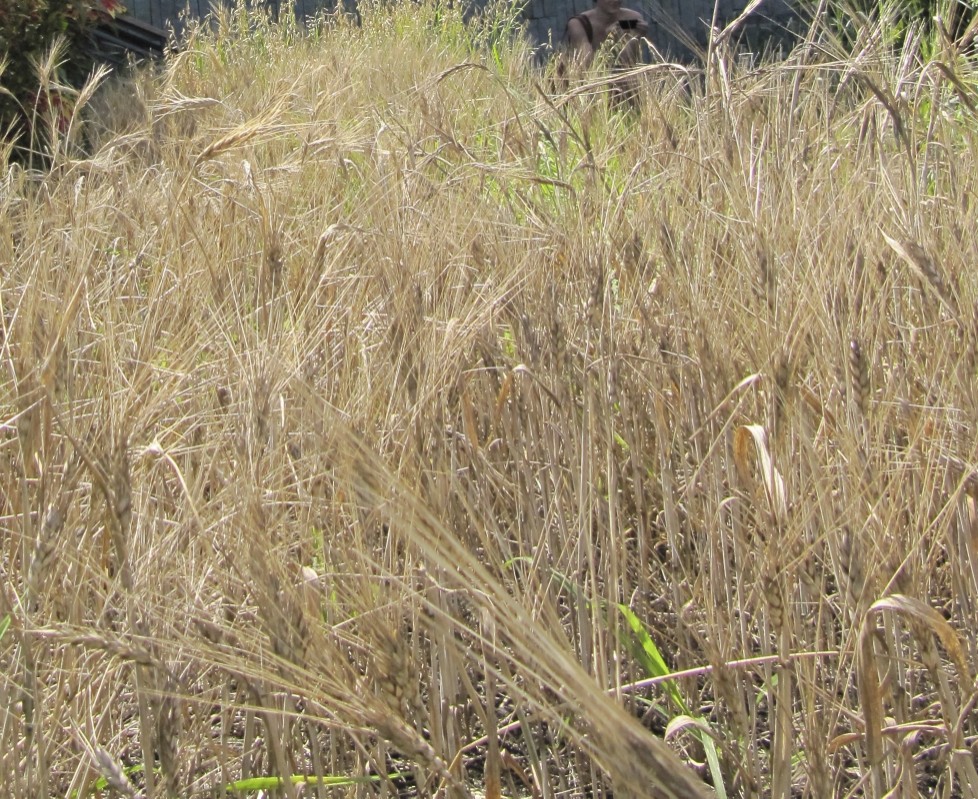
Look at the bread and the wine. Jesus took these small signs into his hands the night before he died and made them  bearers of important mysteries. As we bring them to the altar after our Creed and take them into our hands and ourselves, we ask:  What do they mean?

They’re food and drink, we say, and so they are. Real food and real drink, Jesus said, giving life beyond what we hope for and joys we cannot imagine. God feeds us, as a mother feeds a child, as a father giving daily bread to his children. The bread and wine reveal God’s love for us in Jesus Christ.

They point, though, to other realities too. They tell us of our relationship to God, but they also point to our relationship to the universe made by  God our Creator.

“Blessed are you, Lord, God of all creation, through your goodness we have this bread to offer, which earth has given and human hands have made. it will become for us the bread of life.”

“Blessed are you, Lord, God of all creation, through your goodness we have this wine  we have this wine to offer, fruit of the vine and work of human hands, let it become our spiritual drink.” (Offertory prayers)

Bread and wine are symbols of creation, our prayers say. We don’t live apart from the created world.  We receive God’s gifts through it. God comes to us through it. Creation’s story is our story too.

Both the bible and science tell that story, but in different ways, the Book of Genesis in poetic language;  scientists in the language of science.

As scientists tell it, after probing into space with instruments like the Hubble telescope and sifting through the earth’s crust,  our universe began 15 billion years ago. Then, about 3.5 billion years ago primitive life began on our planet. 200,000 years ago human life emerged. We humans come lately into the story of creation.

However, we late-comers have an important role in the well being and development of our universe. The Book of Genesis describes Adam and Eve, the first of our human family, as cultivators and leaders of the earth community. God made them stewards of the earth and its gifts.

Today the human role as stewards of  the universe has become critical. The recent meeting on climate control in Copenhagen, Denmark, called the human family from all  parts of the earth, to come together and decide what changes must be made in the way we humans live, so that the environment of our world does not deteriorate further.

Sadly, the meeting ended with its goals unmet.

Pope Benedict XVI was one of those who sent a message to the leaders of the conference:

“Can we remain indifferent before the problems associated with such realities as climate change, desertification, the deterioration and loss of productivity in vast agricultural areas, the pollution of rivers and aquifers, the loss of biodiversity, the increase of natural catastrophes and the deforestation of equatorial and tropical regions?”

“It is becoming more and more evident that the issue of environmental degradation challenges us to examine our lifestyle and the prevailing models of consumption and production, which are often unsustainable from a social, environmental and even economic point of view,” the pope said.

“Protecting the natural environment in order to build a world of peace is thus a duty incumbent upon each and all. It is an urgent challenge, one to be faced with renewed and concerted commitment; it is also a providential opportunity to hand down to coming generations the prospect of a better future for all,”

“If you want to cultivate peace, protect creation.”

As we take the bread and wine at Mass, let’s remember God who blesses us in Jesus Christ, but let’s also remember the earth they represent. These small signs point to a universe we are called by God to protect.
Thomas Berry, CP, died June 1,2009

The Passionists will remember him at a liturgy at Immaculate Conception Monastery in Jamaica, New York on Saturday, June 6, 2009. You can find information about this extraordinary priest and scholar at http://www.thepassionists.org

But here are two wonderful videos that captures his contribution as a thinker and scholar: