The Feast of the Triumph of the Holy Cross (September 14) originated in Jerusalem, the city where Jesus died and rose again. An immense throng of Christians gathered on September 13, 335 A.D. to dedicate a church built by the Emperor Constantine over the empty tomb of Jesus and the place where he was crucified– Golgotha.
The resplendent church, one of the world’s largest, was called the Anastasis (Resurrection), or the Church of the Holy Sepulcher. From then on, Christian pilgrims from all over the world flocked there to see where Jesus was buried and where he died.
Until the Moslem conquest in the 7th century, vast crowds of bishops, priests, monks, men and women from all over the Roman empire continued to come annually to celebrate the feast, which went on for 8 days. It was Holy Week and Easter in September. One visitor, Egeria, a widely-traveled 4th century nun, said the celebration recalled the Church’s dedication, but also the day when “the Cross of the Lord was found here.”
Many Christian denominations continue to celebrate the Feast of the Triumph of the Holy Cross on September 14th.
Visitors to Jerusalem’s Old City today see a smaller, shabby successor to Constantine’s great church, which was largely destroyed in 1009 AD by the insane Moslem caliph al-Hakim and was only half rebuilt in the 11th century by the Crusaders. Today the church bears the scars of sixteen centuries of wars, earthquakes, fires, and natural disasters.
The scars of a divided Christendom also appear in the church, where various Christian groups, upholding age-old rights, warily guard their own turf. Visitors have to wonder: Does this place proclaim the great mystery that unfolded here?
Like our reaction to the sacraments, we ask Is This All There Is? It takes time to discover the Cross and its triumph.
Mark’s gospel (Mk 8, 27-35) describes a journey that Jesus and his disciples made from the town of Capernaum on the Sea of Galilee– an area predominantly Jewish– to the villages of Caesarea Phillipi, about 25 miles to the north.
The town of Caesarea Phillipi and its surroundings stood at the foot of Mount Hermon where many of the sources of water for the Jordan River and the Sea of Galilee were located. In Jesus’ time it was also a gentile region where Roman and Greek gods were honored and, as its name indicates, Caesar and Roman power proclaimed.
As he often does, Jesus uses what’s at hand to teach. Here in a center of Roman power he asks, “Who do people say that I am?” His disciples name powerful Jewish figures: John the Baptist, who stood up to King Herod, and Elijah, the fearless prophet who stood up to King Ahab and his notorius wife, Jezebel. Some compared Jesus to them.
However, Peter, speaking for the disciples, goes beyond these Jewish heros. “You are the Christ,” he says, more powerful than the prophets and certainly more powerful than the figures honored at Caesarea Philippi. Jesus is the Messiah come to lead Israel to its high place above the nations.
In response, Jesus tells him he is a suffering Messiah, who will be rejected by the leaders of his own people, will suffer death and rise again. The scriptures had announced a Messiah like this: “I gave my back to those who beat me, my cheeks to those who plucked my beard; my face I did not shield from buffets and spitting.” (Isaiah 50)
When Peter rejects this description of the Messiah and tells Jesus to abandon it, Jesus calls him “Satan,” someone who thinks like human beings and not like God.
We’re not far from Peter’s thinking, human beings that we are. The mystery of the cross is hard for us to accept, whether we see it in Jesus or in ourselves or in the unfolding events of our time.
We celebrate the triumph of the Cross tomorrow, September 14th.
Last Wednesday the pope spoke of St. Peter Damian, the 11th century saint from Ravenna, Italy, who was later named cardinal bishop of Ostia, the port of Rome.
Though Peter was drawn to the silence of the monastic life, he was called to work for the reform of the church, which suffered then from abuses resulting from lay investiture. In many places, bishops, abbots, pastors appointed by lay patrons weren’t fit for the job, and the church suffered from the immorality and lack of leadership the practice brought on.
Pope Benedict stressed Peter Damian’s dedication to the mystery of the cross. The hermitage that he loved was dedicated to Holy Cross. He wrote, “He does not love Christ who does not love the cross of Christ,” and he called himself: ” Peter servant of the servants of the cross of Christ.”
He saw the cosmic dimensions of this mystery in the history of salvation. “O blessed cross, you are venerated in the faith of patriarchs, the predictions of prophets, the assembly of the apostles, the victorious army of the martyrs and the multitudes of all the saints.”
Peter Damian also saw the cosmic dimensions of the cross in the struggles of his own time, it seems. He wanted a quiet, contemplative life. But he couldn’t just lose himself in the beauty of contemplation, the pope says. He had “to assist in the work of renewal of the Church,” and the mystery of the cross gave him strength to do it.
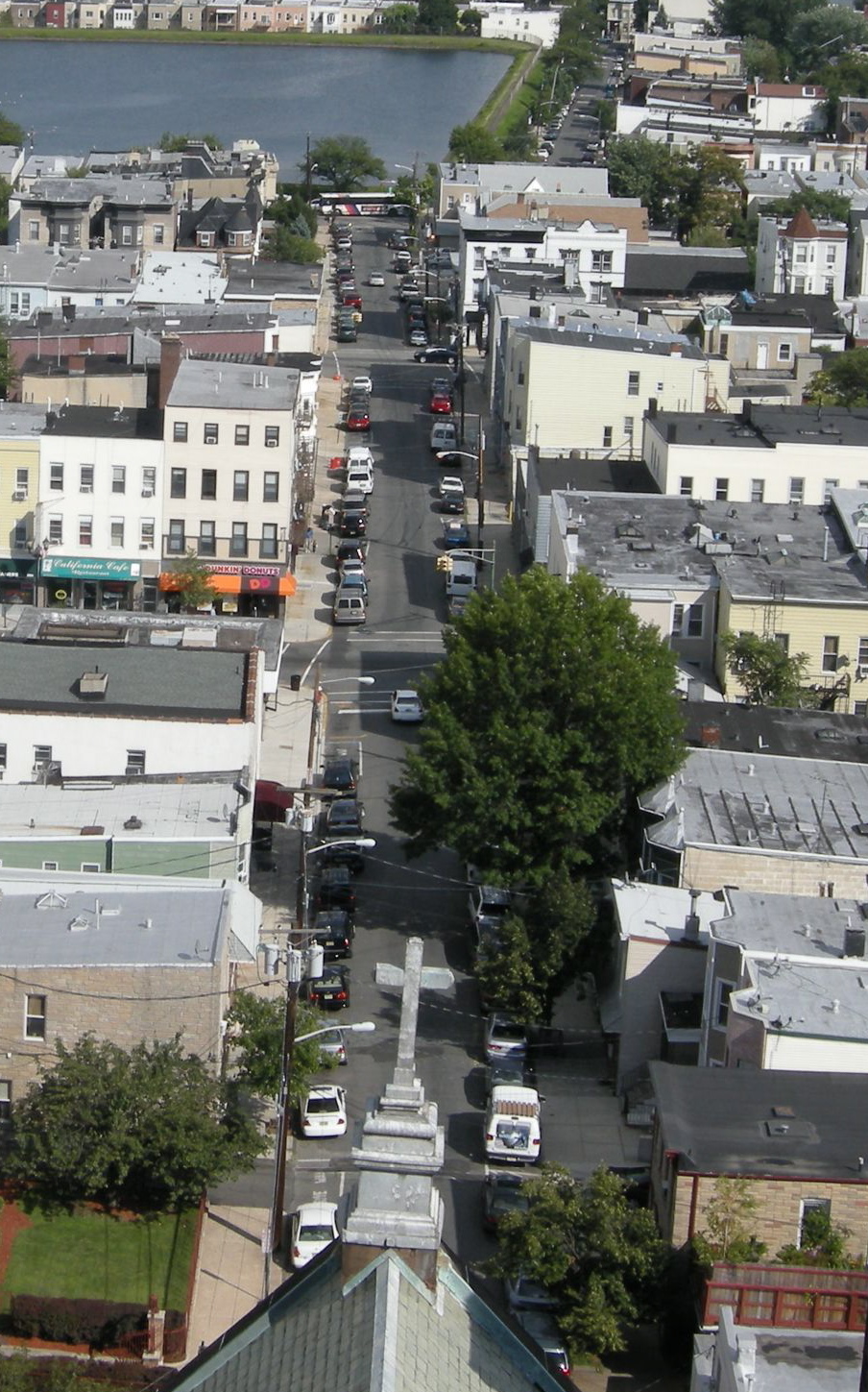
I was noticing the cross on top of the church across the way, looking down on the crowded streets below. The mystery’s here too.
The Cross should never be separated from the rest of Jesus’ life. It is his life “lifted up” for all to see. In him, we see God’s desire for our salvation.
Embracing the Cross, Christ takes on himself our wounds and our sorrows, even death itself. “When we were sinners, Christ died for us.”
On the Cross, he searches for the lost sheep: “Today, you will be with me in paradise.” No scolding of the thief at his side– he puts him on his own shoulders and gently carries him to an unexpected reward.
On the Cross, he shows forgiveness for his enemies: “Father, forgive them for they know not what they do.”
On the Cross, he reveals the longing of the human heart and its ultimate dependence on God. “I thirst,” “Into your hands I commend my spirit.”
On the Cross, he invites those weighed down to come to him. “Come to me, all you who find life burdensome, and I will refresh you.”
On the Cross, Jesus takes the human race into his outstretched arms, as the father embraced his lost son without words.
On the Cross, Jesus Christ reveals a saving God to us.
After Jesus cleanses the temple and says prophetically he himself is its replacement, Nicodemus comes to see him by night. He’s a Pharisee, an important person in Jerusalem, probably connected with the temple worship, and no doubt worried what people would think if they saw him with Jesus by day. In fact, other Jewish leaders in the city were thinking of putting him to death.
But despite coming to Jesus in the darkness, Nicodemus is not a slave of the dark. He’s looking for light. Maybe he’s not the bravest person in the world, but he’s an honest questioner, searching for the truth. Jesus does not point out to him his miracles, his healings, the crowds he draws, to establish his credentials. It’s not success stories he tells Nicodemus. It’s a story of a tragedy turned into victory.
Nicodemus would have recognized the story Jesus tells–a story from the epic desert journey of the Jews from Egypt to the Promised Land when they fell into unbelief and doubt and were bitten by snakes causing many of them to die.
Then, a serpent was lifted up on a staff, and they were healed at the sight. It will not be Jesus’ successes that bring Nicodemus to believe in him. He would soon see Jesus lifted up on a cross and, by God’s grace, he came to believe. God’s mercy and love were there before him, healing all who needed forgiveness.
The Pharisee, a leader in Israel, doesn’t hide in the dark any more; along with Joseph of Arimithea, another Jewish official drawn to Jesus, Nicodemus boldly goes to Pilate to ask for Jesus’ body and they bury it in a tomb nearby. The mystery of the Cross brought Nicodemus to believe.
We go to you through questions, Lord, sometimes with our doubts. Like Nicodemus we often go to you in the night, but you do not mind receiving us then. For with you “the night itself is like the day.”
As long as we do not love the darkness, you listen and reach out. “For God so loved the world that he gave his only Son, so that everyone who believes in him may not perish but might have eternal life.”
Atop the gleaming white façade of this fascinating church is the figure of a woman holding a cross. She is Helena, the mother of the Emperor Constantine.
We don’t know much about Helena. She is said to have been a waitress in a tavern, a pretty young woman who caught the eye of a Roman soldier and future emperor, Constantius Chlorus.
Chlorus aspired to be a member of Rome’s ruling class, and so he kept Helena as his concubine, since she came from the lower class. They had a son–Constantine. Mother and son would play a major role in shaping the empire and Christian church.
There are memories of Helena in the German city of Trier on the Moselle River, in her day a great Roman outpost on the empire’s western borders. Its vineyards and farmlands made it a favorite of soldiers and their families. She probably raised her son there, while Chlorus led Rome’s legions guarding the Rhine River border and then in Britain.
We don’t know when Helena became Christian, but even then Trier had a fervent Christian community. Did she belong to it? Later, she gave her palace to the city’s Christians for their cathedral.
The ambitious Chlorus eventually married Flavia Theodora, stepdaughter of Maximian, emperor of the west, and he put aside Helena, the former waitress, who stood in the way of his career. In 292 Chlorus became Caesar of the western part of the Roman Empire and eventually succeeded Maximian as emperor.
All the while, Helena’s son stayed loyal to his mother. Constantine became a soldier, Caesar– finally, emperor of Rome–Constantine the Great.
Constantine’s rise to power
Constantine rose to power in 312, while he was commander of the army in Britain. Rome’s leaders were fighting among themselves then–a situation ripe for an imperial coup– and Constantine’s soldiers proclaimed him emperor. He and his legions marched into Italy to take possession of Rome; Helena must have followed him.
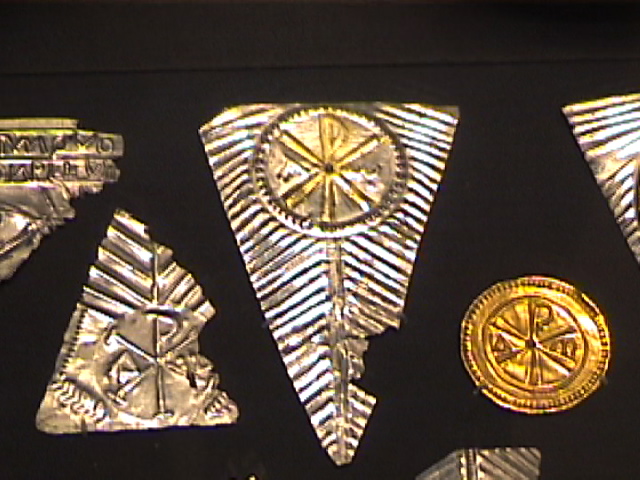
By October Constantine’s legions reached the city, where his rival Maxentius had drawn up his army at the Milvian Bridge. Before their battle he saw the sign of the Christian Cross. The historian Eusebius described it:
“He said that about noon, when the day was beginning to decline, he saw with his eyes the trophy of a Cross of light in the heavens, above the sun, and bearing the inscription, ‘Conquer by this sign.”
Constantine ordered the sign placed on the standards of his army. The next day he won a decisive victory over Maxentius at the Milvian Bridge and became emperor of the west.
Constantine and the Christians
A year later in Milan, the new emperor ended the persecution of Christians and began to embrace their cause. We don’t know when Constantine himself became Christian, but he waited until he was dying to be baptized. His mother Helena surely played a role in his religious development.
On the extensive Lateran property on the eastern side of Rome, which he confiscated from his enemies, Constantine began a massive building program for the once-persecuted Christian church. He ordered a large Christian basilica and baptistery built there, where the present basilica and baptistery of St. John Lateran now stand, and built a residence for the Christian bishop of Rome.
He gave the Sessorian Palace, close by, to Helena as her official residence. She converted a room of the palace into a chapel, where she later placed the relics of the Cross she brought from Jerusalem. The room and the relics still remain in what is now called the Church of the Holy Cross.
At the same time the new emperor honored some of Rome’s great Christian martyrs by building churches next to their tombs – the church of St. Sebastian, St. Lawrence the deacon, Saints Peter and Marcellinus. The largest of the new Christian basilicas he built over the tomb of Peter the Apostle, on the shoulder of the Vatican Hill.
Helena, a convinced Christian, must have inspired some of her son’s plans.
Builder of an empire: Constantine the Great
Twelve years after conquering the city, Constantine left Rome to secure the empire’s borders along the Danube River, where barbarian tribes were breaching the frontiers. He also moved to defeat his rival in the east, the Emperor Licinius. By 324 he was sole ruler of the entire Roman empire.
To unify his large domains, Constantine built a new imperial city where the Black Sea and the Aegean Sea meet. The city was called Constantinople–today Istanbul, Turkey.
Constantine sought to advance his plan for a unified empire to strengthen the position of the Christian church by making the Holy Land, where Jesus had lived and died, its religious center. He chose his mother Helena to oversee his plan,
Helena visits the Holy Land
Helena left Constantinople very likely in the winter of 325 and reached Jerusalem the following spring. She was almost 80 years old; it was a hard trip of over 1500 miles, even for a woman of privilege.
Yet, according to the Christian historian Eusebius:
“She came, old in years, but young in spirit. She wanted to know this land… and walk in the footsteps of the Savior…. “
So Helena visited the places where Jesus had been. She supervised a massive program for building churches over these places. Above all, she wanted to honor the place of Jesus’ death.
It was not hard for her to find. The location of Calvary and the tomb–beneath a Roman temple built by the Emperor Hadrian in 138–was well known to Jerusalem’s Christians since the time of Jesus. The bishop of Jerusalem, Macarius, who probably suggested the plan for enhancing the Holy Land to Constantine in the first place, pointed the places out to her.
The Finding of the Cross
By the emperor’s order the Roman temple on the site was torn down and workmen began digging the foundations for a new church. While they were digging, it is said, they discovered an ancient cistern filled with debris from the old Roman execution site, including three upright beams and the title that Pontius Pilate had attached to the Cross of Jesus. It was an amazing discovery.
According to the oldest accounts, Helena determined the Cross of Jesus by touching each of the three wood pieces to a woman who was deathly sick. At the touch of one the woman was healed.
She concluded that this was the Cross on which Jesus died.
Helena enshrined a large part of that healing Cross in the newly built Church of the Holy Sepulcher in Jerusalem. Leaving Jerusalem, she took with her two other portions of the Cross, a part of the Cross’ title and some nails that were found in the cistern.
One part of the Cross she gave to her son, Constantine, in Constantinople. The rest she placed in the chapel of her private residence at the Sessorian Palace in Rome, where they remain till this day. She covered the floor of her chapel with soil from the Jerusalem excavations.
Christians rejoiced at the discovery. Less than 25 years before, they experienced the worst of all persecutions under the Emperor Diocletian, who tortured and killed great numbers, confiscating Christian homes and property. Their religion was on the verge of extermination. Now a new day had dawned; Christianity was triumphant.
The pieces of scarred wood buried in the earth for so long, seemed a reflection of God’s triumphant power. Now placed in settings of gold and precious stones, were they not a sign that, like Jesus, the church also had tasted death but was now raised up? Helena must have seen her own life reflected in this sign too.
The discovery of the tomb
Besides the relics of the Cross, there was another great discovery. Digging the foundations for the new basilica to honor the Cross, Constantine’s builders discovered the tomb of Jesus and immediately constructed a splendid rotunda around it. The tomb survives today in the Church of the Holy Sepulcher in Jerusalem’s Old City.
Helena’s extraordinary visit to Jerusalem inspired a powerful movement of Christian devotion. After her, crowds of pilgrims made their way to the holy places. Like Helena, they returned home with reminders of their visit: small vials of oil from lamps at the tomb of Jesus, small handfuls of soil. Some even carried back tiny precious portions of the Cross itself.
She died a few years after her Holy Land visit. Her son brought her remains back to Rome from Trier, and today they rest in the center of imperial Rome in the church of Santa Maria in Aracoeli.
She was Helena, a former tavern waitress, cast aside by a powerful, ambitious man with whom she had a child. Her great achievement was her search for the Cross of Jesus, a mystery she treasured.
After her death, she was revered as a model Christian, a model especially for women of the imperial court. The church honors her as a saint.
Did Helena find Calvary and the tomb?
But did Helena really find Calvary and the tomb of Jesus?
For almost twelve hundred years Christians believed that she did; they revered the holy places of Jerusalem and made them part of their devotional life. Artists were inspired by her story.
Then in the 16th century, doubts arose about Helena’s story. Historians scrutinized it for scientific proof and questioned its reliability.
Now, in recent times, archeologists and historians studying these ancient traditions less skeptically are examining the story again.
There is a new appreciation today for ancient traditions about tombs and places where famous figures lived and died. Certainly people at the time of Jesus remembered the tombs of notables from centuries before, such as David and Solomon. They were etched in their memories. Would not the earliest followers of Jesus– eyewitnesses– remember the places where he died and was buried?
Memories of Calvary
They were easily remembered in the years following his death, because executions still took place there. The uprights of the crosses remained standing on Calvary and crucifixions continued. His tomb lay empty nearby.
Then, about the year 41, when Herod Agrippa ruled Judea, the walls of Jerusalem were extended and the site of Calvary enclosed within its walls. Executions and burials ended because they were forbidden within the city. The bloodied uprights of Crosses were pulled up and thrown into a nearby cistern.
In the decades following Jesus’ death, the Christian community– a minority sect then– probably honored the places of Calvary discreetly. But Christians and others must have remembered the sites and told their children where they were.
After the Jewish rebellion against the Romans in 62, the situation changed. Refusing to join the revolt, Jewish Christians in Jerusalem moved to the city of Pella in Transjordan. When the rebellion was crushed in the year 70, Jews were banished from Jerusalem. However, Jewish-Christians–not complicit in the revolt– had some access to the city and their holy places.
Veneration of Jesus’ tomb must have continued; Christians must have come and prayed, even marking the site with graffiti as they customarily did elsewhere. In the 2nd century, the Emperor Hadrian– wishing to eradicate Jerusalem’s Jewish past– rebuilt it as a Roman city. Over the place of Calvary and the tomb of Jesus, he built a splendid temple to Venus. Was he hoping also to eradicate a Jewish-Christian shrine?
If he did, he only ensured an opposite effect. The temple became a marker for local Christians, who knew what lie underneath and told the next generation where it was, waiting for a better time. That time came less than two hundred years later, when Helena arrived.
Today, there is a growing acknowledgment among archeologists and historians that Calvary and the tomb of Jesus are indeed where Christian tradition always claimed them to be– at the Church of the Holy Sepulcher in Jerusalem, where once Hadrian’s temple stood.
What about the relics of the Cross?
Yet, what about the relics of the Cross? What can we say about them? Here the ground is less certain.
An early legend says that Helena’s workers discovered remains of crosses in the debris thrown into a cistern near Calvary. The empress used an unscientific method to decide which piece of wood was the Cross of Jesus. She asked for a sign from God– a healing– and a healing took place. It was the way of her time, but a way a scientist cannot accept.
Other details may help to explain Helena’s choice. Some think that after Jesus’ death, the title on his Cross and other relics of Calvary were kept in his tomb or perhaps kept by disciples or members of his family. Indeed, some relatives of Jesus– like Simeon bar Cleopas, the son of his uncle– who led the Jerusalem community during its exile at Pella and after its return to Jerusalem in 73 or 74– were prominent Jerusalem Christians. Did they and their descendants keep the relics from Calvary? Did they hand them over to Helena–perhaps under coercion, as some of the legends suggest? We will never know for sure.
However Helena’s relics originated, it safe to say that they were not lightly chosen or late fabrications. Slight as it is, the evidence seems to indicate that the relics she introduced to the Christian world, relics revered in countless Christian churches, came from the debris uncovered near the execution place, the Place of the Skull – Calvary.
And so the mystery remains– which may be the very nature of the Cross of Jesus. It will always be a mystery to be discovered.
On Good Friday, the day Jesus was crucified, Christians honor his Cross. In Roman Catholic churches throughout the world, the faithful approach this image and reverence it during the solemn liturgy of the day.
Where did the practice come from? It can be traced back sixteen hundred years to the church of the Holy Sepulcher in Jerusalem, spreading from there to Rome, where the Good Friday liturgy is officially celebrated by the Roman church, and to other parts of the Christian world. A woman named Helena set the practice in motion.
Devotion to relics is waning in the church today as far as I can judge. In the western world, influenced as we are by scientific thinking, we find them puzzling. Rome, the center of the Roman Catholic Church, is filled with them.
Most of the churches we are going to, like St. Peter’s and St.Paul Outside the Walls, were built to house them. So why are bones of saints and relics of the mysteries of the life of Jesus, like relics of the cross in St. Peter’s Basilica and Holy Cross in Jerusalem, the holy stairs at the Scala Sancta, St. Peter’s chains in the church of St. Peter in Chains, the crib from Bethlehem at St. Mary Major, there in the first place?.
The cult of relics flourished when people believed in an “enchanted world,” to use a phrase from Charles Taylor, where heaven and earth were close together and God was seen as actively engaged in nature and history.
Our western world believed in an enchanted world until the time of the Enlightenment in the 17th century, when scientific thinking began to emerge. From then on, religion came under the microscope of science and reason more and more.
You can see an enchanted world in the psalms. “The heavens declare the glory of God,” (Ps.18) God is “maker of heaven and earth, the seas and all that is in them.” (Ps.146) God is savior as well as creator: “The Lord sets prisoners free; the Lord gives sight to the blind…The Lord protects the stranger, sustains the widow and orphan, but thwarts the way of the wicked.” (Ps. 146) He “dwells in a holy temple” and they are happy who find him there. (Psalm 84) He “takes delight in his people.” (Ps.149)
God is close to creation and is its loving savior, these prayers say. God is not distant, as many followers of the Enlightenment came to believe, or unknown as many might say today. According to Christian belief, God is present in our world, as Jews believe, but he reveals himself now in Jesus Christ, his Son.
The sacraments of the Church–Baptism, Confirmation, the Holy Eucharist, etc..– are special signs of God’s abiding presence in our world. They’re signs of Christ who remains with us from birth till death, and leads us to a kingdom that will come.
Relics are part of the sacramental dispensation. Relics of the saints, like those of Peter and Paul, are reminders that God works in people on earth. Now they see him face to face, yet “from their place in heaven they guide us still.” They are part of a communion of saints; even now drawing us into God’s loving friendship.
Similarly, relics of mysteries like his cross and his birth are sensible reminders that the great mysteries of Christ abide with us too.
One danger of an “enchanted world,” a world where God is close, is that people misuse its powers for their own selfish purposes and not as aids to salvation. The abuse of relics became particularly acute in the 15th century when they were bought and sold and used superstitiously. A slide to magical thinking began.
At the time, voices within the church condemned the abuse of relics, but church authority didn’t move quickly enough to stamp out the abuse–partially because they benefited economically from it themselves.
A major attack came from Martin Luther and other Protestant reformers, who not only condemned the abuse of relics for endangering faith, but also called for their elimination altogether.
In its own movement of reform, the Catholic Church upheld the practice of honoring the relics, but laid down laws governing their use. They are not magical objects that give us power over things, but holy signs calling for conversion and humble recognition of an all-powerful God.
A second attack on relics followed the scientific revolution that began in the 17th century. Rationalist scholars, focusing on the Christian faith, questioned the historicity of Jesus himself and the gospels. Since relics were part of church belief and practice, they also came under scientific scrutiny. If they didn’t pass the test of science, they were rejected.
Because of religious and scientific questions about relics, some avoid them and turn to art and architecture instead. But don’t miss the relics. They’re important; you can’t understand the churches without them.

 The Victor's Place