Tag Archives: Corinth

2nd Corinthians: Suffering with Christ

gohistoric_14912_m

For the next two weeks we’re reading at Mass St. Paul’s Second Letter to the Corinthians, a Christian community in the city of Corinth around the year 50, not many years after the time of Jesus.

During the easter season we read about the spread of the Christian church from Jerusalem to Rome from the Acts of the Apostles. Now, in ordinary time we look more closely at a church Paul founded– in Corinth. What was it like? Paul’s two letters to the Corinthians tell us about an early Christian church, but they also tell us about our church today.

The Christian community at Corinth was drawn from different peoples flocking to the great Mediterranean port. It was diverse. It attracted a variety of preachers and teachers, which caused some division, noticeably as they came together to “break bread.” There’s some sexual immorality in this church on a sea port open to the world. Some were wondering about the resurrection of Jesus.

Most of its members were not Jewish Christians, though some there may have wished for the stability a Jewish synagogue might provide. There’s no bishop administering this church as yet. Paul was a minister to the world. There was no one person in charge in Corinth.

It was church  “in the works,” not complete, with glaring weaknesses, struggling to grow in faith, with plenty of loose ends, looking for answers. It was church experiencing great change, a church suffering, not from outward persecution, but from turmoil within.

Maybe a church like ours?

Addressing the Corinthians, Paul sees their suffering as “Christ’s suffering”. He feels that mystery in himself, as he says in the opening chapters of his letter and he returns to that theme over and over.

Yes, problems must be faced, corrections made, restructuring needs to take place, but Paul keeps reminding the Corinthians they’re experiencing the sufferings of Christ and with Christ’s suffering comes his encouragement.

Paul himself knew both the sufferings of Christ and his encouragement. “We were utterly weighed down beyond our strength, so that we despaired of life,” he writes from the province of Asia, but with suffering came an overflowing encouragement, which always accompanies the sufferings of Christ. “We do not trust in ourselves but in God who raises from the dead.” ( 2 Corinthians 1, 5-11)

Paul’s way is the right way, isnt’ it? We’re tempted to judge, analyze, condemn, throw up our hands and lose hope in the world around us. The first way to see it is through the sufferings of Christ, a mystery affecting us all, and the “encouragement” that always accompanies this mystery.

Listen to Paul speaking to the struggling Corinthians:

“Our hope for you is firm, for we know that as you share in the sufferings, you also share in the encouragement,”

Good letter for us to read these days.

The Gospel of Luke and First Corinthians Go Together

We’re reading Paul’s 1st Letter to the Corinthians and the Gospel of Luke together these days at Mass. The two may be more closely connected than we suspect. Luke wrote some years later than Paul, but his audience would be much like those found in the church of Corinth.

Theophilus, to whom Luke dedicates his gospel, could easily be one of Corinth’s better-off Christians, who surely  would recognize  the lack of concern for the poor that Jesus condemns in Luke’s gospel as present in his own community as well. That unconcern appeared at table, in the celebration of the Eucharist in the Corinthian church, and Paul condemns it. (1 Corinthians 11, 17-22) Luke presents Jesus, over and over, at table, condemning the same unconcern for the poor as well.

Luke begins Jesus’ ministry in Galilee with his visit to Nazareth (Luke 4, 16-30) where he’s not recognized by his own who know him too well and are ready to throw him to his death over the hill.

The Corinthians–how many we are unsure– fail to recognize the humble Savior whom Paul preaches. “I did not come with sublimity of words or of wisdom. For I resolved to know nothing while I was with you except Jesus Christ, and him crucified.” (1 Corinthians 2, 1-5)

In Luke’s gospel, Jesus is the teacher and Lord bringing God’s word to the towns of Galilee. He brings God’s word to Corinth as well, but the Corinthians are attracted to the various disciples of Jesus, causing “jealousy and rivalry among you…Whenever someone says, ‘I belong to Paul,’ and another,’I belong to Apollos,’ are you not merely men? What is Apollos, after all, and what is Paul? Ministers through whom you became believers, just as the Lord assigned each one.”

God plants and waters the growth of his church; the disciples are disciples, only disciples, who must have “the mind of Christ.” (1 Corinthians, 3, 1-9)

Luke has a church like Corinth in mind when he writes his gospel. How about our church too, as we take  sides. “I belong to…” Good to read these two readings together now.

Readings.

Paul in Sin City

We’re reading Paul’s First Letter to the Corinthian for the next few weeks at Sunday Mass. Paul wrote a number of letters to the Christian community he founded after reaching Corinth about the year 50. It was the most exasperating community Paul dealt with, but the Corinthians made him think about faith, so we can thank them for keeping Paul on his toes.

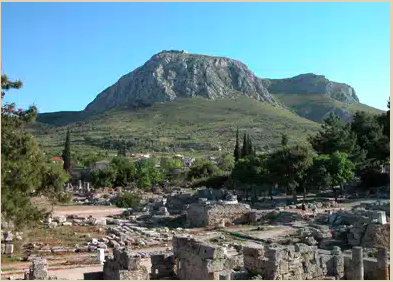
Corinth was a rich, sprawling seaport, being rebuilt as Paul arrived, a frontier city attracting ambitious people from all over the Roman world. They were people who wanted to get ahead. Corinth was a city of “self-made” people; only the tough survived there. It was also a center for prostitution and sexual commerce. We could call it a “sin” city.

Maybe that was a reason why Paul wanted to establish a church there. He was God’s apostle to the Gentiles. Where could be better meet Gentiles than a seaport connected to the whole world. If Christianity could take root there, it could take root anywhere.

When Paul arrived there around the year 50 AD, he did what anybody has to do when they go to a new place– find a place to stay and get a job. He stayed in the house of Prisca and Aquila, a Jewish Christian couple who owned a small shop in Corinth. He worked as a tentmaker in their shop. He met people, and Paul spoke to them of Jesus Christ, and they believed.

Then on the Sabbath in the synagogue he made contacts too, but I think Paul probably did most of his preaching while working. A lot of things can happen when you are working.

To form new believers, Paul asked some of his friends with large houses to hold meetings there. A lot of things happen in homes that don’t happen in church.

Paul generally founded a church and moved on. But when he moved on, troubles often started in many of those communities, so sometimes he wrote letters, and sometimes he had to come back himself to try to straighten things out. There were some grave problems in the church at Corinth. The church was split into factions, based on wealth, status and friendship. It also was confused about sexual morality.

Paul reminded the Corinthians where they came from and who they were. Not many of you were wise or well-born, he told them. God chooses the weak things.

God still does.

Fighting in Church

Today’s Office of Readings has the letter to the Corinthians by Pope St. Clement 1, written about 95 AD,  just after the last of the New Testament writings were written.

Fighting erupted among the members of the church in Corinth, once cared for by Paul the Apostle, who scolded them for the same thing. There’s slander and backbiting and complaining going on; people like to hear themselves talk, Clement remarks, quoting scripture: If you talk a lot you only hear yourself. A big talker thinks he’s always right.

The Corinthians were a scrappy bunch, it seems.

Clement tells them that their fighting makes the church look bad among their unbelieving neighbors. Who wants to belong to a community like that? Paul wrote to the Romans; I guess Clement thought he should write to the Corinthians.

Stop fighting among yourselves and do some good, the pope says. Obey your leaders, but above all, obey God. Bow down in respect before God and be silent before his holy will, as the Prophet Isaiah bowed silently  before the overwhelming presence of God in the temple.

“Our boasting and our confidence must rest on him. Let us be subject to his will. Look carefully at the whole host of his angels; they stand ready and serve his will. Scripture says: Ten thousand times ten thousand stood before him, and a thousand thousand served him, and cried out: Holy, holy, holy is the Lord of hosts; the whole creation is full of his glory.”

“Holy, Holy, Holy, Lord God of hosts…” We say at Mass. We bow down before God; our thoughts, our judgments, our plans are nothing before God’s thoughts, judgments and plans. We know so little. Be humble before your God, Clement says, then you’ll get along with your neighbor.

Good advice for all of us.

Clement’s letter also gives the earliest testimony to the deaths of Peter and Paul at Rome.