In our 2018 pastoral letter, “Open Wide Our Hearts,” we lamented the impact of immigration raids and mass deportations in which even those who are U.S. citizens have been caught up and deported, noting: “Today, many Hispanics are often assumed to be in this country illegally. These attitudes of cultural superiority, indifference, and racism need to be confronted; they are unworthy of any follower of Christ.”
We consistently reaffirm what the church has always taught: that every human person is created in the image and likeness of God, the imago Dei, and that the dignity of the human person does not depend on a particular legal status, nationality or occupation. We also recognize that promoting public order and upholding the rule of law are necessary endeavors, especially because these measures help guard against trafficking and other forms of exploitation.
Today, however, we see aggressive approaches to immigration enforcement that inflict harm on our sisters and brothers, sometimes restricting their ability to work, live and worship in arbitrary ways. Many citizens and lawful residents have reported being detained by methods that blur the line between legitimate enforcement and discriminatory profiling. This climate of fear makes our neighbors hesitant to go to work, to attend Mass or to visit loved ones.
In light of this, we must ask again: Who is my neighbor? The answer, as always, is found in Christ. He calls us to see with the eyes of mercy, to walk with those who suffer and to build a society rooted in justice and love. As disciples, we cannot remain indifferent. We are called to advocate for a just and meaningful immigration reform that respects human dignity, upholds due process and promotes the common good.
Let us follow the example of Our Lady of Guadalupe and stand in solidarity with those who live in fear, as a testament to God’s abiding peace. Let us be beacons of Christ’s light, filled with compassion and courage. Let us raise our voices in support of a meaningful reform of our immigration system, one that recognizes, as the U.S. bishops reaffirmed last month, that ensuring national security and safeguarding human dignity are not in conflict. Let us reject dehumanizing rhetoric and violence, whether directed at immigrants or at law enforcement. And let us never grow weary in the Gospel call to love without condition.
May the Lord, who is close to the brokenhearted, strengthen us in this mission. And may we, as one body of Christ, never forget who our neighbors are (Ps 34:19).
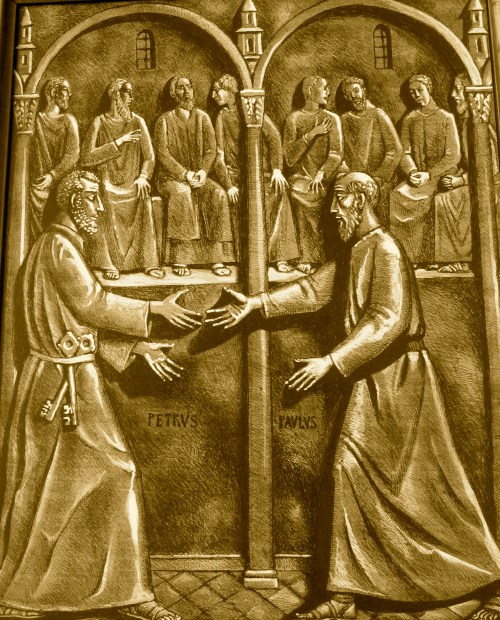
On November 18th, we honor the great apostles, Peter and Paul, remembering the dedication of the two ancient churches built over their graves. Peter is honored in the Vatican Basilica of St. Peter; Paul is honored in the Basilica of St. Paul, outside the Aurelian Walls along the Via Ostiense. The two apostles are founders and teachers of the Roman church.
Constantine built churches over the apostles’ graves in the middle of the 4th century. Besides honoring the apostles Peter and Paul, the churches were part of a wider plan of prayer, instruction and pilgrimage still seen in the Holy Year pilgrimages to Rome today. An early example of evangelization and catechesis.
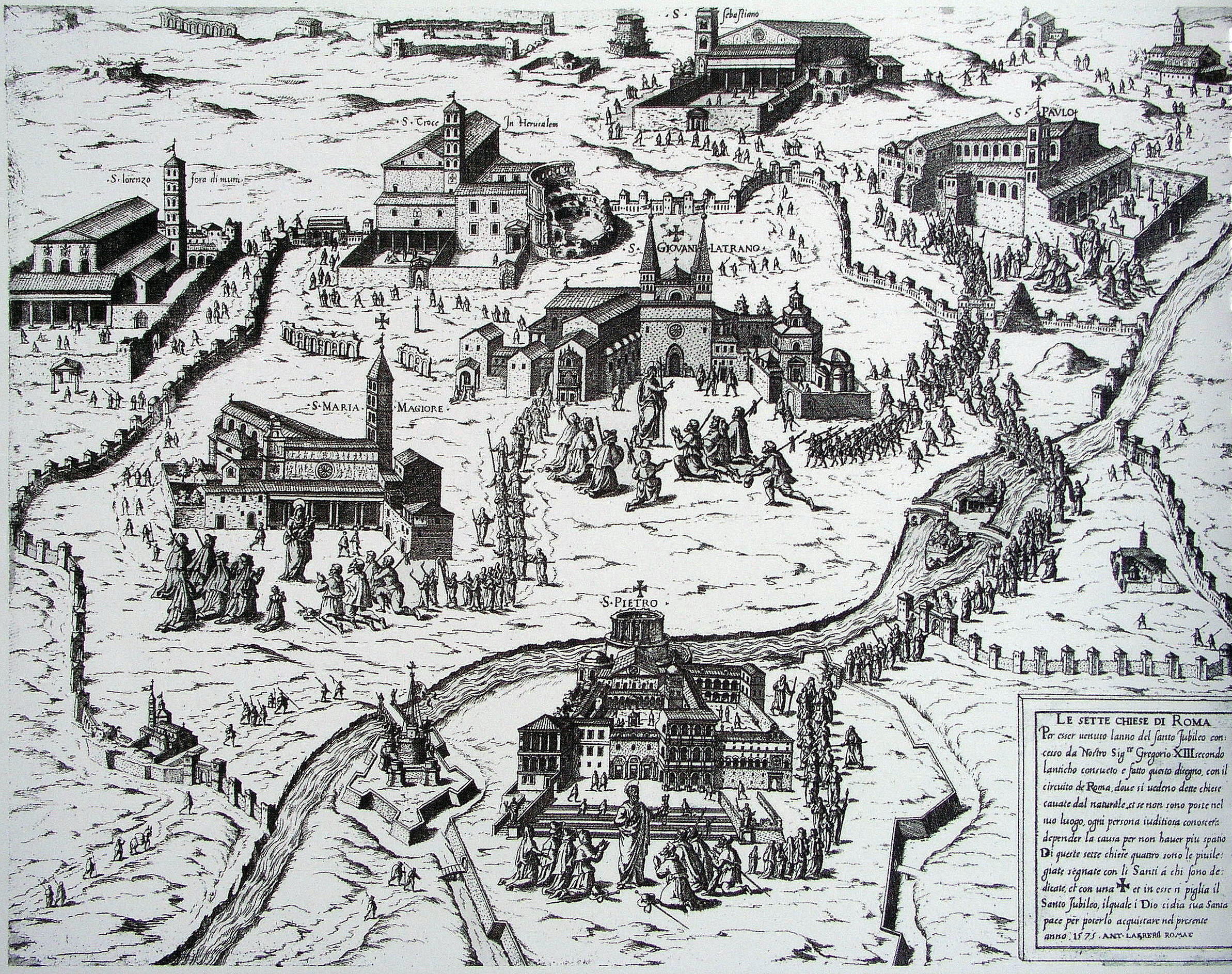
From earliest times pilgrims followed a path from one church to the other, visiting a number of other Christian shrines – St. Agnes and St. Lawrence, for example–on their way. A later pilgrim map based on that ancient pilgrimage journey offers an example.
Pilgrim Map, 17th century, Wikipedia Commons
Peter was crucified on the Vatican Hill in 64 near the obelisk not far from the circus of the emperors Caligula and Nero and was butried nearby. Constantine erected a basilica over his burial site in 326, while Sylvester was pope. Later in 1626 the present basilica replaced Constantine’s church. It’s in the process of reconstruction in the illustration above. Recent excavations have confirmed Peter’s burial place under the papal altar of this church.
Paul, tradition says, was beheaded on the Ostian Way, outside the ancient city walls, in 67. Constantine built a shrine church over the gave in 325; it was enlarged by Theodosius I in386. The church was rebuilt after a fire in 1823, according to its original measurements. The apostle’s grave lies before the main altar of the church.
Defend your Church, O Lord, by the protection of the holy Apostles, that, as she received from them. the beginnings of her knowledge of things divine, so through them she may receive, even to the end of the world, an increase in heavenly grace. Through our Lord Jesus Christ, your Son. (Collect for the feast)
That was one of the first question and answer I learned from my catechism many years ago.
The Pharisees ask a question somewhat like that as Jesus approaches Jerusalem with his followers:
“When is the kingdom of God coming?”
Jesus responds: “The coming of the Kingdom of God cannot be observed, and no one will announce, ‘Look, here it is,’ or, ‘There it is.’For behold, the Kingdom of God is among you.” (Luke 17:20-25)
The catechism of the scriptures, which we listen to now, says “The kingdom of God is among you.” The Greek word translated “among” can also be translated “within” so some translations have “The kingdom of God is within you.” But commentators say it’s better we look for the kingdom of God among us than simply within us.
Yes, God who is everywhere is within us, holding us and all things in being. God makes a home in us, Jesus says, but we should not limit God’s presence to human beings or see God working only in us. God is among us, in others and in the universe we are part of. God is not present among us as an observer, God is building a kingdom that we may not observe. We can miss it, the parables of Jesus indicate.
Especially in times like our, the kingdom that’s coming is hard to see.
It’s hard to see Jesus in the bread and wine, in his followers, in the wars and the destruction happening in our environment.
That’s what eyes of faith are for. Lord, that we may see.
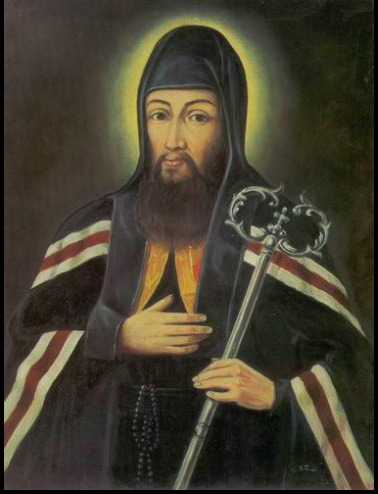
The Eastern Catholic Church of the Ukraine will be celebrating the feast of St. Josaphat (1580-1683) on November 12. They’re celebrating him as a holy ecumenist who worked tirelessly to bring unity among the Eastern Christian churches of Eastern Europe. He gave his life for it.
Josaphat was born in Voldymyr, a Ukrainian city the Russians targeted early in their current invasion of the country. Raised Orthodox, he joined the Ruthenian Catholic church, became a monk, then was made archbishop of Polotsk. At the time, Polish and Lithuanian armies conquered this disputed territory – the land has been continually fought over.
St. Sophia Cathedral, Polotsk
Religion entered the fight. Some Orthodox churches wished to be aligned to Rome after the Polish-Liithuanian conquest, so the authorities ordered some Orthodox churches be turned over to the Eastern Catholic Church. That triggered a violent reaction. Mobs sought out Josaphat in his cathedral, beat him, put him to death and threw his body in the Daugava River.
His body was retrieved and brought to his cathedral for burial. Later, it was interred in St. Peter’s Basilica in Rome.
Relations between the church of Rome and the Orthodox churches were strained then; they’re strained now. Political battles, historic feuds and rivalries have only increased tensions between the churches. For Josaphat they caused his death, at the hands of fellow Christians.
The Second Vatican Council in its document Orientalium Ecclesiarum affirmed the right of the Eastern churches to their own liturgy, theology and organization. As we appreciate their history and spirituality more, respect needs to grow. Members of churches in communion with Rome can share in the sacraments with one another.
Josaphat’s experience points to the difficult path to Christian unity, in this case between the church of Rome and many of the Eastern Orthodox churches. Presently, there are 23 Eastern Churches and about 18 million members united to the Roman Catholic Church. The Eastern Orthodox number about 300 million. The churches originate in Middle East, Eastern Europe, North Africa and India
Efforts towards Christian unity among the churches of the east and west need a patient, steady faith that looks more on God’s grace than human skills. Jesus commands we be one.
St.Josaphat reminds us to respect the Eastern churches and the rich liturgical and spiritual traditions they offer. Much of Roman Catholic liturgy and spirituality, especially our feasts of Mary, comes from the churches of the east. Josaphat had a keen appreciation of the common treasure we all share. We need that appreciation today.
Our liturgical calendar, honoring Josaphat, recognizes the universal call to holiness in saints who are from every age and nation. “Holiness is not bound by time and place.” (The Roman Calendar. Text and Commentary, 1976) We’re called to recognize the church as universal, catholic, existing everywhere..
When we think of saints, we may think of Mary, the mother of Jesus, apostles like Peter and Paul, or extraordinary individuals like Mother Teresa. True friends of God.
Besides those saints – shining lights of faith– there are unnumbered others in God’s company, the Feast of All Saints says. In a vision of heaven, St. John saw “a great multitude, which no one could count, from every nation, race, people, and tongue.” {Revelations 7, 9-13} We hope to be with them one day.
Our hope rests on a promise Jesus made, the same apostle says:
“See what love the Father has bestowed on us that we may be called the children of God. Yet so we are…Beloved, we are God’s children now; what we shall be has not yet been revealed.” (1 John 3,1-3)
How shall we reach that place where we’ll be revealed as children of God? Jesus said to follow him and live as he taught. He offers the way in his Sermon on the Mount, our gospel reading for this feast says. He will be the way, the truth and the life.
We haven’t seen yet that life we hope for or what God intends us to be. Life does not end; it changes. This feast invites us to trust in God’s promise and hope for the day it’s revealed.
Extraordinary saints are not the only ones in heaven. There won’t be just a few either. Countless others are in God’s company: saints unnoticed here on earth, saints with little to show, saints who were sinners. People like us.
As we celebrate this feast, St. Bernard says:
“Rise again with Christ and seek the world above and set your mind on heaven. Long for those who are longing for us; hasten to those who are waiting for us, ask those who are looking for our coming to intercede for us. Desire their company and seek a share in their glory. There’s no harm in being ambitious for this. No danger in setting your heart on such glory. Remembering the saints inflames us with a yearning that Christ our life may appear to us as he appeared to them and that one day we may share in his glory.”
Who are the Romans Paul writes to in his letter to the church in Rome? Historians say Jews were the predominant group that first embraced Christianity in Rome, but there were not many Jewish converts at first. A substantial population of Jews at the time lived in Trastevere, across the Tiber River. Claudius had to expel some of them from the city around the year 47 because of violent disturbances in the Trastevere synagogues over Christ. It’s unlikely there was a large number of converts to Christianity from Judaism when Paul wrote his letter.
Many Jews in Rome, faithful to Judaism, would strongly question Paul’s argument that the law was a failure.
Not many Romans, Gentiles, embraced the gospel early on either. I doubt the majority of the Romans would agree with Paul that the Roman gods had failed. Rome was a powerful, successful empire in Paul’s day. I doubt many thought too much about its flaws.
The Christian community made up of Jews and Gentiles was not large, if my reading of Paul’s time is accurate. The Christians of Rome were fervent, but few.
In his letter, Paul pictures sin as a cosmic reality, but cosmic sin is not always easy to see. It was not easy to see in Paul’s day, nor is it easy to see in our day. We identify sin with personal sin, murder, theft, cheating, adultery. Paul is aware of personal sin, yet his focus is on cosmic sin. Harder to see who’s responsible for cosmic sin. Who’s responsible for the sin in wars, armament races, manipulation of world markets, plundering the environment?
The Letter to the Romans has a large place in the Sunday and weekday readings of our lectionary. It can be difficult to read, but we need Paul’s larger picture, which calls for a larger hope. Until the final coming of Jesus, we must live in the world pictured by the apostle.
We thank God for his grace of forgiveness and his promise of new life.
The feast of St. Jerome, the great biblical scholar, is a good time to look at the history of the bible itself. Where does it come from? I happen to be staying today in a place Jerome knew well, the Celian Hill, in Rome.
Our Christian bible comes from two closely related religious traditions: Judaism and Christianity. The first books of any Christian bible come from the Jews, the Jewish scriptures. The rest of the writings found in a Christian bible– gospels, letters– come from Christian writers.
It’s good to remember that before printing was invented in the 15th century, the various writings of the bible were copied on papyri and parchment, materials too limited at first to be bound together in one book. “When you come,” Paul writes to Titus, “bring the cloak I left with Carpus, the papyrus rolls and especially the parchment.” ( Titus 4:13)
Paul does not have a complete bible, but only individual writings. Luke’s Gospel describes Jesus in the synagogue at Nazareth taking a scroll of the Prophet Isaiah to read. Unrolling the scroll, he read a passage from Isaiah, probably in Aramaic or Hebrew, then he rolled back the scroll, handed it an attendant, and began to teach. (Like 4:16-30) Something like this:
Ancient scroll Byzantine Museum Wiki Commons
That’s how the scriptures were read in early Christian liturgies, from papyri and parchment copies of individual Christian gospels and letters and various books from the Jewish scriptures.
The first Christians read the books of the Old and New Testament in Greek, the language of the Mediterranean world. Only in the 2nd century did Latin versions of the scriptures begin to appear in Roman North Africa as people began speaking Latin instead of Greek. Versions in other languages, like Syriac, Coptic and Armenian, also appeared as Christianity spread through the world.. Jerome was responsible for the Latin translation.
Codexes or books of the complete Christian Bible appear only towards the 4th century, as printing methods evolved. Only towards the 9th century did complete copies of the Bible become commonplace in the latin Christian world. These complete “books” of scripture were mainly located in a church; some copies might circulate among the wealthy.
Until the 9th century copies of the scriptures were found in mostly in churches, monasteries, and church libraries of western and eastern Christianity . Complete copies of the scriptures were marked for use in the liturgies and feasts of the church. Often the scriptures appeared in lectionaries specifically designed for use in the liturgy. The ordinary Christian heard the Word of God proclaimed and then commented on in a church.
Gospel of Mark. Vulgate
St. Jerome began his important translation of the scriptures from Greek and Hebrew into latin and wrote his commentaries from 382 till his death in 420. His translations, known as the vulgate, were sponsored by friends in Rome, especially Pope Damasus, who looked for a fresh translation of the various latin versions currently in use in the western church.
The Roman church then was experiencing a spiritual revival, and Roman Christians, especially women from the wealthy families on the Caelian and Aventine hills, found Jerome writings and translations from the original Greek and Hebrew inspiring. Like all languages, latin was a developing language and Jerome produced the scriptures in a language they appreciated. Some of his wealthy friends produced copies of his translations and commentaries, which they circulated among themselves.
The Roman senator, Pammachius, whom Jerome called “ my old fellow-learner, companion and friend”, was one of the advocates of the new translations. Like other Roman Christians, he hoped to convert the followers of Rome’s traditional religion through the wisdom of the scriptures. What better resource to win them over than fresh translations of the Christian scriptures from the original Greek and Hebrew and commentaries of a brilliant scholar like Jerome?
Pammachius built an impressive basilica on the Caelian Hill in sight of the Roman Forum, Saints John and Paul. Until then, no Christian church was built in this area in deference to the sensibilities of Rome’s traditional religion firmly established in the temples and monuments of the forum.
Saints John and Paul was the first Christian church to be built in this sensitive area, according to Richard Krautheimer, an expert on Rome’s early Christian churches. The church not only honored two Roman Christian martyrs but it brought the Christian message to the spiritual heart of Rome, the Roman Forum.
Gutenberg Bible. New York Public Library. Wiki commons
Jerome’s latin translations of the scriptures, the vulgate, remained the scriptures western Christians read until the printing press revolutionized communication in the western world in the 15th century. The Gutenberg Bible, an edition of the latin vulgate printed in the 1450s, ushered in the mass production of bibles. No longer for a few, the bible became available for all.
The Protestant Reformation benefitted especially from new versions of the scriptures quickly produced in the languages of western Europe. The Catholic Church reacted defensively, fearing that the faithful, uninstructed in the scriptures, would question the traditional teachings of faith. Instead of a biblically grounded spirituality fostered by the flow of printed bibles, the church turned to a spirituality nourished by devotions.
Thanks to the work of Catholic biblical scholars in the last century following in the footsteps of St. Jerome, the Catholic Church recognized the importance of the scriptures at the Second Vatican Council (1962-1965 ). In its Constitution on Divine Revelation the church professed her veneration for the scriptures “just as she venerates the body of the Lord, since, especially in the sacred liturgy, she unceasingly receives and offers to the faithful the bread of life from the table both of God’s word and of Christ’s body.”
The scriptures are “together with sacred tradition, the supreme rule of faith… Therefore, like the Christian religion itself, all the preaching of the Church must be nourished and regulated by Sacred Scripture.” They are “the food of the soul, the pure and everlasting source of spiritual life.” (DV 21)
“Easy access to Sacred Scripture should be provided for all the Christian faithful. That is why the Church from the very beginning accepted as her own that very ancient Greek translation of the Old Testament which is called the septuagint; and she has always given a place of honor to other Eastern translations and Latin ones especially the Latin translation known as the vulgate. But since the word of God should be accessible at all times, the Church by her authority and with maternal concern sees to it that suitable and correct translations are made into different languages, especially from the original texts of the sacred books. And should the opportunity arise and the Church authorities approve, if these translations are produced in cooperation with the separated brethren as well, all Christians will be able to use them. “ (DV 22)
The council also decreed that a treasure of scripture be available in the liturgy of the church.
St. Jerome and later scripture scholars were recognized at the Second Vatican Council, but the task of creating a biblical spirituality in the Catholic Church remains to be done. For Jerome it was not an easy task. His letters reveal that in his day critics strongly questioned his scholarly efforts. Even prominent teachers like St. Augustine were not altogether in favor of Jerome’s new translations, but favored versions they were used to.
Fostering a biblical spirituality today is not an easy task. St. Jerome, pray for us.
For a history of the Bible, see the Bible: A Global History, by Bruce Gordon, , Basic Books, New York 2024
Today the Passionists celebrate the feast of St. Vincent Strambi, CP (1745-1824). In his early years as a Passionist priest Strambi was a well known preacher, writer and spiritual director. He was a close associate of St. Paul of the Cross and wrote his biography after his death.
He was chosen to be bishop of Marcerata during tumultuous years in Italian history when Napoleon moved to take over Italy, the papacy and the Catholic Church. Strambi was an heroic supporter of the pope and fought for the freedom of the church.
To understand most saints you have to understand the times in which they lived. They’re antidotes for the poison of their time. Unfortunately historians pay little notice to the challenging times Vincent Strambi lived in.
In 1789, following the French Revolution, a Reign of Terror struck the church in France, religious orders were suppressed, priests and religious were imprisoned, exiled, put to death. Word of the terror quickly reached Italy and Rome; the defenseless Italian peninsula would be the next target for France’s fierce revolution.
Pope Pius VI asked for prayers that Rome be spared, and he called on Vincent Strambi, then one of the church’s best preachers, to prepare the people for a blow sure to come. In packed churches and piazzas in Rome Strambi promised that God would not abandon his people. The Roman people gained strength from his words.
In 1796 Napoleon Bonaparte turned to Italy, demanding heavy tribute from the Pope and the Papal States. The murder of the French General Duhot in Rome gave him the pretext for invading the city, deposing and imprisoning the pope and declaring the Papal States a Republic.
Religious houses were suppressed, their goods systematically confiscated. Strambi, a well-known opposition figure, fled to Monte Argentario, a Passionist sanctuary on the Mediterranean Sea.
In 1799 Pius VI died in exile and was succeeded by Pius VII who, in 1801, appointed Strambi bishop of Macerata and Tolentino, two important cities in the Papal States along Italy’s Adriatic coast, poverty-stricken from years of political and military turmoil.
The bishops of the Papal States were largely responsible for temporal as well as spiritual affairs and Bishop Strambi became a champion of the poor in his diocese. He lived sparingly himself, without signs of wealth or position. The poor were constantly on his mind. “Don’t you hear the cries of the poor?” he said one day to the treasurer of his seminary, looking out his window.
The education of poor children interested him especially and he urged his priests to care for them. In sermons he constantly looked to the Passion of Jesus for wisdom in the struggles of the time. His devotion to the Precious Blood of Jesus was influenced, at least in part, from reflection on the bloodshed the Napoleonic Wars brought to millions in Europe. Almost 4 million died as warfare rose to a level never seen before. Their blood was precious to God.
On May 5, 1809, after occupying Rome and most of the Papal States. Napoleon declared the region under French control and the temporal power of the pope abrogated. On June 6, 1809 Pius VII placed notices on church doors throughout Rome excommunicating anyone cooperating with the French. July 6, the French general Radet arrested the pope and brought him north to Savona.
Napoleon then demanded bishops sign an oath of loyalty to his new government. Refusal meant exile and imprisonment, signing was an act of disloyalty to the pope.
“I am ready for prison and for death. I am with the pope,” Strambi declared. On September 28,1808 he left his diocese under guard for northern Italy where he remained for 5 years under house arrest.
After Napoleon’s defeat in 1814 the church’s exiled leaders returned. Bishop Strambi returned to his diocese in May, 1814; immediately the pope asked him to come to Rome to preach a nine day “retreat of reconciliation” in late July and early August. Not all met the French invasion heroically.
In 1816 a typhoid epidemic followed invading armies. Food shortages and inflation spread through the bishop’s diocese. He opened hospitals for the dying and sought supplies for his suffering flock.
Physically frail from birth, Bishop Strambi became increasingly ill and found it harder to manage his diocese. By 1814, the world too had changed. The Papal States had no bishops in the long chaotic period of the Napoleonic invasion and new forces demanding change came to power. Strambi recognized it was too much for him.
In 1823 he asked the new pope, Leo XII, to allow him to retire. The pope accepted his resignation on one condition, that he come and live with him as an advisor in the Quirinal Palace, then the pope’s residence in Rome. A local commentator said of the departing bishop: “ He was a man who lived a holy life, giving alms to all and content with only the necessary for himself. We are sorry to see him go, for we lose a good pastor. The cries of the poor are especially loud, for they lose one who cared for and sustained them.”
Vincent died in Rome on January 1, 1824, having offered his life to the Lord in place of that of the pope who was seriously ill.
Pope Leo ordered the process for his canonization 8 days after his death. He was declared a Saint in 1950 and his relics now rest in Macerata, the city where he was a zealous pastor for twenty-two years.
St. Vincent Strambi’s room, Saints John and Paul Monastery, Rome
With the help of the Holy Spiirt, I on my part will do all I can that the living image of Jesus crucified be imprinted in the hearts of each of you. I do this gladly, not counting the cost. I consider myself fortunate to give my lifeblood so that Christ might be formed in you. I can say, like the apostle, that because of my love for you, I want to share with you “not only God’s message, but our very lives, so dear have you have become to us.”
I urge you, then, to look attentively on the Image of the Crucified, the bishop of your souls, on his throne of grace. In that way I shall fulfill my obligation to announce to you the death of the Lord, an obligation arising from my profession in the Congregation of the Holy Cross and Passion of our Lord Jesus Christ. I shall do all I can to urge you all to fulfill your duty to love him who first loved us, who offered himself on the altar of the cross for us, who shed his blood for us.
( Letter to the people of Marcerata on becoming their bishop)
Labor Day Parade 1889, New York City, NYPublic Library
Labor Day is a holiday in my country, a day off. It’s also day to reflect on issues affecting work and workers. Labor Day can be traced back to when our world was agricultural rather than industrial. In many Christian societies, it was a day when people gave thanks for the crops they harvested and prayed for continued blessings. “Prosper the work of our hands, Lord, prosper the work of our hands.”
Labor Day can be traced to the rogation days in the Christian calendar, when people gathered in their church and went in procession through their fields thanking God for his gifts of the earth and asking God’s blessing for the future. Their procession was a walk of appreciation. As they walked through their fields people saw creation as good.
In a gospel suggested for today, Jesus tells us
“Do not worry and say, ‘What are we to eat?’ or ‘What are we to drink?’ or ‘What are we to wear?’ All these things the pagans seek. Your heavenly Father knows that you need them all. But seek first the kingdom [of God] and his righteousness, and all these things will be given you besides. Do not worry about tomorrow; tomorrow will take care of itself. Sufficient for a day is its own evil.” (Matthew 6:311-36)
Each day has its worries, but worrying about tomorrow stops us from appreciating today, Jesus tells us. Worrying about tomorrow can stop us from living today.
That’s not to say we should not reflect on society’s social ills. Labor Day is also a time to call out against poor labor conditions, abusive labor conditions, lack of opportunities for good, meaningful work. There’s the threat that comes now from Artificial Intelligence. How will that impact workers?
Still, Labor Day calls us to take an appreciative walk through our own wheat fields, through the place where we are, looking at the work we do, appreciating the work others do for us. It’s a holiday.
Ten years ago, Pope Francis called for A World Day of Prayer for the Care of Creation for September 1st. The day of prayer, coinciding with the publication of his letter Laudato si’ , began a Season of Creation, an ecumenical endeavor shared with other churches and communities that extends from September 1st to October 4th, the Feast of St. Francis of Assisi.
Our church calendar, besides feasts and seasons, has days of prayer when particular causes arise. In a recent letter, Pope Leo called the care of creation a particularly timely issue to pray for:
“…given the evidence in various parts of the world that our earth is being ravaged. On all sides, injustice, violations of international law and the rights of peoples, grave inequalities and the greed that fuels them are spawning deforestation, pollution and the loss of biodiversity. Extreme natural phenomena caused by climate changes provoked by human activity are growing in intensity and frequency (cf. Laudato Deum, 5), to say nothing of the medium and long-term effects of the human and ecological devastation being wrought by armed conflicts.
As yet, we seem incapable of recognizing that the destruction of nature does not affect everyone in the same way. When justice and peace are trampled underfoot, those who are most hurt are the poor, the marginalized and the excluded. The suffering of indigenous communities is emblematic in this regard.
That is not all. Nature itself is reduced at times to a bargaining chip, a commodity to be bartered for economic or political gain. As a result, God’s creation turns into a battleground for the control of vital resources. We see this in agricultural areas and forests peppered with landmines, “scorched earth” policies, [1] conflicts over water sources, and the unequal distribution of raw materials, which penalizes the poorer nations and undermines social stability itself…
Environmental justice – implicitly proclaimed by the prophets – can no longer be regarded as an abstract concept or a distant goal. It is an urgent need that involves much more than simply protecting the environment. For it is a matter of justice – social, economic and human. For believers it is also a duty born of faith, since the universe reflects the face of Jesus Christ, in whom all things were created and redeemed. In a world where the most vulnerable of our brothers and sisters are the first to suffer the devastating effects of climate change, deforestation and pollution, care for creation becomes an expression of our faith and humanity.
Now is the time to follow words with deeds.”
( For THE 10th WORLD DAY OF PRAYER FOR THE CARE OF CREATION 2025)
Recently, the Dicastery for Divine Worship provided a preliminary text for a Mass for the Care of Creation. A good resource for prayer during the Season of Creation.
MASS FOR THE CARE OF CREATION
Entrance Antiphon Ps 18: 2
The heavens declare the Glory of God,
and the firmament proclaims the work of his hands.
Collect
God our Father,
who in Christ, the firstborn of all creation,
called all things into being,
grant, we pray, that docile to the life-giving breath of your Spirit, we may lovingly care for
the work of your hands.
Through our Lord Jesus Christ, your Son,
who lives and reigns with you in the unity of the Holy Spirit,
God, for ever and ever.
Prayer over the Offerings
Receive, O Father,
these fruits of the earth and of our hands:
bring to completion in them the work of your creation,
so that, transformed by the Holy Spirit,
they may be for us the food and drink of eternal life.
Through Christ our Lord.
Communion Antiphon All the ends of the earth have seen the salvation of our God.
cf. Ps 97: 3
Prayer after Communion
May the sacrament of unity
which we have received, O Father,
increase communion with you and with our brothers and sisters,
so that, as we await the new heavens and the new earth,
we may learn to live in harmony with all creatures.