Tag Archives: Bethany

Palm Sunday Procession

The gospels of Mark, Matthew and Luke report that Jesus began his entry to Jerusalem on Palm Sunday at Bethphage and Bethany on the Mount of Olives. From here he went into the city of Jerusalem seated on a donkey and those who followed him threw olive branches before him, crying, “Hosanna to the Son of David, blessed is he who comes in the name of the Lord, hosanna in the highest.”

From the roof of the Passionist house in Bethany you can see the eastern slopes of the Mount of Olives looming ahead; the road winds over the crest of the mount down the other side past the Garden of Gethsemani and into Jerusalem. We walked part of the road last week.
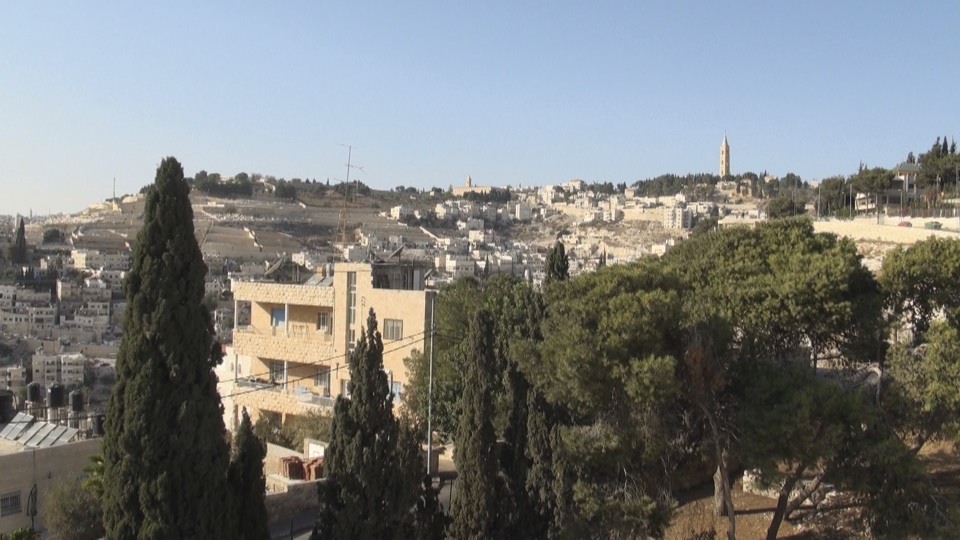
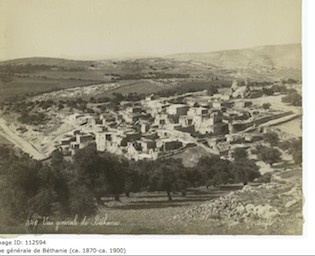
The area around  Bethany was probably sparsely populated at the time of Jesus and into the Christian era. During great feasts, the poorer pilgrims would stay in the area, probably pitching tents up in the olive groves, and walk to the city. Here are two pictures from the 1940‘s when the area was less populated, today it is Muslim.

After Constantine established the church in Jerusalem and built churches like the Church of the Holy Sepulcher in the 4th century, vast crowds came here on Palm Sunday to reenact the gospel. They probably began near here to go their way into the city to the empty tomb .

Fr. Roberto tells me the procession today for the Latin church goes through St. Stephen’s Gate and ends in the Church of St. Ann.

Our Palm Sunday celebration today in the Roman rite imitates the ancient practice of the Church of Jerusalem, as well as many other of its Holy Week rites as well. We follow our ancestors in faith in sign. Before our Palm Sunday procession we hear these words:

“Let us remember with devotion this entry which began his saving work and follow him with  lively faith. United with him in his suffering on the cross, may we share his resurrection and new life.”

Don’t forget, however, that the little procession we have in our churches today once stretched over some tough hills and went for a distance.

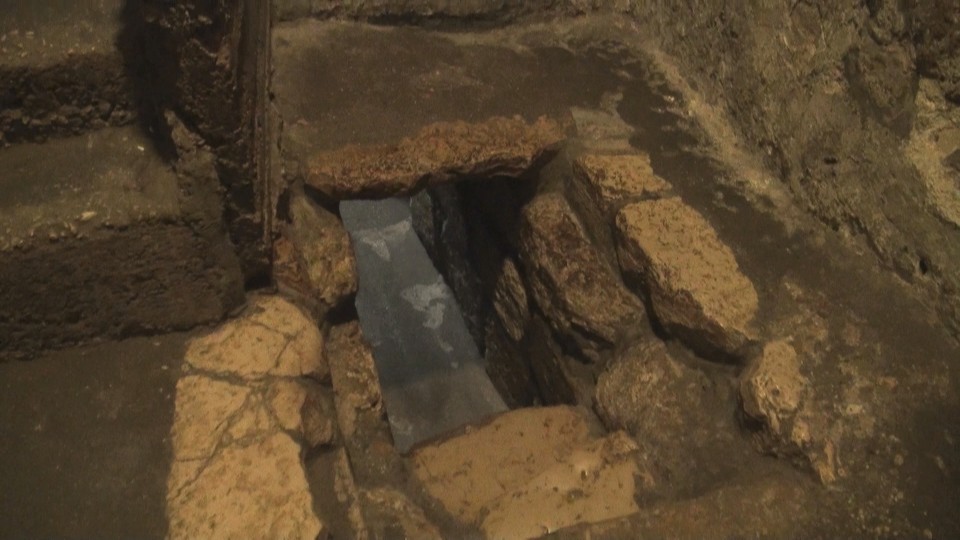
In the garden behind the Passionist house are some first century ruins of a few Jewish houses from the time of  Jesus. Outside one is  a mikvah for purifications. Not far away is the Franciscan church next to the traditional site of the tomb of Lazarus. Who knows? Could they have lived here? It looks like its part of the ancient village of Bethany.

In back of the site is the famous security wall which runs through the Passionist property. More about that later.

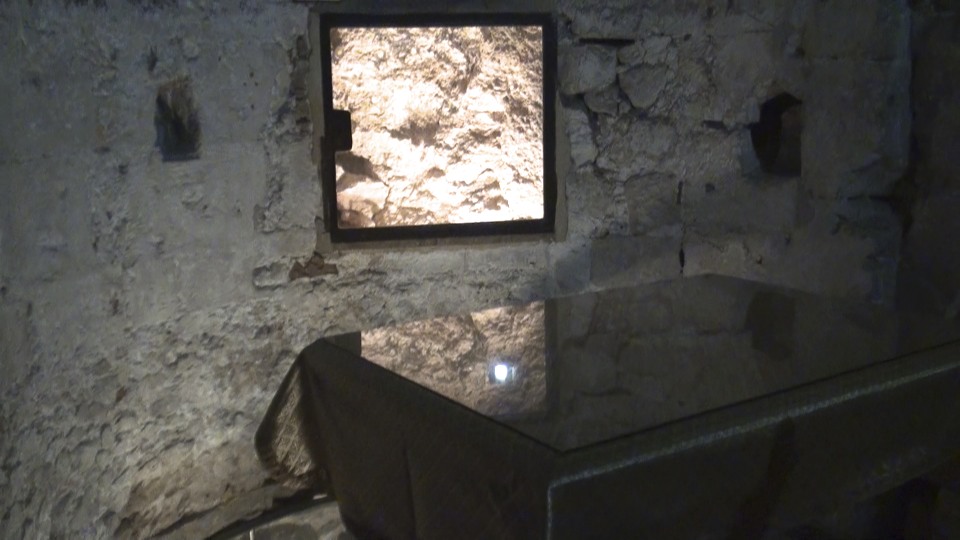
The Tomb of Lazarus

I visited the tomb of Lazarus in November 2010 while in the Holy Land. It’s only a few hundred yards from the Passionist house, St Martha, in Bethany, where I was staying, but because of the Israeli security wall you now have to drive about 13 miles around the wall to get there.

Some sisters from the nearby Comboni convent drove me there on their way to go food shopping one day. As I approached the tomb a group of about 30 pilgrims from one of the slavic countries were entering the tomb, so I stayed outside till they left. During the 2nd World War over 40 million people were killed by Hitler and Stalin in what’s been called “The Bloodlands,” parts of Eastern Europe that were fought over so viciously. Were these people going down to the tomb from that part of the world, bringing memories of “The Bloodlands,” I wondered?

They started to sing in harmony their beautiful eastern chants and the haunting, glorious music came up from the dark rock cavern below. Lazarus was being celebrated again and his tomb rang with their joyful song.

“Lazarus, come out!”

And not only were they celebrating the raising of Lazarus but our hope of resurrection too.

The dark tomb was still ringing with their singing when I went in. Joyful song from a tomb. Lazarus represents us all. That’s the powerful message from our gospel today which prepares us for the life-giving death of Jesus.


Meal at Bethany

John 12, 1-11

John’s Gospel read today calls us to a meal honoring Jesus in Bethany following the Resurrection of Lazarus. It’s the last meal before the Passover supper. The gift of life that Jesus gives his friend leads to a sentence of death.

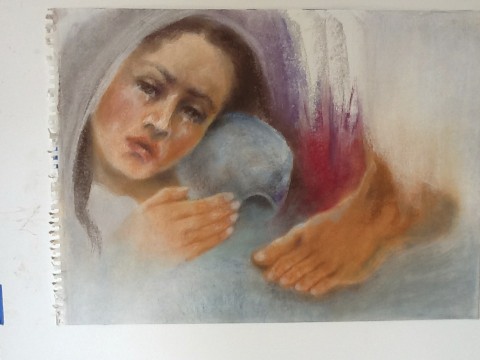
Faithful Martha serves the meal; Lazarus newly alive, is at the table. But the one drawing most of our attention is Mary, their sister who, sensing what’s coming, kneels before Jesus to anoint his feet with precious oil and dry them with her hair. “And the house was filled with the fragrance of the oil.”

The precious oil is an effusive sign of her love and gratitude; it also anoints Jesus for his burial. Only in passing does the Gospel mention that evil is in play here. Judas, “the one who would betray him,” complains that the anointing is a waste, but his voice is silenced. Believers are honoring the one they love.

How fitting that Holy Week begins with this Gospel when, like Mary, we kneel and pour out the precious oil of our love upon him who pours out his precious life for us.

Martha

Martha and Mary were not just related  by blood, St. Augustine says, they were related by the same holy desire.  “ They stayed close to our Lord and both served him harmoniously when he was among them.”

Martha served him as the “Word made flesh,” who was hungry and thirsty, tired and in need of human care and support. She longs to share what Mary enjoys, his presence, his wisdom and his gifts. And she will find her desires fulfilled.

“You, Martha, if I may say so, will find your service blessed and your work rewarded with peace. Now you are much occupied in nourishing the body, admittedly a holy one. But when you come to the heavenly homeland you will find no traveller to welcome, no one hungry to feed or thirsty to give drink, no one to visit or quarrelling to reconcile. no one dead to bury.”

“No, there will be none of these tasks there. What you will find there is what Mary chose. There we shall not feed others, we ourselves shall be fed. What Mary chose in this life will be realized there in full.  She was gathering only fragments from that rich banquet, the Word of God. Do you wish to know what we will have there? The Lord himself tells us when he says of his servants, Amen, I say to you, he will make them recline and passing he will serve them.

Raising Lazarus

John 11,1-45

The wonderful story of the death and resurrection of Lazarus helps us appreciate the mystery of Jesus’ death and resurrection. Lazarus belongs to an influential family that welcomed Jesus to their home in Bethany, a village about two miles from Jerusalem. Martha and Mary were his sisters. Jesus stayed with them when he visited the Holy City.
When Lazarus died some days before the Passover, Jesus had left Jerusalem because of threats to his life and was staying in the safety of the Transjordan, the region where John the Baptist had baptized. Notified of his friend’s death, Jesus returned to Bethany, unconcerned for himself.
Death in its many forms was what Jesus came to take away, our gospel wants us to understand, and the dead Lazarus was a sign of what he wishes to do for all humanity. Lazarus was his friend, but Jesus, the Word made flesh, befriends the whole human race.
In the stirring conclusion of today’s gospel, Jesus calls the dead Lazarus from the tomb and “the dead man came out,” bound with the burial cloths that claimed him for death. “Untie him and let him go,” Jesus says. Those powerful, hopeful words are said to us too. We are called, not to die, but to live.
Later, on Calvary Jesus himself becomes our sign. A painful death does not claim him, nor will the grave hold him. He is our hope.
The same hope nourished Paul of the Cross: “ You ask me how I’m doing. I’m more sick than well and full of ailments. I can hardly write this…(but) I find it very good. Bearing the chains, the ropes, the blows, the scourges, the wounds, the thorns, the cross and death of my Savior, I fly to the bosom of the Father, where the gentle Jesus always is, and I allow myself to be lost in his immense Divinity.” (Letter 1925)
Like Martha, the sister of Lazarus, O Lord,
I believe you are the Resurrection and the Life.

A Church of the Hebrews?

Fr. Pol took me to the airport this morning early for the flight home. He celebrated Mass the evening before at Tel Aviv for about 700 Filipinos and other Catholics who work in that area as care-givers and domestics. There are over 80,000 Filipinos alone in Israel.

In the Gulf area there are about 2 million Catholics, many from the Philippines, India, Sri Lanka and Africa.

Pol was enthusiastic about the lively, ingenious faith of these immigrants, who send much of their earnings home, yet contribute so much to the efforts of their church here in Israel. They meet regularly at St. Peter’s Church in Joppa  and are planning another Christian center between Tel Aviv and Haifa. Some vital new movements are inspiring them.

The Israeli who hire them appreciate these workers for their ability to care for the sick and the elderly, and their honest values. Often they will arrange for them to get to Church on Sunday. Fr. Pol wonders if they will bring some of them to the faith.

Relations of immigrants to the government can be difficult, however. As in America, some are here illegally. Their children often are schooled in Hebrew and they want a more permanent relationship to the country but the political situation is not favorable now. Some are thinking that these immigrants may be the beginning of a new Christian presence, not just a pilgrim presence, in the Holy Land. One priest who is a Jewish convert is speaking of a Church of the Hebrews.

Fr. Pol and Fr. Marito and the Camboni Sisters next to them minister to this immigrant community regularly, driving all over Israel to wherever they can meet them.

Today is the Feast of Christ the King. Usually great things are done, according to Christian thinking, not by political or military or economic power, but by the power of the weak and the small. Weren’t lowly immigrants largely responsible for the original growth of the church?

Yesterday I missed an  opportunity for going with Fr. Pol to Tel Aviv because I wanted to get to Lazarus’ tomb and the Comboni Sisters offered to take me because they were going shopping. 17 Kilometers later we landed at the tomb and the sister said, “Look across the wall, that’s where we live, just a few yards away.”

The ugly security wall.

It didn’t stop a group of Russians from descending into the tomb. For about 15 minutes they sang glorious Russian chants and then came up into the sunlight. The tomb became radiant with their faith.

The Second Tomb

Right down the street from where I’m staying these days–in Bethany–is the traditional tomb of Lazarus. Jesus raised Lazarus from the dead, you remember, and stories of that famous incident and other events from Bethany figure large in the New Testament.

I went over to the Franciscan bookstore near the Joppa Gate this morning and got a small book on Bethany which goes into the history of this tomb and what archeologists have found as they dig and dig. Actually, they have stopped digging–for the present.

Surely, like the tomb of Jesus, the tomb of Lazarus would be remembered. Egeria, the 4th century nun, who was to all these places, says that there were so many people at Lazarus’ tomb  when she was there that they packed the whole church and all the fields around. For Christian pilgrims Lazarus played a vital part in the story of Jesus.

Right now, the Franciscans, the Greek Orthodox and the Muslims (who venerate Lazarus, by the way) are all around his tomb together. It looks like the same war over turf that goes on at the Church of the Holy Sepulcher.

Raising Lazarus from the dead was the final sign God gave before raising Jesus from the dead, John’s gospel says. It’s a miracle telling us we shall share in his resurrection.

Political reasons weren’t the only thing that brought Jesus to his death, it was his claim to be the way, the truth and life. The miracle brought people from Jerusalem to see a man who came from the dead and the one who raised him. The authorities reckoned that Lazarus would have to be taken care of too.

The believers were here in Bethany; not many in the temple, according to John’s gospel. Like Martha, carrying her pots and pans, they believed he was the Messiah, the Son of the Living God, who  brings life to the whole world. That’s why Bethany, and Lazarus, are important.

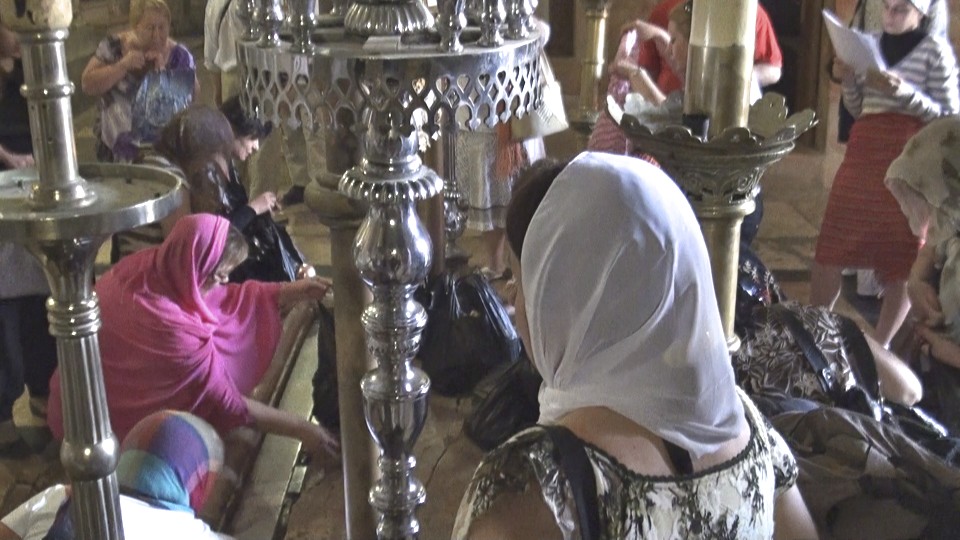
I spent today at the Church of the Holy Sepulcher, watching the crowds pile into the dark church and sat for some time in “Adam’s Cave” next to Calvary on a bench looking at the exposed rock where the crucifixion took place.  A stuffy guide came in with two Englishmen and said, “Look at that fellow over there, he’s sitting on the tomb of Baldwin 1, one of the first Crusader rulers of Jerusalem and doesn’t even know it.” I went back and looked up Jerome Murphy O’Connor who says the Greeks removed that tomb in 1809.

So much for experts.

Love Poured Out

Jn 12:1-11
Six days before Passover Jesus came to Bethany,
where Lazarus was, whom Jesus had raised from the dead.
They gave a dinner for him there, and Martha served,
while Lazarus was one of those reclining at table with him.
Mary took a liter of costly perfumed oil
made from genuine aromatic nard
and anointed the feet of Jesus and dried them with her hair;
the house was filled with the fragrance of the oil.
Then Judas the Iscariot, one of his disciples,
and the one who would betray him, said,
“Why was this oil not sold for three hundred days’ wages
and given to the poor?”
He said this not because he cared about the poor
but because he was a thief and held the money bag
and used to steal the contributions.
So Jesus said, “Leave her alone.
Let her keep this for the day of my burial.
You always have the poor with you, but you do not always have me.”

The large crowd of the Jews found out that he was there and came,
not only because of him, but also to see Lazarus,
whom he had raised from the dead.
And the chief priests plotted to kill Lazarus too,
because many of the Jews were turning away
and believing in Jesus because of him.

Monday, Holy Week

A gift of life leads to a sentence of death. We’re called to a meal in Bethany by these verses of John’s gospel. It follows the resurrection of Lazarus and is given to honor Jesus by his friends. It will be the last meal the gospel records before the Passover supper he will eat with his disciples.

Faithful Martha serves it; Lazarus newly alive, is at the table. But the one who draws our attention most is Mary, their sister. Sensing what is to come, she kneels before Jesus to anoint his feet with precious oil and dry them with her hair. “And the house was filled with the fragrance of the oil.”

The precious oil that fills the house is an effusive sign of her love and gratitude; it also signifies an anointing of Jesus for his burial.

Only in passing does the gospel mention the evil in play that will bring Jesus to his death. Judas, one of his own disciples, “the one who would betray him” complains that the anointing is a waste, but his voice is silenced. This is a time for believers to pay tribute to the one they love.

How fitting to begin Holy Week with this gospel! This week we recall the events that lead to the crucifixion, death and resurrection of Jesus. These events are surrounded by mysteries too many to name. But we don’t have to name them all.

Like Mary, we kneel and pour out the precious oil of our love on him who brings us life by giving up his own life.