Tag Archives: Artists

Martha Revisited

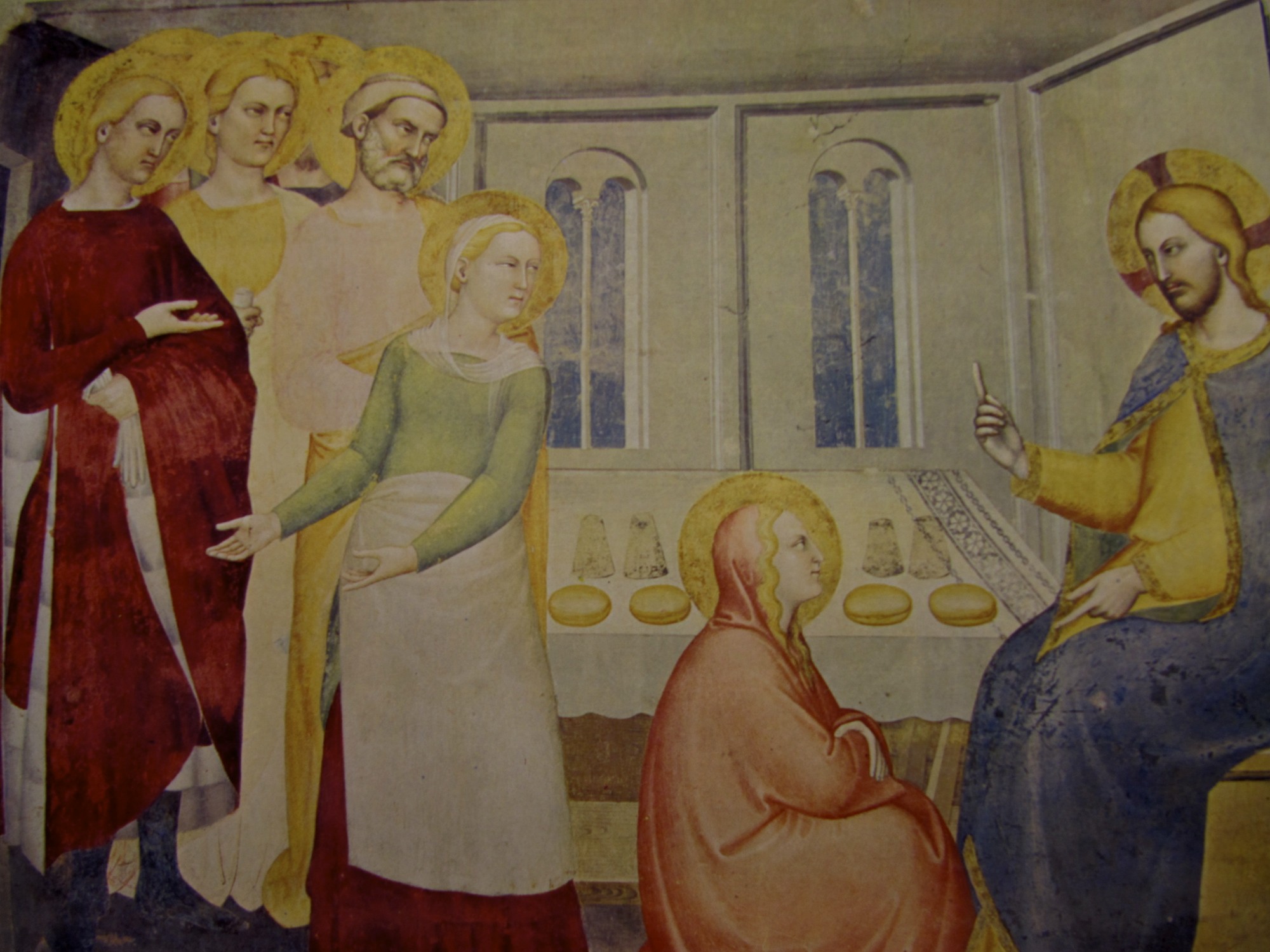
We listen to scholars who study the bible. How about artists too? Here’s  the 13th century Tuscan artist, Giovanni di Milano, looking into Luke’s gospel about  Jesus with Martha and Mary at Bethany.

The artist adds some delightful details of his own to Luke’s account. He’s let his imagination roam. The table’s set for four people. That would be Jesus, Lazarus, Mary and Martha.

But, who are those others coming in the door?  Obviously, they’re Jesus’ disciples, led by Peter. One of them gestures towards Peter, as if saying, “He told us to come.”

Poor Martha in her apron holds up her hands, “What are we going to do?”

There will be no miracle, except the miracle of Martha’s hospitality.

More than four are going to be fed.

We need to read the gospels like this too.

Almighty ever-living God, your Son was welcomed in Martha’s house as a guest, grant, we pray, that through her intercession, serving Christ faithfully in our brothers and sisters, we may be received by you in the halls of heaven.Through our Lord Jesus Christ, your Son, who lives and reigns with you in the unity of the Holy Spirit, one God, for ever and ever.

Beauty from Scraps of Things

FullSizeRender 2

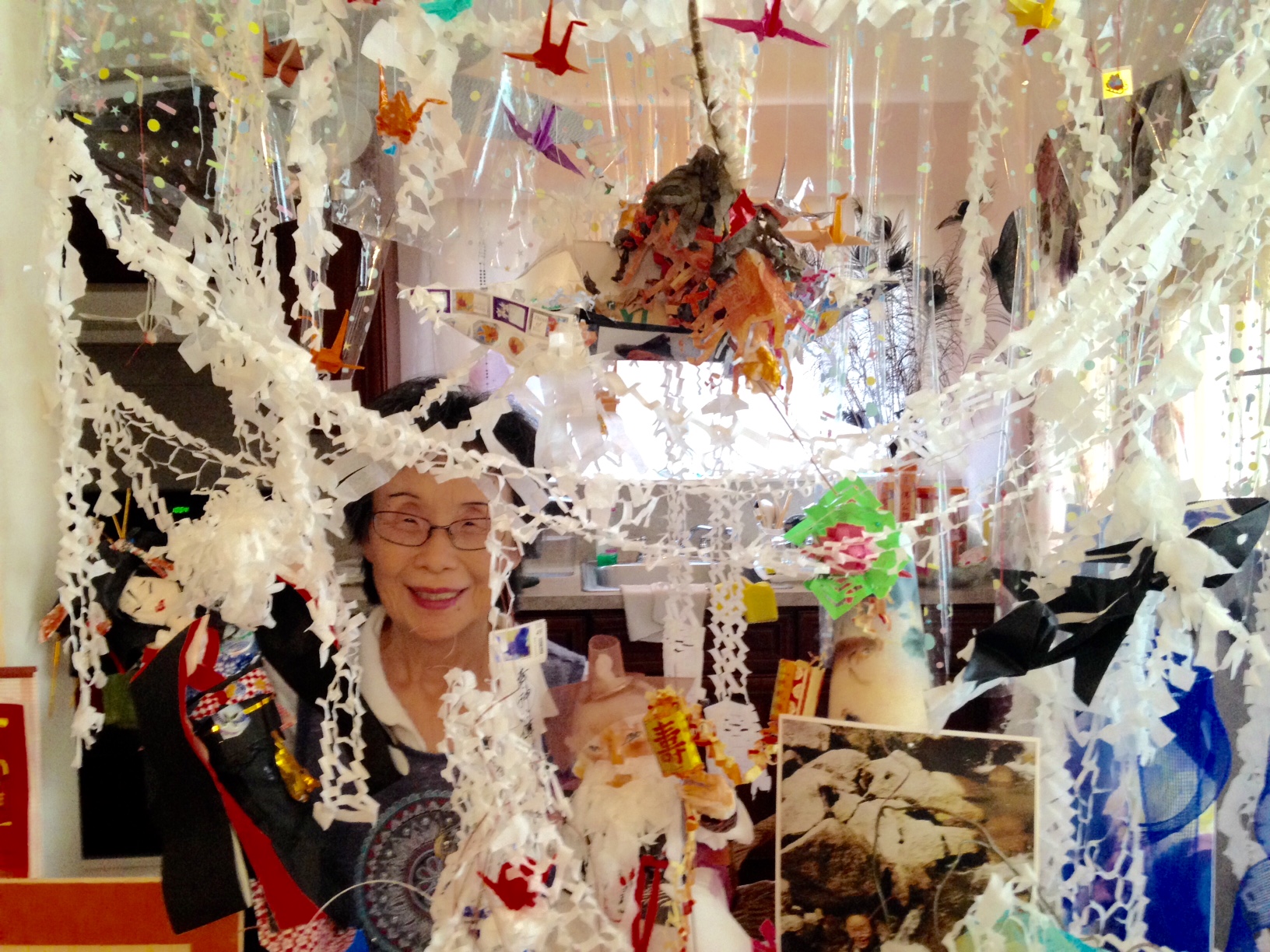
Yesterday, I visited my friend, Duk Soon Fhwang, a Korean born artist whom you see peeking out at you from her New Jersey kitchen through her wonderland of hand-crafted art. As a child  in hard times under the Japanese and then during the Korean War, her mother told her that even if you’re poor,  you can bring beauty into the world through scraps of things, pieces of paper or cardboard you find almost everywhere. 

IMG_1924

From scraps of things Duk Soon creates colorful streams, birds, flying creatures of all kind, an old man fishing. She’s blessed with a creative imagination. She sees beauty waiting in stuff others throw away.

Isn’t that a gift we all could use?

FullSizeRender 3

FullSizeRender

Questions About God


At a wedding banquet some years ago, a little girl named Chelsea, a flower girl at the wedding, came up and asked if I wanted to see her walk on her heels. And she proceeded to show me how well she could do it.

Then she leaned over and said. “ Could I ask you something?’” I said “Sure.” She said “ What was God doing about a million years ago?”

Well, I had to think for a while about that. Then I said something like  “A million years ago, God was taking care of the sun in the sky, so that it could shine bright every day. And God was counting all the stars. God was making sure there were enough animals around, like giraffes.  About a million years ago, God was taking care of the world and everybody in it, and loved doing it.”

Children ask the best questions, questions that make us think about things we take for granted or maybe we’ve stopped wondering about. Or worse, we may think we know all the answers.

Some of the questions Jesus was asked are like that. “What does God want us to do?” Jesus is asked in today’s gospel. He answered; “God wants you to love him with all your heart, and all your  mind, and all your soul. And he wants you to love your neighbor as yourself.”

A curious child wouldn’t let it go at that. “What does loving God with all your heart, and all your mind and all your soul mean?” “How do you do that?” “”What’s does loving your neighbor like yourself mean?” “Who is my neighbor anyway?”

We should never stop asking those questions either. Questions about God and about love are big questions that open the windows of our minds to a bigger world and the way we live in it. They can make us grow.

I suppose that’s why Jesus told us that only by becoming a child will we enter the kingdom of heaven. Don’t lose the sense of wonder a child has. Don’t lose the curiosity of a child. Don’t lose the imagination of a child.

I think this is true especially in religious matters. “ I believe in God, the Father Almighty, Creator of heaven and earth.” What does that mean? “I believe in the communion of saints, the forgiveness of sins, the resurrection of the body, and life everlasting.” What does that mean?

We need a childlike curiosity and imagination when we approach stories from scripture. My last blog was about an artist who tells the story of Martha and Mary and Jesus in Bethany. He had a wonderful childlike imagination. Take a look at the way at the way he tells that great story.

God meets us through the Word made flesh, Jesus Christ. It’s a wonderful story. Let’s not make it too small or forget it.
Secular Pilgrims

A few days ago at the Vatican with Fr. Franz  I was fortunate to find a book at the Pauline bookstore that had material I’ve been looking for here in Rome. Happily, it was cheap. (8 Euros, on sale)  An Italian book “Viaggio at Roma e nella sua compangna: Pittori e letterati alla scoperta del paesaggio e della magiche atmosfere di un mondo perduto,Roma, 2007”

The book is about secular pilgrims to Rome and its surrounding areas: writers and artists who found inspiration in this ancient world. It’s a big, heavy book of 527 pages; I don’t know yet how I’m going to carry it home. A computer’s one thing, books are another.

The book is filled with pictures painted all the way back to the 16th century and notes about the artists who painted them. Besides religious pilgrims, secular pilgrims have long been attracted to Rome. “We’re all pilgrims looking for Italy,” Goethe said. “We find here something we have lost,” the English poet Samuel Rogers wrote to his friend Lord Byron. So many of them were touched by the ruins of this city.

The book’s author says the artists and writers furnish us today with a “multi-media” look at those times, and that’s precisely what I was looking for.

I’m searching for the secular background of some of our Passionist saints, like St. Paul of the Cross and Vincent Strambi, saints of the 18th and 19th century. This book helps.

We tend to put saints like them into a spiritual world, or a church world, but in reality they also walked in the world painted by the artists mentioned in this book. Besides their links to heaven, they walked on earth.

Some days ago, I was at the shrine of Maria Goretti in Nettuno, and there found some historical pictures of peasant families and how they lived in the poverty-stricken countryside where she lived in the last century. Those pictures were more moving and informative than any holy card I’ve seen of the saint.

Besides holy cards, we need a better appreciation of earthly wisdom and spirituality of the saints and the ground on which they walked.