Tag Archives: Advent

Advent: The Season of Joy

Watch! 1st Sunday of Advent

To listen to the audio for today’s homily please select file below:

Every once in awhile I watch Jeopardy on television. At one point the host poses a question and waits a few seconds for a contestant to get the answer. Here’s my question. What’s the last of the seven capital sins?

If you got the answer, Sloth, you’re right. Sloth is the last of the capital sins and that’s where you would expect to find it, at the end of the list. It’s sleeping there, because that’s what sloth is. It’s laziness; it’s complacency. It can be spiritual or intellectual or physical laziness or complacency. It could be one or all of them together.

The passage in St. Mark’s gospel we’re reading today begins on the Mount of Olives. Jesus and his disciples have just visited the temple in the city of Jerusalem and one of his disciples points out the majestic  temple across the Kidron Valley.  “Look, teacher, what stones and what buildings!” Jesus said to him, “Do you see these great buildings? There will not be one stone left upon another that will not be thrown down.”

Can we hear complacency in the disciple’s voice. “ We have everything here, a great place, what more could we want.” Sloth is complacency in that it thinks there nothing more to do; we’ve made it and we don’t need anything more. The Advent season warns us about complacency.

You can see laziness,too, another characteristic of sloth, in the servants Jesus mentions in today’s gospel. The Master goes away and they seem to breathe a sigh of relief. “He’s gone, now we can do whatever we want. We can take it easy.”

The message we hear at the beginning of Advent is the same message Jesus spoke to his disciples on the Mount of Olives. “Watch! Stay awake!” You don’t know when I will knock on your door.

Our first reading  today from the Prophet Isaiah is filled with similar warnings  about not paying attention to God. You’re like dirty rags, withered leaves, he says to them. You’ve become like mud, hard clay that stuck and hardened in place. You need a potter to come along and water the hardness in you and mold you again. You need the potter’s hands to soften you and give you new life.

That’s what the Advent season is about. We asking God to awaken us from complacency, from  laziness, from sloth. The psalm response in our today’s liturgy sums up that prayer so beautifully.

“Lord, make us turn to you, let us see your face and we shall be saved.”

What is the face of God we are to turn to  in this season? It’s the face of Jesus Christ, first as a child, born in Bethlehem. Then as a man, who speaks God’s words to us, who reaches into our lives and shares our sufferings. Then, as our Risen Lord whom we hope to see and who promises us life everlasting.

Advent, the season we begin today, is filled with the grace of God. Let’s watch for it.


Be Prepared

virgins 1
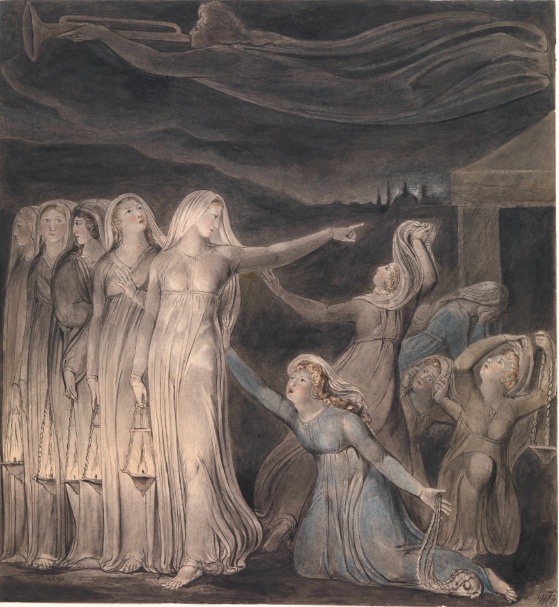
Some visual meditations from the Metropolitan Museum in New York recently caught my eye. One of them “Be Prepared,” by Constance McPhee is based on a drawing of the Wise and Foolish Virgins by William Blake and seems made for Advent. You may want to take a look.

So many visual presentations in the media today give a few seconds at most to something before they’re off to the next image. No time to linger over something. Guess that’s part of our hurry through life today.

Anyway, I like this:

http://82nd-and-fifth.metmuseum.org/be-prepared

The Road Through the Wilderness

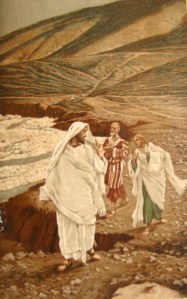
Sometimes the best view you get of the world is from above. Here’s a picture taken from a plane in the 1930s or so of the road up to Jerusalem from Jericho and the Jordan Valley. I add another from the ground of the road outside Jericho from more recent times.


Jericho Rd  3

Jericho road modern


Both pictures tell us the road to Jerusalem is a climbing, winding road. It wasn’t easy to take when prophets like Isaiah and John the Baptist knew it. Of course today it’s easily managed by car or bus. But in those days, walking or on a donkey, you didn’t always know what to expect when you went through deserts and mountains and some fertile areas where crops were grown.

Isaiah and John the Baptist knew this road very well and they used it to explain our way to God. First, it’s an image that says life will never be easy.  On that road you’re going to get hungry, tired, even wonder whether you will make it or not. Unexpected things can happen: you may get robbed like the man did in the parable of the Good Samaritan. That happened on the road up from Jericho to Jerusalem, remember. You might be blind, like the two blind men from Jericho who couldn’t find their way.

But if you want to get to Jerusalem and enter the house of God, you have to take that road. Jesus took it when he went up to the Holy City. He began in the wilderness.

The message of Isaiah and John the Baptist, so beautifully expressed in our first reading for today (Isaiah 35,1-10), is that God will bring us there.

Keeping Awake

sf-efrem-sirul
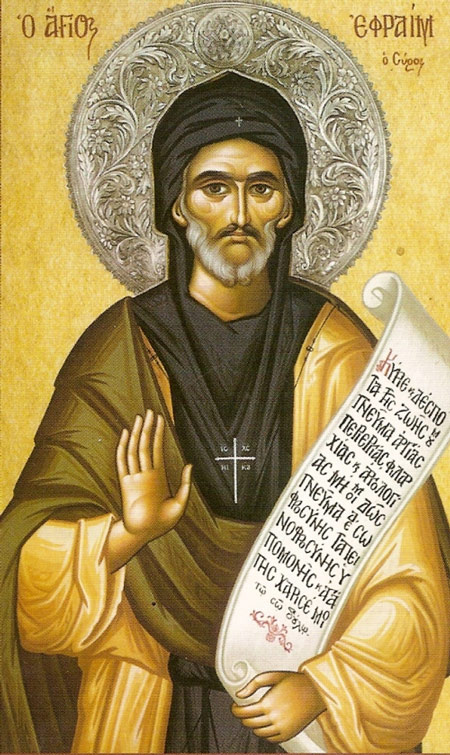
Keeping awake is one of the themes for Advent. St. Ephrem the Syrian, a voice from the early 4th century, offers some insights into the sleep we need to fear.

“To prevent his disciples from asking the time of his coming, Christ said: About that hour no one knows, neither the angels nor the Son. It is not for you to know times or moments. He has kept those things hidden so that we may keep watch..

Keep watch; when the body is asleep nature takes control of us, and what is done is not done by our will but by force, by the impulse of nature. When deep listlessness takes possession of the soul, for example, faint-heartedness or melancholy, the enemy overpowers it and makes it do what it does not will. The force of nature, the enemy of the soul, is in control.

When the Lord commanded us to be vigilant, he meant vigilance in both parts of man: in the body, against the tendency to sleep; in the soul, against lethargy and timidity. As Scripture says: Wake up, you just, and I have risen, and am still with you; and again, Do not lose heart. Therefore, having this ministry, we do not lose heart.

Black Friday and Christmas

photo
Now that Black Friday is over maybe we can get down to thinking about Christmas. For four weeks we prepare for that feast in the season of Advent.

The best place to look for the meaning of Christmas is the scriptural readings for these next four weeks. A timely source I suggest we add to them is the recent Apostolic Exhortation of Pope Francis, “The Joy of the Gospel.”

The Old Testament readings for today and all through the 1st Week of Advent are from Isaiah. Even if you can’t get to Mass, take a look at them, they make wonderful readings for Advent.

Isaiah promises salvation for all people, and one of his favorite images to describe God’s promise is found in this Sunday’s reading: Isaiah 2:1-5. All nations will stream to God’s mountain for instruction. “They will beat their swords into plowshares and their spears into pruning hooks.” Wars are no more; a fragmented humanity becomes one.

Quite a claim, considering that Assyrian armies were laying waste the towns and cities of Israel and Judea as Isaiah spoke. But God’s promise trumps all human conquests.

For Isaiah, the mountain of the Lord is Jerusalem, on which the Jewish temple is built. All nations will come there; they will be fed a rich banquet (Wednesday), the poor will be welcomed there (Thursday), the blind will see there (Friday); it’s the rock where people will dwell safely, where children play around the cobra’s den, and the lion and the lamb lie down together (Tuesday). The prophet’s imagery in these readings is strikingly beautiful.

The Gospels for the 1st week point to the fulfillment of the Isaian prophecies in Jesus Christ. The Roman centurion humbly approaching Jesus in Capernaum represents all the nations that will come to him. (Monday) Jesus praises the childlike, who will enter the kingdom of heaven. (Tuesday) He feeds a multitude on the mountain.(Wednesday) He affirms that his kingdom will be built on rock. (Thursday) He gives sight to the blind. (Friday)

Remember, too, that Matthew’s gospel, source of many of our Advent readings, portrays Jesus teaching on a mountain (Isaiah’s favorite symbol) and working great miracles there that benefit all who come. He is the new temple, the new Presence of God, Emmanuel, God with us.

Prophets like Isaiah were brave people, brave enough to speak when all seemed lost. They’re strong people, strong enough to hope when hope seems gone. And something of that prophetic spirit is in Pope Francis, I believe, who last week issued an important exhortation to the church.

He says that we can’t bring the gospel to the world if we don’t know what our world needs. We can’t bring greater human life to our world if we don’t realize what disfigures human dignity now.

What disfigures human dignity today is social inequality. Money had become our god. He speaks of the “tyranny of the financial markets.” We pay attention to a 2% drop in the stock market and ignore the death of a homeless man who dies in the cold. We’re a throw-away society. Not only do we discard things, we discard people. We tend to exploit immigrants and then throw them away. We ignore the economically unproductive, who may be without jobs or skills or socially deprived through sickness or being displaced.

The pope’s message is a hard-hitting restatement of traditional Catholic social teaching. It’s interesting to see a papal document quoted so freely on Tweeter, Facebook and the social media. It’s because he’s touched on something we need to hear.

The front page of the Asbury Park Press this morning seemed to echo the picture the pope painted in his recent address. There’s the big picture of smiling shoppers fresh from the stores on Black Friday holding their precious treasures. Next to it is a story of a homeless man who died in the cold yesterday.

No picture of him at all.
Spiritual Childhood

peaceable kingdom copy

This evening at the Catholic Chapel at Dover Air Force Base I spoke on spiritual childhood, an important part of the spirituality of Advent and Christmas. “Unless you become like a little child, you cannot enter the kingdom of heaven,” Jesus said. Isaiah saw a child at the center of the Peaceable Kingdom.

In the short catechesis as our service began, I recommended the bible as a way to know Jesus Christ as a teacher of faith and prayer. I like the New American Bible, Revised Edition (NABRE) because it’s the version we use in our liturgy and it’s got great notes. Its recent revision takes into account newly discovered biblical manuscripts, the latest archeological finds and historical and biblical scholarship.

The New Jerusalem Bible and the RSVP translations are also good.

Many still use the King James version of the bible, one of the great literary treasures of the English language, but it has drawbacks. It hasn’t benefited from the advances in biblical scholarship that have taken place since its creation in the 16th century.

According to a recent survey of Catholics in England, most English Catholics still don’t read the bible much; usually they only know it from Mass on Sundays. That’s also true here in the United States, I think.

It’s important that we take our direction from the 2nd Vatican Council which sees the bible at the heart of our spirituality and a bridge to better relationships with other Christian churches.

Pope Benedict offers a fine example of how to use the bible in his three volumes entitled Jesus of Nazareth. His last volume, on the infancy narratives, was just published before Christmas.

I spoke in my main presentation about the spirituality of childhood, reflecting on a description given by St. Leo the Great. To be a child means to be free from crippling anxieties, forgetful of injuries, sociable and wondering before all things.

2nd Sunday of Advent

We’re reading from the Gospel of Luke today. He plays a major role in the season of Advent. All this year, in fact, we’ll be reading from Luke’s Gospel on Sundays.

When you read Luke, notice especially his thrust towards the world beyond Judaism. Though he repeats most of the stories about Jesus found in the gospels of Mark and Matthew, Luke emphasizes the universal message of Jesus. His gospel is meant for everybody.

In Luke’s gospel, for example, old Simeon in the temple predicts the Child will be a “light of revelation to the gentiles.” ( Luke 2, 32) “All flesh shall see the salvation of our God,” John the Baptist says to today’s gospel. (Luke 3,6) Outsiders like Namaan the Syrian and the widow of Zareptha will accept his gospel rather than his neighbors, Jesus says in the synagogue at Nazareth. (Luke 4,17 ff) After his resurrection Jesus tells his disciples “A message of repentance and forgiveness would be preached to all nations.” (Luke 24,47)

Luke further emphasizes that the Christian message is good for this world. It brings life. The Acts of the Apostles, Luke’s sequel to his gospel, tells of the beneficial spread of the gospel from Jerusalem to Rome, “the ends of the earth.”

In today’s gospel for the 2nd Sunday of Advent you can see the evangelist’s universal thrust. He introduces John the Baptist by a list of impressive world leaders:  Tiberius Caesar, Pontius Pilate, Herod Antipas and Philip, the sons of Herod the Great, and the Jewish priests Anna and Caiaphas– all significant figures, and most strong opponents of Jesus.

They represent the power structure of the day, but Luke is not interested in their stories. He would have us recognize the real power in this world: Jesus and John.

How insignificant John the Baptist seems compared to an emperor and Roman governor, other powerful rulers and priests. Unkempt in appearance and in ragged clothes, John looks like a nobody as he preaches to travelers near the Jordan River, on the road to Jerusalem. What power does he have? Luke answers simply, “The word of God came to John the son of Zechariah in the desert.” The word of God empowered him.

The gospels invite us to see ourselves and our world in the stories they tell. What can we see in this gospel?

Does Luke remind us that Jesus is more important than anyone else in this world, even ourselves? Keep before your eyes the One who is far more important, far more wise, far better than any celebrity or anyone famous. Look for the One who in the manger and on a cross. God is present and powerful there.

We are meant to bring our gifts to this world. Our time and place wait for the goodness of the gospel, and who will bring it but us?  I mentioned earlier that Luke’s gospel says Jesus’ message is meant for everybody. Do we really believe that, or are we losing our belief that Jesus Christ belongs in everyone’s life?

John the Baptist in the desert seems to have nothing. But he has the word of God, a word he preached and lived.  Isn’t that enough?

Friday, First Week of Advent

  Readings:

Isaiah 29:17-24:  The deaf shall hear and the blind shall see.

Matthew 9:27-31:  Jesus gives two blind men sight.

Two blind men are among the many healed by Jesus in Matthew’s gospel. They’re healed together and they represent the blind who will see when the Messiah comes, Isaiah says.

Notice there are two of them, not one. Do the two blind men represent a collective blindness, a group blindness, perhaps a group prejudice against certain people, or a way of thinking that distorts how others are seen? Is it more than    physical blindness they share?  The cures Jesus worked touched more than the ills of body.

When John Newton, the former 18th century captain of an African slave ship, wrote the famous hymn “Amazing grace,” he said he “was blind, but now I see.” It wasn’t physical blindness he described. The tough seaman was converted on a voyage after reading Thomas a Kempis’ “The Imitation of Christ,” and gradually came to see the horrific evil of slavery as well as other vices he had fallen into.

In 1788 after years of debate over the issue in England, Prime Minister William Pitt formed a committee to investigate the slave trade which, until then, was largely seen by the nation as good for their country’s economic welfare. One of its star witnesses was John Newton who described in detail the slave trade and the horrendous practice it was.

This advent may Jesus bring light to our world, our nation, and our church. There are many things we don’t see.

What do you think they are?

Come and See

There’s not much said about the apostles in the New Testament; they walk in the shadow of Jesus. Because of that, we have only a few details about Andrew, the brother of Peter, whose feast is today.

One detail is his name, Andrew, a Greek name, which may be due to the fact that the area around the Sea of Galilee was multi-cultural and Jewish families sometimes took gentile names.  His family was from Bethsaida where a lot of trade went on. Did Andrew speak some Greek?

Maybe he did, because later in John’s gospel he and Philip bring some Greek pilgrims to Jesus before his death. Jesus sees their coming as a sign of his approaching passion and glorification and he rejoices. (John 12, 20-28) We have to be careful of seeing Jesus’ apostles as poor uneducated fishermen, not likely to get along in a bigger world.

Andrew must have been religious. Early in John’s gospel, he’s described as a disciple of John the Baptist who points Jesus out to him. Jesus then invites Andrew and another disciple to stay for a day with him. “Come and see.” Afterwards, Andrew “found his brother Simon and said to him ‘We have found the Messiah.’” (John 1,35-41)

The Greek Church honors Andrew as its patron and considers him the first apostle because he was the first to see Jesus and follow him; then he called his brother. Tradition says Andrew was crucified on the beach at Patras in Greece and during his martyrdom extolled the mystery of the Cross of Jesus. He’s also the patron of Russia and Scotland.

A number of saints and feasts are celebrated during Advent. Certainly, saints like Andrew belong in our celebration of the Incarnation.  Jesus, the Incarnate Word, drew people to himself who, in turn, drew others. His grace can’t be contained.

“Come and see,” Andrew says.