St. Luke’s account of the Annunciation to Mary, read today at Mass, follows the announcement of the birth of John to Zechariah in yesterday’s advent readings. Mary responds to the angel so differently than the priest Zechariah. (Luke 1, 5-25,)
In the temple where great mysteries are celebrated, the priest won’t believe he and his wife can conceive a child. They’re too old. He doubts.
In Nazareth, an unlikely place for a great revelation, the angel approaches Mary with a message far more difficult to grasp. “ The Holy Spirit will come upon you and the power of the Most High will overshadow you. Therefore the child to be born will be called holy, the Son of God.”
Mary believes and does not doubt and by God’s power conceives a Son who will be born in Bethlehem. “Behold, the handmaid of the Lord, be it done to me according to your word,”
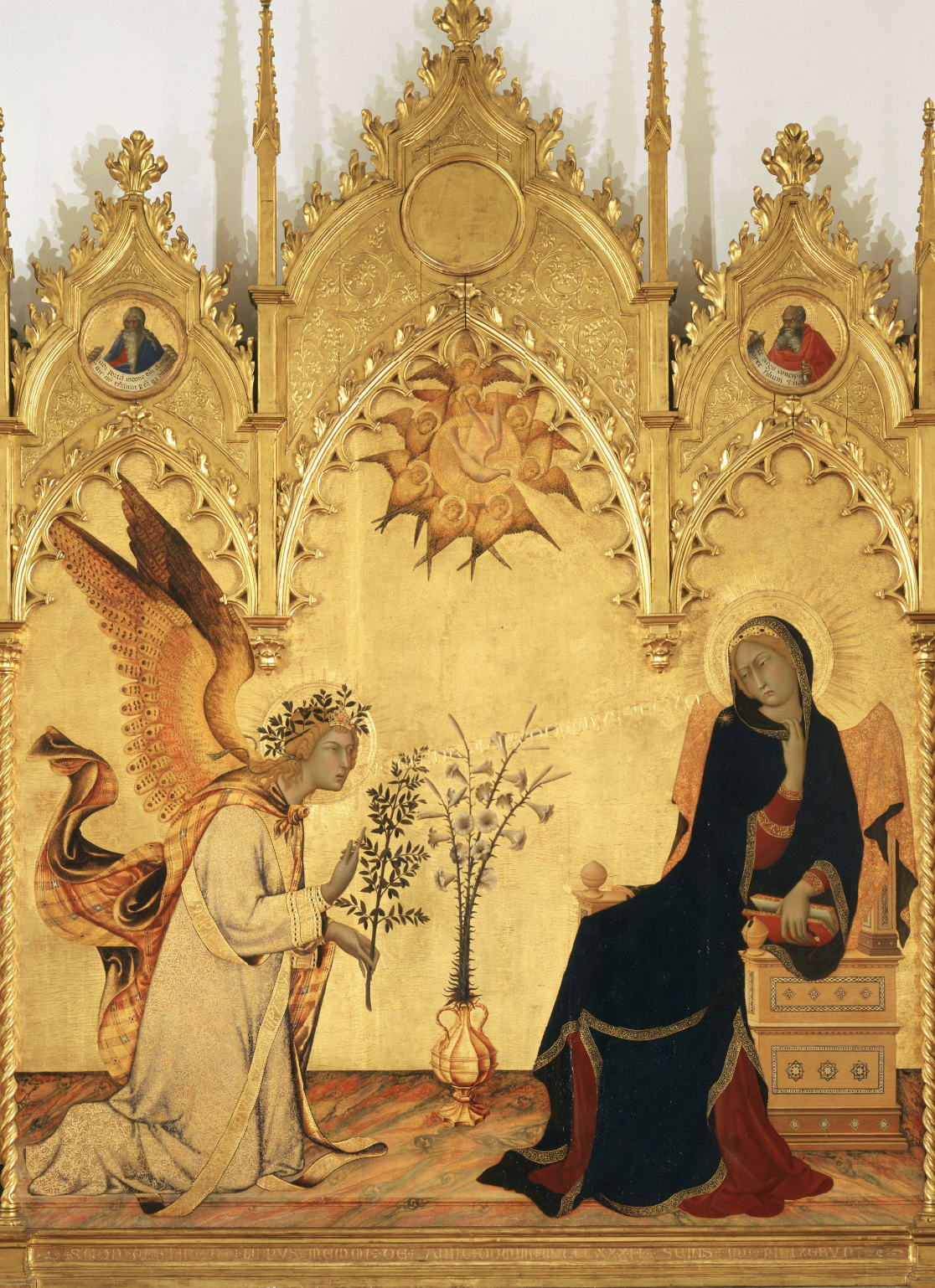
This is a golden moment, the 13th century painting above by Simone Martini and Lippo Memmi indicates. Mary is at home in prayer when the angel comes. Prayer enables her to believe and accept what is revealed. That’s true for all of us: prayer helps us discern and say yes to what God reveals.
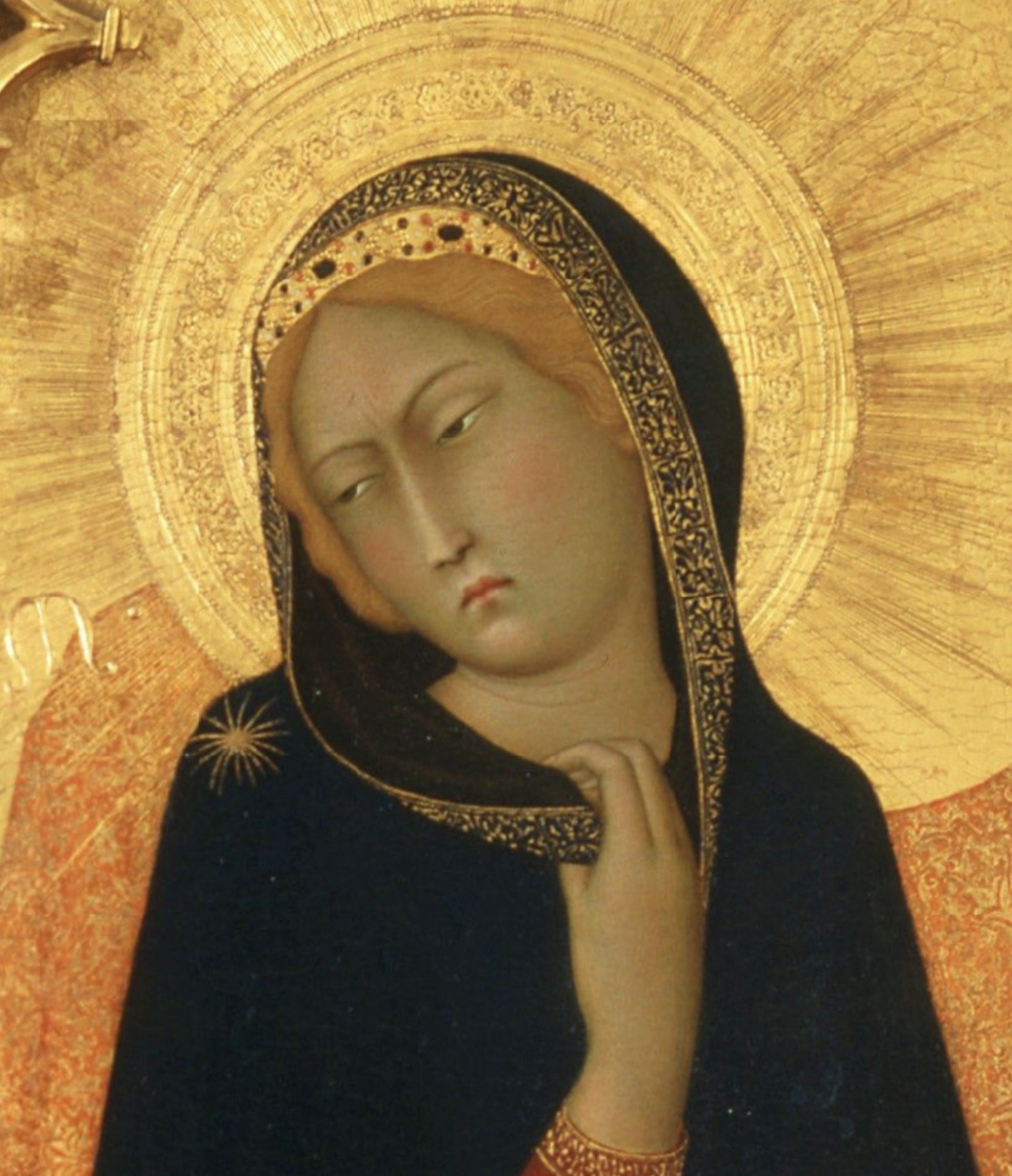
“How can this be. I do not know man?” Mary says to the angel. Our painting seems to capture that moment in our gospel passage, but Mary will go on to respond in faith, “Be it done to me according to your word.” Mary is a woman of faith; we learn from her.
Today we pray:
O Flower of Jesse’s stem, you have been raised as a sign for all peoples; kings stand silent in your presence; the nations bow down in worship before you. Come, let nothing keep you from coming to our aid.
From December 17th until Christmas, we read from the infancy narratives of Matthew and Luke to prepare for the Christmas feast.
Matthew’s genealogy of Jesus Christ traces his ancestry as “the son of David and the son of Abraham.” Descended from Abraham Jesus fulfilled the promise God made to the patriarch: “in your descendants all nations would be blessed.” Matthew ends his genealogy with “Joseph, the husband of Mary. Of her was born Jesus who is called the Messiah. ” In our portrayal above Mary points to Joseph as the one who can explain it to us all.
Matthew’s genealogy offers a Messiah whom Jew and Gentile can claim for their Savior. His ancestors reach beyond Palestine; his roots are worldwide. He’s not just a Jewish Messiah in Matthew’s listing either. His bloodline includes women like Tamar, Ruth and Bathsheba– foreigners and even women with questionable backgrounds.
In his humanity, Jesus didn’t come from perfect ancestors or untainted Jewish royalty ; he’s rooted in all humanity. His bloodline includes saints and sinners; he comes from a line of sinners and some saints. He shares our human DNA.
Matthew obviously wants us to look at Jesus’ family tree and see it as our own. We’re at home there. The Tree of Jesse, based on Matthew’s genealogy was a favorite subject for medieval artists working on illuminated manuscripts or creating stained glass windows for churches. A great way to see the humanity of Jesus Christ.
Luke’s genealogy goes further and brings Jesus beyond Abraham to Adam. He becomes the new Adam. We are born from his side, we share his blood; he is the first born of many like us. So we pray:
“O God, Creator and Redeemer of human nature…your Only Begotten Son, having taken to himself our humanity, may you be pleased to grant us a share in his divinity.” (Collect)
O Wisdom of our God Most High, guiding creation with power and love: come to teach us the path of knowledge!
The Gospel of Luke is our principal guide through the final days of Advent till the feast of Christmas. These days are our “novena” preparing for the mystery of Christmas.
December 17th and December 18th we read Matthew’s genealogy of Jesus and his account of Jesus’ birth.
December 19 The angel’s announcement to Zechariah the priest about the birth of John the Baptist. (Luke 1: 5-26)
December 20. The angel announces to Mary that she will bring “the Son of God” into the world. (Luke 26-38)
December 21. Mary visits her cousin Elizabeth to share this Good News. ( Luke 1:39-45 )
December 22. The 4th Sunday of Advent. The gospel account of Mary’s visit to Elizabeth is repeated. ( Luke 1:46-56)
December 23. Elizabeth gives birth to John, who will announce the coming of Jesus: (Luke 1:57-66)
December 24. Zechariah praises God’s compassion towards those who “dwell in darkness and the shadow of death.” (Luke 1:67-79.)
December 25Christmas. The evening readings for Christmas are:
Isaiah 9: 1-6
Timothy 2:11-14
Luke 2:1-14, The story of the Birth of Jesus Christ
Old Testament readings add their voice to the gospel accounts. A number of stories, like the unpredictable births of Sampson and Samuel accompany the story of the birth of John the Baptist and Jesus. They remind us that “nothing is impossible with God.” The prayers in Advent speak too of the gentle rain that makes the earth fertile and the numerous “miracles” found in the ordinary course of nature. From the created world we can gain a sense of wonder for this great wonder of God.
Our readings are stories of belief and doubt. Isaiah offers King Ahaz, the consummate doubter and cold calculator on December 20. He was mentioned on Wednesday mornings at morning prayer each week of Advent. Ahaz stands in contrast to Mary, who believes and accepts the angel’s promise. She wonders “how can this be?” before this mystery of God, but she believes.
In yesterday’s first reading for Advent, Second Isaiah repeats to the exiles in Babylon words he hears from God: “Comfort, give comfort to my people, says your God.” In today’s gospel reading Jesus says:“Come to me, all you who labor and are burdened, and I will refresh you.” A favorite reading for so many of us.
Notice Jesus speaks to the “crowds” in Matthew’s gospel, not just to the disciples who know him, or the Jewish Christian church Matthew wrote for at the end of the first century. God’s love and God’s promises reach far beyond the circle of disciples or the church. Jesus Christ came to refresh the world that labors and is burdened, even if it doesn’t know him.
Second Isaiah in today’s readings appeals to Jewish exiles to remember the eternal God, creator of the ends of the earth. Do not to abandon God for the Babylon’s gods who are too small, he tells them and us all.
“To whom can you liken me as an equal? says the Holy One… Do you not know or have you not heard? The LORD is the eternal God, creator of the ends of the earth. He does not faint nor grow weary, and his knowledge is beyond scrutiny.”
God still holds us in his hands, sustains and comforts us, even if we do not know him or seem to care. God’s Spirit does not faint or grow weary
St. Bernard says there are three comings of Jesus Christ, who is our rock, our support, our comfort.
“We know that the coming of the Lord is threefold: the third coming is between the other two and it is not visible in the way they are. At his first coming the Lord was seen on earth and lived among men, who saw him and hated him. At his last coming All flesh shall see the salvation of our God, and They shall look on him whom they have pierced. In the middle, the hidden coming, only the chosen see him, and they see him within themselves; and so their souls are saved. The first coming was in flesh and weakness, the middle coming is in spirit and power, and the final coming will be in glory and majesty.
“This middle coming is like a road that leads from the first coming to the last. At the first, Christ was our redemption; at the last, he will become manifest as our life; but in this middle way he is our rest and our consolation.
“If you think that I am inventing what I am saying about the middle coming, listen to the Lord himself: If anyone loves me, he will keep my words, and the Father will love him, and we shall come to him. Elsewhere I have read: Whoever fears the Lord does good things. – but I think that what was said about whoever loves him was more important: that whoever loves him will keep his words. Where are these words to be kept? In the heart certainly, as the Prophet says I have hidden your sayings in my heart so that I do not sin against you. Keep the word of God in that way: Blessed are those who keep it. Let it penetrate deep into the core of your soul and then flow out again in your feelings and the way you behave; because if you feed your soul well it will grow and rejoice.
Isaiah 26:1-6: On the day of the Lord those who depend on God will enter God’s city.
Matthew 7: 21-24-27: Build your house on rock.
Ancient peoples built their cities on rocky heights because they promised safety. With water, food and strong defenses they were less likely to be invaded. That’s why the Jews chose Jerusalem. Built high on a rocky mountain, it was safe.
There’s a city on God’s holy mountain, Isaiah says in today’s reading, where all peoples will dwell. Yet even now, our cities and places where we live are meant to be an image of the Holy City. Don’t depend on natural resources or human skills or human planning alone to build your earthly cities, the prophets warn. Don’t rely on them; they can’t save you. The strongest city becomes “a city of chaos” without God.
God builds the strong city, the prophet says; he is our Rock, our strong city: he admits through its gates “ a nation that is just; one that keeps faith.”
Build your lives on rock, Jesus says in the gospel. Don’t rely on a token faith (Lord, Lord) or be like fools who build on sand .
“Everyone who listens to these words of mine and acts on them will be like a wise person who built a house on rock.”
That’s true for our homes and the cities and places where we live.
A secular society like ours often sees religion as a destructive force or a brake on progress or something to be dispensed of. It turns to “human reason” alone.
So how do we see our cities and countries today? Should be turn away from them and wait for the City on the Mountain? Time to wait for the right politician or a better economy, and take care of yourself?
I don’t think that’s the answer we get in this Season of Advent which proclaims the coming of Jesus Christ in the flesh to an earthly city.
“It is better to take refuge in the LORD, than to trust in man. It is better to take refuge in the LORD than to trust in princes.” (Psalm 118)
“The calf and the young lion shall browse together, with a little child to guide them. A shoot shall sprout from the stump of Jesse, and from his roots a bud shall blossom.” (Isaiah 11,1)
A child stands atop Isaiah’s peaceable kingdom in Tuesday’s first reading at Mass. Edward Hicks, the Quaker painter, made over 100 copies of this scene from Isaiah, carefully indicating in the far left the peace treaty between William Penn and the native peoples of Pennsylvania in colonial America.
It takes a child to believe the astounding promises Isaiah makes. Adults, hardened by the experience of life, struggle with the prophet’s words. That’s why Advent invites us to become children, not physically, of course, but spiritually.
Become like little children. That’s what Jesus told his followers, and he praised the childlike:
“I give you praise, Father, Lord of heaven and earth, for although you have hidden these things from the wise and the learned, you have revealed them to the childlike.” Luke 10
Only the childlike believe in great promises.
What does being “childlike” mean? Here’s what St. Leo the Great said about Jesus’s teaching on spiritual childhood: To be a child means to be “free from crippling anxiety, to be forgetful of injuries, to be sociable and to keep wondering at all things.”
A little child in its mother’s arms has no worries. It’s a good place to be, free from anxieties and a mother’s voice promising all will be well. Advent brings that grace back to us; a grace we can lose so easily.
Jesus experienced that grace in Mary’s arms. Herod’s soldiers, like Isaiah’s Assyrian armies, were on their way. It’s a poor place where he’s born, no room in the inn, but the Child in his mother’s arms has no fear. All will be well.
Injuries come. The world can turn hostile. The promises may seem far away, but from infancy to his death, Jesus knew he was a child of God, his Father, in God’s caring hands and destined for God’s kingdom.
Wikipedia’s article on Advent offers a description about how Christian denominations– Catholic, Anglican, Lutheran, Presbyterian, Methodist– approach the feast of Christmas, through devotional prayers and practices like the Advent wreath, the Christmas tree, musical performances like the Nine Lessons of Carols and Handel’s Messiah. Purple is the color of the season in most of these churches, blue in the Scandinavian countries.
The Wikipedia article features the devotions of Advent. Little is said ofGreek church’s Nativity Fast or the Roman Catholic liturgy of Advent. The Catholic liturgy of Advent “remained unchanged until the Second Vatican Council introduced minor changes,” it says.
That’s not accurate. The Roman Catholic Advent liturgy underwent a major change after the Second Vatican Council. A better schedule of readings and new Eucharistic prefaces were introduced to the liturgy; morning and evening prayers and other parts of its liturgy were enhanced. The Catholic Advent liturgy is a ringing affirmation of hope.
Advent hope is nourished by the first coming of Jesus Christ, but also by the promise of his second coming. It’s hope defying human calculation or human logic – an impossible hope. A hope spelled out in the devotions like the Advent wreath and the Christmas tree, but above all proclaimed in the Advent scriptures and liturgy.
Isaiah’s oracles from 8th century Judea are heard in the first few week of Advent, They proclaim that kind of hope. Even as Assyrian armies capture and destroy his land, Isaiah sees a sign, the root of Jesse, set up before the nations.
“His dwelling shall be glorious. The wolf shall be a guest of the lamb, and the leopard shall lie down with the kid; The calf and the young lion shall browse together, with a little child to guide them. The cow and the bear shall be neighbors, together their young shall rest; the lion shall eat hay like the ox. The baby shall play by the cobra’s den, and the child lay his hand on the adder’s lair. There shall be no harm or ruin on all my holy mountain; for the earth shall be filled with knowledge of the LORD, as water covers the sea.”
Wolves and lambs, leopards and kid goats, calves and lions lie down together on God’s holy mountain. The impossible becomes possible. That’s the kind of hope we need today.
Our Christian holidays and seasons are suffering more and more from secularization and commercialization. Like Santa Claus they need to be saved. They celebrate a greater hope than human imagination dares – hope in God and the promises God offers in Jesus Christ.
Santa came to town for Macy’s annual Thanksgiving Parade. From the parade he went into the store for Black Friday and he will be there for the rest of the days till Christmas.
More than a salesman, Santa’s a saint– Saint Nicholas– and he reminds us Christmas is for giving rather than getting. His quiet giving mirrors God’s love shown in Jesus Christ.
Telling his story is one of the ways we can save Santa Claus from being captured by Macys and Walmart and all the rest. First, take a look at our version for little children, which has over 200,000 views on YouTube. How about telling that story to a real little kid you know? Wouldn’t you rather they know someone like him than the guy in the store in a red suit?
Then, you might want to go on to our modest contribution for bigger children– like us:
The Presentation of Mary in the Temple, November 21, is an ecumenical feast originatingin Jerusalem in the 6th century. A new church, honoring Mary, was built for pilgrimsby the Emperor Justinian near the ruins of the Jewish temple. Tradition said Mary was born nearby. Other early traditions place her birthplace inNazareth or the neighboring city of Sepphoris.
Artists like Giotto supported the Jerusalem tradition by their popular portrayals of Mary introduced into the temple by Ann and Joachim, her mother and father. (above)
Luke’s gospel may support the Jerusalem tradition by noting that Mary’scousin Elizabeth was married to Zechariah, a temple priest. Luke also says Mary and Joseph were familiar visitors to the temple. Forty days after the birth of Jesus , they went there “when the days were completed for their purification,” (Luke 2,22) Theybrought Jesus to the temple as a child to celebrate the feasts. For Jesus the temple is“my Father’s house.”There is no direct scriptural support that says Mary was born and raised in Jerusalem, however.
This feast celebrates Mary’s gift for “listening to the word of God and keeping it.” (Luke 11:28) For Mary the temple was always a place of God’s presence. In the temple she learned to see that God was everywhere, in Nazareth, Bethlehem, even on Calvary.(cf. John 4, 22-26) “You are the temple of God and the Spirit of God dwells in you,” St. Paul reminds the Corinthians. (1 Corinthians 3, 16)
St. Paul of the Cross, founder of the Passionists, was greatly devoted to this feast because he began his 40 day retreat to discern God’s will on this day. He experienced God’s call to found a community during those holy days. Afterwards, he dedicated the first retreat of his congregation on Monte Argentario to the Presentation of Mary and returned there year after year to renew the grace he received then. St. Vincent Strambi, his biographer, writes:
“Whenever possible, Paul kept the feast in the Retreat of the Presentation. How often, even when old and crippled, he would set out from the Retreat of St.Angelo, traveling over impassible roads in the harsh days of November, to Monte Argentario, where he would celebrate the feast with great recollection. It would be difficult to describe the days he spent there. His heart seemed to melt like wax in a fire because of his love for the Mother of God and his gratitude towards her.As the feast drew near he was so full of joy that the air around Monte Argentario seemed to breathe a sweetness similar to what the prophet Joel describes: “On that day, the mountains will drop down sweetness and the hills flow with milk.” On the day of the feast, he seems totally penetrated with tender devotion.Even on his deathbed, he recalled, “The day of the Presentation was always a holy and solemn day for me.”
Please pray for the Passionists, the community he founded that, like Mary, the Mother of God, we may hear God’s word and kept it.
Today many young people are not baptizing their children or offering them much religious formation. “Let them decide for themselves.” Introduce your children to your religious tradition from their earliest years, this feast says. Get them familiar with their church. That’s what the parents of Mary did. They prepared her for the coming of the Angel and the presence of her Son.
“Where is the temple where you learn to hear God’s word?’ we have to ask ourselves.


 The Victor's Place
