The crooked oak, the tall Norway spruce and other trees that surround us were touched with sunlight this morning. We don’t need a bell tower; they serve that purpose.
I discovered on Google books a few days ago an old study of plants and trees by Richard Folkard, Plant Lore, Legends and Lyrics, London 1884 that’s a treasure of information.
From the beginning human beings saw plants, flowers and trees as more than just things; they were involved in their lives and the stories of their religion. Folkard traces the attribution of plants, flowers and trees:
“In the dark ages the Catholic monks , who cultivated with assiduity all sorts of herbs and flowers in their monastic gardens , came in time to associate them with traditions of the Church , and to look upon them as emblems of particular saints . Aware , also , of the innate love of humanity for flowers , they selected the most popular as symbols of the Church festivals , and in time every flower became connected with some saint of the Calendar , either from blowing about the time of the saint’s day , or from being connected with him in some old legend.”
“But it was more especially upon the Virgin Mary that the early Church bestowed their floral symbolism … The poetry no less than the piety of Europe has inscribed to her the whole bloom and colouring of the fields and hedges . The choicest flowers were wrested from the classic Juno , Venus , and Diana , and from the Scandinavian Bertha and Freyja , and bestowed upon the Madonna , whilst floral offerings of every sort were laid upon her shrines . Her husband , Joseph , has allotted to him a white Campanula , which in Bologna is known as the little Staff of St. Joseph . In Tuscany the name of St. Joseph’s staff is given to the Oleander : a legend recounts that the good Joseph possessed originally only an ordinary staff , but that when the angel announced to him that he was destined to be the husband of the Virgin Mary , he became so radiant with joy , that his very staff flowered in his hand.”
“A Catholic writer complained that at the Reformation” Foukard continues, “ the very names of plants were changed in order to divert men’s minds from the least recollection of ancient Christian piety ; and a Protestant writer of the last century , bewailing the ruthless action of the Puritans in giving to the ” Queen of Beauty ” flowers named after the ” Queen of Heaven , ” says : Botany , which in ancient times was full of the Blessed Virgin Mary , is now as full of the heathen Venus . ”
The monks were good catechists, but their work today is largely ignored. There’s hardly a trace of the Catholic tradition in Wikipedia’s listings of trees and plants.
So I sent for seeds for white Campanula, the Lupine, and others I found in Foukard’s book. I hope I can tells the stories the old Catholic monks told. They’re stories that should be told.
Our gospel readings for the final weeks of Lent are taken mostly from St. John’s Gospel. Unlike the synoptic gospels which picture Jesus’ ministry occurring mainly in Galilee, John’s Gospel sees Jerusalem as the place where Jesus reveals himself. Instead of going from town to town in Galilee, Jesus goes from feast to feast in Jerusalem.
His miracles and his teaching in the temple in Jerusalem proclaim his replacement of the Jewish feasts. He is the new Sabbath. He heals a paralyzed world as he heals the paralyzed man at the pool of Bethesda on a Sabbath. (John 5: 1-18) On the Feast of Tabernacles (John 7-8 ), which supply most of our gospel readings for the 5th week of Lent, Jesus reveals himself as the living water come down from heaven and the light of the world. His cure of the man born blind during that feast is a sign he is the world’s light.
On Friday this week, as he celebrated the Feast of the Dedication of the Temple, a winter feast, Jesus is challenged over his claim to be the new Temple. He teaches in the temple this Saturday as the Feast of Passover draws near. In the reading from John 11:45-56 Caiaphas, the high priest, makes the fateful prophecy that one man should die instead of a whole people perishing. In response, Jesus raises Lazarus from the dead. The whole people will die and rise with him.
The gospel readings Tuesday- Saturday of this week contain Jesus’ important claims to be greater than Abraham. He is God’s Son, “I Am”. He will be condemned for this claim.
The Pool of Siloam was a spring-fed pool where Jewish pilgrims washed before going up to the temple in the time of Jesus. Water from the pool, a sign of life, was poured on the altar by priests during the days Feast of Tabernacles, a popular Jewish autumn feast. Toward the end of that feast Jesus gave sight to the man born blind and told him to wash in the pool.
Excavations uncovered the pool in 2004.
Pool of Siloam, Wiki Comons
The long discourses of Jesus in the temple from John’s Gospel (Jn 7:1- 10:19:21), which we read these days of Lent, should be read in the light of this feast and the miracle he worked then.
The feast, originally an agricultural feast, became a feast that recalled the journey of the Jews through the desert when they lived in tents and were tested by its harsh conditions.
They were children of Abraham and Moses. Jesus calls his hearers, then and now, to accept him as greater than Abraham and Moses. He is God’s Son. He is the living Water who brings life, the Bread that brings life forever. Lifted up in the desert, he draws all to himself. He calls from partial faith to full faith. Even those who put him to death, he calls to forgiveness.
Though he’s known best for his portrayal of the Dutch world of his time, Rembrandt was very interested in stories from the Bible, both from the Old and New Testament. Possibly one third of his work is devoted to biblical subjects, about 700 drawings among them.
What led him to paint and draw biblical events? It wasn’t mainly a patron’s commission, as was the case of his contemporaries– Rubens, for instance. Rembrandt seems genuinely attracted to the bible and felt compelled to draw from the biblical narrative, not because he could make money on it, but because it spoke to him and his situation in life.
“Rembrandt’s relation to the biblical narrative was so intense that he repeatedly felt impelled to depict what he read there. These sketches of Rembrandt have the quality of a diary. It is as though he made marginal notes to himself…The drawings are testimonies, self-revelations of Rembrandt the Christian.” (Rembrandt’s Drawings and Etchings for the Bible. p. 6)
It seems this interest in the bible came, in part, from his mother, a devout woman, who had a Catholic prayerbook that featured the Sunday gospels with illustrations on facing pages. As she prayed from this book, did she show them to her little boy growing up?
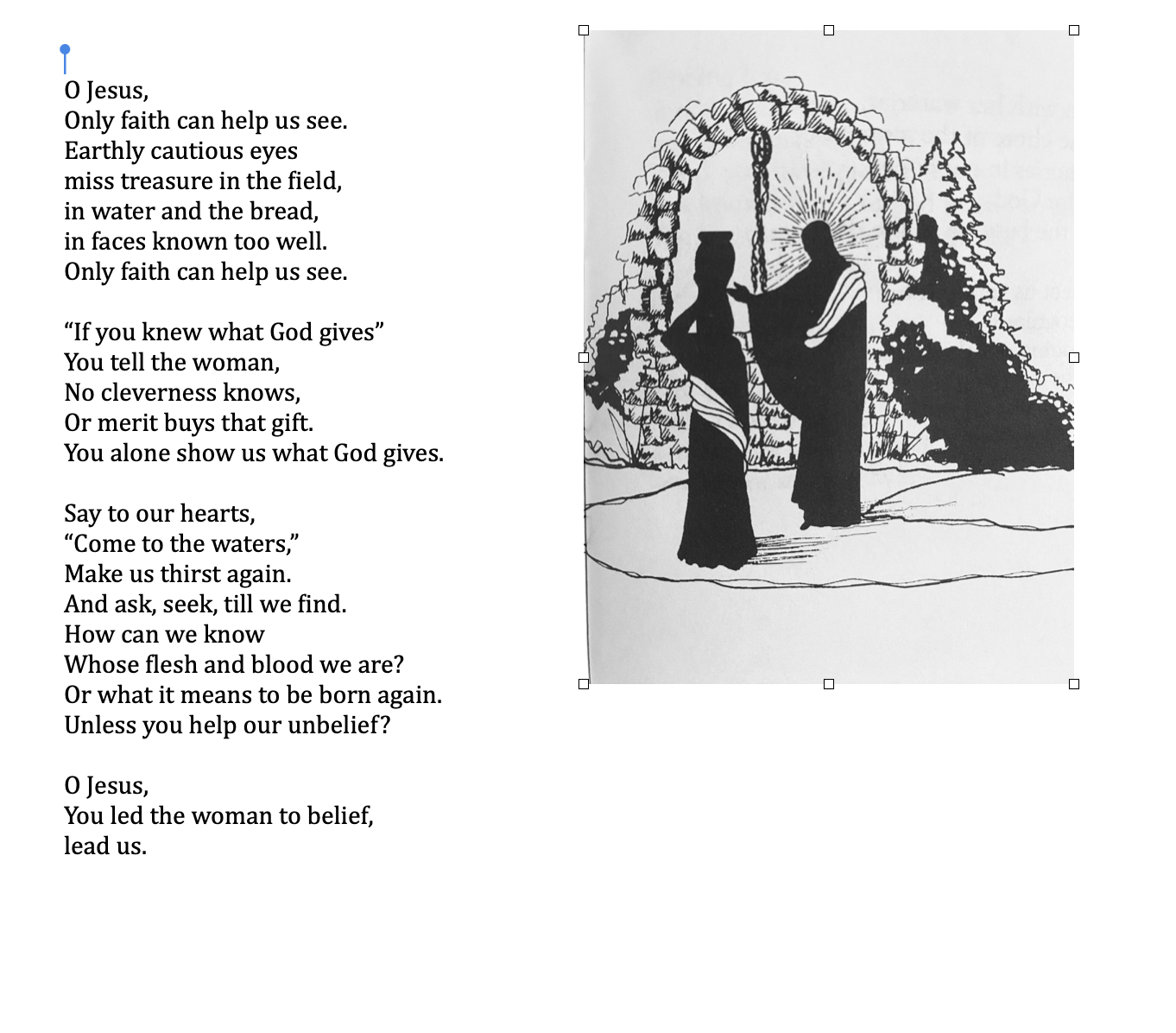
His portrayal of scriptural stories are so insightful. Just look at his portrayal of Jesus at the well with the Samaritan woman, which is found in John’s gospel. Jesus deferentially asks for a drink of water, bowing to the woman as he points to the well. And she stands in charge, her hands firmly atop her bucket. She’s a Samaritan and a woman, after all. He wont get the water until she says so. Jesus looks tired, bent over by the weariness of a day’s long journey.
Certainly, this is no quick study of a gospel story. Obviously, Rembrandt has thought about the Word who made our universe and humbled himself to redeem us. Perhaps he’s also thinking of the way Catholics and Protestants at the time were clashing among themselves, their picture of Jesus a strong, vigorous warrior. But here he stands humbly outside a little Dutch village that the artist’s contemporaries might recognize. Some of them may be pictured looking on at the two.
Artists have a powerful role in relating truth and beauty.
And what about Rembrandt’s mother? A 19th century French Sulpician priest, Felix Dupanloup, who had a lot to do with early American Catholic catechetical theory said to parents:
“Till you have brought your children to pray as they should, you have done nothing.”
Looks like she did her job.
The Samaritan woman and Naaman the Syrian, two individuals we read about this third week of Lent. Aren’t they complicated people? Surely the woman with five husbands, who goes alone to Jacob’s well for water, who stands up to a Jewish man, is a complicated woman. She’s also a powerful voice in her world, as she persuades the people of her town to come and see a Prophet who promises living water.
Naaman is also a person of many dimensions. He’s a general in the Syrian army, seemingly their most important general, but he has leprosy. His journey to Israel causes a political uproar, as the King of Israel wonders what the political consequences of his visit might be.
So he comes as a political figure, from the messy world of Middle East politics. But he’s a man who knows he’s in need.
He is dismayed when he’s not welcomed by the prophet, and told to wash in the waters of the Jordan, a small stream in comparison to the rivers of Syria. But the waters of that small stream, the waters of faith, the water of baptism will give him life.
Faith is a challenge to complicated people, like the woman with five husbands and the man highly invested in the power politics of the day.
But God calls them both.
We pray during Lent for the complicated people of our world.
Last week’s weekday readings ended with the story of the Prodigal Son; this week’s end with the tax collector who prays in the temple and finds mercy. There are also readings from the Book of Hosea this week; he’s the prophet whose unbroken love for his unfaithful wife reminds us of God’s relationship with humanity. God wants us back.
The Sunday’s readings from cycle A, the Temptation of Jesus and his Transfiguration are basic catechetical teachings. The 3rd Sunday readings, from the Book of Exodus and John’s multi-leveled account of the meeting of Jesus and the Samaritan woman at the well, prepare us to meet him in sacraments.
The story of Naaman the Syrian general (Monday) is also a multi-leveled story. Naaman’s appreciation of the saving water of the Jordan recalls the mystery of baptism, celebrated in the Easter mysteries.
Naaman and the Samaritan woman, both interesting characters, remind us that sacraments are meant for complicated people who are drawn gradually into the mysterious reality of God’s grace.
Sacraments can be easily forgotten or unappreciated, simple signs as they are. They draw on the natural world, which can also be unappreciated, as we are learning today.
Can a renewed appreciation of nature lead to a greater understanding of the sacraments? Can figures like the Samaritan woman and Naaman Can figures like the Samaritan woman and Naaman remind us that the sacraments are meant for people immersed in their own time and place?




 The Victor's Place