Brother Michael Stromber, CP, a member of the Passionist community in Queens, New York, produced this sculptor of St. Joseph the Worker some years ago while he was a missionary in Jamaica. Brother Michael is a fine artist as well as a worker who fixes almost anything, cars, toilets, broken light fixtures, chairs. Not much he doesn’t know how to do. He also flew planes in Guyana and Papua New Guinea carrying missionaries to their isolated mission stations.
I pass this sculpture regularly on my way up to my room on the 3rd floor in the monastery. The faces on the statue are blank, you can see, which is the way it is with so many ordinary workers in our society, isn’t it? We hardly notice them. We only see what they do.
In this case, that’s clearly shown in our sculpture. The most defined thing in it is the hammer in Joseph’s hand which he’s sharing with the young boy standing with him. He’s teaching the young boy how to work with it. They are absorbed in what they’re doing.
The people of Nazareth dismiss Jesus when he speaks in their synagogue! “Where did he get this wisdom? Isn’t he the son of Joseph, the carpenter?” The man who fixes things and goes unnoticed..
Our feast encourages us to see Joseph, the Worker, who went unnoticed and unappreciated in Nazareth and at the same time, to see the many like him who also do so much and are unnoticed. It calls us to recognize the dignity of work and so many things associated with it– the right to a just wage, equality of wages for women and men, the right to a job, the right to join other workers to seek good working conditions.
How important to pass on to the young what Joseph is passing on to Jesus. It’s a wisdom the people of Nazareth, unfortunately, don’t see.
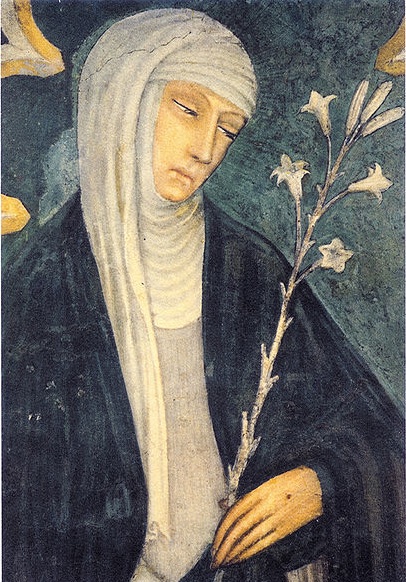
St. Catherine of Siena is a doctor of the church and Italy’s patron saint along with St. Francis.
The 24th child in a family of 25 children, Catherine was a saintly teacher and church reformer. As a young girl, she clashed with her father, who worked dying wool, and her mother, a hardy determined housewife, after she told them she wasn’t going to get married, but was giving herself totally to God.
She cut her hair and began to fast and pray. She joined a group of women who helped the poor in Siena, mostly widows associated with the Dominican order. They were suspicious of the pious young girl who kept to herself and at odds with her mother and father.
At 21 years old, Catherine went beyond the mission of the women’s group and reached out further to the church and society. Men and women, priests and laypeople, from Siena and its surroundings gathered around her. They cared for the poor– famine struck Siena in 1370 and a plague in 1374– but also they sought to reform the church and the society of their day.
At the time, Italian cities like Siena, Florence, Pisa and Padua were fighting among themselves as rival families clashed continuously over political power and economic advantages. In 1309 the popes fled the violence and factional riots in Rome for the safety of Avignon in France, where the papacy remained for almost 70 years. They call it “the Babylonian Captivity.”
Catherine and her companions pleaded with the feuding Italian cities for peace and urged the popes to return to Rome to exercise their mission as bishops of the city where Peter and Paul once led the Christian church. Catherine cajoled, warned and scolded the absent popes to do their duty as shepherds of their sheep and get back to where they belonged.
Without any formal education, Catherine learned to read and write only later in life, which made her an unlikely public figure. She was also a woman teaching and preaching– unusual for that day : “Being a woman, I need not tell you, puts many obstacles in my way. The world has no use for women in a work such as that and propriety forbids a woman to mix so freely with men.” (Letter) Despite those obstacles, Catherine traveled to the warring cities of Italy urging peace and to Avignon to plead with the pope to return to Rome.
Catherine had a deep experience of God in prayer, as the “Dialogue,” her mystical exchange with God, attests. God spoke with her and she shared those words. Her prayerfulness drew others to join her in her mission of peace-making and reform.
Jesus was her “Gentle Truth,” her guide and strength.
As a lay-woman in the church, she was not afraid to speak to power, once correcting a bishop for “ordaining little boys instead of mature men… idiots who can scarcely read and say the prayers. They consider it beneath them to visit the poor, they stand by and let people die of hunger.”
Tell the truth, God told her. Tell the truth because love impels you. “You must love others with the same love with which I love you. But you cannot repay my love. Love other people, loving them without being loved by them. Love them without concern for spiritual and material gain, but only for the glory of my name, because I love them.” ( Dialogue ) Loving God inevitably means loving others.
She died in Rome in 1378 and is buried there in the Dominican church of Santa Maria sopra Minerva. Her heart is in Siena.
“This is a sign that you trust in me and not in yourself: that you have no cowardly fear. Those who trust in themselves are afraid of their own shadow; they think heaven and earth are letting them down. Fear and a twisted trust in their own small wisdom makes them pitifully concerned about getting and holding on to everything on earth and throwing away everything spiritual…The only ones afraid are those who think they are alone…They are afraid of every little thing because they are alone–without me.” (Dialogue)
Jesus engaged Nicodemus at night. Will he engage the hesitant visitors in our age, that growing group whom surveys say are leaving religious traditions they were raised in because they have stopped believing in their teachings.
Charles Taylor in his book “A Secular Age” may have insights into the “Nones”. Some become unaffiliated because they do not believe in God or the teachings of most religions. Many leave a religion because “they think of religious people as hypocritical or judgmental, because religious organizations focus too much on rules or because religious leaders are too focused on power and money.”
It’s interesting to see, Taylor writes, that “ far fewer say they became unaffiliated because they believe that modern science proves that religion is just superstition.”
The theory that religion will disappear as science advances doesn’t hold up, Taylor says, because there’s a search for “human fullness” for a “higher world” that doesn’t go away. Surveys indicate that’s the case among the unaffiliated today
But Taylor also recognizes that people find religions difficult today. In the western world, our secular age is an age of “expressive individualism;” people want reasons to believe and belong. They need religious places that meet them as they are. They’re looking for religious experience.
“Those who believe in the God of Abraham should normally be reminded of how little they know him, how partial is their grasp of him. They have a long way to go…Many believers (the fanatics, but also more than these) rest in the certainty that they have got God right (as against all those heretics and pagans in the outer darkness). They are clutching onto an idol, to use a term familiar to the traditions of the God of Abraham.” (p.769)
Churches need to engage the world with reasons, not with condemnations. Belief leads us to the mysterious Unknown, not sharp certainties. Jesus kept speaking to Nicodemus many nights, it seems. His story and the story of the disciples on the way to Emmaus says it takes time to believe. We’re slow learners. We have to keep talking to the “Nones” at night, praying they find him “in the breaking of the bread.”
That question is posed constantly in the media these days. I don’t know who it will be, only God knows, but I think the better question is: What path is the Catholic Church on now?
Recent popes, like Francis, Benedict, John Paul, Paul VI and John XXII, never thought themselves having absolute power over the church. Rather, they saw themselves leading the church on a path begun by Jesus Christ centuries ago and recently envisioned by the Second Vatican Council more than 70 years ago. The next pope, like them, will be chosen to shepherd the church along the path begun by that council. He’s not to steer the church in whatever direction he decides. He has a path to follow.
What, then, is the path the Second Vatican Council set for the church? In its “ Constitution on the Church in the Modern World” the council states: “The joys and the hopes, the griefs and the anxieties of the people of this age, especially those who are poor or in any way afflicted, these are the joys and hopes, the griefs and anxieties of the followers of Christ. Indeed, nothing genuinely human fails to raise an echo in their hearts. For theirs is a community composed of people.” ( LG 1)
The church is on a path of engagement and accompaniment with the people of its time, especially with “ the poor or those in any way afflicted.” Like the popes before him, Pope Francis recognized his duty was to promote a church of engagement and accompaniment, not just among the people of the church, but with the people of the world, with their joys and hopes, their griefs and anxieties.
Besides the human family, Pope Francis promoted the path of engagement and accompaniment with the world of creation. Facing the consequences of climate change, our common home needs care. He urged the human family to care for creation in his work “Laudato si’.”
The Second Vatican Council, with its emphasis on the church as the People of God, set the church on the path of synodality, another goal Pope Francis strongly fostered. All who belong to the church by reason of their baptism are called to participate in her ministry and governance. The entire people of God, not just the clergy, are called to pray, to read the signs of the times, to discern and dialogue about what we must do together to bring the gospel to all people.
The next pope will feel bound to follow the path rooted in the way given by Jesus Christ centuries ago and indicated by the Second Vatican Council.. A pope has an important role in leading us on the path, and let’s not forget it’s a path.
The image of “path” helps us understand how the future may unfold. All our recent popes used that word to speak of the direction the church should take. A path is never a super-highway, a straight easily managed way. A path often takes twists and turns, sometimes even diverting from its goal, but a well-founded path gets us there.
“Who will be the next pope?” Better to keep in mind the path our church is on. Faith tells us it’s well founded. The Holy Spirit prepares the path to the days ahead and leads us on its way. “Come, Holy Spirit, and renew the face of the earth!” Yes, also give us a good pope.
We heard from Thomas, doubting Thomas, on Sunday. The next few days he’s joined in this week’s readings by Nicodemus, a teacher in Israel, fluent in religious matters, but he comes to Jesus by night. Was it fear, human respect? Yet Jesus meets him at night. (John 3)
Nicodemus has questions but doesn’t understand Jesus’ answers.
“How can this happen?”
So Thomas isn’t the only skeptic, a lone dissenter. Others are slow to believe too.
There’s skepticism in us all.
Nicodemus and Joseph of Arimathea– members of the Jewish ruling party – finally come forward at Jesus’ death.
Joseph asks Pilate for his body. Nicodemus brings an abundance of spices for his burial. They finally leave the darkness and follow Jesus into the light.
Here’s how John’s gospel describes them:
“After this, Joseph of Arimathea, secretly a disciple of Jesus for fear of the authorities, asked Pilate if he could remove the body of Jesus. And Pilate permitted it. So he came and took his body. Nicodemus, the one who had first come to him at night, also came bringing a mixture of myrrh and aloes weighing about one hundred pounds.
They took the body of Jesus and bound it with burial cloths along with the spices, according to the Jewish burial custom.
Now in the place where he had been crucified there was a garden, and in the garden a new tomb, in which no one had yet been buried. So they laid Jesus there because of the Jewish preparation day; for the tomb was close by. “(John 19, 39-42)
John’s Gospel sees the dark time of Jesus’ death bathed in glory. Nicodemus’ store of spices makes Jesus’ burial a kingly burial. And the new tomb in a garden suggests something wonderful about to happen.
The seed fallen to the ground will rise, bearing much fruit.
“For God so loved the world that he gave his only Son, so that everyone who believes in him might not perish but might have eternal life. For God did not send his Son into the world to condemn the world, but that the world might be saved through him.” (John 3,17)
“Everyone who believes in him might have eternal life.” Everyone, even slow believers like Joseph and Nicodemus.
Like the first followers of Jesus, we’re slow learners. Our liturgy is a patient teacher. Through the days of the Easter Season reveals to us the mystery the Resurrection of Jesus.
In our morning and evening prayer it gathers key passages from the Acts of the Apostles, Letter to the Hebrews and the 1st Letter of Peter.
Jesus, risen from the dead, takes his place at the right hand of the Father as our high priest who saves those who approach God through him, interceding for them. (Hebrews 7:24-27) We are saved by confessing him on our lips and believing in our hearts he is our Lord. (Romans 10:8-10)
Passages from the Acts of the Apostles tell how this message came to be announced by those who first saw the Risen Christ. Two early sermons are especially important. The first is Peter’s message to the Roman centurion Cornelius and his household :
“ God raised (Jesus) on the third day and granted that he be visible, not to all the people, but to us, the witnesses chosen by God in advance, who ate and drank with him after he rose from the dead. He commissioned us to preach to the people and testify that he is the one appointed by God as judge of the living and the dead. (Acts 10:40-43)
Paul’s message to Jews and gentiles in a synagogue in Pisidian Antioch is similar: For many days after his resurrection,
Jesus “appeared to those who had come up with him from Galilee to Jerusalem. God raised him from the dead.These are [now] his witnesses before the people. We ourselves are proclaiming this good news to you that what God promised our ancestors he has brought to fulfillment for us, their children, by raising up Jesus, as it is written in the second psalm, ‘You are my son; this day I have begotten you.’” (Acts 13: 30-33)
Paul describes elsewhere how the Risen Jesus, after appearing to the Galilean disciples, also appeared to him. “Last of all, as to one born abnormally, he appeared to me.” ( 1 Corinthians 15: 8)
The Resurrection of Jesus fulfills a promise God made long ago to save his people. It is a promise shared with the whole world. Besides human witnesses, the Holy Spirit testifies to the Resurrection of Jesus by signs and wonders.
Peter tells the crowds gathered in Jerusalem after Pentecost “God exalted him at his right hand as leader and savior to grant Israel repentance and forgiveness of sins.We are witnesses of these things, as is the holy Spirit that God has given to those who obey him.” (Acts 5:30-32)
In his Resurrection Jesus becomes a living stone. ” Come to him, a living stone, rejected by human beings but chosen and precious in the sight of God, and, like living stones, let yourselves be built into a spiritual house to be a holy priesthood to offer spiritual sacrifices acceptable to God through Jesus Christ.” (1 Peter 2: 1-5 )
The summaries of faith in the church’s morning and evening prayers bring. us the witness of those who came from Galilee and saw the Lord. Risen from the dead, Jesus does not leave us orphans or forget us. “Son though he was, Christ learned obedience from what he suffered:” he knows our human ways and he carries our wounds in his risen body. We are branches on a vine that reaches from earth to heaven. The Holy Spirit gives witness to him.
The church grows gradually after the resurrection. The followers of Jesus meet him, but they are slow to believe.The ApostleThomas exemplifies their skepticism. John’s gospel this week adds another group slow to believe – people like Nicodemus, who comes to Jesus by night. Supposedly a well-informed religious person, Nicodemus only understands Jesus Christ slowly.
Our week’s readings from the Acts of the Apostles describe the apostles witnessing bravely in the temple after the Holy Spirit comes upon them at Pentecost. “Uneducated, ordinary men,” the temple leaders call them, but they proclaim boldly God’s mighty works in Jesus Christ. Told to end their witness, they cannot. “It is impossible for us not to speak about what we have seen and heard.” They’re persecuted, imprisoned, yet the number of believers grows.
The account of the healing of the crippled man read last Wednesday is only the beginning of the healing miracles that accompany the preaching of the resurrection of Jesus. Signs must accompany preaching. Signs not only support the witnesses, they are evidence that God is creatively restoring humanity and the earth itself.
The Acts of the Apostles for Saturday points to a new development of the Christian community. ( Acts 6:1-7) Seven men are chosen to provide for the needs of Greek-speaking followers of Jesus, Stephen and Philip among them. Their call prepares for a Christian break from Jerusalem, its temple and its laws, for a new center in Antioch in Syria.
With the 6th chapter of John’s gospel, we begin reading about the miracle of the loaves, an important reading for the Easter season. Bread is a sign that the Risen Jesus remains with us. Bread, “which earth has given and human hands have made,” is also a sign that creation itself shares in the mystery of the Lord’s resurrection. John’s gospel is read into next week: the mystery of the Eucharist has a major place in the Easter season.
On Friday the Passionists celebrate the beautiful feast of The Glorious Wounds of Christ.
This is the Second Sunday of Easter. Notice we don’t say the Second Sunday after Easter. We say it’s the 2nd Sunday of Easter because Easter isn’t a one day feast. It’s celebrated every Sunday of the year. Every Sunday is a little Easter. After the yearly feast of Easter we continue to celebrate it for fifty days. Easter isn’t for one day.
Why do we celebrate Easter so extensively? Because the resurrection of Jesus is the center of our faith. It’s central to what we believe. We believe in God who created us and all things. We believe in Jesus Christ, who came among us, died and rose from the dead on the third day. That belief has tremendous consequences for us and for our world.
The story of Thomas the apostle in today’s gospel offers another reason why we celebrate easter as often as we do. Thomas was one of Jesus’ closest followers, “one of the twelve” who heard him teach and saw him work wonders, but Thomas won’t believe the others who tell him they saw Jesus, risen from death.
He’s deeply skeptical. You can hear skepticism in his words: “Unless I see the marks of the nails, and put my finger into the nailmarks, and put my hand into his side, I won’t believe.”
Certainly Thomas isn’t the only one who’s skeptical. You can hear skepticism in the way the other disciples after Jesus rises from the dead. Thomas represents human skepticism, the slowness of us all to believe, the distrust we all have. What’s unique about Thomas is he represents skepticism at its worst.
It’s all right to have some skepticism, you know. We shouldn’t believe everything we hear. We need to check things out. We have to make sure that facts are facts, we need a certain caution in life.
But Thomas’ skepticism seems more than the ordinary. He’s a strong doubter. Yet still, the next Sunday–notice it’s a Sunday–Jesus comes and says “Put your finger here and see my hands, and bring your hand and put it into my side, and do not be unbelieving, but believe.”
Thomas answer, “My Lord and my God!” That’s a beautiful act of faith.
What about us? We’re described in today’s gospel as “those who have not seen, but believe.” and Jesus called us blessed. Yet, we can relate to Thomas. In fact, we live today in skeptical times. We’re skeptical about politics, about our institutions, about our churches, about ourselves. There’s a deep distrust today in the way we speak and in the way we think. We’re wary of others, especially people different from us. It affects our faith too.
Yet, as he did to Thomas, Jesus never abandons us. He gives us the gift to believe. His mercy is always at work. He strengthens us when he comes in the signs of the Eucharist; he strengthens us through the faith we share with each other, week by week, day be day.
Our Sundays may not be the dramatic experience that Thomas had, but something happens here. Our Sundays are always little easters. Jesus come into the room where we are, with our fears and lack of trust. He tells us, as he told his disciples: “Peace be with you.” He shows us the signs of his love and enters our lives. Every Sunday is a happy Easter. Jesus gives us life.
Like the apostles we’re slow to understand the mystery of the death and resurrection of Jesus. The two disciples going to Emmaus are not the only ones slow to understand– we’re slow too.
Peter, who preaches to the crowds in Jerusalem at Pentecost, certainly was slow to understand. He speaks forcefully at Pentecost, forty days after the Passover when Jesus died and rose from the dead, but the days before he’s speechless. It took awhile for him and for the others who came up with Jesus from Galilee to learn and be enlightened about this great mystery..
Mark’s accounts of Jesus resurrection appearances, read on the Saturday of Easter week, stresses the unbelief of his disciples. They were not easily persuaded.
For this reason, each year the Lord refreshes our faith in the resurrection, but it’s not done in a day. We need time to take it in, like the first followers of. Jesus, and for that we have an easter season of forty days. Just for starters.
The disciples are slow to understand the mission they’re to carry out because it’s God plan not theirs, a plan that outruns human understanding. A new age had come, the age of the Holy Spirit, and they didn’t understand it. The fiery winds of Pentecost had to move them to go beyond what they see, beyond Jerusalem and Galilee to the ends of the earth.
The Holy Spirit also moves us to a mission beyond our understanding. Luke says that in the Acts of the Apostles. “The mission is willed, initiated, impelled and guided by God through the Holy Spirit. God moves ahead of the other characters. At a human level, Luke shows how difficult it is for the church to keep up with God’s action, follow God’s initiative, understand the precedents being established.” (Luke Timothy Johnson, The Acts of the Apostles)
“You judge things as human beings do, not as God does,” Jesus says to Peter elsewhere in the gospel. We see things that way too.
Peter’s slowness to follow God’s plan remained even after Jesus is raised from the dead. He doesn’t see why he must go to Caesaria Maritima to baptize the gentile Cornelius and his household. (Acts 10,1-49) It’s completely unexpected. Only gradually does he embrace a mission to the gentiles and its implications. The other disciples are like him; God’s plan unfolds but they are hardly aware of it.
One thing they all learned quickly, though, as is evident in the Acts of the Apostles. Like Jesus, they experience the mystery of his cross, and in that experience they find wisdom.






 The Victor's Place