Grumbling Times:Exodus 16:4-5

The Exodus, James Tissot

Today’s reading from Exodus tells us that one month after they leave Egypt,” the whole assembly of the children of Israel grumbled against Moses and Aaron.” The children of Israel said to them, “Would that we had died at the LORD’s hand in the land of Egypt, as we sat by our fleshpots and ate our fill of bread! But you had to lead us into this desert to make the whole community die of famine!” (Exodus 16:4-5)

One month after they leave Egypt, they’ve forgotten the Lord’s mighty deeds and promises.

Food and water run out, triggering their complaints, but God gives them enough to go on. Manna, bread from heaven is their daily food. Water comes from the rock that Moses strikes with his wooden staff. A cloud by day and fire at night guide them.

Still, they grumble, and so do we. Food and water figure in climate change today, so does a confusion of leadership. As the world moves on through the desert now, can we learn from our ancestors’ journey then? 

That’s what St. Paul told the Corinthians to do in the 10th chapter of his first letter to them. “These things happened to them as an example, and they have been written down as a warning to us…” 

Jesus promises to be Bread from heaven, the rock for our thirst.  (1Cor. 10:4) The Spirit is a cloud by day and a pillar of fire by night.

Let’s expect grumbling–these are tough times– but hopefully that grumbling leads to a deeper faith and also a determination to take on the challenges of our time. The Book of Deuteronomy, the last of the 5 books of the Law, ends with Moses and the people poised to enter a new land after almost 40 years of desert wandering. Significantly, they’re poised, not there yet, not yet in possession, still hoping in the promises of God. 

We need this large view of history today, don’t we?

Parables of the Kingdom

The Sower James Tissot, Brooklyn Museum

Jesus answers the opposition described in chapters 11-12 in Matthew’s gospel with a series of parables that begin with the parable of the sower sowing his seed. (Chapter 13) The seed doesn’t always fall on good ground, he reminds his disciples. Sometimes it falls on the path where it quickly dries up– like the  towns that welcome him enthusiastically and soon forget him.

The parable of the weeds and the wheat points to enemies who want to poison the power and beauty of his words and deeds because of their own claims.  The Pharisees did that.

The kingdom of God comes in smallness. It’s like the mustard seed, not a full grown tree. You can miss it if  you’re looking for something fully grown and done. The treasure is hidden in a field; you may discover almost accidentally. Maybe Jesus’ own extended family in Nazareth still saw him as just the little boy they knew before and could not appreciate him now. We underestimate small things and  what they can grow to be.

But the kingdom of heaven is also like a merchant in search of fine pearls. You have to keep searching for it all your life. You can’t give up that search. Keep looking, hoping searching.

Jesus concludes his teaching with the parable of the net cast into the sea that catches fish of every kind, good and bad. At the end of time, the net will be dragged to shore and the good will be separated from the bad. God is the ultimate judge, leave judgment to him.

His parables are about the real world, the world Jesus experienced. They also help us look at the world we live in, which is not far from his.

St. Mary Magdalene: July 22

Mary Magdalene, Fra Angelico

In 2016, Pope Francis raised the liturgical celebration of Mary Magdalene, July 22, from a memorial to a feast and directed she be referred to as an “Apostle to the apostles”. Today, the pope said, we must recognize more fully the dignity of women and their role in bringing the gospel to the world. Mary Magdalene is an example.

Gregory the Great, an early pope, got it wrong when he identified Mary Magdalene with Mary, the sister of Lazarus and the sinful women in Luke 7: 33ff, who washed Jesus’ feet. She is neither one. She was a star witness at his resurrection. Unfortunately, Gregory’s picture of Mary influenced the way western Christianity saw Mary. The eastern Christian churches, for the most part, have not seen her that way.

The composite view of Mary Magdalene in the western church could be found until recently in the Tridentine mass texts for her feast. The collect identified her as Mary of Bethany and the gospel was the story from Luke of the penitent woman anointing Jesus’ feet. That picture of her is often found in western Christian art.

Instead of the gospel of the sinful woman, our present lectionary offers John’s account of the appearance of Jesus to Mary after his resurrection. (John 20:1-18) 

Unfortunately some recently, using flimsy evidence from 3rd and 4th century gnostic writings, want to “de-mythologize” Jesus and romanticize his relationship with Mary. Some even claim he was married to her. Their claims have been sensationalized in the  media and unfortunately get a wide hearing.

Better to listen to the four gospels, especially St. Luke’s Gospel, and the evidence of the New Testament. They see Mary as a disciple among other important woman followers of Jesus who loved him. Their witness is older and more reliable. There’s also new archeological evidence about Magdala, Mary’s hometown, that helps us understand Mary Magdalene. Take a look.

Yet,  Gregory the Great’s description of Mary’s spirituality is right on. Here’s an excerpt from his beautiful sermon in today’s Liturgy of the Hours:

“We should reflect on Mary’s attitude and the great love she felt for Christ; for though the disciples had left the tomb, she remained. She was still seeking the one she had not found, and while she sought she wept; burning with the fire of love, she longed for him who she thought had been taken away. And so it happened that the woman who stayed behind to seek Christ was the only one to see him. For perseverance is essential to any good deed, as the voice of truth tells us: Whoever perseveres to the end will be saved.

“At first she sought but did not find, but when she persevered it happened that she found what she was looking for. When our desires are not satisfied, they grow stronger, and becoming stronger they take hold of their object. Holy desires likewise grow with anticipation, and if they do not grow they are not really desires. Anyone who succeeds in attaining the truth has burned with such a great love. As David says: My soul has thirsted for the living God; when shall I come and appear before the face of God? And so also in the Song of Songs the Church says: I was wounded by love; and again: My soul is melted with love.

“Woman, why are you weeping? Whom do you seek? She is asked why she is sorrowing so that her desire might be strengthened; for when she mentions whom she is seeking, her love is kindled all the more ardently.

“Jesus says to her: Mary. Jesus is not recognized when he calls her “woman”; so he calls her by name, as though he were saying: Recognize me as I recognize you; for I do not know you as I know others; I know you as yourself. And so Mary, once addressed by name, recognizes who is speaking. She immediately calls him rabboni, that is to say, teacher, because the one whom she sought outwardly was the one who inwardly taught her to keep on searching.”

Here’s Pope Francis on Jesus’ words to Mary in the garden, “Do not cling to me.”

“It is specifically in the garden of the resurrection that the Lord says to Mary Magdalene: “Do not hold on to me”. This is an invitation directed not only to Mary, but also to the entire Church, to enter into an experience of faith that surpasses any materialistic appropriation or human understanding of the divine mystery. A disciple of Jesus is not to seek human securities and worldly titles, but faith in the Living and Risen Christ! “

The article on Mary Magdalene in Wikipedia deals extensively, and generally fairly, with the interpretations of Mary in religious and popular culture through history. She is an importance reference for recognizing women’s role in the world and in the church today. An importance saint to know.

Women at the Tomb

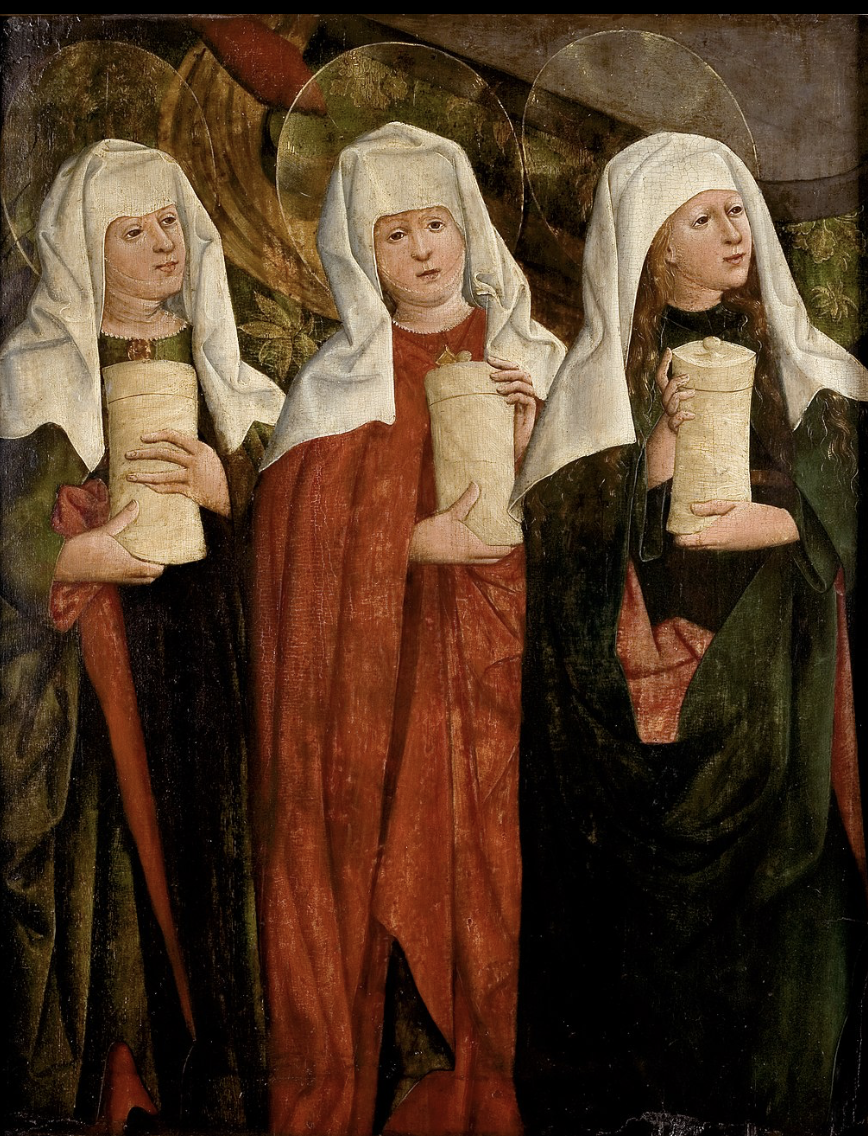
Women at the Tomb, Mikolaj Haberschrack 15th century

The revised readings and prayers at Mass for the Feast of St. Mary Magdalene reflect beautifully on this great saint.

All the gospel writers give a prominent place to women in their narratives of Jesus’ resurrection, but  John’s gospel singles out Mary Magdalene especially. John 20: 1-2;11-16, Omitting some verses describing Peter and the other disciple visit to the tomb, our gospel today ends: “Mary Magdalene went and announced to the disciples, ’I have seen the Lord,’ and then reported what he told her.’

On the first day of the week, Mary Magdalene came to the tomb early in the morning, while it was still dark, and saw the stone removed from the tomb. So she ran and went to Simon Peter and to the other disciple whom Jesus loved, and told them, “They have taken the Lord from the tomb, and we don’t know where they put him.”

  Mary stayed outside the tomb weeping. And as she wept, she bent over into the tomb and saw two angels in white sitting there, one at the head and one at the feet where the Body of Jesus had been. And they said to her, “Woman, why are you weeping?” She said to them, “They have taken my Lord, and I don’t know where they laid him.” When she had said this, she turned around and saw Jesus there, but did not know it was Jesus. Jesus said to her, “Woman, why are you weeping? Whom are you looking for?” She thought it was the gardener and said to him, “Sir, if you carried him away, tell me where you laid him, and I will take him.” Jesus said to her, “Mary!” She turned and said to him in Hebrew, “Rabbouni,” which means Teacher. Jesus said to her, “Stop holding on to me, for I have not yet ascended to the Father. But go to my brothers and tell them, ‘I am going to my Father and your Father, to my God and your God.’” Mary Magdalene went and announced to the disciples, “I have seen the Lord,” and then reported what he told her. John 20: 1-2;11-16

 Mary is an Apostle to the Apostles, announcing to them and to us that the risen Jesus  said he was ascending to “my Father and your Father, my God and your God.”                                                                                                                                                                           Her journey to the tomb early Easter morning  is described in the Song of Songs:

On my bed at night I sought him whom my heart loves. I sought him but did not find him. I will rise then and go about the city: in the streets and crossings I will seek him whom my heart loves.

“My soul is thirsting for you, my God.” The responsory psalm proclaims.

Though she came with other women, Mary stayed at the tomb, weeping, and then the dark garden was filled with light when Jesus spoke her name, “Mary.”

“Before all others”  God called Mary to announce the great joy of the resurrection, the opening prayer of her feast says. May we “through her intercession and example proclaim the living Christ and come to see him reigning in glory.”

The preface for her feast day gives thanks:

“In the garden he appeared to Mary Magdalene,  who loved him in life,  who witnessed his death on the cross, who sought him as he lay in the tomb ,who was the first to adore him when he rose from the dead  and whose apostolic duty was honored by the apostles that the good news of life might reach the ends of the earth.”

“May the holy reception of your mysteries, Lord, instill in us that persevering love with which Saint Mary Magdalene clung resolutely to Christ her Master” (Prayer after Communion}                                                                                                                                                                                                                                                                                                                             

Traditions about St. Ann

In my part of the world, novenas to Saint Ann have begun in churches and dioceses, like Scranton, PA. Where did the story of Saint Ann come from? From earliest times Christians wondered who the parents of Mary were and, as you would expect, that interest was particularly strong in Palestine. Ann and Joachim were first honored there as the mother and father of Mary, the mother of Jesus Christ.

Around the year 550, a church in her honor was built in Jerusalem on the site where her home was said to be, near the Pool of Bethesda, where Jesus cured the paralyzed man. Since then, many churches honoring Ann and Joachim have been built throughout the Christian world; The saints appear frequently in Christian art.

Feasts of St. Ann

Feasts honoring Mary’s birth (September 8) and her presentation in the temple (November 21) – inspired by the Protoevangelium– were introduced into the liturgies of the Eastern churches in the 6th century. Feasts in honor of St.Joachim and Ann (September 9), the conception of St Ann (December 9), and St.Ann alone (July 26) have been celebrated from the 7th century in the Greek and Russian churches.

The western church, adopting the eastern traditions, has celebrated the feast of St. Ann on July 26 since the 16th century. In 1969 her feast was joined with her husband Joachim to become the Feast of Saints Joachim and Ann.

Why was the story of Ann and Joachim so popular?  Besides satisfying curiosity about the family background of Mary and Jesus, they supported traditional belief that Jesus is the Son of God, born of the Virgin Mary, a belief questioned by heretical elements in the church as well as outsiders of the faith from the beginning.

Ann and Joachim also offered inspiration to mothers and fathers, wives and husbands, grandmothers and grandfathers in their roles in family life.

Devotion to St. Ann in Europe

In the western church, devotion to St.Ann was fed by a popular belief that relics of her were brought to France by Mary Magdalen, Lazarus, Martha, and other friends of Jesus who crossed the stormy sea from Palestine to bring the Christian faith to the region around Marseilles.

Her relics were buried in a cave under the church of St.Mary in the city of Apt by its bishop, St. Auspice, the story goes. Barbarians invaded the area and the cave was filled with debris and almost forgotten, only to be unearthed 600 years later during the reign of Charlemagne. You can see why sailors and miners would be devoted to St. Ann.

Crusaders from Europe – many from France – went to the Holy Land in the 11th century, and they rebuilt the ancient church of St. Ann in Jerusalem. The date the crusader church was consecrated, July 26, is the day we celebrate the feast of Joachim and Ann in the western church today.

By the 14th century, devotion to St. Ann was on the rise throughout Europe as the Black Death struck the continent and raged everywhere for over 150 years, wiping out almost 30 percent of its population. Families bore the brunt of the catastrophe as they tended their sick and cared for the healthy.

They needed models like Mary and Joseph, Ann and Joachim, who supported their child and grandchild. Mothers and grandmothers were particularly important for raising children.

When the plague ended, Europe’s population expanded dramatically in the late 15th and 16th centuries; new towns and cities sprang up everywhere and families were uprooted from places and people familiar to them. Families needed help to stay together and survive.

Faith suggested Mary and Joseph, Ann and Joachim as models to be imitated.  Images of the nursing Madonna and the caring grandparents became important sources of Christian inspiration.

Christians joined Confraternities of St. Ann, dedicated to caring for widows, orphans and families under stress. Images of Mary and Ann, nursing their children, playing with the Christ Child and/or John the Baptist were more than pious pictures; they had a social purpose as well.

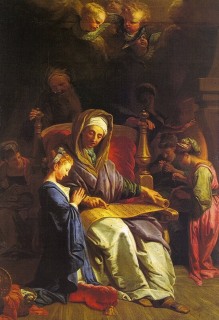
One picture from this era, still popular today, portrays St. Ann teaching her little daughter how to read.  Sometimes the words on the book are words of scripture; sometimes they’re basic numbers or letters of the alphabet: 1,2,3,4-A,B,C.

Playing with children, teaching them the ABC’s, passing on the mysteries of God to them are vital actions. Simple as they may seem, they’re holy actions and they can make those who do them saints.

16th Sunday c: Hospitality

For this week’s homily, please watch the video below.

Christ, our Passover

This Thursday, appropriately, we read the Passover account from the Book of Exodus in our lectionary. The mystery of the Passover is the mystery of Christ, the beautiful homily of Melito, an early bishop of Sardis, says.

“For the sake of suffering humanity he came down from heaven to earth, clothed himself in that humanity in the Virgin’s womb, and was born a man. Having then a body capable of suffering, he took the pain of fallen humanity upon himself; he triumphed over the diseases of soul and body that were its cause, and by his Spirit, which was incapable of dying, he dealt man’s destroyer, death, a fatal blow.

  He was led forth like a lamb; he was slaughtered like a sheep. He ransomed us from our servitude to the world, as he had ransomed Israel from the hand of Egypt; he freed us from our slavery to the devil, as he had freed Israel from the hand of Pharaoh. He sealed our souls with his own Spirit, and the members of our body with his own blood.

  He is the One who covered death with shame and cast the devil into mourning, as Moses cast Pharaoh into mourning. He is the One who smote sin and robbed iniquity of offspring, as Moses robbed the Egyptians of their offspring. He is the One who brought us out of slavery into freedom, out of darkness into light, out of death into life, out of tyranny into an eternal kingdom; who made us a new priesthood, a people chosen to be his own for ever. He is the Passover that is our salvation.

  It is he who endured every kind of suffering in all those who foreshadowed him. In Abel he was slain, in Isaac bound, in Jacob exiled, in Joseph sold, in Moses exposed to die. He was sacrificed in the Passover lamb, persecuted in David, dishonored in the prophets.

  It is he who was made man of the Virgin, he who was hung on the tree; it is he who was buried in the earth, raised from the dead, and taken up to the heights of heaven. He is the mute lamb, the slain lamb, the lamb born of Mary, the fair ewe. He was seized from the flock, dragged off to be slaughtered, sacrificed in the evening, and buried at night. On the tree no bone of his was broken; in the earth his body knew no decay. He is the One who rose from the dead, and who raised man from the depths of the tomb.

Come to Me: Matthew 11:25-30

 At that time Jesus said in reply,* “I give praise to you, Father, Lord of heaven and earth, for although you have hidden these things from the wise and the learned you have revealed them to the childlike.

Yes, Father, such has been your gracious will. All things have been handed over to me by my Father. No one knows the Son except the Father, and no one knows the Father except the Son and anyone to whom the Son wishes to reveal him.

“Come to me, all you who labor and are burdened, and I will give you rest. Take my yoke upon you and learn from me, for I am meek and humble of heart; and you will find rest for yourselves. For my yoke is easy, and my burden light.”

There’s new interest today in the founders of my country: Washington, Jefferson, Adams, Franklin. New biographies and media presentations, present their struggles to bring our country to birth in trying circumstances. Yes, they had clay feet, like all of us. They could be vain, deceitful, wrong-headed and trapped in the limited vision of their time. So are we. But they were also brave, idealistic, courageous, patient, willing to sacrifice for the unknown. We hope to imitate them. 

They tell the story that General Washington after the war met with a number of his disgruntled troops, who hadn’t been paid or rewarded by the Continental Congress for their long years of hard service. The ex-soldiers were angry, on the brink of another revolution. 

Washington took out a paper to address the troops, but he couldn’t read it. His eyesight was failing him. So he put on a pair of spectacles. “Excuse me, gentlemen,” he said, “ but I have lost my sight in the service of my country. “

No one remembered what Washington said that day, but the mood of the men changed. They remembered what this man had gone through. 

It’s important to honor our heroes, to keep them in mind.  We’re living in an unfinished world, an unfinished church and an unfinished country. They lived that way too. We must learn from them how to do what we are given to do.

In the gospel today, Jesus says, “Come to me, all you who labor and are burdened, and I will give you rest…Learn from me.”  

He is the Great Hero. Remember his story: his poor birth, his love for those with little, his assurances of God’s care, his cruel death and then his resurrection. With our labors and burdens, we come to rest in him, to learn from him, to share his life and be refreshed. 

He is the Bread of the Strong, so that in our time we can be strong.

Moses and the Quest for God

Modern historians, looking at Moses, ask did he really exist? When did he live and what are the facts of his life?

The 4th century writer, Gregory of Nyssa, in his classic work “The Life of Moses”, asks a different question: How can we see our own journey to God in him?

In the 120 years of his life Moses was on a journey to God. . He shows us how God draws us to himself in our life’s journey.  

Exodus 2,1-15 brings us to his birth and first 40 years. His Jewish mother puts him in the Nile river in a little boat ( the word for boat in Exodus is the same word used in Genesis for Noah’s ark). Those years are not without danger, but Moses–like all of us – is placed on the river of life, with a mission from God and God’s protection.

Moses’ adoption by Pharoah’s daughter brought him the wealth of Egypt. He makes his way to God with human gifts as well as divine gifts, and so do we. We’re blessed with gifts,  human and divine, and we must use them.

Moses’ first forty years end with the killing of the Egyptian and his subsequent flight to the mountainous desert of Midian. There, Moses meets God alone in the burning bush and choses to stand with God.

If we want to see the face of God, we’re called to face the burning mystery of God and choose to stand with him.

Then, at eighty years, Moses begins the next stage of his life: leading his people through the desert to the promised land. Eighty years old– hardly a good time for something like that, isn’t it? 

For Gregory, though, Moses’ life is an inward journey, not so much of events, as a journey of desire, and the journey of desire is a constant journey–an ascent– that never ends or grows old in this life. It’s not ended by sickness or the cessation of our active lives and responsibilities.  Here’s how Gregory describes it:

“…the great Moses, becomes ever greater, he never stops his ascent, never sets a limit to his upward course. Once setting his foot on the ladder that God sets up (as Jacob says) he continually climbed to the step above and never ceases to rise higher, because there was always a step higher than the one he attained…though lifted up through his lofty experiences, he’s still unsatisfied in his desire for more. He still thirsts for what seems beyond his capacity… asking God to appear to him, not according to his capacity, but according to God’s true being.

“Such an experience seems to me to belong to the soul who loves the beautiful. Hope always draws the soul from the beauty that’s seen to what ‘s beyond; it always kindles the desire for what’s hidden from what’s now known. Boldly requesting to go up the mountain of desires the soul asks to enjoy Beauty, not in mirrors, or reflections, but face to face. “ (Gregory of Nyssa)

“Old men ought to be explorers

Here or there does not matter

We must be still and still moving

Into another intensity

For a further union, a deeper communion

Through the dark cold and the empty desolation,

The wave cry, the wind cry, the vast waters

Of the petrel and the porpoise. In my end is my beginning.” T. S. Eliot, Four Quartets

Matthew 11-12: Opposition

Scribes and Pharisees before Jesus. James Tissot

The 11th and 12th chapters of Matthew’s gospel which we’re reading this 15th week of the year describe a growing opposition to Jesus after he begins his ministry in Galilee. It’s a dark section of the gospel. 

The Pharisees now take “counsel against him to put him to death” and begin to oppose him. (Matthew 12.14) They’re not satisfied with his teachings and his miracles and demand a sign. They’re joined by the Herodians, agents of Herod Antipas, ruler in Galilee. The political establishment joins the opposition. 

Jesus is also opposed  by “this generation” of Israelites, the towns “where most of his mighty deeds had been done,” Corazin, Bethsaida, Capernaum. (Matthew 11,16-19) The towns that first welcomed him enthusiastically now dismiss him.

Finally,  another group, who may surprise us, appear to oppose him – his family from Nazareth.  (Matthew 12,47-50) All together, this opposition must have affected Jesus, as he faced  the fickleness of humanity and even those closest to him. 

But it also must have affected his disciples as well, who joined him expecting to see God’s kingdom come. I think they’re among those whom Jesus prays for in the gospel read today and tomorrow: 

“I give praise to you, Father, Lord of heaven and earth, for although you have hidden these things from the wise and the learned you have revealed them to the childlike.
Yes, Father, such has been your gracious will. All things have been handed over to me by my Father. No one knows the Son except the Father, and no one knows the Father except the Son and anyone to whom the Son wishes to reveal him.”

His first disciples were not wise or learned, they were more like children excited by what they saw Jesus do and say. They were struck by the miracles he worked and the wisdom he taught in parables. Yet, they would have been affected by the growing rejection to him.   

Are we like them in a time like ours, when he in the church he founded meets so much rejection? The Lord prays for us too, little children not wise or clever.